Supplements · September 29, 2026 · Memios · 14 min read
Glutamine
Limited evidence. Claims for glutamine centre on gut lining, immunity, recovery and muscle.
TLDR
- Limited evidence. Claims for glutamine centre on gut lining, immunity, recovery and muscle.
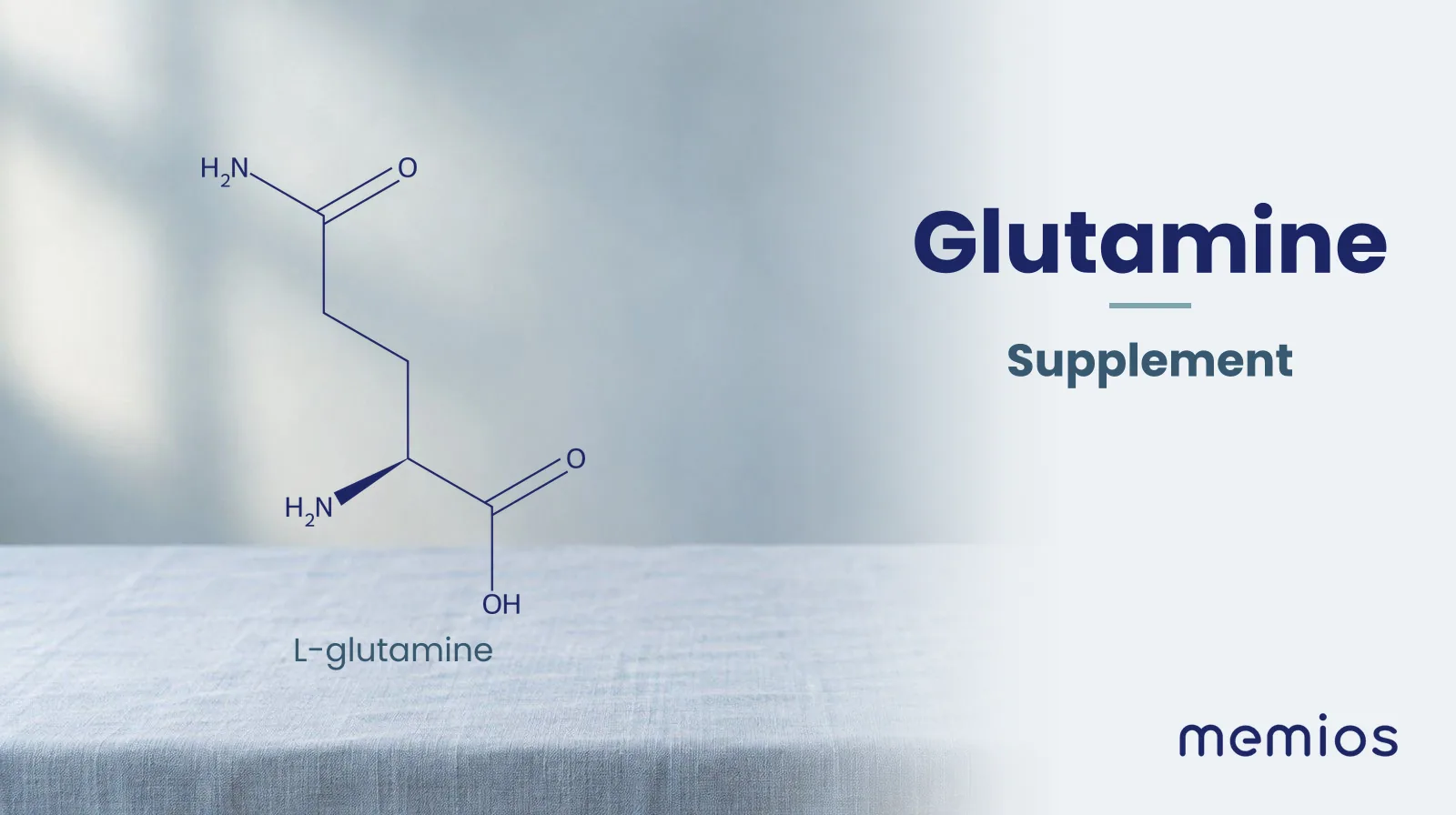
- What it is: Glutamine is an amino acid and the most abundant one in the body.
- Main use, supported: A meta-analysis of 12 controlled trials reported that glutamine lowered fasting plasma glucose, and reported a fall in C-reactive protein whose published confidence interval is impossible as printed. (low certainty)
- Claim NOT supported by research: In a meta-analysis of 25 trials in athletes, glutamine had no effect on immune function, aerobic performance or body composition. (low certainty)
- Another claim NOT supported: A 2024 meta-analysis of 10 randomised placebo-controlled trials found glutamine did not significantly change intestinal permeability overall. (very low certainty)
- Recommended dose: not established. No reference intake exists for supplemental glutamine. It is the most abundant amino acid in the body and is produced by the gut, liver and skeletal muscle, so no body has set an RDA or adequate intake for it.
- Studied dose (a trial dose, not a recommendation): The gut permeability meta-analysis reported a subgroup of trials using oral doses over 30g/day. Findings citing that trial: 1 against.
- Upper limit: No upper limit has been set by any authority we could reach.
- What goes wrong: 1 finding on harm. In a blinded randomised trial of 1223 critically ill adults with multiorgan failure, glutamine was associated with higher in-hospital and 6-month mortality and a trend to higher 28-day mortality.
- Common myth: Glutamine is a harmless amino acid, so more of it can only help the gut and immune system.
What it is
Glutamine is an amino acid and the most abundant one in the body. It is classed nutritionally as non-essential because the body makes it, mainly in the gut, liver and skeletal muscle, and releases it into the circulation. Immune cells consume it at a rate similar to or greater than glucose. In severe illness, injury or sepsis the body's own supply can fall short, which is why it is described as conditionally essential in those states.
What the research says
Claims for glutamine centre on gut lining, immunity, recovery and muscle. The trial evidence is uneven and in one setting it is alarming. A 2021 meta-analysis found reductions in fasting plasma glucose and C-reactive protein but no effect on other cardiometabolic markers. A 2019 meta-analysis of 25 trials in athletes found no effect on immune function, aerobic performance or body composition. A 2024 meta-analysis found no overall effect on intestinal permeability. In the largest critical-care trial, 1223 ventilated patients with multiorgan failure, glutamine was associated with higher mortality. The US FDA has nonetheless approved an L-glutamine powder for sickle cell disease, a different population and a different question.
Evidence grade: Limited evidence.
What goes wrong
In a blinded randomised trial of 1223 critically ill adults with multiorgan failure, glutamine was associated with higher in-hospital and 6-month mortality and a trend to higher 28-day mortality. (Source 1)
- Randomized trial, High certainty.
- Size: 1223 critically ill adults in 40 intensive care units.
- Who: Critically ill adults with multiorgan failure receiving mechanical ventilation, in Canada, the United States and Europe.
- How long: Supplements started within 24 hours of ICU admission; outcomes to 6 months.
- Result: 28-day mortality 32.4% with glutamine vs 27.2% without; adjusted odds ratio 1.28, 95% CI 1.00 to 1.64, P=0.05. In-hospital and 6-month mortality significantly higher with glutamine. No effect on organ failure or infectious complications. No difference in serious adverse events, P=0.83.
- Funding: Canadian Institutes of Health Research; independent of industry.
Limit of this finding: Read this alongside the trial's own rule. Because of its interim-analysis plan, the trial decided before it began that a P value below 0.044 would count as statistically significant. The 28-day mortality result, P=0.05 with a confidence interval whose lower edge is exactly 1.00, did not meet that threshold, which is why the paper calls it a trend rather than a significant increase. The in-hospital and 6-month mortality increases are reported as significant, but the abstract gives no effect sizes or confidence intervals for them at all, so their size is unknown. And this was glutamine given intravenously and enterally at high dose to critically ill adults on ventilators; it is not the same exposure as an oral supplement in a healthy person.
There was a trend toward increased mortality at 28 days among patients who received glutamine as compared with those who did not receive glutamine (32.4% vs. 27.2%; adjusted odds ratio, 1.28; 95% confidence interval [CI], 1.00 to 1.64; P=0.05). In-hospital mortality and mortality at 6 months were significantly higher among those who received glutamine than among those who did not.
What the evidence supports
A meta-analysis of 12 controlled trials reported that glutamine lowered fasting plasma glucose, and reported a fall in C-reactive protein whose published confidence interval is impossible as printed; other cardiometabolic risk factors were unchanged. (Source 2)
- Meta-analysis, Low certainty.
- Size: 12 studies.
- Who: Adults in randomised clinical trials of glycaemic indices, triglycerides and inflammatory markers.
- How long: not stated in the abstract.
- Result: Fasting plasma glucose SMD -0.73, 95% CI -1.35, -0.11, I2 84.1%; CRP SMD -0.58 printed with 95% CI -0.1, -0.17 (an interval that does not contain its own point estimate), I2 0%; other cardiometabolic risk factors P > 0.05.
- Funding: not stated.
Limit of this finding: Two faults here are in the published paper itself, not in this record. First, the C-reactive protein result is printed as SMD -0.58 with a 95% confidence interval of -0.1 to -0.17, which places the estimate outside its own interval; that number cannot be right and nothing should be concluded from it. Second, the fasting glucose result is statistically significant but the trials behind it disagree severely with one another (I-squared 84.1%), so the pooled average conceals very different results in different studies. The quoted sentence also carries the journal's own duplicated wording, 'significantly decreased significantly'; it is reproduced exactly as printed and is not a transcription error.
Meta-analysis showed that glutamine supplementation significantly decreased significantly serum levels of FPG
What the evidence does not support
In a meta-analysis of 25 trials in athletes, glutamine had no effect on immune function, aerobic performance or body composition. (Source 3)
- Meta-analysis, Low certainty.
- Size: 47 studies reviewed, 25 trials pooled.
- Who: Athletes aged over 18.
- How long: Trials published up to January 2017; durations varied.
- Result: Weight reduction WMD = -1.36, 95% CI -2.55 to -0.16, p = 0.02; neutrophil counts at doses above 200 mg/kg body weight WMD = -605.77, 95% CI -1200.0 to 52.1, P = 0.03; glutamine dipeptide raised post-exercise blood glucose WMD = 0.51, 95% CI 0.18 to 0.83 mmol/l, P = 0.002; no association with other outcomes.
- Funding: not stated.
Limit of this finding: The same conclusion also says glutamine reduced neutrophil numbers and produced greater weight reduction, and neither should be taken at face value. The neutrophil result is printed in the same abstract as WMD = -605.77 with a 95% confidence interval of -1200.0 to 52.1 and P = 0.03: an interval running from a large fall to a rise includes 'no change at all', so it contradicts the claim that the reduction was significant, and it comes from a subgroup of the 25 pooled trials rather than from all 47 studies screened. The weight reduction was 1.36 kg in athletes, which in this setting is unintended loss of body mass rather than a benefit.
According to this meta-analysis, generally, glutamine supplementation has no effect on athletics immune system, aerobic performance, and body composition.
A 2024 meta-analysis of 10 randomised placebo-controlled trials found glutamine did not significantly change intestinal permeability overall. (Source 4)
- Meta-analysis, Very low certainty.
- Size: 10 studies from 1998 to 2014, reported as 352 participants.
- Who: Adults with a range of health conditions, mean age 46.52 years.
- How long: Subgroup signal reported for durations of less than 2 weeks.
- Result: Overall WMD -0.00, 95% CI -0.04 to 0.03. A subgroup at doses over 30g/day is printed as WMD -0.01, 95% CI -0.10, -0.08, a confidence interval that does not contain its own point estimate.
- Funding: not stated.
Limit of this finding: Three things in this abstract do not add up, and all three are the journal's rather than this record's. It states 352 participants, then reports 216 in the intervention group and 212 in the control group, which comes to 428. The subgroup result is printed as WMD -0.01 with a 95% confidence interval of -0.10 to -0.08, an interval that does not contain its own estimate. And the dose is given as 'over 30g/day' in one sentence and 'exceeding 30 mg/day' in the next, a thousand-fold difference left unresolved. The dependable part of this paper is the overall result: no effect on intestinal permeability. The subgroup claim should not be treated as a finding.
Overall, glutamine supplementation did not significantly affect intestinal permeability (WMD: -0.00, 95% CI -0.04, 0.03).
What official bodies say
The US Food and Drug Administration approved L-glutamine oral powder for sickle cell disease in July 2017 on the basis of a 48-week randomised trial. (Source 5)
- Official position, Certainty not rated.
- Size: Regulatory decision resting on one randomised trial in patients aged five to 58.
- Who: Patients aged five years and older with sickle cell disease who had two or more painful crises in the preceding 12 months.
- How long: 48 weeks.
- Result: Median 3 vs 4 hospital visits for pain, median 2 vs 3 hospitalisations, median 6.5 vs 11 days in hospital, and acute chest syndrome in 8.6 percent vs 23.1 percent.
- Funding: US Food and Drug Administration statement; the trial sponsor was the product's manufacturer.
Limit of this finding: The FDA announcement reports medians only, with no measure of spread, no p-values and no group sizes. A median of 3 hospital visits for pain against a median of 4 over 48 weeks is a one-visit difference, and nothing in the release lets a reader judge how certain it is. It is a regulatory decision, not a published trial report.
Patients who received Endari also had fewer occurrences of acute chest syndrome (a life-threatening complication of sickle cell disease) compared with patients who received a placebo (8.6 percent vs. 23.1 percent).
Where the research disagrees
Whether glutamine supplementation helps seriously ill people
- REDOXS trial investigators, 2013, blinded randomised 2-by-2 factorial trial in 1223 critically ill adults: In-hospital mortality and mortality at 6 months were significantly higher among those who received glutamine than among those who did not. (Source 1)
- US Food and Drug Administration, July 2017, regulatory approval resting on a 48-week randomised trial in sickle cell disease: Patients who received Endari also had fewer occurrences of acute chest syndrome (a life-threatening complication of sickle cell disease) compared with patients who received a placebo (8.6 percent vs. 23.1 percent). (Source 5)
How much
- Reference intake: No reference intake exists for supplemental glutamine. It is the most abundant amino acid in the body and is produced by the gut, liver and skeletal muscle, so no body has set an RDA or adequate intake for it. (Source 6)
- Upper limit: No upper limit has been set by any authority we could reach. The clearest dose-related signal of harm is not a limit but a trial result: in 1223 critically ill adults given glutamine intravenously and enterally from ICU admission, in-hospital and 6-month mortality were significantly higher than without it. (Source 1)
- Studied: The gut permeability meta-analysis reported a subgroup of trials using oral doses over 30g/day. (Source 4)
- Studied: The athlete meta-analysis analysed a subgroup taking glutamine at doses greater than 200 mg/kg body weight. (Source 7)
- Studied: The REDOXS trial gave glutamine both intravenously and enterally, starting within 24 hours of ICU admission. (Source 8)
A common belief, and what the research shows
The belief: Glutamine is a harmless amino acid, so more of it can only help the gut and immune system.
What the research shows: In the largest randomised trial of glutamine in critically ill people, the opposite was found: "In-hospital mortality and mortality at 6 months were significantly higher among those who received glutamine than among those who did not." In athletes, pooled trials found that "generally, glutamine supplementation has no effect on athletics immune system, aerobic performance, and body composition." And a 2024 meta-analysis reported that "Overall, glutamine supplementation did not significantly affect intestinal permeability (WMD: -0.00, 95% CI -0.04, 0.03)."
Questions and answers
What is it?
Glutamine is an amino acid, one of the building blocks of protein, and the most plentiful one in the human body. It is classed as non-essential because the body makes its own. The gut, liver and skeletal muscle are the main organs that release it into the blood. (Source 6)
What does it do in the body?
Glutamine is a fuel and a raw material for fast-dividing cells, particularly immune cells, which consume it at a rate similar to or greater than glucose. It supports lymphocyte proliferation, cytokine production, macrophage activity and neutrophil bacterial killing in laboratory and animal work. Its supply into the blood is controlled mainly by the gut, liver and muscle. (Source 6)
Is it good or bad for you?
It depends sharply on the setting. In athletes, pooled randomised trials show no benefit to immunity, aerobic performance or body composition. In critically ill adults with organ failure, a large randomised trial found higher mortality with glutamine. In sickle cell disease, a regulator judged a 48-week trial good enough to approve it as a medicine. The same molecule is not the same intervention in those three settings. (Source 1)
How do you get more of it?
The body makes its own from the gut, liver and skeletal muscle. In studies, extra glutamine is given by mouth, by feeding tube or intravenously; the gut permeability review used oral doses in every included trial, with a subgroup above 30 g a day, and the athlete review analysed doses above 200 mg per kg of body weight. These describe trial protocols, not a recommendation. (Source 4)
If it is harmful, what reduces it?
Glutamine is not a substance to be removed; the body makes and uses it constantly. Where it has been shown to do harm, the exposure was supplementation on top of that, and the comparison group simply did not receive it. In the critical care trial, the patients who did worse were the ones given supplements within 24 hours of admission, so not giving them is what avoided the exposure. (Source 8)
Why might someone be low in it or missing it?
Healthy people are not short of glutamine. Levels can fall in severe illness, injury, sepsis or other catabolic states, when the body's ability to keep up with demand is disrupted. That is why it is described as becoming conditionally essential in those circumstances rather than in ordinary life. (Source 6)
Which whole foods contain it or feed it?
Glutamine is a component of dietary protein, so protein-containing foods supply it, but none of the sources we reached quantifies how much glutamine specific whole foods provide or what a typical daily dietary intake is. What the review we used does establish is that circulating glutamine is governed mainly by the body's own organs rather than by intake. (Source 6)
We searched: Searched the 2018 Nutrients review of glutamine metabolism, the 2024 gut permeability meta-analysis, the 2019 athlete meta-analysis and the 2021 cardiometabolic meta-analysis for food sources or dietary intake figures; none reports them.
What happens if you do not have it?
In health, nothing: the body makes what it needs. In severe illness or injury, the body's supply can be outstripped and glutamine becomes functionally essential. That is a description of the physiology, not a demonstration that supplying extra fixes the problem, and in critically ill patients supplying extra was associated with higher mortality. (Source 6)
How can you test for it?
Plasma glutamine can be measured, sometimes called glutaminemia, but the reviewers are explicit that it is currently difficult to use that measurement to decide who should be supplemented. In other words a blood level exists as a laboratory number without an established threshold for action. (Source 6)
References
- The New England Journal of Medicine. A randomized trial of glutamine and antioxidants in critically ill patients (Results). 2013. PMID 23594003, DOI 10.1056/NEJMoa1212722. Read the source
- BMC Cardiovascular Disorders. Effect of glutamine supplementation on cardiometabolic risk factors and inflammatory markers: a systematic review and meta-analysis. 2021. DOI 10.1186/s12872-021-01986-8. Read the source
- Clinical Nutrition. The effect of glutamine supplementation on athletic performance, body composition, and immune function: A systematic review and a meta-analysis of clinical trials (Conclusion). 2019. PMID 29784526, DOI 10.1016/j.clnu.2018.05.001. Read the source
- Amino Acids. A systematic review and meta-analysis of clinical trials on the effects of glutamine supplementation on gut permeability in adults. 2024. PMID 39397201, DOI 10.1007/s00726-024-03420-7. Read the source
- US Food and Drug Administration. FDA approves new treatment for sickle cell disease. 2017. Read the source
- Nutrients. Glutamine: Metabolism and Immune Function, Supplementation and Clinical Translation. 2018. PMID 30360490, DOI 10.3390/nu10111564. Read the source
- Clinical Nutrition. The effect of glutamine supplementation on athletic performance, body composition, and immune function: A systematic review and a meta-analysis of clinical trials (Results). 2019. PMID 29784526, DOI 10.1016/j.clnu.2018.05.001. Read the source
- The New England Journal of Medicine. A randomized trial of glutamine and antioxidants in critically ill patients (Methods). 2013. PMID 23594003, DOI 10.1056/NEJMoa1212722. Read the source