Supplements · September 29, 2026 · Memios · 18 min read
Glucosamine
Disputed. The evidence is disputed rather than settled.
TLDR
- Disputed. The evidence is disputed rather than settled.
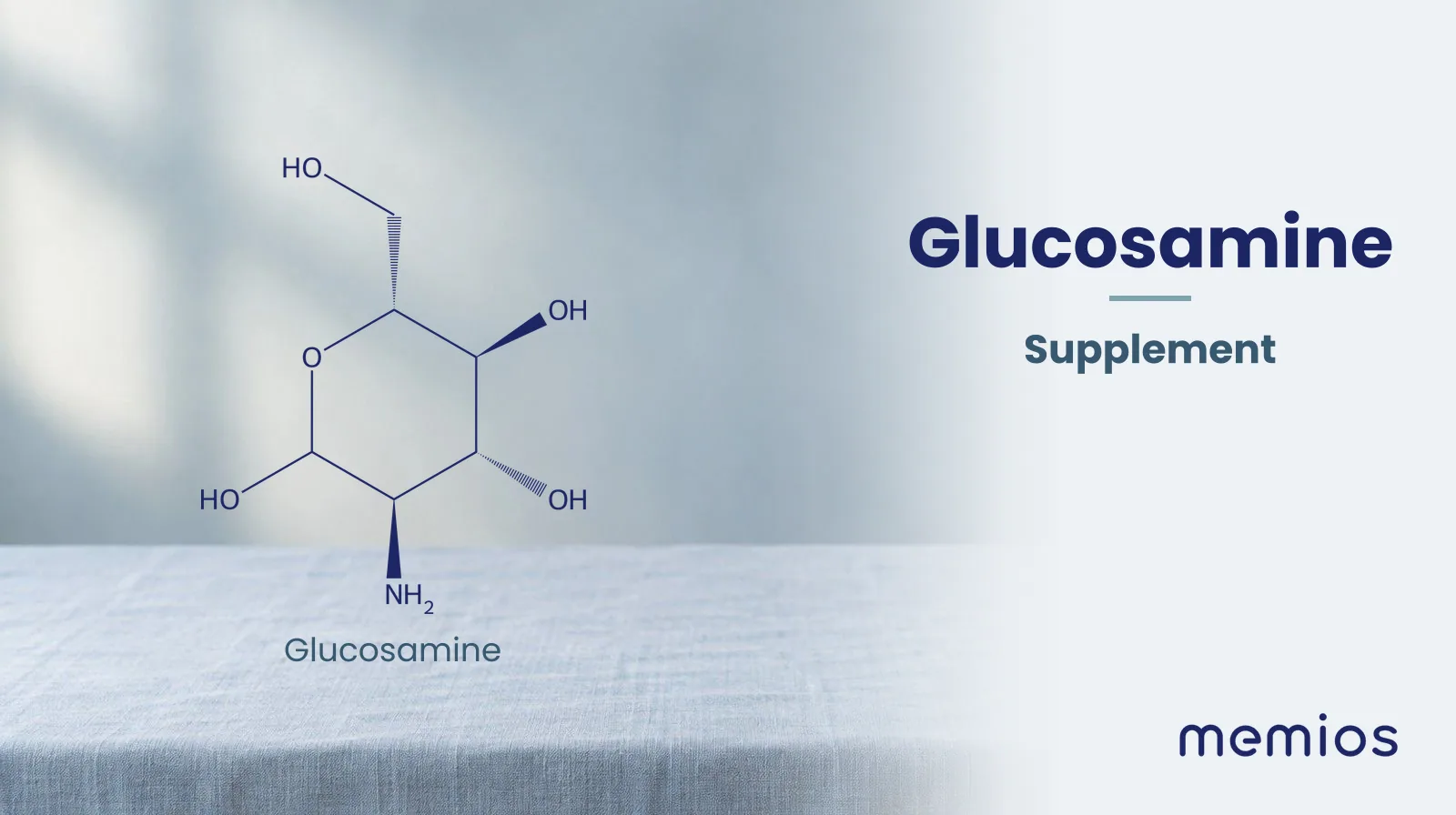
- What it is: Glucosamine is an amino sugar that the body makes and that is present in cartilage, where it feeds into the synthesis of glycosylated proteins and lipids and of keratan sulfate and hyaluronic acid.
- Main use, supported: A Cochrane review found that pooling only the trials of the Rotta preparation showed glucosamine superior to placebo for pain and Lequesne function, while the same review's other analyses did not. (low certainty)
- Other use, supported: The ESCEO working group holds a position, dated 2019, strongly recommending one prescription crystalline glucosamine sulfate while discouraging other glucosamine formulations.
- Claim NOT supported by research: A network meta-analysis of 10 large trials concluded that glucosamine does not reduce joint pain or affect joint space narrowing compared with placebo. (moderate certainty)
- Another claim NOT supported: In that network meta-analysis, industry-independent trials produced smaller effects than commercially funded trials. (moderate certainty)
- Recommended dose: not established. No reference intake (RDA or AI) exists for glucosamine from any body we located: it is described as an over-the-counter nutritional supplement and a natural component of cartilage, not an essential nutrient.
- Studied dose (a trial dose, not a recommendation): The GAIT trial gave 1500 mg of glucosamine daily for 24 weeks. No finding here cites that trial.
- Upper limit: We located no tolerable upper intake level or acceptable daily intake for glucosamine.
- What goes wrong: 6 findings on harm. Regulatory pharmacovigilance and case reports link glucosamine (usually with chondroitin) to raised INR and bleeding in people taking warfarin, including one catastrophic bleed.
- Common myth: The patented crystalline form of glucosamine sulfate gets into the blood better, which is why only it works.
What it is
Glucosamine is an amino sugar that the body makes and that is present in cartilage, where it feeds into the synthesis of glycosylated proteins and lipids and of keratan sulfate and hyaluronic acid. Supplement glucosamine is not extracted from ordinary food: most raw material is made from chitosan taken from the shells of shrimp and other sea crustaceans, with fermentation-derived material a newer alternative. It is sold as the sulfate salt (including a patented crystalline form), as the hydrochloride, and very often combined with chondroitin. Typical over-the-counter doses are 500 mg three times daily or 1500 mg once daily.
What the research says
The evidence is disputed rather than settled. The largest independent network meta-analysis found no clinically important effect on osteoarthritis pain or joint space, and the biggest US government-funded trial (GAIT) missed its primary endpoint; the 2005 Cochrane review found benefit only in trials of one manufacturer's preparation and none in trials with adequate allocation concealment. A European society (ESCEO) nonetheless gives a strong recommendation to one prescription crystalline form, and an observational UK Biobank analysis found an association with lower cardiovascular risk that cannot show cause. Serious harm is uncommon, but there are published case reports of liver injury and a documented pattern of raised INR in people taking warfarin.
Evidence grade: Disputed.
What goes wrong
Regulatory pharmacovigilance and case reports link glucosamine (usually with chondroitin) to raised INR and bleeding in people taking warfarin, including one catastrophic bleed. (Source 1)
- Case report, Low certainty.
- Size: 1 index case plus 20 FDA MedWatch reports and 21 WHO database reports.
- Who: adults on long-term warfarin who also took glucosamine or glucosamine-chondroitin.
- How long: weeks after a dose increase.
- Result: index case INR rose from 2.3 to 3.9 and then 4.7; 17 of 21 WHO reports resolved when glucosamine was stopped.
- Funding: not stated.
One report described an intraventricular bleed and subdural hematoma, which resulted in a persistent vegetative state.
A clinic case series found aminotransferase elevations temporally associated with glucosamine in 2 of 151 patients with chronic liver disease surveyed. (Source 2)
- Case series, Very low certainty.
- Size: 151 consecutive patients surveyed; 23 (15.2%) had used the products; 2 with enzyme elevations.
- Who: outpatients with chronic liver disease of mixed aetiology, mean age 59 years, 56.9% women.
- How long: one patient had taken glucosamine sulfate for a year.
- Result: transaminases 4-fold to 7-fold above normal, returning to usual values after stopping.
- Funding: not stated.
Review of the clinical records and liver function tests identified 2 patients presenting an elevation in aminotransferase values temporarily associated with glucosamine treatment; one of the cases simultaneously presented a skin rash attributed to the drug.
LiverTox records glucosamine as a possible rare cause of clinically apparent liver injury, with at least one reported case of acute liver failure, while noting that controlled trials showed no signal. (Source 3)
- Official position, Low certainty.
- Size: case reports and small series; no cases from prospective trials.
- Who: people taking glucosamine with or without chondroitin.
- How long: onset usually 1 to 4 weeks after starting.
- Result: hepatocellular or mixed pattern; most recovered within 4 to 8 weeks of stopping; likelihood score D.
- Funding: US National Institute of Diabetes and Digestive and Kidney Diseases (position dated March 12, 2018)
At least one instance of acute liver failure has been reported.
A 2025 systematic review of 146 studies reported that rare adverse events in case reports included cholestatic jaundice, autoimmune hepatitis and raised transaminases, alongside mostly mild gastrointestinal effects. (Source 4)
- Systematic review, Low certainty.
- Size: 146 studies screened from 2013 records.
- Who: humans taking glucosamine and/or chondroitin, mostly for osteoarthritis and joint pain.
- How long: varied.
- Result: no pooled rates reported; adverse events described qualitatively.
- Funding: not stated.
Rare AEs reported in case series or case reports were drug-induced cholestatic jaundice, autoimmune hepatitis, and elevated transaminases.
NCCIH, updated October 2023, states that glucosamine may raise blood glucose in some people. (Source 5)
- Official position, Certainty not rated.
- Size: not applicable.
- Who: general public.
- How long: not applicable.
- Result: no rates given.
- Funding: US National Center for Complementary and Integrative Health.
Glucosamine may cause increases in blood glucose (sugar) levels in some people.
NCCIH also states that glucosamine and chondroitin have been linked to an increased bleeding risk in people taking warfarin. (Source 6)
- Official position, Certainty not rated.
- Size: not applicable.
- Who: general public.
- How long: not applicable.
- Result: no rates given.
- Funding: US National Center for Complementary and Integrative Health.
Glucosamine and chondroitin have been associated with an increased risk of bleeding in people who are taking the anticoagulant warfarin.
What the evidence supports
A Cochrane review found that pooling only the trials of the Rotta preparation showed glucosamine superior to placebo for pain and Lequesne function, while the same review's other analyses did not. (Source 7)
- Systematic review, Low certainty.
- Size: 20 RCTs, 2570 patients (10 RCTs in the Rotta-preparation pain analysis)
- Who: adults with osteoarthritis, mostly of the knee.
- How long: trials of varying length, up to three years.
- Result: Pain SMD -1.31 (95% CI -1.99, -0.64); Lequesne function SMD -0.51 (95% CI -0.96, -0.05)
- Funding: not stated in the abstract; the Rotta preparation is a commercial product.
In the 10 RCTs in which the Rotta preparation of glucosamine was compared to placebo, glucosamine was found to be superior for pain (SMD -1.31, 95% CI -1.99, -0.64) and function using the Lequesne index (SMD -0.51, 95% CI -0.96, -0.05).
The ESCEO working group holds a position, dated 2019, strongly recommending one prescription crystalline glucosamine sulfate while discouraging other glucosamine formulations. (Source 8)
- Official position, Certainty not rated.
- Size: a GRADE-based expert working group recommendation.
- Who: people with knee osteoarthritis.
- How long: long-term background therapy.
- Result: effect size of pCGS on pain given as 0.27 (95% CI 0.12 to 0.43)
- Funding: ESCEO working group; the meeting received unrestricted grants and several authors declared pharmaceutical industry relationships.
GRADE recommendation: (4) The ESCEO working group affords a strong recommendation to the use of prescription crystalline glucosamine sulfate (pCGS) as Step 1 long-term background therapy for the management of knee OA, and discourages the use of other glucosamine formulations.
What the evidence does not support
When the same Cochrane review restricted analysis to trials with adequate allocation concealment, glucosamine showed no benefit for pain or WOMAC function. (Source 7)
- Systematic review, Low certainty.
- Size: 8 RCTs with adequate allocation concealment.
- Who: adults with osteoarthritis.
- How long: varied.
- Result: no benefit shown for pain or WOMAC function.
- Funding: not stated.
Analysis restricted to eight studies with adequate allocation concealment failed to show benefit of glucosamine for pain and WOMAC function.
Cochrane also reported that WOMAC pain, function and stiffness outcomes did not reach statistical significance for either Rotta or non-Rotta preparations. (Source 9)
- Systematic review, Low certainty.
- Size: 20 RCTs, 2570 patients.
- Who: adults with osteoarthritis.
- How long: varied.
- Result: non-Rotta preparations: pain SMD -0.15 (95% CI -0.35, 0.05); WOMAC function SMD 0.03 (95% CI -0.18, 0.25)
- Funding: not stated.
WOMAC outcomes of pain, stiffness and function did not show a superiority of glucosamine over placebo for both Rotta and non-Rotta preparations of glucosamine.
A network meta-analysis of 10 large trials concluded that glucosamine does not reduce joint pain or affect joint space narrowing compared with placebo. (Source 10)
- Meta-analysis, Moderate certainty.
- Size: 10 trials in 3803 patients.
- Who: adults with osteoarthritis of the hip or knee.
- How long: trials of at least 100 patients per group.
- Result: Overall pain difference vs placebo for glucosamine -0.4 cm on a 10 cm VAS (95% credible interval -0.7 to -0.1 cm); no estimate crossed the minimal clinically important difference.
- Funding: independent (the authors flag commercial funding as a source of bias in the included trials)
Compared with placebo, glucosamine, chondroitin, and their combination do not reduce joint pain or have an impact on narrowing of joint space.
In that network meta-analysis, industry-independent trials produced smaller effects than commercially funded trials. (Source 11)
- Meta-analysis, Moderate certainty.
- Size: 10 trials in 3803 patients.
- Who: adults with osteoarthritis of the hip or knee.
- How long: as above.
- Result: P=0.02 for the interaction between funding source and effect size.
- Funding: independent.
Industry independent trials showed smaller effects than commercially funded trials (P=0.02 for interaction).
The GAIT randomised trial found glucosamine no better than placebo for its primary endpoint of a 20 percent reduction in knee pain. (Source 12)
- Randomized trial, Moderate certainty.
- Size: 1583 patients randomised across five arms.
- Who: adults with symptomatic knee osteoarthritis, mean age 59 years, 64 percent women.
- How long: 24 weeks.
- Result: Response rate 60.1 percent on placebo; glucosamine 3.9 percentage points higher (P=0.30); celecoxib 10.0 points higher (P=0.008)
- Funding: independent (US National Institutes of Health sponsored)
Overall, glucosamine and chondroitin sulfate were not significantly better than placebo in reducing knee pain by 20 percent.
A crossover pharmacokinetic pilot found no significant bioavailability advantage for crystalline glucosamine sulfate over regular glucosamine sulfate. (Source 13)
- Blood level study, Very low certainty.
- Size: 10 healthy adults.
- Who: healthy volunteers.
- How long: single 1500 mg dose with 24 hours of sampling and a 7-day washout.
- Result: AUC0-24 for glucosamine 18,300 ng.h/mL with rGS versus 12,900 ng.h/mL with cGS, p = 0.136.
- Funding: no external funding; several authors employed by ISURA and one author contracted to a manufacturer.
This pilot study found no significant pharmacokinetic advantage of cGS over rGS.
Where the evidence is mixed
In a UK Biobank prospective cohort, habitual glucosamine use was associated with a lower risk of cardiovascular events; the study measured an association, not a demonstrated effect. (Source 14)
- Cohort study, Low certainty.
- Size: 466,039 participants without cardiovascular disease at baseline; 10,204 incident CVD events.
- Who: UK Biobank adults.
- How long: median follow-up of seven years.
- Result: Total CVD hazard ratio 0.85 (95% CI 0.80 to 0.90); CVD death 0.78 (0.70 to 0.87); coronary heart disease 0.82 (0.76 to 0.88); stroke 0.91 (0.83 to 1.00)
- Funding: independent (academic funding)
glucosamine use was associated with a significantly lower risk of total CVD events (hazard ratio 0.85, 95% confidence interval 0.80 to 0.90), CVD death (0.78, 0.70 to 0.87), coronary heart disease (0.82, 0.76 to 0.88), and stroke (0.91, 0.83 to 1.00).
The UK Biobank authors state that healthy lifestyle cannot be separated from supplement use in an observational design. (Source 15)
- Cohort study, Low certainty.
- Size: 466,039 participants.
- Who: UK Biobank adults.
- How long: median seven years.
- Result: no effect estimate; a stated limitation.
- Funding: independent.
It is difficult to separate the effects of a healthy lifestyle from the use of habitual supplements in an observational study.
A randomised crossover trial in healthy overweight adults found lower CRP on glucosamine plus chondroitin but no change in the other inflammation or oxidative stress biomarkers. (Source 16)
- Randomized trial, Low certainty.
- Size: 18 adults (9 men, 9 women)
- Who: healthy overweight adults aged 20 to 55.
- How long: 28 days per period.
- Result: Serum CRP 23% lower than placebo (P = 0.048); no significant difference in interleukin 6, soluble TNF receptors I and II, prostaglandin E2-metabolite or F2-isoprostane.
- Funding: US National Cancer Institute grant; supplements donated by Nutramax Laboratories Consumer Care, Inc.
Serum CRP concentrations were 23% lower after glucosamine and chondroitin compared to placebo (P = 0.048). There were no significant differences in other biomarkers.
Where the research disagrees
Whether glucosamine reduces osteoarthritis pain
- ESCEO working group (2019), expert working group position using GRADE, with declared industry relationships: GRADE recommendation: (4) The ESCEO working group affords a strong recommendation to the use of prescription crystalline glucosamine sulfate (pCGS) as Step 1 long-term background therapy for the management of knee OA, and discourages the use of other glucosamine formulations. (Source 8)
- Wandel and colleagues, BMJ (2010), network meta-analysis of 10 large trials in 3803 patients: Compared with placebo, glucosamine, chondroitin, and their combination do not reduce joint pain or have an impact on narrowing of joint space. (Source 10)
- NCCIH, NIH (October 2023), agency position summarising the trial literature: still uncertain whether glucosamine and chondroitin are helpful for knee osteoarthritis symptoms (Source 17)
Whether the patented crystalline sulfate form is absorbed better than ordinary glucosamine sulfate
- ESCEO working group (2019), position citing trial evidence: Conversely, other glucosamine preparations were devoid of efficacy in high-quality trials (Source 18)
- Crossover pharmacokinetic pilot, Nutrients (2025), randomised double-blind crossover pharmacokinetic study in 10 healthy adults: This pilot study found no significant pharmacokinetic advantage of cGS over rGS. (Source 13)
How much
- Reference intake: No reference intake (RDA or AI) exists for glucosamine from any body we located: it is described as an over-the-counter nutritional supplement and a natural component of cartilage, not an essential nutrient. (Source 19)
- Upper limit: We located no tolerable upper intake level or acceptable daily intake for glucosamine. LiverTox (2018) records only typical use, not a limit: glucosamine is typically taken at 500 mg three times daily. (Source 19)
- Studied: The GAIT trial gave 1500 mg of glucosamine daily for 24 weeks. (Source 20)
- Studied: A pharmacokinetic pilot gave a single 1500 mg oral dose to healthy adults. (Source 13)
- Studied: A 2025 systematic review reports that glucosamine and chondroitin were most commonly given together at 1500 mg and 1200 mg daily. (Source 21)
A common belief, and what the research shows
The belief: The patented crystalline form of glucosamine sulfate gets into the blood better, which is why only it works.
What the research shows: A randomised crossover pharmacokinetic pilot comparing the two salt forms in healthy adults reported that "This pilot study found no significant pharmacokinetic advantage of cGS over rGS." The same paper adds that "These preliminary findings challenge claims of cGS' pharmacokinetic superiority, although the small sample size limits definitive conclusions." Ten people is a very small study, so this does not settle the question either way; it does mean the absorption explanation is not established.
Questions and answers
What is it?
Glucosamine is an amino sugar that occurs naturally in cartilage and is sold as an over-the-counter supplement for osteoarthritis pain. In the body it feeds the pathways that build glycosylated proteins and lipids. It is a building block of keratan sulfate and hyaluronic acid, both found in joint cartilage and synovial fluid. It is usually sold alone or combined with chondroitin. (Source 19)
What does it do in the body?
Inside the body glucosamine is a raw material for large sugar-protein molecules of cartilage and joint fluid. What swallowing extra glucosamine does to a joint is not established: the largest trials and the independent network meta-analysis found no clinically important change in pain or joint space. A pharmacokinetic study shows oral glucosamine does reach the bloodstream and is measurable there. (Source 19)
Is it good or bad for you?
Neither clearly good nor clearly bad. Large independent analyses found no clinically important pain benefit, while a European society recommends one prescription form; the US agency NCCIH says the question is still open. Serious harm is uncommon, but liver injury case reports exist and people on warfarin have had dangerous rises in INR. (Source 17)
How do you get more of it?
It is taken as a supplement, not obtained from ordinary food. Most commercial glucosamine is made from chitosan extracted from the shells of shrimp and other sea crustaceans; fermentation-derived glucosamine is a newer source. Trials have most often used 1500 mg a day, or 500 mg three times a day. (Source 22)
If it is harmful, what reduces it?
Glucosamine is not usually treated as something to remove. Where it has caused a problem, stopping the product is what the reports describe: in LiverTox's summary of liver injury cases most people recovered after stopping, and in the warfarin reports the INR came back down when the supplement was reduced or withdrawn. (Source 3)
Why might someone be low in it or missing it?
There is no recognised dietary deficiency of glucosamine, because the body makes it and it is not supplied in meaningful amounts by food. The one biological statement made about low levels is that glucosamine and chondroitin are reduced in osteoarthritic cartilage. Someone can also simply not be taking a supplement, which is not a deficiency. (Source 19)
Which whole foods contain it or feed it?
No ordinary whole food is a meaningful source. The raw material for supplements comes from the shells of shellfish, which are not eaten, so consumer worry about shellfish allergy relates to the supplement rather than to seafood on a plate. Fermentation-derived glucosamine avoids the shellfish route altogether. (Source 22)
What happens if you do not have it?
Nothing identifiable happens: there is no deficiency disease. In the large placebo-controlled trials the people who received no glucosamine did about as well as those who did, so not taking it was not shown to worsen joint pain or joint space. (Source 10)
How can you test for it?
There is no clinical test for a person's glucosamine status, and none is used to guide treatment. Glucosamine can be measured in blood in research settings: a 2025 pharmacokinetic study quantified plasma glucosamine and its metabolite by high-resolution mass spectrometry after a single dose. That measures recent intake, not joint health. (Source 13)
References
- Pharmacotherapy. Potential glucosamine-warfarin interaction resulting in increased international normalized ratio: case report and review of the literature and MedWatch database. 2008. PMID 18363538, DOI 10.1592/phco.28.4.540. Read the source
- World Journal of Gastroenterology. Hepatotoxicity associated with glucosamine and chondroitin sulfate in patients with chronic liver disease. 2013. PMID 23983444, DOI 10.3748/wjg.v19.i32.5381. Read the source
- National Institute of Diabetes and Digestive and Kidney Diseases (NIDDK), NCBI Bookshelf. Glucosamine - LiverTox: Clinical and Research Information on Drug-Induced Liver Injury. 2018. Read the source
- Nutrients (MDPI). The Safety and Efficacy of Glucosamine and/or Chondroitin in Humans: A Systematic Review. 2025. DOI 10.3390/nu17132093. Read the source
- National Center for Complementary and Integrative Health (NCCIH), NIH. Glucosamine and Chondroitin for Osteoarthritis. 2023. Read the source
- National Center for Complementary and Integrative Health (NCCIH), NIH. Glucosamine and Chondroitin for Osteoarthritis. 2023. Read the source
- Cochrane Database of Systematic Reviews. Glucosamine therapy for treating osteoarthritis. 2005. PMID 15846645, DOI 10.1002/14651858.CD002946.pub2. Read the source
- Seminars in Arthritis and Rheumatism. An updated algorithm recommendation for the management of knee osteoarthritis from the European Society for Clinical and Economic Aspects of Osteoporosis, Osteoarthritis and Musculoskeletal Diseases (ESCEO). 2019. PMID 31126594, DOI 10.1016/j.semarthrit.2019.04.008. Read the source
- Cochrane Database of Systematic Reviews. Glucosamine therapy for treating osteoarthritis. 2005. PMID 15846645, DOI 10.1002/14651858.CD002946.pub2. Read the source
- BMJ. Effects of glucosamine, chondroitin, or placebo in patients with osteoarthritis of hip or knee: network meta-analysis. 2010. PMID 20847017, DOI 10.1136/bmj.c4675. Read the source
- BMJ. Effects of glucosamine, chondroitin, or placebo in patients with osteoarthritis of hip or knee: network meta-analysis. 2010. PMID 20847017, DOI 10.1136/bmj.c4675. Read the source
- New England Journal of Medicine. Glucosamine, chondroitin sulfate, and the two in combination for painful knee osteoarthritis. 2006. PMID 16495392, DOI 10.1056/NEJMoa052771. Read the source
- Nutrients (MDPI). Does Salt Form Matter? A Pilot Randomized, Double-Blind, Crossover Pharmacokinetic Comparison of Crystalline and Regular Glucosamine Sulfate in Healthy Volunteers. 2025. DOI 10.3390/nu17152491. Read the source
- BMJ. Association of habitual glucosamine use with risk of cardiovascular disease: prospective study in UK Biobank. 2019. PMID 31088786, DOI 10.1136/bmj.l1628. Read the source
- BMJ. Association of habitual glucosamine use with risk of cardiovascular disease: prospective study in UK Biobank. 2019. PMID 31088786, DOI 10.1136/bmj.l1628. Read the source
- PLOS ONE. Randomized Trial of Glucosamine and Chondroitin Supplementation on Inflammation and Oxidative Stress Biomarkers and Plasma Proteomics Profiles in Healthy Humans. 2015. PMID 25719429, DOI 10.1371/journal.pone.0117534. Read the source
- National Center for Complementary and Integrative Health (NCCIH), NIH. Glucosamine and Chondroitin for Osteoarthritis. 2023. Read the source
- Seminars in Arthritis and Rheumatism. An updated algorithm recommendation for the management of knee osteoarthritis from the European Society for Clinical and Economic Aspects of Osteoporosis, Osteoarthritis and Musculoskeletal Diseases (ESCEO). 2019. PMID 31126594, DOI 10.1016/j.semarthrit.2019.04.008. Read the source
- National Institute of Diabetes and Digestive and Kidney Diseases (NIDDK), NCBI Bookshelf. Glucosamine - LiverTox: Clinical and Research Information on Drug-Induced Liver Injury. 2018. Read the source
- New England Journal of Medicine. Glucosamine, chondroitin sulfate, and the two in combination for painful knee osteoarthritis. 2006. PMID 16495392, DOI 10.1056/NEJMoa052771. Read the source
- Nutrients (MDPI). The Safety and Efficacy of Glucosamine and/or Chondroitin in Humans: A Systematic Review. 2025. DOI 10.3390/nu17132093. Read the source
- Nutrients (MDPI). Pharmacokinetic Comparison of Chitosan-Derived and Biofermentation-Derived Glucosamine in Nutritional Supplement for Bone Health. 2022. DOI 10.3390/nu14153213. Read the source