Medications · September 29, 2026 · Memios · 18 min read
Folic acid
The strongest evidence is in pregnancy: pooled randomised trials show folic acid around conception cuts neural tube defects by roughly two thirds, with no clear effect on other birth defects.
TLDR
- Mixed evidence. The strongest evidence is in pregnancy: pooled randomised trials show folic acid around conception cuts neural tube defects by roughly two thirds, with no clear effect on other birth defects.
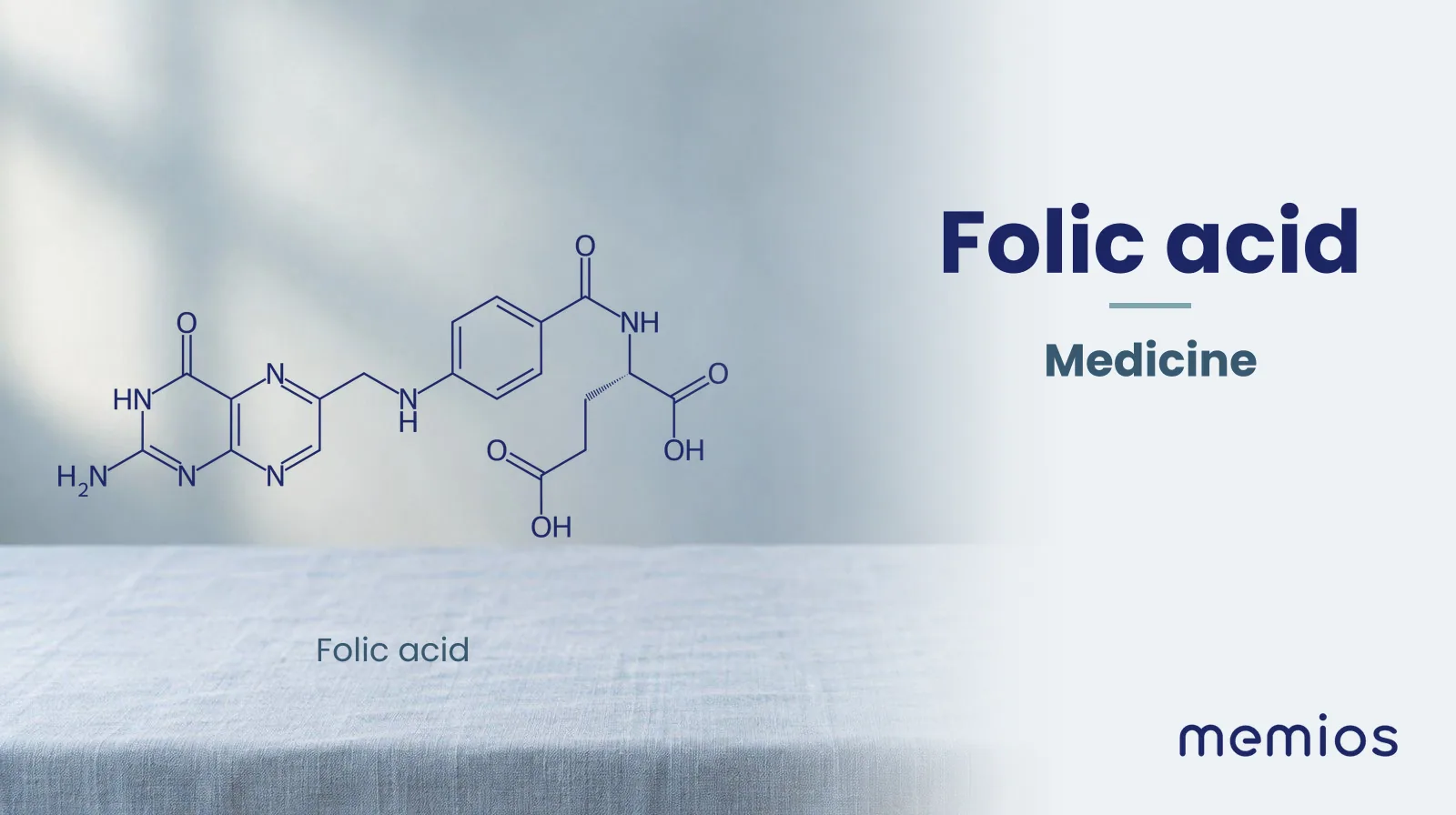
- What it is: Folic acid is the synthetic, fully oxidised form of vitamin B9 used in supplements, fortified flour and prescription tablets.
- Main use: Megaloblastic anaemia caused by folate deficiency (well supported).
- Other approved uses: Preventing neural tube defects around conception (well supported).
- Off-label uses (not on the FDA label): Reducing the gastrointestinal side effects of low-dose methotrexate (limited evidence).
- Uses NOT supported by research: Preventing heart attack and death by lowering homocysteine.
- Recommended dose (official position): Dose is set by the prescriber. For nutrition, NIH's Office of Dietary Supplements gives the adult Recommended Dietary Allowance in its Table 1 as 400 mcg DFE a day for males and females aged 19 and older; the fact sheet explains that these values come from the Dietary Reference Intakes.
- Studied dose (a trial dose, not a recommendation): The Norwegian cancer-outcome trials gave 0.8 mg/d of folic acid plus 0.4 mg/d of vitamin B12. Findings citing that trial: 1 on harm.
- Upper limit: NIH's Office of Dietary Supplements gives the adult Tolerable Upper Intake Level in its Table 3 as 1,000 mcg a day for ages 19 and older.
- What goes wrong: 3 findings on harm. In a Norwegian randomised trial in people with ischaemic heart disease, folic acid plus B12 was followed by more cancer and more deaths.
- Interactions: 4 recorded, including Methotrexate, Antiepileptic drugs (phenytoin, carbamazepine, valproate), Alcohol, Vitamin B12 (cyanocobalamin) status.
- Common myth: Folic acid is good for the heart because it lowers homocysteine, and homocysteine is a cardiovascular risk factor.
What it is
Folic acid is the synthetic, fully oxidised form of vitamin B9 used in supplements, fortified flour and prescription tablets. In the body it is converted to tetrahydrofolic acid, the cofactor that carries single-carbon units for making the building blocks of DNA and for red blood cell production. It is a prescription drug at 1 mg strength and an over-the-counter supplement at lower strengths.
What the research says
The strongest evidence is in pregnancy: pooled randomised trials show folic acid around conception cuts neural tube defects by roughly two thirds, with no clear effect on other birth defects. Outside pregnancy the picture is much weaker. Fifteen randomised trials in 71,422 people found no effect on heart attack or death, and only a small reduction in stroke. And one large randomised trial in Norway found more cancer and more deaths in people given folic acid plus B12, which a bigger pooled analysis did not confirm.
Evidence grade: Mixed evidence.
How it works
Drug class: Water-soluble B vitamin; haematopoietic agent (folate replacement)
Folic acid is converted to tetrahydrofolic acid, which acts as the carrier of one-carbon groups used to build the purines and thymidylate of DNA. Without enough of it, cells that divide quickly - especially the ones making red blood cells - cannot copy their DNA properly and produce large, immature cells instead. (Source 1)
What it is used for
- The label's approved use is correcting the anaemia of folate deficiency; it works by letting the bone marrow make normal red cells again. Evidence: established. (Source 1)
- Five randomised trials in 7,391 women found daily folic acid around conception cut neural tube defects sharply (RR 0.31, 95% CI 0.17 to 0.58), with a similar effect for recurrence, and no clear effect on cleft lip, cleft palate, heart defects or miscarriage. Evidence: established. (Source 2)
- A Cochrane review of 15 trials in 71,422 people found no difference against placebo for myocardial infarction (7.1% versus 6.0%, RR 1.02) or death from any cause (11.7% versus 12.3%, RR 1.01), both high-quality evidence. A small reduction in stroke was found (4.3% versus 5.1%, RR 0.90). Evidence: not-supported. (Source 3)
- NIH's Office of Dietary Supplements records, as a position, that folate supplements may reduce the gut side effects of low-dose methotrexate used for rheumatoid arthritis or psoriasis, while cautioning that supplements could interfere with methotrexate given for cancer. Evidence: limited. (Source 4)
Interactions
- Methotrexate (label): Methotrexate works by blocking folate metabolism, so folic acid opposes it. For cancer treatment that opposition matters and the fact sheet tells patients on methotrexate for cancer to consult their oncologist before taking folate supplements; for low-dose methotrexate in arthritis or psoriasis, folate may reduce gut side effects. (Source 4)
- Antiepileptic drugs (phenytoin, carbamazepine, valproate) (label): These drugs lower folate levels, and folate supplements can in turn lower the blood levels of the antiepileptic drug. (Source 5)
- Alcohol (clinical trial): Alcohol interferes with folate absorption and liver uptake, speeds its breakdown and increases how much is lost in urine; even moderate drinking lowers serum folate. (Source 6)
- Vitamin B12 (cyanocobalamin) status (label): Folic acid can correct the anaemia of B12 deficiency while the nerve damage keeps progressing, which can delay diagnosis. (Source 1)
What goes wrong
In a Norwegian randomised trial in people with ischaemic heart disease, folic acid plus B12 was followed by more cancer and more deaths. (Source 7)
- Randomized trial, Moderate certainty.
- Size: 6,837 patients across two randomised trials pooled in this analysis (341 versus 288 cancers)
- Who: Patients with ischaemic heart disease in Norway, a country without folic acid food fortification.
- How long: Median 39 months of treatment plus 38 months of observational follow-up.
- Result: Cancer 10.0% versus 8.4%, HR 1.21 (95% CI 1.03-1.41; P = .02); cancer death 4.0% versus 2.9%, HR 1.38 (1.07-1.79); all-cause death 16.1% versus 13.8%, HR 1.18 (1.04-1.33). Dose 0.8 mg/d folic acid plus 0.4 mg/d B12.
- Funding: not stated in the abstract we read.
Limit of this finding: This was a combined analysis of two Norwegian trials (6,837 patients) that were designed to test homocysteine lowering, not cancer, and the cancer counts include 38 months of observational follow-up after the trials ended. Half of all participants also received vitamin B6 40 mg a day. The doses were folic acid 0.8 mg a day plus vitamin B12 0.4 mg a day. Norway did not fortify food with folic acid, so background intake was low; the finding may not transfer to fortified countries.
After a median 39 months of treatment and an additional 38 months of posttrial observational follow-up, 341 participants (10.0%) who received folic acid plus vitamin B12 vs 288 participants (8.4%) who did not receive such treatment were diagnosed with cancer (hazard ratio [HR], 1.21; 95% confidence interval [CI], 1.03-1.41; P = .02).
Folic acid can mask the anaemia of vitamin B12 deficiency while the neurological damage continues. (Source 1)
- Official position, Certainty not rated.
- Size: Not applicable.
- Who: People with undiagnosed anaemia.
- How long: Not applicable.
- Result: No rate given; a label warning applying above 0.1 mg daily.
- Funding: Manufacturer label.
Limit of this finding: The same label also states that folic acid alone is improper therapy for pernicious anaemia and other megaloblastic anaemias in which vitamin B12 is deficient. Vitamin B12 status should be established before folate is used to treat an anaemia.
There is a potential danger in administering folic acid to patients with undiagnosed anemia, since folic acid may obscure the diagnosis of pernicious anemia by alleviating the hematologic manifestations of the disease while allowing the neurologic complications to progress.
Allergic reactions to folic acid preparations have been reported, though rarely. (Source 1)
- Official position, Certainty not rated.
- Size: Not applicable.
- Who: People taking oral or injected folic acid.
- How long: Not applicable.
- Result: No rate given; described as rare.
- Funding: Manufacturer label.
Rare instances of allergic responses to folic acid preparations have been reported and have included erythema, skin rash, itching, general malaise, and respiratory difficulty due to bronchospasm.
What the evidence supports
Daily folic acid around conception sharply reduces neural tube defects. (Source 2)
- Systematic review, High certainty.
- Size: Five studies, 6,708 births (from five trials involving 7,391 women)
- Who: Women planning or capable of pregnancy, 2,033 with a previously affected pregnancy and 5,358 without.
- How long: Periconceptional supplementation.
- Result: RR 0.31, 95% CI 0.17 to 0.58; five studies; 6708 births; high quality evidence. For recurrence the review reports RR 0.34, 95% CI 0.18 to 0.64; four studies; 1846 births.
- Funding: not stated.
Limit of this finding: The review's sentence carries an unmatched closing bracket after 'high quality evidence)' - that is how the abstract prints it and it has been left as printed.
The results of the first comparison involving 6708 births with information on NTDs and other infant outcomes, show a protective effect of daily folic acid supplementation (alone or in combination with other vitamins and minerals) in preventing NTDs compared with no interventions/placebo or vitamins and minerals without folic acid (risk ratio (RR) 0.31, 95% confidence interval (CI) 0.17 to 0.58); five studies; 6708 births; high quality evidence).
The same review found a small reduction in stroke, about 8 fewer strokes per 1,000 people treated. (Source 3)
- Systematic review, High certainty.
- Size: 10 trials, N = 44,224.
- Who: Adults, mostly with or at risk of cardiovascular disease.
- How long: Varies by trial.
- Result: 4.3% versus 5.1%, RR 0.90, 95% CI 0.82 to 0.99 (an absolute difference of 0.8 percentage points)
- Funding: not stated.
Limit of this finding: This is the only positive result in the review and it is a small one. The confidence interval, 0.82 to 0.99, only just excludes no effect, and the absolute difference is 4.3% versus 5.1% - about 8 fewer strokes per 1,000 people. In the same review heart attacks, death from any cause and serious adverse events all showed no difference.
Compared with placebo, homocysteine-lowering interventions were associated with reduced stroke outcome (homocysteine-lowering = 4.3% versus comparator = 5.1%, RR 0.90, 95% CI 0.82 to 0.99, I2 = 8%, 10 trials, N = 44,224; high-quality evidence).
What the evidence does not support
For cleft lip, cleft palate, heart defects, miscarriage and other birth defects the same review found no usable evidence either way, not a demonstrated absence of effect. (Source 8)
- Systematic review, Low certainty.
- Size: Five trials, 7,391 women.
- Who: Women planning or capable of pregnancy.
- How long: Periconceptional supplementation.
- Result: Cleft palate RR 0.73, 95% CI 0.05 to 10.89 (three studies, 5612 births, low quality); cleft lip RR 0.79, 0.14 to 4.36 (low quality); congenital cardiovascular defects RR 0.57, 0.24 to 1.33 (low quality); miscarriage RR 1.10, 0.94 to 1.28 (five studies, 7391 pregnancies, moderate quality); any other birth defects RR 0.94, 0.53 to 1.66 (low quality)
- Funding: not stated.
Limit of this finding: These are not settled null results. For cleft palate the confidence interval runs from 0.05 to 10.89 on low-quality evidence from three studies - that is, the trials cannot rule out either a twenty-fold reduction or a ten-fold increase. The honest reading is that the trials were too small to tell, not that folic acid has been shown to make no difference. The miscarriage estimate is the only one rated moderate quality. The source also prints a doubled opening bracket before 'RR 0.79'; it is left as printed.
There is no evidence of any preventive or negative effects on cleft palate (RR 0.73, 95% CI 0.05 to 10.89; three studies; 5612 births; low quality evidence), cleft lip ((RR 0.79, 95% CI 0.14 to 4.36; three studies; 5612 births; low quality evidence), congenital cardiovascular defects (RR 0.57, 95% CI 0.24 to 1.33; three studies; 5612 births; low quality evidence), miscarriages (RR 1.10, 95% CI 0.94 to 1.28; five studies; 7391 pregnancies; moderate quality evidence) or any other birth defects (RR 0.94, 95% CI 0.53 to 1.66; three studies; 5612 births; low quality evidence).
Lowering homocysteine with B vitamins including folic acid did not prevent heart attacks or death. (Source 3)
- Systematic review, High certainty.
- Size: 15 randomised controlled trials, 71,422 participants (12 trials, N = 46,699 for myocardial infarction)
- Who: Adults, mostly with or at risk of cardiovascular disease.
- How long: Varies by trial.
- Result: Myocardial infarction 7.1% versus 6.0%, RR 1.02, 95% CI 0.95 to 1.10; death from any cause 11.7% versus 12.3%, RR 1.01, 95% CI 0.96 to 1.06.
- Funding: not stated.
Compared with placebo, there were no differences in effects of homocysteine-lowering interventions on myocardial infarction (homocysteine-lowering = 7.1% versus placebo = 6.0%; RR 1.02, 95% confidence interval (CI) 0.95 to 1.10, I2 = 0%, 12 trials; N = 46,699; Bayes factor 1.04, high-quality evidence), death from any cause (homocysteine-lowering = 11.7% versus placebo = 12.3%, RR 1.01, 95% CI 0.96 to 1.06, I2 = 0%, 11 trials, N = 44,817; Bayes factor = 1.05, high-quality evidence)
A much larger pooled analysis of 13 randomised trials did not find a significant increase in cancer with folic acid. (Source 9)
- Meta-analysis, Moderate certainty.
- Size: 13 trials, 49,621 participants.
- Who: Adults in randomised folic acid trials.
- How long: First five years of treatment.
- Result: Overall cancer incidence RR 1.06, 95% CI 0.99 to 1.13; no significant effect at any specific site.
- Funding: not stated in the structured abstract.
Limit of this finding: The pooled estimate is RR 1.06 with an upper limit of 1.13, so a 13% relative increase in cancer is not ruled out - 'no significant effect' is not the same as 'no effect'. The conclusion is also confined to the first five years of treatment. The quoted words are the CRD reviewers' structured abstract, not the Lancet authors' own text.
Folic acid treatment had no significant effect on overall cancer incidence (RR 1.06, 95% CI 0.99 to 1.13).
Where the research disagrees
Whether folic acid supplementation increases cancer risk
- Ebbing and colleagues, JAMA 2009 (Norwegian trials, unfortified population), randomised trials with post-trial follow-up: Treatment with folic acid plus vitamin B12 was associated with increased cancer outcomes and all-cause mortality in patients with ischemic heart disease in Norway, where there is no folic acid fortification of foods. (Source 10)
- Vollset and colleagues, pooled analysis of 13 randomised trials (DARE structured abstract), meta-analysis of individual participant data from 49,621 participants: Folic acid supplementation did not substantially increase or decrease incidence of site-specific cancer during the first five years of treatment. (Source 9)
How much
- Reference intake: Dose is set by the prescriber. For nutrition, NIH's Office of Dietary Supplements gives the adult Recommended Dietary Allowance in its Table 1 as 400 mcg DFE a day for males and females aged 19 and older; the fact sheet explains that these values come from the Dietary Reference Intakes. The 1 mg prescription label states the usual therapeutic dose is up to 1 mg daily. (Source 11)
- Upper limit: NIH's Office of Dietary Supplements gives the adult Tolerable Upper Intake Level in its Table 3 as 1,000 mcg a day for ages 19 and older. The fact sheet is explicit that this limit applies only to the synthetic forms of folate in supplements and fortified foods, and that no upper limit was set for folate from food. The table also lists separate values by age and for pregnancy and lactation. (Source 12)
- Studied: The Norwegian cancer-outcome trials gave 0.8 mg/d of folic acid plus 0.4 mg/d of vitamin B12. (Source 7)
- Studied: The neural tube defect trials gave daily folic acid alone or with other vitamins and minerals around the time of conception, in five trials of 7,391 women. (Source 2)
A common belief, and what the research shows
The belief: Folic acid is good for the heart because it lowers homocysteine, and homocysteine is a cardiovascular risk factor.
What the research shows: Lowering the marker did not lower the events. Cochrane's 2017 review of 15 trials in 71,422 people reports: 'Compared with placebo, there were no differences in effects of homocysteine-lowering interventions on myocardial infarction (homocysteine-lowering = 7.1% versus placebo = 6.0%; RR 1.02, 95% confidence interval (CI) 0.95 to 1.10, I2 = 0%, 12 trials; N = 46,699; Bayes factor 1.04, high-quality evidence), death from any cause (homocysteine-lowering = 11.7% versus placebo = 12.3%, RR 1.01, 95% CI 0.96 to 1.06, I2 = 0%, 11 trials, N = 44,817; Bayes factor = 1.05, high-quality evidence)' The one exception was a small stroke reduction: 'Compared with placebo, homocysteine-lowering interventions were associated with reduced stroke outcome (homocysteine-lowering = 4.3% versus comparator = 5.1%, RR 0.90, 95% CI 0.82 to 0.99, I2 = 8%, 10 trials, N = 44,224; high-quality evidence).'
Questions and answers
What is it?
Folic acid is the manufactured form of vitamin B9, used in supplements, fortified flour and prescription tablets. The body converts it to tetrahydrofolic acid, which carries the single-carbon groups needed to build DNA. Natural folate in food is a family of related compounds. (Source 1)
What does it do in the body?
Its central job is supplying one-carbon units for making DNA, which matters most in tissues that divide fast. That is why a shortage shows up first in the bone marrow as large, immature red cells, and why folate is critical when a baby's neural tube is forming in the first weeks of pregnancy. (Source 1)
Is it good or bad for you?
Context decides. Around conception the randomised evidence for preventing neural tube defects is strong. For preventing heart attacks it does nothing. In one Norwegian trial population, folic acid with B12 was followed by more cancer and more deaths, though a larger pooled analysis of 13 trials did not confirm an overall cancer increase. (Source 9)
How do you get more of it?
From food folate, from fortified grain products, and from supplements or prescription tablets. As a position, the Institute of Medicine RDA recorded by NIH is 400 mcg dietary folate equivalents a day for adults; this is a reference intake, not advice to the reader. (Source 11)
If it is harmful, what reduces it?
Folic acid is water-soluble and excess is excreted, so there is no process for clearing it deliberately. What the literature sets instead is a ceiling on synthetic intake, because high intakes can mask B12 deficiency. (Source 12)
Why might someone be low in it or missing it?
Low intake, poor absorption, alcohol, pregnancy's higher demand, and several medicines. Alcohol is documented to reduce absorption and liver uptake while speeding breakdown and urinary loss; antiepileptic drugs such as phenytoin, carbamazepine and valproate lower serum folate. (Source 6)
Which whole foods contain it or feed it?
Leafy greens, liver, asparagus, brussels sprouts, legumes and, in countries that fortify, enriched flour and cereals. Food folate is the natural form and is not subject to the upper limit that applies to synthetic folic acid. (Source 13)
What happens if you do not have it?
A folate shortage produces megaloblastic anaemia, which folic acid reverses. In early pregnancy, low folate is linked to neural tube defects, and randomised trials show supplementation around conception cuts them by roughly two thirds. (Source 1)
How can you test for it?
Two blood tests exist. Serum folate reflects recent intake; red-cell folate reflects stores over the previous few months and is the more stable measure. Thresholds for adequacy are published, so the tests are interpretable, though serum values move with a recent meal. (Source 14)
References
- DailyMed (US National Library of Medicine) / manufacturer label. folic acid- Folic Acid tablet. label revision Rev. February 2006 (West-ward Pharmaceutical Corp.). Read the source
- Cochrane Database of Systematic Reviews (plain-language evidence page, cochrane.org). Effects and safety of periconceptional oral folate supplementation for preventing birth defects (Main results, neural tube defects). 2015. PMID 26662928, DOI 10.1002/14651858.CD007950.pub3. Read the source
- Cochrane Database of Systematic Reviews (plain-language evidence page, cochrane.org). Homocysteine-lowering interventions for preventing cardiovascular events. 2017. PMID 28816346, DOI 10.1002/14651858.CD006612.pub5. Read the source
- Office of Dietary Supplements, US National Institutes of Health. Folate - Health Professional Fact Sheet (Interactions with Medications: methotrexate). NIH Office of Dietary Supplements fact sheet; copy fetched 24 September 2026, page last modified 5 September 2026. Read the source
- Office of Dietary Supplements, US National Institutes of Health. Folate - Health Professional Fact Sheet (Interactions with Medications: antiepileptic medications). NIH Office of Dietary Supplements fact sheet; copy fetched 24 September 2026, page last modified 5 September 2026. Read the source
- Office of Dietary Supplements, US National Institutes of Health. Folate - Health Professional Fact Sheet (Groups at Risk of Folate Inadequacy: people with alcohol use disorder). NIH Office of Dietary Supplements fact sheet; copy fetched 24 September 2026, page last modified 5 September 2026. Read the source
- JAMA 302(19). Cancer Incidence and Mortality After Treatment With Folic Acid and Vitamin B12 (abstract, Results). 2009. PMID 19920236, DOI 10.1001/jama.2009.1622. Read the source
- Cochrane Database of Systematic Reviews (plain-language evidence page, cochrane.org). Effects and safety of periconceptional oral folate supplementation for preventing birth defects (Main results, other birth defects and miscarriage). 2015. PMID 26662928, DOI 10.1002/14651858.CD007950.pub3. Read the source
- Database of Abstracts of Reviews of Effects (DARE) structured abstract written by CRD reviewers, NCBI Bookshelf; the PMID and DOI recorded belong to the underlying Lancet paper by Vollset and colleagues, not to these words. Effects of folic acid supplementation on overall and site-specific cancer incidence during the randomised trials: meta-analyses of data on 50 000 individuals (DARE quality-assessed structured abstract of Vollset SE et al., Lancet 2013). 2013. PMID 23352552, DOI 10.1016/S0140-6736(12)62001-7. Read the source
- JAMA 302(19). Cancer Incidence and Mortality After Treatment With Folic Acid and Vitamin B12 (abstract, Conclusion). 2009. PMID 19920236, DOI 10.1001/jama.2009.1622. Read the source
- Office of Dietary Supplements, US National Institutes of Health. Folate - Health Professional Fact Sheet (Recommended Intakes). NIH Office of Dietary Supplements fact sheet; copy fetched 24 September 2026, page last modified 5 September 2026. Read the source
- Office of Dietary Supplements, US National Institutes of Health. Folate - Health Professional Fact Sheet (Health Risks from Excessive Folate: upper intake level). NIH Office of Dietary Supplements fact sheet; copy fetched 24 September 2026, page last modified 5 September 2026. Read the source
- Office of Dietary Supplements, US National Institutes of Health. Folate - Health Professional Fact Sheet (Sources of Folate: food). NIH Office of Dietary Supplements fact sheet; copy fetched 24 September 2026, page last modified 5 September 2026. Read the source
- Office of Dietary Supplements, US National Institutes of Health. Folate - Health Professional Fact Sheet (assessing folate status). NIH Office of Dietary Supplements fact sheet; copy fetched 24 September 2026, page last modified 5 September 2026. Read the source