Medications · September 30, 2026 · Memios · 16 min read
Fluticasone propionate and salmeterol
In asthma, adding salmeterol to fluticasone reduced severe exacerbations in a very large safety trial and did not raise serious asthma-related events.
TLDR
- Well established. In asthma, adding salmeterol to fluticasone reduced severe exacerbations in a very large safety trial and did not raise serious asthma-related events.
- What it is: This is an inhaler holding two drugs.
- Main use: Asthma (twice-daily maintenance treatment, age 4 and over) (well supported).
- Other approved uses: Chronic obstructive pulmonary disease (maintenance treatment of airflow obstruction and reducing exacerbations) (well supported).
- Recommended dose (official position): There is no reference intake for an inhaled prescription medicine; the strength and schedule are set by the prescriber. As a position, the manufacturer's label (DailyMed, revision dated 8/2025) describes twice-daily treatment of asthma in patients aged 4 years and older.
- Studied dose (a trial dose, not a recommendation): The AUSTRI safety trial randomised 11,679 adolescents and adults to fluticasone-salmeterol or fluticasone propionate alone for 26 weeks. Findings citing that trial: 2 for.
- Upper limit: As a position, the label states that the maximum recommended dosage is ADVAIR DISKUS 500/50 twice daily.
- What goes wrong: 8 findings on harm. Salmeterol taken without an inhaled steroid increased respiratory-related and asthma-related deaths.
- Interactions: 4 recorded, including Strong CYP3A4 inhibitors - ritonavir, atazanavir, clarithromycin, itraconazole, ketoconazole and others, Strong CYP3A4 inhibitors (label position on co-administration), Monoamine oxidase inhibitors and tricyclic antidepressants, Beta-blockers (including eye drops for glaucoma).
- Common myth: The asthma-death warning that used to be on this inhaler means the combination inhaler itself is dangerous.
What it is
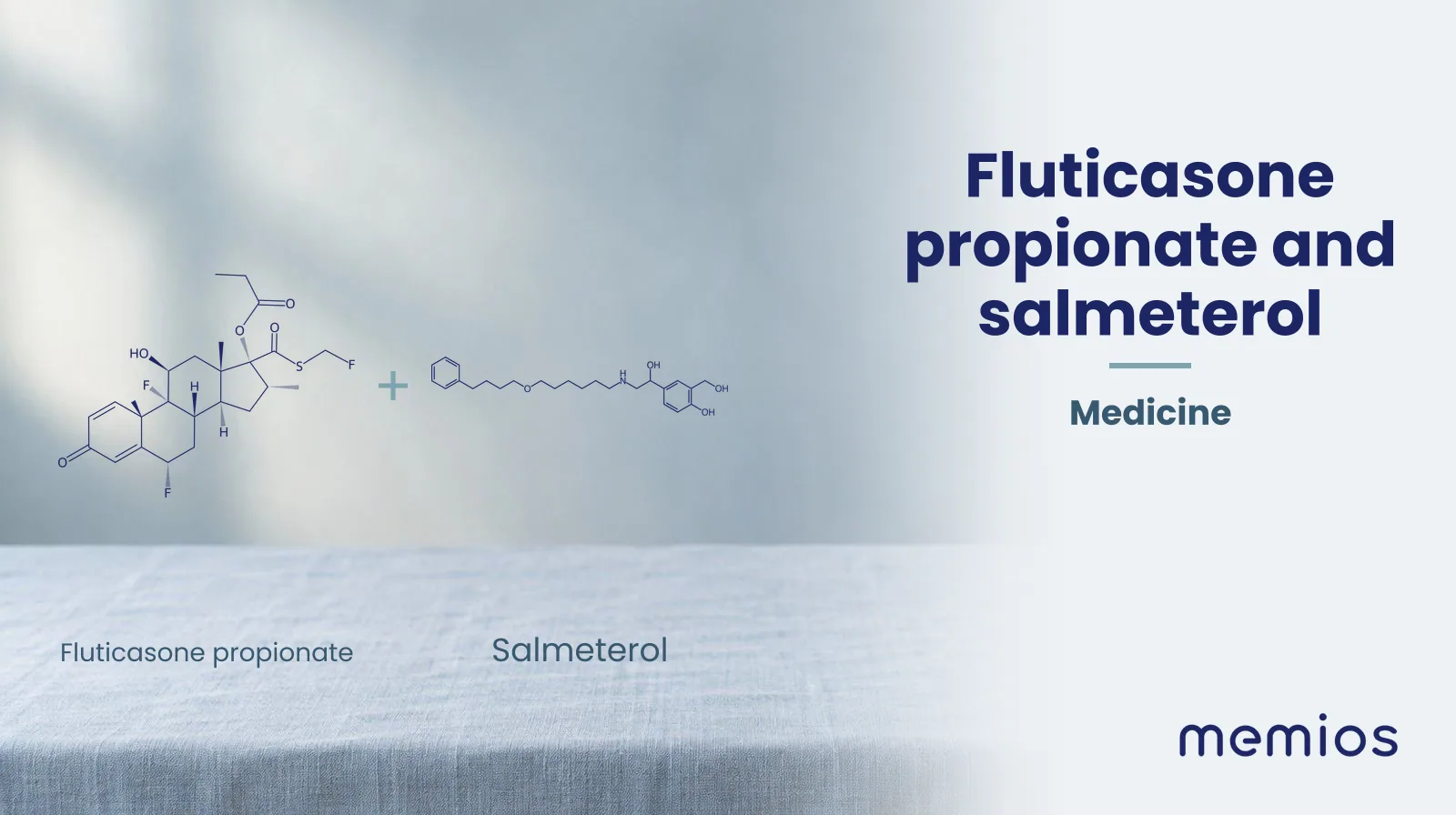
This is an inhaler holding two drugs. Fluticasone propionate is an inhaled corticosteroid (ICS), which reduces inflammation in the airways. Salmeterol is a long-acting beta-2 agonist (LABA), which relaxes airway muscle for about twelve hours. In the United States it is licensed for twice-daily treatment of asthma from age four, and for maintenance treatment of airflow obstruction and reducing exacerbations in COPD.
What the research says
In asthma, adding salmeterol to fluticasone reduced severe exacerbations in a very large safety trial and did not raise serious asthma-related events, and a Cochrane review found no difference in deaths or serious adverse events between salmeterol plus inhaled steroid and inhaled steroid alone (moderate-certainty evidence). That matters because salmeterol used on its own, without an inhaled steroid, increased asthma deaths in the SMART trial - which is why the combination inhaler exists. In COPD, the three-year TORCH trial reduced exacerbations but its mortality result did not reach statistical significance, and pneumonia was clearly more common on the fluticasone-containing arms (19.6% versus 12.3%).
Evidence grade: Well established.
How it works
Drug class: Fixed-dose combination: inhaled corticosteroid (fluticasone propionate) plus long-acting beta-2 agonist (salmeterol)
Fluticasone is a steroid that settles inflammation in the lining of the airways, so they swell and react less. Salmeterol relaxes the muscle wrapped around the airways for about twelve hours, holding them open. Because a long-acting reliever used alone leaves the underlying inflammation untreated, the two are combined in one inhaler. (Source 1)
What it is used for
- In the 26-week AUSTRI safety trial, fewer patients on fluticasone-salmeterol had severe asthma exacerbations than on fluticasone alone (480 of 5,834 versus 597 of 5,845), and the composite serious asthma-event hazard ratio was 1.03 (95% CI 0.64 to 1.66), showing no excess risk. A Cochrane review found no difference in death or serious adverse events with moderate-certainty evidence. Evidence: established. (Source 2)
- In TORCH (6,112 patients, 3 years) the combination cut the annual exacerbation rate from 1.13 to 0.85, but the reduction in all-cause death did not reach statistical significance (12.6% versus 15.2%; HR 0.825, 95% CI 0.681-1.002, P=0.052). Pneumonia was substantially more common on fluticasone-containing treatment. Evidence: established. (Source 3)
Interactions
- Strong CYP3A4 inhibitors - ritonavir, atazanavir, clarithromycin, itraconazole, ketoconazole and others (case reports): These block the enzyme that clears fluticasone, so steroid levels in the blood rise; Cushing's syndrome and adrenal suppression have been reported with ritonavir. (Source 1)
- Strong CYP3A4 inhibitors (label position on co-administration) (label): The label advises against using them together at all, because of both steroid and cardiovascular effects. (Source 1)
- Monoamine oxidase inhibitors and tricyclic antidepressants (label): These can amplify salmeterol's effects on the heart and blood vessels. (Source 1)
- Beta-blockers (including eye drops for glaucoma) (label): They cancel out salmeterol's effect on the airways and can trigger severe airway narrowing. (Source 1)
Stopping it
- The most important stopping-related point in the literature is what must not be stopped: if the inhaled steroid is dropped and the long-acting beta-agonist is continued alone, asthma death risk rises. That is the finding behind the combination product existing at all. (Source 1)
- For people who have been on higher steroid exposure, the label's concern on reducing or withdrawing steroid cover is adrenal insufficiency, because the adrenal glands may not restart quickly. (Source 1)
What goes wrong
Salmeterol taken without an inhaled steroid increased respiratory-related and asthma-related deaths. (Source 4)
- Randomized trial, Moderate certainty.
- Size: 26,355 subjects randomised; trial stopped early by the sponsor.
- Who: people with asthma on their usual therapy, randomised to add salmeterol or placebo.
- How long: 28-week planned treatment period.
- Result: respiratory-related deaths 24 versus 11 (RR 2.16, 95% CI 1.06-4.41); asthma-related deaths 13 versus 3 (RR 4.37, 95% CI 1.25-15.34)
- Funding: GlaxoSmithKline, the manufacturer.
there was a small, significant increase in respiratory-related deaths (24 vs 11; RR, 2.16; 95% CI, 1.06 to 4.41) and asthma-related deaths (13 vs 3; RR, 4.37; 95% CI, 1.25 to 15.34)
The excess deaths in that trial fell disproportionately on African American participants. (Source 4)
- Randomized trial, Low certainty.
- Size: 26,355 subjects; subgroup analysis.
- Who: African American participants within the SMART trial.
- How long: 28 weeks.
- Result: respiratory-related deaths or life-threatening experiences 20 versus 5 (RR 4.10, 95% CI 1.54-10.90); asthma-related deaths or life-threatening experiences 19 versus 4 (RR 4.92, 95% CI 1.68-14.45)
- Funding: manufacturer-funded; this is a subgroup analysis and so is hypothesis-generating.
The imbalance occurred largely in the African-American subpopulation: respiratory-related deaths or life-threatening experiences (20 vs 5; RR, 4.10; 95% CI, 1.54 to 10.90)
Pneumonia was markedly more common on the fluticasone-containing arms of the COPD trial. (Source 3)
- Randomized trial, Moderate certainty.
- Size: 6,112 patients.
- Who: people with COPD.
- How long: 3 years.
- Result: pneumonia reported as an adverse event in 19.6% (combination) and 18.3% (fluticasone) versus 12.3% (placebo), P<0.001 - an absolute excess of about 7 percentage points over three years.
- Funding: GlaxoSmithKline, the manufacturer.
The probability of having pneumonia reported as an adverse event was higher among patients receiving medications containing fluticasone propionate (19.6% in the combination-therapy group and 18.3% in the fluticasone group) than in the placebo group (12.3%, P<0.001
The manufacturer's own COPD trials also showed more pneumonia on the combination than on salmeterol alone. (Source 1)
- Official position, Certainty not rated.
- Size: 1,579 subjects across 2 replicate 1-year trials.
- Who: people with COPD.
- How long: 1 year.
- Result: pneumonia 7% on the combination versus 3% on salmeterol alone.
- Funding: not applicable (manufacturer label reporting manufacturer trials)
In 2 replicate 1-year trials in 1,579 subjects with COPD, there was a higher incidence of pneumonia reported in subjects receiving ADVAIR DISKUS 250/50 (7%) than in those receiving salmeterol 50 mcg (3%).
Inhaled fluticasone can slow growth in children and adolescents. (Source 1)
- Official position, Certainty not rated.
- Size: not given in the passage read.
- Who: children and adolescents using inhaled corticosteroids.
- How long: not stated.
- Result: no magnitude given in the sentence read; the label directs that growth be monitored.
- Funding: not applicable (manufacturer label)
ICS, including fluticasone propionate, a component of ADVAIR DISKUS, may cause a reduction in growth velocity in children and adolescents.
Systemic steroid effects including adrenal suppression can occur in susceptible people. (Source 1)
- Official position, Certainty not rated.
- Size: not given.
- Who: people using inhaled fluticasone, especially at higher doses or with CYP3A4 inhibitors.
- How long: not stated.
- Result: described as occurring in a small number of sensitive patients; no rate given.
- Funding: not applicable (manufacturer label)
It is possible that systemic corticosteroid effects such as hypercorticism and adrenal suppression (including adrenal crisis) may appear in a small number of patients who are sensitive to these effects.
Thrush in the mouth and throat can occur with the inhaled steroid component. (Source 1)
- Official position, Certainty not rated.
- Size: not given in the passage read.
- Who: people using the inhaler.
- How long: not stated.
- Result: no rate in the sentence read; the label's adverse-reaction tables report oral candidiasis at low single-figure percentages in asthma trials.
- Funding: not applicable (manufacturer label)
Candida albicans infection of the mouth and pharynx may occur. Monitor patients periodically.
The reason the two drugs are combined is that a long-acting beta-agonist alone raises the risk of asthma death. (Source 1)
- Official position, Certainty not rated.
- Size: not applicable.
- Who: people with asthma.
- How long: not stated.
- Result: no rate on the label; the underlying trial evidence is SMART.
- Funding: not applicable (manufacturer label)
Use of LABA as monotherapy (without ICS) for asthma is associated with an increased risk of asthma-related death.
What the evidence supports
Adding salmeterol to fluticasone reduced severe asthma exacerbations compared with fluticasone alone. (Source 2)
- Randomized trial, Moderate certainty.
- Size: 11,679 patients (5,834 fluticasone-salmeterol, 5,845 fluticasone)
- Who: adolescents and adults with persistent asthma and a history of exacerbation.
- How long: 26 weeks.
- Result: 480/5834 versus 597/5845 had a severe asthma exacerbation; the letter reports a hazard ratio of 0.78 (95% CI, 0.69 to 0.89; P = 0.0002) by intention to treat.
- Funding: the AUSTRI trial was funded by GlaxoSmithKline, the manufacturer.
Limit of this finding: These numbers were read from a letter to the editor that reports the AUSTRI trial, not from the trial report itself. The letter gives the intention-to-treat hazard ratio for severe asthma exacerbation as 0.78 (95% CI, 0.69 to 0.89); we were unable to reach the New England Journal of Medicine paper or its PubMed abstract to confirm that this matches the figure published there, and a nearby value of 0.79 has been reported elsewhere. Treat 0.78 as the letter's figure. The difference is too small to change what the result means - fewer severe exacerbations on the combination - but the exact figure should not be quoted as AUSTRI's published value.
480 patients out of 5834 in fluticasone-salmeterol and 597 out of 5845 in fluticasone group had SAEx
The same trial found no excess of serious asthma-related events with the combination. (Source 2)
- Randomized trial, Moderate certainty.
- Size: 11,679 patients.
- Who: adolescents and adults with persistent asthma.
- How long: 26 weeks.
- Result: composite serious asthma-related event HR = 1.03 (95% CI 0.64 to 1.66) - the confidence interval is wide, so a modest difference in either direction is not excluded.
- Funding: manufacturer-funded (GlaxoSmithKline), conducted as an FDA-mandated safety trial.
Limit of this finding: This hazard ratio is quoted from a letter to the editor reporting the AUSTRI trial rather than from the trial report itself. The confidence interval, 0.64 to 1.66, is wide, so the result rules out a large excess of serious asthma-related events but not a modest difference in either direction.
HR = 1.03 (95% confidence interval [CI], 0.64 to 1.66)
A Cochrane review found no difference in deaths between regular salmeterol plus inhaled steroid and inhaled steroid alone. (Source 5)
- Systematic review, Moderate certainty.
- Size: 41 studies (27,951 participants) in adults and adolescents, along with eight studies (8453 participants) in children.
- Who: adults and children with chronic asthma.
- How long: varies across included trials.
- Result: 11 deaths of 14,233 adults taking regular salmeterol and ICS versus 13 of 13,718 adults taking regular ICS at the same dose; pooled Peto OR 0.80 (95% CI 0.36 to 1.78; participants = 27,951; studies = 41; I² = 0%; moderate-certainty evidence); non-fatal serious adverse events 332 versus 282, pooled Peto OR 1.14 (95% CI 0.97 to 1.33; participants = 27,951; studies = 41; I² = 0%; moderate-certainty evidence)
- Funding: not stated in the summary read; many included trials were manufacturer-sponsored.
The pooled Peto odds ratio (OR) was 0.80 (95% confidence interval (CI) 0.36 to 1.78; participants = 27,951; studies = 41; I² = 0%; moderate-certainty evidence).
The Cochrane review's plain language summary opens by stating that no difference was found in the risk of death or serious adverse events in either adults or children. (Source 6)
- Systematic review, Moderate certainty.
- Size: as above.
- Who: as above.
- How long: as above.
- Result: see odds ratios above; the review reports no asthma deaths among the children studied, so rare-event risk remains imprecisely estimated.
- Funding: not stated in the summary read.
We did not find a difference in the risk of death or serious adverse events in either adults or children.
In COPD, the combination reduced the yearly exacerbation rate. (Source 3)
- Randomized trial, Moderate certainty.
- Size: 6,112 patients.
- Who: people with COPD.
- How long: 3 years.
- Result: annual rate of exacerbations fell from 1.13 to 0.85 (about one fewer exacerbation every four patient-years)
- Funding: GlaxoSmithKline, the manufacturer.
the combination regimen reduced the annual rate of exacerbations from 1.13 to 0.85
What the evidence does not support
The same COPD trial did not show a statistically significant reduction in death. (Source 3)
- Randomized trial, Moderate certainty.
- Size: 6,112 patients.
- Who: people with COPD.
- How long: 3 years.
- Result: all-cause mortality 12.6% versus 15.2% (absolute difference 2.6 percentage points); HR 0.825 (95% CI 0.681 to 1.002; P=0.052)
- Funding: GlaxoSmithKline, the manufacturer.
The reduction in death from all causes among patients with COPD in the combination-therapy group did not reach the predetermined level of statistical significance.
Where the research disagrees
Whether long-acting beta-agonists are safe in asthma when combined with an inhaled steroid
- SMART investigators (Nelson and colleagues, 2006), large manufacturer-funded randomised placebo-controlled trial of salmeterol added to usual therapy, where most participants were not on an inhaled steroid: There were small, but statistically significant increases in respiratory-related and asthma-related deaths and combined asthma-related deaths or life-threatening experiences in the total population receiving salmeterol. (Source 4)
- Cochrane review (Cates and colleagues, 2018), systematic review of 41 adult/adolescent trials and 8 paediatric trials where the inhaled steroid was given in both arms: We did not find a difference in the risk of death or serious adverse events in either adults or children. (Source 6)
How much
- Reference intake: There is no reference intake for an inhaled prescription medicine; the strength and schedule are set by the prescriber. As a position, the manufacturer's label (DailyMed, revision dated 8/2025) describes twice-daily treatment of asthma in patients aged 4 years and older. (Source 1)
- Upper limit: As a position, the label states that the maximum recommended dosage is ADVAIR DISKUS 500/50 twice daily. (Source 1)
- Studied: The AUSTRI safety trial randomised 11,679 adolescents and adults to fluticasone-salmeterol or fluticasone propionate alone for 26 weeks. (Source 2)
- Studied: TORCH randomised 6,112 patients with COPD for 3 years to the salmeterol-fluticasone combination, either component alone, or placebo. (Source 3)
- Studied: The manufacturer's COPD trials compared ADVAIR DISKUS 250/50 with salmeterol 50 mcg over one year. (Source 1)
A common belief, and what the research shows
The belief: The asthma-death warning that used to be on this inhaler means the combination inhaler itself is dangerous.
What the research shows: The death signal came from salmeterol used without an inhaled steroid. In SMART, "there was a small, significant increase in respiratory-related deaths (24 vs 11; RR, 2.16; 95% CI, 1.06 to 4.41) and asthma-related deaths (13 vs 3; RR, 4.37; 95% CI, 1.25 to 15.34)". When the steroid is given in both arms, the Cochrane review reports: "We did not find a difference in the risk of death or serious adverse events in either adults or children." The current US label carries no boxed warning; it still warns that LABA monotherapy raises asthma-death risk.
Questions and answers
What is it?
It is a single inhaler containing an inhaled steroid (fluticasone propionate) and a long-acting airway opener (salmeterol). It is a maintenance treatment taken twice a day, not a rescue inhaler. It is licensed for asthma from age four and for COPD. (Source 1)
What does it do in the body?
The steroid half calms the inflammation in the airway lining so it swells and reacts less. The salmeterol half relaxes the muscle around the airways for about twelve hours so they stay open. The steroid is essential because the opener on its own leaves the inflammation untreated. (Source 1)
Is it good or bad for you?
In asthma the balance looks favourable: a very large trial found fewer severe flare-ups with the combination than with the steroid alone and no excess of serious asthma events. In COPD the picture is more mixed: fewer exacerbations, no significant mortality benefit, and clearly more pneumonia. (Source 2)
How do you get more of it?
It is prescription-only and the strength is chosen by the prescriber. The label's ceiling is stated as the 500/50 strength twice a day; trials used specific strengths, for example the 250/50 strength in the one-year COPD trials. (Source 1)
If it is harmful, what reduces it?
Where the inhaler causes harm, the countermeasures in the literature are targeted rather than general: watch for pneumonia in COPD, where the absolute excess over three years was about seven people in a hundred, and monitor for thrush and for slowed growth in children. Any reduction is a prescriber's decision, because dropping the steroid while keeping the opener is the dangerous move. (Source 3)
Why might someone be low in it or missing it?
This is not a nutrient, so no one is deficient in it. People do end up not taking it, and the literature's concern with that is specific: if the inhaled steroid stops while a long-acting opener continues, asthma death risk rises, which is the whole reason the two are packaged together. (Source 1)
Which whole foods contain it or feed it?
No food contains or feeds these drugs. Food matters only as an interaction route: drugs and products that block the CYP3A4 enzyme raise fluticasone levels in the blood, which is why strong CYP3A4 inhibitors are not recommended alongside it. (Source 1)
What happens if you do not have it?
In the asthma trial, people on the steroid alone had more severe exacerbations than those on the combination (597 of 5,845 versus 480 of 5,834 over 26 weeks). In COPD, people on placebo had more exacerbations per year than those on the combination, and more deaths, though the death difference did not reach significance. (Source 3)
How can you test for it?
There is no blood test for the inhaler. What gets measured is lung function (spirometry) and exacerbation frequency, and in COPD the thing to look for is pneumonia, which was the clearest harm signal in the long trial. In children, height is tracked because inhaled steroids can slow growth. (Source 1)
References
- US National Library of Medicine, DailyMed (manufacturer label, revision dated 8/2025). ADVAIR DISKUS (fluticasone propionate and salmeterol inhalation powder), for oral inhalation use - prescribing information (DailyMed). 2025. Read the source
- Journal of Respiratory Diseases and Medicine (OA Text); letter by Singh S and Kaur R reporting the AUSTRI trial (Stempel DA et al., N Engl J Med 2016;374:1822-1830, PMID 26949137, DOI 10.1056/NEJMoa1511049). Letter to the editor - serious asthma events with fluticasone plus salmeterol versus fluticasone alone. 2020. DOI 10.15761/JRDM.1000110. Read the source
- The New England Journal of Medicine (Calverley PMA, Anderson JA, Celli B, et al.); abstract read on ichgcp.net clinical trials registry publications. Salmeterol and fluticasone propionate and survival in chronic obstructive pulmonary disease (TORCH). 2007. PMID 17314337, DOI 10.1056/NEJMoa063070. Read the source
- CHEST (Nelson HS, Weiss ST, Bleecker ER, Yancey SW, Dorinsky PM). The Salmeterol Multicenter Asthma Research Trial: a comparison of usual pharmacotherapy for asthma or usual pharmacotherapy plus salmeterol. 2006. PMID 16424409, DOI 10.1378/chest.129.1.15. Read the source
- Cochrane Database of Systematic Reviews (Cates CJ, Schmidt S, Ferrer M, Sayer B, Waterson S). Inhaled steroids with and without regular salmeterol for asthma: serious adverse events (Cochrane review abstract, Main results). 2018. DOI 10.1002/14651858.CD006922.pub4. Read the source
- Cochrane Database of Systematic Reviews (Cates CJ, Schmidt S, Ferrer M, Sayer B, Waterson S). Inhaled steroids with and without regular salmeterol for asthma: serious adverse events (Cochrane plain language summary, Key results). 2018. DOI 10.1002/14651858.CD006922.pub4. Read the source