Medications · September 29, 2026 · Memios · 13 min read
Fluoxetine
Well established. Fluoxetine blocks the reuptake of serotonin by nerve cells.
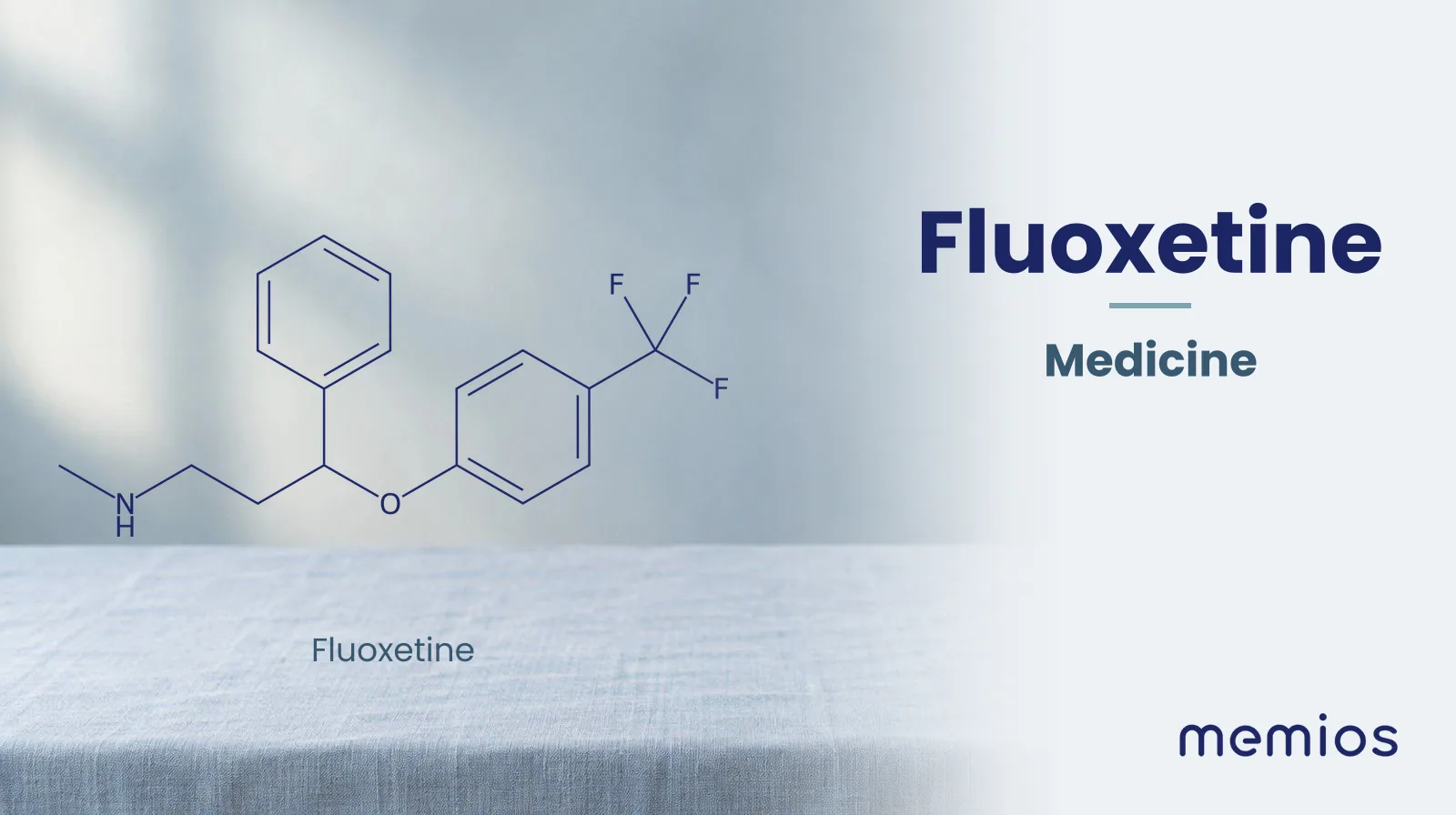
TLDR
- Boxed warning: PROZAC is not approved for use in children less than 7 years of age.
- Well established. Fluoxetine blocks the reuptake of serotonin by nerve cells.
- What it is: Fluoxetine is a prescription antidepressant of the selective serotonin reuptake inhibitor (SSRI) class, sold as Prozac and as generics.
- Main use: Major depressive disorder (adults) (well supported).
- Other approved uses: Obsessive-compulsive disorder (limited evidence); Bulimia nervosa (limited evidence); Panic disorder; bipolar depression and treatment-resistant depression (with olanzapine) (evidence not rated).
- Off-label uses (not on the FDA label): Repetitive/obsessive-compulsive behaviours in autism (children and adolescents) (evidence not rated).
- Uses NOT supported by research: Recovery of function after stroke.
- Recommended dose (official position): Dosing is set by the prescriber. As a position, the 2023 Prozac label says doses above 20 mg/day are given once daily in the morning or split morning and noon.
- Studied dose (a trial dose, not a recommendation): The AFFINITY stroke trial gave 20 mg once daily for 6 months. Findings citing that trial: 1 against, 1 on harm.
- Upper limit: The 2023 Prozac label, as a position, states the maximum should not exceed 80 mg/day.
- What goes wrong: 4 findings on harm. In the stroke trial, bone fractures were about three times as common on fluoxetine as on placebo.
- Interactions: 4 recorded, including St John's wort, Tryptophan and other serotonergic products, Aspirin, NSAIDs, warfarin and other anticoagulants, Drugs cleared by CYP2D6 (e.g. some tricyclics, some antipsychotics).
- Common myth: Stopping an antidepressant like fluoxetine always brings a severe, lasting withdrawal syndrome.
What it is
Fluoxetine is a prescription antidepressant of the selective serotonin reuptake inhibitor (SSRI) class, sold as Prozac and as generics. It and its active breakdown product norfluoxetine stay in the body unusually long: StatPearls gives half-lives of 2 to 4 days for fluoxetine and 7 to 9 days for norfluoxetine.
What the research says
Fluoxetine blocks the reuptake of serotonin by nerve cells. In adult major depression, pooled trials show it does better than placebo, but the average gain is small, and one review questions whether it matters clinically. Trials support its use in bulimia nervosa and OCD. Large trials found it does not improve recovery after stroke and that it raised falls, fractures and seizures. Common side effects include nausea, insomnia, sleepiness and sexual effects. The label carries a boxed warning on suicidal thoughts and behaviours in young people.
Evidence grade: Well established.
How it works
Drug class: Selective serotonin reuptake inhibitor (SSRI) antidepressant
Fluoxetine blocks the serotonin transporter on nerve cells. This stops serotonin being taken back up after release, so more of it stays available at the synapse. It has little effect on noradrenaline reuptake and mild activity at 5-HT2A and 5-HT2C receptors. (Source 1)
Boxed warning
Antidepressants increased the risk of suicidal thoughts and behavior in children, adolescents, and young adults in short-term studies.
(Source 2)
What it is used for
- In a network meta-analysis of 522 trials, every antidepressant studied, fluoxetine included, beat placebo. Fluoxetine had fewer dropouts than placebo but was among the least effective in head-to-head trials. An SSRI-class review found the average benefit fell below its own threshold for clinical significance. Evidence: established. (Source 3)
- An 8-week trial in 214 adults, funded by the manufacturer, found more responders on fluoxetine than on placebo. The effect on the total Y-BOCS score was only marginal. Evidence: limited. (Source 4)
- A 16-week trial of 60 mg/day in 398 randomised patients, run by the manufacturer, found fluoxetine cut vomiting and binge episodes more than placebo. Evidence: limited. (Source 5)
- The label lists these approvals. We did not retrieve the trials for these uses in this run, so no evidence grade is given here. Evidence: unknown. (Source 2)
- The AFFINITY trial randomised 1,280 people. Six months of fluoxetine 20 mg did not improve function, and it raised the rates of falls, fractures and seizures. Evidence: not-supported. (Source 6)
- Off-label. A 2019 randomised trial in children and adolescents with autism exists, but we could not verify its wording, so its findings are held back until they can be checked. Evidence: unknown.
Interactions
- St John's wort (case reports): Taking it with an SSRI can raise serotonin to dangerous levels (serotonin syndrome). The published cases involved sertraline and paroxetine rather than fluoxetine, but the label lists St John's wort among the serotonergic products that raise the risk. (Source 7)
- Tryptophan and other serotonergic products (label): The label lists tryptophan with triptans, tramadol, lithium and others as raising the risk of serotonin syndrome. (Source 2)
- Aspirin, NSAIDs, warfarin and other anticoagulants (label): SSRIs raise bleeding risk, and these drugs add to it. (Source 2)
- Drugs cleared by CYP2D6 (e.g. some tricyclics, some antipsychotics) (label): Fluoxetine strongly blocks the CYP2D6 liver enzyme, which can raise the levels of drugs that depend on it. (Source 2)
Stopping it
- The label reports dizziness, irritability, sensory disturbances ('electric shock' sensations), anxiety and insomnia after stopping SSRIs, especially abruptly. These are usually self-limiting, though serious cases have been reported. (Source 2)
- Because fluoxetine and norfluoxetine leave the body slowly, the drug in effect tapers itself. The label says this may lower the risk of discontinuation symptoms. (Source 2)
- A 2025 meta-analysis of randomised trials found about one extra discontinuation symptom in week 1 after stopping antidepressants, with dizziness the most common. Symptoms usually peak at 1 to 2 weeks, but fluoxetine is the stated exception and was underrepresented in the data. (Source 8)
- In that meta-analysis, stopping was not linked to worse mood. The authors read depression that appears later as relapse, not withdrawal. (Source 8)
What goes wrong
SSRIs raised the rate of serious adverse events from 22 to 31 per 1,000 people. (Source 9)
- Meta-analysis, Low certainty.
- Size: 44 trials.
- Who: Adults with major depressive disorder.
- How long: Acute trials.
- Result: OR 1.37 (95% CI 1.08 to 1.75); 31/1000 versus 22/1000.
- Funding: Independent.
This corresponds to 31/1000 SSRI participants will experience a serious adverse event compared with 22/1000 control participants.
In FDA trial data, antidepressants raised suicidal behaviour in adults under 25. They were neutral or possibly protective at older ages. (Source 10)
- Meta-analysis, Moderate certainty.
- Size: 99,231 adults in 372 trials.
- Who: Adults in antidepressant drug-development trials.
- How long: Short-term trials.
- Result: Suicidal behaviour OR 2.30 (1.04 to 5.09) for under 25; OR 0.06 (0.01 to 0.58) for age 65 and over.
- Funding: FDA analysis of sponsor data.
Compared with placebo, the increased risk for suicidality and suicidal behaviour among adults under 25 approaches that seen in children and adolescents.
In pivotal trials, fluoxetine caused more nausea, insomnia, anxiety and sleepiness than placebo. (Source 2)
- Official position, Certainty not rated.
- Size: Pooled label trials.
- Who: Label placebo-controlled trials.
- How long: Acute trials.
- Result: Label table as transcribed from the fetched page (verify): nausea 22% vs 9%; insomnia 19% vs 10%; anxiety 12% vs 6%; somnolence 12% vs 5%; decreased libido 4% vs 1%.
- Funding: Manufacturer label.
abnormal ejaculation, anorexia, anxiety, asthenia, diarrhea, dry mouth, dyspepsia, flu syndrome, impotence, insomnia, libido decreased, nausea
In the stroke trial, bone fractures were about three times as common on fluoxetine as on placebo. (Source 6)
- Randomized trial, High certainty.
- Size: 1,280 patients.
- Who: Adults after acute stroke.
- How long: 6 months.
- Result: 19 (3%) vs 6 (1%) fractures; p=0.014.
- Funding: Independent.
bone fractures (19 [3%] vs six [1%]; p=0·014), and epileptic seizures (ten [2%] vs two [<1%]; p=0·038) at 6 months
What the evidence supports
Across 522 trials, all 21 antidepressants, fluoxetine included, were more effective than placebo for acute adult depression. Fluoxetine had fewer dropouts than placebo. (Source 3)
- Meta-analysis, Moderate certainty.
- Size: 116,477 participants in 522 trials.
- Who: Adults with major depressive disorder.
- How long: Acute treatment (about 8 weeks)
- Result: All drugs beat placebo, with OR from 1.38 to 2.13; fluoxetine acceptability OR 0.88 versus placebo.
- Funding: Mixed; the review states certainty was moderate to very low.
In terms of efficacy, all antidepressants were more effective than placebo, with OR ranging between 2.13 for amitriptyline and 1.38 for reboxetine.
In bulimia nervosa, fluoxetine 60 mg/day cut vomiting and binge-eating episodes more than placebo over 16 weeks. (Source 5)
- Randomized trial, Moderate certainty.
- Size: 398 randomised (225 completed)
- Who: Adults with bulimia nervosa.
- How long: 16 weeks.
- Result: Vomiting F=14.73, P<0.0001; binge-eating F=14.39, P=0.0002.
- Funding: Industry (authors from the manufacturer's research group)
Compared with placebo, fluoxetine treatment resulted in significantly greater reductions in vomiting (F 1,360 = 14.73, P< 0.0001)
In OCD, more patients responded on fluoxetine than on placebo over 8 weeks. (Source 4)
- Randomized trial, Low certainty.
- Size: 214 patients.
- Who: Adults with OCD.
- How long: 8 weeks plus 16-week extension.
- Result: Higher response at 40 and 60 mg/day (P<0.05); Y-BOCS change marginal.
- Funding: Industry (Lilly European OCD Study Group)
A statistically significantly greater number of fluoxetine-treated patients achieved the prospectively defined criteria for clinical response when compared to placebo treatment.
What the evidence does not support
In head-to-head trials, fluoxetine was among the least effective antidepressants. (Source 3)
- Meta-analysis, Low certainty.
- Size: 522 trials.
- Who: Adults with major depressive disorder.
- How long: Acute treatment.
- Result: OR range 0.50-0.89 for fluoxetine, reboxetine and trazodone against other drugs.
- Funding: Not stated in the abstract read.
while fluoxetine, reboxetine and trazodone were the least efficacious drugs (OR range: 0.50-0.89)
SSRIs as a class lowered depression scores by about 2 points on a 52-point scale. That is below the review's own 3-point threshold for clinical significance, and all trials were at high risk of bias. (Source 9)
- Meta-analysis, Low certainty.
- Size: 27,422 participants in 131 trials.
- Who: Adults with major depressive disorder.
- How long: Acute trials.
- Result: Mean difference -1.94 HDRS points (95% CI -2.50 to -1.37)
- Funding: Independent (Copenhagen Trial Unit)
The effect estimate, however, was below our predefined threshold for clinical significance of 3 HDRS points.
Fluoxetine 20 mg for 6 months after stroke did not improve function. It raised falls, fractures and seizures. (Source 6)
- Randomized trial, High certainty.
- Size: 1,280 patients.
- Who: Adults 2-15 days after acute stroke.
- How long: 6 months.
- Result: Common OR 0.94 (0.76-1.15) for function; fractures 3% vs 1%; falls 3% vs 1%; seizures 2% vs <1%.
- Funding: Independent (NHMRC Australia)
Oral fluoxetine 20 mg daily for 6 months after acute stroke did not improve functional outcome and increased the risk of falls, bone fractures, and epileptic seizures.
Where the evidence is mixed
A 30-year review found only moderate benefit of antidepressants over placebo in acute depression, with newer drugs showing smaller gaps than tricyclics. (Source 11)
- Meta-analysis, Certainty not rated.
- Size: Placebo-controlled trials over three decades.
- Who: Adults with acute unipolar major depression.
- How long: Acute.
- Result: Drug-placebo differences moderate.
- Funding: Not stated in the abstract read.
Study findings generally support moderate efficacy of clinically employed antidepressants for acute major depression
Where the research disagrees
Whether the benefit of SSRIs such as fluoxetine in depression is clinically meaningful
- Cipriani et al. 2018 network meta-analysis, Network meta-analysis of 522 trials: All antidepressants were more efficacious than placebo in adults with major depressive disorder. (Source 3)
- Jakobsen et al. 2017 (Copenhagen Trial Unit), Meta-analysis of 131 placebo-controlled SSRI trials: The potential small beneficial effects seem to be outweighed by harmful effects. (Source 9)
How much
- Reference intake: Dosing is set by the prescriber. As a position, the 2023 Prozac label says doses above 20 mg/day are given once daily in the morning or split morning and noon. (Source 2)
- Upper limit: The 2023 Prozac label, as a position, states the maximum should not exceed 80 mg/day. (Source 2)
- Studied: The AFFINITY stroke trial gave 20 mg once daily for 6 months. (Source 6)
- Studied: The 16-week bulimia trial gave 60 mg/day. (Source 5)
A common belief, and what the research shows
The belief: Stopping an antidepressant like fluoxetine always brings a severe, lasting withdrawal syndrome.
What the research shows: A 2025 meta-analysis found 'the mean number of discontinuation symptoms at week 1 after stopping antidepressants was below the threshold for clinically significant discontinuation syndrome'. The Prozac label says the slow fall in fluoxetine levels 'may minimize the risk of discontinuation symptoms', and it also notes that serious discontinuation symptoms have been reported.
Questions and answers
What is it?
Fluoxetine is a prescription SSRI antidepressant, sold as Prozac and as generics. It works by blocking the protein that pulls serotonin back into nerve endings. (Source 1)
What does it do in the body?
It leaves more serotonin at the gaps between nerve cells. Because it and its active metabolite stay in the body for days to weeks, dose changes take weeks to settle. (Source 2)
Is it good or bad for you?
It depends on the use. In adult depression, trials show a benefit over placebo that is real but small. In stroke recovery it did not help and caused harm. It increases suicidal thoughts and behaviour in people under 25 and raises serious adverse events in trials overall. (Source 9)
How do you get more of it?
Does not apply as a nutrient would. Fluoxetine is a prescription drug, and a prescriber sets the dose within the label's range. (Source 2)
If it is harmful, what reduces it?
The drug leaves the body slowly after the last dose, over several weeks. The label recommends stopping with the prescriber's supervision, and SSRI withdrawal symptoms have been reported, especially after abrupt stops. (Source 2)
Why might someone be low in it or missing it?
Does not apply. Fluoxetine is a synthetic drug, not something the body makes or needs, so no one is deficient in it. (Source 1)
We searched: Searched the label and pharmacology review for any natural source or deficiency state; none exists for a synthetic drug.
Which whole foods contain it or feed it?
Does not apply. No food contains fluoxetine. The relevant diet question is interactions: the label lists tryptophan and St John's wort as serotonergic products that raise serotonin syndrome risk. (Source 2)
We searched: Searched the label and interaction literature for food sources; none exist.
What happens if you do not have it?
Not taking it is the normal state. The question is whether an untreated condition, such as depression, is better managed with it or without it. For people under 25 the label warns of increased suicidal thinking early in treatment, and for people 65 and over trials showed lower risk. (Source 2)
How can you test for it?
No routine test is used to guide fluoxetine treatment in the sources we read. Response is judged clinically. (Source 1)
We searched: Searched the Prozac label and StatPearls for therapeutic drug monitoring or blood-level testing; neither recommends a routine blood test.
References
- StatPearls Publishing, NCBI Bookshelf. Fluoxetine (StatPearls). undated (continuously updated). Read the source
- US National Library of Medicine DailyMed (FDA-approved label). PROZAC (fluoxetine) capsules, prescribing information (Dista/Lilly), DailyMed. 2023. Read the source
- The Lancet (repository copy, University of Bristol). Comparative efficacy and acceptability of 21 antidepressant drugs for the acute treatment of adults with major depressive disorder: a systematic review and network meta-analysis. 2018. DOI 10.1016/S0140-6736(17)32802-7. Read the source
- European Neuropsychopharmacology. A double-blind, placebo-controlled study of fluoxetine in patients with DSM-III-R obsessive-compulsive disorder (Lilly European OCD Study Group). 1993. DOI 10.1016/0924-977X(93)90266-O. Read the source
- The British Journal of Psychiatry. Long-term fluoxetine treatment of bulimia nervosa. 1995. DOI 10.1192/bjp.166.5.660. Read the source
- The Lancet Neurology. Safety and efficacy of fluoxetine on functional outcome after acute stroke (AFFINITY): a randomised, double-blind, placebo-controlled trial. 2020. DOI 10.1016/S1474-4422(20)30207-6. Read the source
- European Psychiatry. The Effects of St. John's Wort and its Interactions with SSRI's (conference abstract). 2025. DOI 10.1192/j.eurpsy.2025.2087. Read the source
- UCL Discovery repository (accepted manuscript; published in JAMA Psychiatry). Incidence and nature of antidepressant discontinuation symptoms: A systematic review and meta-analysis (accepted manuscript). 2025. Read the source
- BMC Psychiatry. Selective serotonin reuptake inhibitors versus placebo in patients with major depressive disorder. A systematic review with meta-analysis and Trial Sequential Analysis. 2017. DOI 10.1186/s12888-016-1173-2. Read the source
- BMJ. Risk of suicidality in clinical trials of antidepressants in adults: analysis of proprietary data submitted to US Food and Drug Administration. 2009. DOI 10.1136/bmj.b2880. Read the source
- Neuropsychopharmacology. Randomized, Placebo-Controlled Trials of Antidepressants for Acute Major Depression: Thirty-Year Meta-Analytic Review. 2012. DOI 10.1038/npp.2011.306. Read the source