Supplements · September 29, 2026 · Memios · 25 min read
Feverfew
Limited evidence. The evidence is thin and Cochrane rates it low quality.
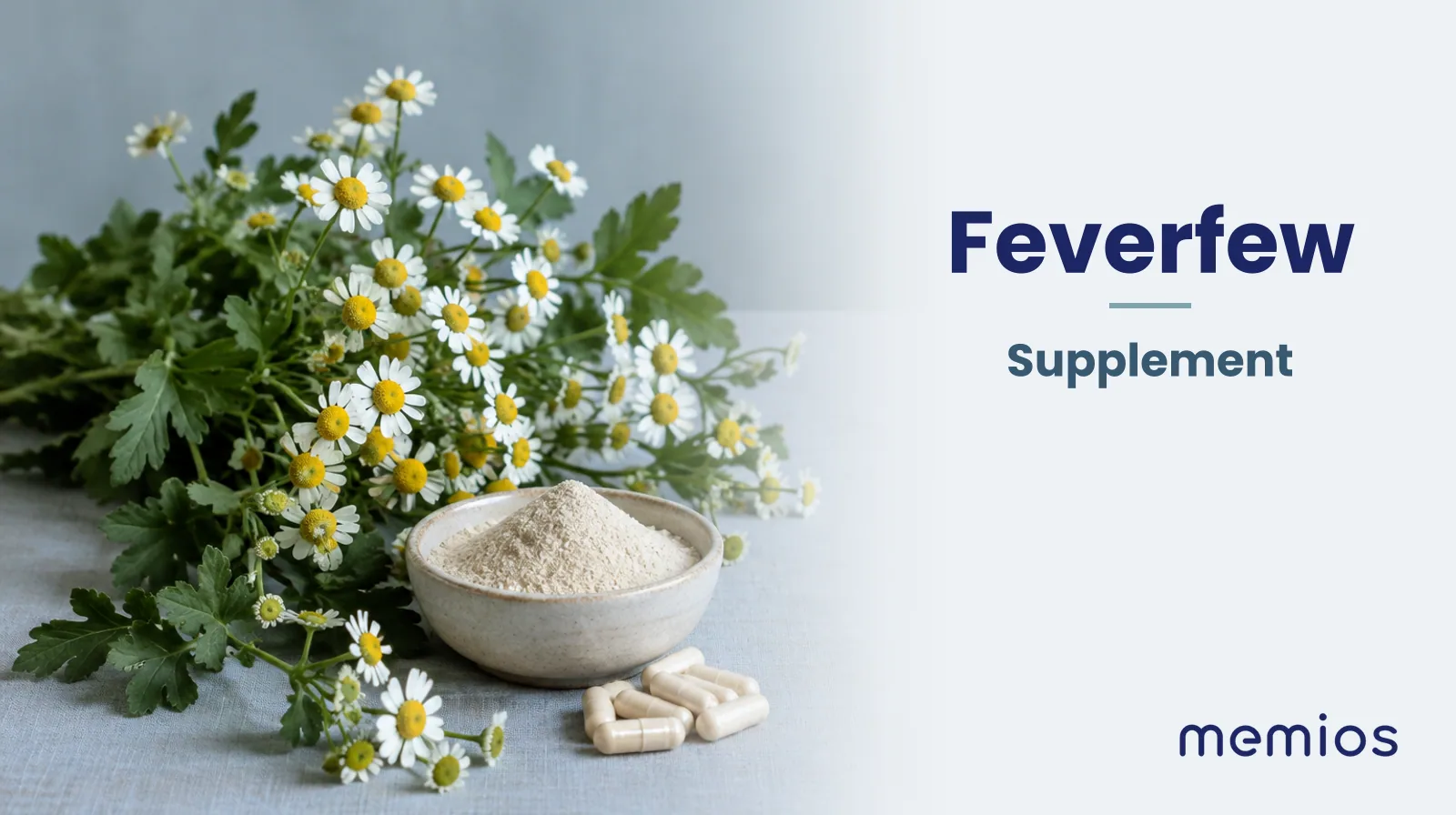
TLDR
- Limited evidence. The evidence is thin and Cochrane rates it low quality.
- What it is: Feverfew is a plant in the daisy family whose dried leaf, or an extract of it, is taken to prevent migraine.
- Main use, supported: In the largest and most rigorous trial included in the Cochrane review, feverfew reduced migraine frequency by 0.6 attacks per month more than placebo. (low certainty)
- Claim NOT supported by research: Two earlier rigorous trials found no significant difference between feverfew and placebo, and the three trials reporting positive effects were all small. (low certainty)
- Another claim NOT supported: On every outcome other than attack frequency, including pain intensity, attack duration, nausea and vomiting and global assessment, no statistically significant differences were reported. (low certainty)
- Recommended dose: not established. No reference intake exists: feverfew is a herbal preparation, not a nutrient. A case-report review notes only that short-term use of up to four months is considered safe in adults.
- Studied dose (a trial dose, not a recommendation): One safety study gave 50 mg a day, roughly equivalent to two leaves, for six months. No finding here cites that trial.
- Upper limit: No upper limit or acceptable daily intake was located.
- What goes wrong: 11 findings on harm. A professional natural-products monograph reports that in a larger series of feverfew users, 18% reported adverse effects, the most serious being mouth ulceration in 11%.
- Common myth: Feverfew is a proven migraine preventive, so it can be relied on like a licensed drug.
What it is
Feverfew is a plant in the daisy family whose dried leaf, or an extract of it, is taken to prevent migraine. Its chemistry is well characterised: the main biologically active constituents are sesquiterpene lactones, principally parthenolide, which sits in the superficial leaf glands at 0.2 to 0.5 per cent and not in the stems. More than thirty sesquiterpene lactones have been identified in the plant. The name comes from the Latin febrifugia, meaning fever reducer.
What the research says
The evidence is thin and Cochrane rates it low quality. Six placebo-controlled trials in 561 people could not be pooled; the single largest and most rigorous trial found feverfew cut migraine frequency by about 0.6 attacks a month more than placebo, while intensity, duration, nausea and vomiting showed no statistically significant difference. Two earlier rigorous trials found no difference at all, and the three positive ones were small. Cochrane says feverfew is not associated with major safety concerns, but a case series of users reported adverse effects in 18 per cent, mouth ulceration in 11 per cent, a withdrawal syndrome after long use, and one published case links it to abnormal clotting tests and vaginal bleeding.
Evidence grade: Limited evidence.
What goes wrong
Position: NCCIH states that feverfew may slow blood clotting and should be stopped at least two weeks before scheduled surgery. (Source 1)
- Official position, Certainty not rated.
- Size: not applicable.
- Who: US public.
- How long: not applicable.
- Result: Advice to stop at least 2 weeks before surgery; page last updated February 2025.
- Funding: independent (US government agency)
Feverfew may slow blood clotting and should be stopped at least 2 weeks before scheduled surgery.
A professional natural-products monograph reports that in a larger series of feverfew users, 18% reported adverse effects, the most serious being mouth ulceration in 11%. (Source 2)
- Expert review, not systematic, Low certainty.
- Size: a larger series of feverfew users; the monograph does not state the number.
- Who: people taking feverfew, the monograph's context being migraine prophylaxis.
- How long: not stated.
- Result: 18% reported adverse effects; mouth ulceration in 11%, with inflammation of the oral mucosa and tongue, lip swelling and loss of taste described.
- Funding: not stated.
Limit of this finding: The 18% and 11% figures come from a tertiary clinical monograph (Drugs.com professional natural products), not from the survey that produced them. The monograph does not name that survey, or give its size, design or date, and the primary source behind the figures could not be reached while this entry was written. Read the numbers as a sign that mouth ulceration is a recognised reaction to feverfew, not as a measured rate you can rely on.
In a larger series of feverfew users, 18% reported adverse effects, the most serious being mouth ulceration (11%). Feverfew can induce widespread inflammation of the oral mucosa and tongue, often with lip swelling and loss of taste.
A case report describes a 36-year-old woman with migraine who developed vaginal bleeding, a prolonged menstrual cycle and markedly prolonged clotting times while taking high-dose feverfew. (Source 3)
- Case report, Very low certainty.
- Size: 1 patient.
- Who: 36-year-old woman with chronic migraine, no chronic disease, blood disorder or polycystic ovary syndrome.
- How long: feverfew 800 mg twice daily for 6 months then 800 mg three times daily; symptoms present for 3 months before she attended the clinic.
- Result: prothrombin time 27.3 s, partial thromboplastin time 42 s and haemoglobin 10 g/dL at presentation; gynaecological examination and biopsies were normal.
- Funding: not stated.
The laboratory results showed a normal complete blood count (CBC) but a low hemoglobin level of 10 g/dL, a partial thromboplastin time (PTT) of 42 s, a prothrombin time (PT) of 27.3 s, a negative urine pregnancy test and no serum beta human chorionic gonadotropin (hCG).
The authors of that case report applied the Naranjo causality scale and rated the reaction probably caused by feverfew. (Source 4)
- Case report, Very low certainty.
- Size: 1 patient.
- Who: the same 36-year-old woman with migraine.
- How long: causality assessed after feverfew was stopped and the coagulation profile recovered.
- Result: Naranjo score in the 5 to 8 band, which the authors state indicates a probable adverse drug reaction.
- Funding: not stated.
We applied this algorithm in our case. The causality rating for feverfew fell within the range of 5 - 8, which indicates a probable ADR.
A professional natural-products monograph lists no well-documented interactions for feverfew but flags potential interactions with anticoagulant and antiplatelet agents and herbs, non-steroidal anti-inflammatory agents, salicylates and thrombolytics. (Source 5)
- Expert review, not systematic, Very low certainty.
- Size: not applicable; a monograph statement, not a study.
- Who: people taking feverfew alongside blood-thinning or anti-inflammatory medicines, and people due to have surgery.
- How long: not applicable.
- Result: no quantified interaction effect is reported; the monograph describes the interactions as potential rather than documented.
- Funding: not stated.
Limit of this finding: This is a statement in a tertiary clinical monograph, not a finding from an interaction study. The monograph itself calls these interactions potential, and no primary source behind them was reached while this entry was written. It does not show that feverfew has caused bleeding with these medicines, and it does not show that it is safe to combine them.
Potential drug interactions may occur with coadministration of agents or herbs with anticoagulant/antiplatelet properties, nonsteroidal anti-inflammatory agents, salicylates, or thrombolytic agents.
The same monograph states that no studies of chronic toxicity of feverfew have been performed and that the safety of long-term use has not been established. (Source 6)
- Expert review, not systematic, Low certainty.
- Size: not applicable; a statement about the absence of studies.
- Who: long-term feverfew users.
- How long: long-term use is the gap identified.
- Result: no chronic-toxicity data exist, so long-term safety is unquantified.
- Funding: not stated.
Limit of this finding: This is a statement in a tertiary clinical monograph rather than a primary study, and the primary literature behind it was not reached while this entry was written. It records an absence of long-term safety studies, which is not the same thing as evidence that long-term use is safe.
No studies of chronic toxicity have been performed. The safety of long-term use has not been established.
A Cochrane systematic review of six trials in 561 people reports that the adverse events seen in feverfew trials were only mild and transient, most commonly gastrointestinal complaints and mouth ulcers. (Source 7)
- Systematic review, Low certainty.
- Size: 561 participants across 6 randomised trials.
- Who: adults with migraine taking feverfew for migraine prevention in randomised placebo-controlled trials.
- How long: trials of varying length; the review searched the literature to January 2015.
- Result: no per-event rates are given; the review records mouth ulcers and gastrointestinal complaints as the most common adverse events and reports no major adverse effects.
- Funding: not stated.
Limit of this finding: The Cochrane page's own sentence carrying the migraine-frequency numbers is garbled: it reads "by 1.3 from to 4.8 to 3.5 per month", with a stray "from to". That is a typo on the published page, not a transcription error here. What the surrounding text does establish is that in the one large trial feverfew cut attacks from 4.8 to 2.9 a month and placebo from 4.8 to 3.5, a difference of 0.6 attacks a month. What it does not establish is anything pooled across the six trials: the review says their outcome measures and designs differed too much to combine, so the adverse-event picture quoted here is a description of what the trials reported, not a rate.
Only mild and transient adverse events, most commonly gastrointestinal complaints and mouth ulcers, were reported in the included trials.
A systematic review of feverfew trials reports that mouth ulceration and gastrointestinal symptoms were the most frequent adverse effect, and were also experienced by long-term feverfew users. (Source 8)
- Systematic review, Low certainty.
- Size: the randomised controlled trials included in the review; the review gives no pooled participant total for adverse effects.
- Who: participants in randomised trials of feverfew, and long-term feverfew users described in the reference texts the review consulted.
- How long: not stated for the adverse-effect data.
- Result: no percentage is given; mouth ulceration and gastrointestinal symptoms are named as the most frequent adverse effect, described as generally mild and reversible.
- Funding: not stated.
Mouth ulceration and gastrointestinal symptoms were the most frequent adverse effect, also experienced by long-term feverfew users.
The same systematic review records a post-feverfew syndrome of rebound migraine, anxiety, insomnia and muscle and joint stiffness reported by long-term consumers after stopping feverfew. (Source 8)
- Systematic review, Low certainty.
- Size: not stated in the review.
- Who: long-term feverfew consumers who discontinued it.
- How long: after long-term consumption; the review gives no duration.
- Result: rebound of migraine symptoms, anxiety, insomnia, and muscle and joint stiffness; no frequency or number of affected people is reported.
- Funding: not stated.
A "post feverfew syndrome" including a rebound of migraine symptoms, anxiety, insomnia, and muscle and joint stiffness was reported by long-term consumers after discontinuation of feverfew.
A 1983 dermatology report of a single patient describes delayed hypersensitivity brought on by repeated skin contact with a wild form of feverfew, with parthenolide named as the responsible contact allergen. (Source 9)
- Case report, Very low certainty.
- Size: 1 patient.
- Who: one person with repeated skin contact with a wild form of Tanacetum parthenium.
- How long: after repeated contact; not further specified.
- Result: specific delayed hypersensitivity; parthenolide content in the flowers investigated was 0.6-0.9%, about 10 times greater than in earlier years.
- Funding: not stated.
Limit of this finding: This is one patient in one 1983 report. It shows that skin contact with feverfew can set off an allergic reaction in a susceptible person. It gives no rate and no denominator, so nothing in it says how common such a reaction is among people who handle or take feverfew.
A case of specific, delayed hypersensitivity induced by repeated contact with a wild form of feverfew (Tanacetum parthenium) is reported.
In the same paper, sensitisation experiments in guinea pigs confirmed the strong sensitising potency of feverfew, and cross-reactions in those animal experiments were elicited with 11 of 21 mostly Compositae plants containing chemically related sesquiterpene lactones. (Source 9)
- Animal study, Very low certainty.
- Size: guinea pigs; the abstract does not state how many animals were used.
- Who: guinea pigs sensitised experimentally, not people.
- How long: not stated.
- Result: cross-reactions elicited with 11 of 21 plants tested, not 11 of 21 people; the strongest reactions were elicited by tansy, yarrow (milfoil), marguerite, aster, sunflower, laurel and Frullania.
- Funding: not stated.
Limit of this finding: These results come from guinea pigs, not from people. The 11 of 21 counts plants tested for cross-reaction in those animal experiments; it is not a proportion of anyone who reacted, and it cannot be read as a human risk.
Guinea pig experiments confirm the strong sensitizing potency of this Compositae species. Cross-reactions were elicited with 11 of 21 mostly Compositae plants containing chemically related sesquiterpene lactones.
What the evidence supports
In the largest and most rigorous trial included in the Cochrane review, feverfew reduced migraine frequency by 0.6 attacks per month more than placebo. (Source 10)
- Systematic review, Low certainty.
- Size: 218 patients in the largest trial, within 6 trials and 561 patients overall.
- Who: adults with migraine.
- How long: not stated in the review abstract.
- Result: Feverfew reduced attacks from 4.8 to 2.9 per month (a fall of 1.9) and placebo from 4.8 to 3.5 (a fall of 1.3), a between-group difference of 0.6 attacks per month.
- Funding: not stated.
It reports that feverfew reduced migraine frequency by 1.9 attacks from 4.8 to 2.9 and placebo by 1.3 from to 4.8 to 3.5 per month, resulting in a difference in effect between feverfew and placebo of 0.6 attacks per month.
What the evidence does not support
Two earlier rigorous trials found no significant difference between feverfew and placebo, and the three trials reporting positive effects were all small. (Source 10)
- Systematic review, Low certainty.
- Size: two null trials of 50 and 147 patients; three positive trials of 17 to 60 patients.
- Who: adults with migraine.
- How long: not stated in the review abstract.
- Result: No significant differences between feverfew and placebo in the two rigorous trials.
- Funding: not stated.
Results of previous trials are not convincing: three trials reporting positive effects of feverfew are all of small sample size (17 to 60 participants), while two rigorous trials (n = 50, 147) did not find significant differences between feverfew and placebo.
On every outcome other than attack frequency, including pain intensity, attack duration, nausea and vomiting and global assessment, no statistically significant differences were reported. (Source 10)
- Systematic review, Low certainty.
- Size: 6 trials, 561 patients.
- Who: adults with migraine.
- How long: not stated.
- Result: No statistically significant differences for intensity, duration, incidence and severity of nausea and vomiting, or global assessment.
- Funding: not stated.
For the secondary outcome measures intensity and duration of migraine attacks, incidence and severity of nausea and vomiting, and global assessment no statistically significant differences were reported.
Where the evidence is mixed
Cochrane graded the overall evidence for feverfew in migraine prevention as low quality and said larger rigorous trials with stable extracts are needed before firm conclusions can be drawn. (Source 11)
- Systematic review, Low certainty.
- Size: 6 trials, 561 patients.
- Who: patients of any age with migraine.
- How long: search to January 2015.
- Result: Only a 0.6 attacks per month difference, rated low quality evidence.
- Funding: independent (Cochrane)
However, this constitutes low quality evidence, which needs to be confirmed in larger rigorous trials with stable feverfew extracts and clearly defined migraine populations before firm conclusions can be drawn.
Cochrane judged every included trial to be at unclear or high risk of bias with respect to sample size, and could not pool the results. (Source 10)
- Systematic review, Low certainty.
- Size: 6 trials, 561 patients.
- Who: adults with migraine.
- How long: search to January 2015.
- Result: Five of six trials generally of good methodological quality but all at unclear or high risk of bias for sample size; pooling impossible because of heterogeneity.
- Funding: independent (Cochrane)
Although five of the trials were generally of good methodological quality, all studies were either of unclear or high risk of bias with regards to sample size.
Position: NCCIH describes the migraine research as mixed and says there is not enough evidence for other conditions. (Source 12)
- Official position, Certainty not rated.
- Size: not applicable.
- Who: US public.
- How long: not applicable.
- Result: Mixed results for migraine prevention; insufficient evidence for other uses; page last updated February 2025.
- Funding: independent (US government agency)
Some research suggests that feverfew may help prevent migraine headaches, but results have been mixed.
The same Cochrane review rates the efficacy evidence low quality and states that, on the data reviewed, feverfew is not associated with any major safety concerns. (Source 13)
- Systematic review, Low certainty.
- Size: 561 participants across 6 randomised trials.
- Who: adults with migraine in randomised placebo-controlled trials of feverfew.
- How long: review searched to January 2015.
- Result: difference in effect between feverfew and placebo of 0.6 attacks per month, graded low quality evidence; no major safety concerns identified in the reviewed data.
- Funding: not stated.
Limit of this finding: The 0.6 attacks a month figure comes from one trial, not from pooling the six: the review states that the included studies were too different in outcome measures, participants and designs to combine. In the review's Main results the sentence holding the underlying numbers is garbled on the published Cochrane page, reading "by 1.3 from to 4.8 to 3.5 per month" with a stray "from to". That is the page's own typo. The placebo change from 4.8 to 3.5 and the 0.6 difference are still readable from it, but a reader should not treat that sentence as carefully worded, and the authors themselves grade the whole efficacy finding low quality evidence.
However, this constitutes low quality evidence, which needs to be confirmed in larger rigorous trials with stable feverfew extracts and clearly defined migraine populations before firm conclusions can be drawn. It appears from the data reviewed that feverfew is not associated with any major safety concerns.
In the trials that systematic review examined, three withdrawals for adverse effects occurred in the feverfew groups against five in the placebo groups, and the post-feverfew syndrome was described after previous feverfew takers were allocated to placebo. (Source 14)
- Systematic review, Low certainty.
- Size: the randomised controlled trials of feverfew included in the review.
- Who: trial participants taking feverfew or placebo for migraine.
- How long: the trial periods; not separately stated for withdrawals.
- Result: 3 withdrawals for adverse effects on feverfew versus 5 on placebo; feverfew did not appear to affect blood pressure, heart rate, body weight or haematological and biochemical safety parameters.
- Funding: not stated.
In total, three withdrawals were necessitated by adverse effects in the feverfew groups compared with five in the placebo groups. A "post-feverfew syndrome" has been described after allocating patients who previously were taking feverfew to placebo treatment.
In the largest randomised trial of a stable feverfew CO2 extract, adverse events judged at least possibly related to the study medication occurred in 9 of 107 patients (8.4 per cent) on feverfew and 11 of 108 (10.2 per cent) on placebo, a difference that was not statistically significant; those denominators come from the trial's 215-patient safety population, not from the 170 patients in the intention-to-treat efficacy analysis. (Source 15)
- Randomized trial, Moderate certainty.
- Size: 170 patients in the intention-to-treat analysis (MIG-99 n = 89, placebo n = 81); 215 patients in the safety analysis.
- Who: patients with migraine meeting International Headache Society criteria, in a multicentre double-blind placebo-controlled trial.
- How long: 16 weeks of treatment after a 4-week baseline period.
- Result: adverse events possibly related to study medication 9/107 (8.4%) with MIG-99 versus 11/108 (10.2%) with placebo, P = 0.654, in the 215-patient safety population; the efficacy numbers in the same abstract (a fall of 1.9 attacks a month on MIG-99 versus 1.3 on placebo, P = 0.0456) belong instead to the 170-patient intention-to-treat population.
- Funding: industry-funded: the paper states the design, conduct and data analysis were supported by a grant from Schaper & Bruemmer, the manufacturer of MIG-99.
Limit of this finding: This trial reports its numbers against two different groups of people. The 8.4 per cent and 10.2 per cent are 9 of 107 and 11 of 108 patients in the safety population of 215. The trial's efficacy figures come from a different, smaller group, the 170 patients in the intention-to-treat analysis. The two sets of percentages are not describing the same denominator and should not be compared as if they were.
Adverse events possibly related to study medication were 9/107 (8.4%) with MIG-99 and 11/108 (10.2%) with placebo (P = 0.654).
Among the 215 patients available for that trial's safety analysis, 27 feverfew-treated patients (25.2 per cent) and 32 placebo-treated patients (26.6 per cent) experienced adverse events of any kind, with gastrointestinal complaints the most frequent. (Source 16)
- Randomized trial, Moderate certainty.
- Size: 215 patients available for the safety analysis.
- Who: patients with migraine randomised to feverfew CO2 extract 6.25 mg three times daily or placebo.
- How long: 16 weeks of double-blind treatment.
- Result: of the 215 patients in the safety analysis, 27 MIG-99-treated (25.2%) and 32 placebo-treated (26.6%) had adverse events; 106 adverse events in total, 56 on MIG-99 and 50 on placebo; gastrointestinal complaints most frequent (MIG-99 N = 4, placebo N = 7, P = 0.361); the related-adverse-event analysis in the same paper uses denominators of 107 and 108 within that safety population.
- Funding: industry-funded: supported by a grant from Schaper & Bruemmer, the manufacturer of MIG-99.
Limit of this finding: Every number in this finding belongs to the trial's 215-patient safety population, which is larger than the 170 patients in its intention-to-treat efficacy analysis. The percentages are the paper's own: 25.2 per cent and 26.6 per cent are printed in the source and have not been recomputed here.
Twenty-seven MIG-99-treated (25.2%) and 32 placebo-treated patients (26.6%) experienced AEs in the double-blind treatment phase.
Where the research disagrees
Whether feverfew carries a meaningful safety concern
- Cochrane review authors (2015), systematic review of six placebo-controlled trials: It appears from the data reviewed that feverfew is not associated with any major safety concerns. (Source 11)
- Authors of a 2021 case report in Journal of Medical Cases, single case report with Naranjo causality assessment: Feverfew should be used cautiously by patients planning elective surgery, having coagulant disorders or taking antithrombotic drugs. (Source 17)
How much
- Reference intake: No reference intake exists: feverfew is a herbal preparation, not a nutrient. A case-report review notes only that short-term use of up to four months is considered safe in adults. (Source 17)
- Upper limit: No upper limit or acceptable daily intake was located. A systematic review of the plant states that no chronic toxicity studies have been done and long-term safety is not established. (Source 18)
- Studied: One safety study gave 50 mg a day, roughly equivalent to two leaves, for six months. (Source 18)
- Studied: The largest Cochrane-included trial (n = 218) used a stable feverfew extract at a dose set by an earlier dose-finding trial. (Source 10)
- Studied: The published bleeding case involved 800 mg capsules taken three times a day for nine months. (Source 17)
A common belief, and what the research shows
The belief: Feverfew is a proven migraine preventive, so it can be relied on like a licensed drug.
What the research shows: Cochrane's conclusion is far weaker than that. The benefit rests on one trial and amounts to "a difference in effect between feverfew and placebo of 0.6 attacks per month", while "this constitutes low quality evidence, which needs to be confirmed in larger rigorous trials with stable feverfew extracts and clearly defined migraine populations before firm conclusions can be drawn." Earlier work points the other way: "two rigorous trials (n = 50, 147) did not find significant differences between feverfew and placebo."
Questions and answers
What is it?
Feverfew is a small, bushy, aromatic perennial plant in the daisy (Asteraceae) family. It grows roughly 0.3 to 1 metre tall, with yellow-green, almost hairless, chrysanthemum-like leaves and small daisy-like flower heads. It is native to the Balkan Peninsula and is now found across Europe, North America, Australia, China, Japan and North Africa. Supplements are made mainly from its dried leaf. (Source 19)
What does it do in the body?
Feverfew's activity is attributed mainly to a group of compounds called sesquiterpene lactones, chiefly parthenolide. Parthenolide sits in glands on the surface of the leaf rather than in the stems, at 0.2% to 0.5%, and makes up as much as 85% of the plant's total sesquiterpene content. That is a description of what is in the plant; on its own it is not evidence that feverfew does anything in the body. (Source 20)
Is it good or bad for you?
Mostly neither strongly. For migraine prevention the evidence is low quality and the measured benefit small, so it cannot be called established. Reported harms are usually mild and reversible - mouth ulcers and stomach upset - but they are not nothing, and the plant slows clotting, which matters around surgery or anticoagulants. (Source 11)
How do you get more of it?
Feverfew is taken as a herbal supplement rather than obtained from the diet. A professional natural-products monograph records that no optimal dose has been established, and that dried leaf preparations of 50 to 150 mg a day, for various treatment durations, have been evaluated in clinical trials for migraine prevention. That is a description of what trials gave people, not a recommendation. (Source 21)
If it is harmful, what reduces it?
Feverfew is not made by the body, so reducing it means stopping the supplement. A professional monograph states that when feverfew is discontinued the dose should be tapered gradually, because stopping abruptly after long-term use can bring on withdrawal symptoms, the cluster known as post-feverfew syndrome. No method of clearing feverfew compounds from the body is described. (Source 22)
Why might someone be low in it or missing it?
This question does not really apply in the way it does for a nutrient. Feverfew is a plant taken as a herbal product, not something the body needs, makes or can be deficient in, so there is no state of being low in it. What can be missing is the active compound inside the product: a professional monograph reports that parthenolide content across 21 feverfew products varied 150-fold, from 0.02 to 3 mg, and that feverfew-containing products are not strictly regulated by the US Food and Drug Administration. (Source 23)
Which whole foods contain it or feed it?
Feverfew is not a food. The plant's own fresh leaves are the only dietary form, and chewing them is linked to mouth sores and irritation, which is the commonest reported adverse effect of the herb. No ordinary whole food supplies parthenolide in the amounts used in trials. (Source 1)
What happens if you do not have it?
Nothing is lost physiologically, because there is no feverfew requirement. On the trial evidence, what a person forgoes is at most a small reduction in migraine frequency, about 0.6 attacks a month in the one large rigorous trial, with no measurable difference in pain intensity, attack duration, nausea or vomiting. (Source 10)
How can you test for it?
No validated test of feverfew status in a person exists in the literature we searched. What can be measured is the product: parthenolide content varies by plant part and preparation, and Cochrane specifically called for future trials to use stable feverfew extracts, which implies content is not dependable across products. (Source 11)
We searched: The 2015 Cochrane review of feverfew for preventing migraine, the 2011 Pharmacognosy Reviews systematic review of the plant (chemistry and adverse effects sections), the NCCIH feverfew page, and a 2021 case report; none describes a clinical or laboratory test of a person's feverfew or parthenolide status.
References
- National Center for Complementary and Integrative Health. Feverfew - What do we know about safety? (NCCIH). 2025. Read the source
- Drugs.com Natural Products (professional monograph). Feverfew (professional natural products monograph) — Adverse Reactions. 2026. Read the source
- Journal of Medical Cases. Alteration of Coagulation Test Results and Vaginal Bleeding Associated With the Use of Feverfew (Tanacetum parthenium) — Case Report section. 2021. DOI 10.14740/jmc3601. Read the source
- Journal of Medical Cases. Alteration of Coagulation Test Results and Vaginal Bleeding Associated With the Use of Feverfew (Tanacetum parthenium) — Discussion section, Naranjo causality assessment. 2021. DOI 10.14740/jmc3601. Read the source
- Drugs.com Natural Products (professional monograph). Feverfew (professional natural products monograph) — Clinical Overview — Interactions section. 2026. Read the source
- Drugs.com Natural Products (professional monograph). Feverfew (professional natural products monograph) — Clinical Overview — Toxicology section. 2026. Read the source
- Cochrane Database of Systematic Reviews. Feverfew for preventing migraine (Cochrane Database of Systematic Reviews) — Main results. 2015. DOI 10.1002/14651858.CD002286.pub3. Read the source
- Public Health Nutrition (Cambridge University Press). The efficacy and safety of feverfew (Tanacetum parthenium L.): an update of a systematic review — Discussion, safety. 2000. DOI 10.1017/S1368980000000598. Read the source
- Acta Dermato-Venereologica. Contact allergy to parthenolide in Tanacetum parthenium (L.) Schulz-Bip. (feverfew, Asteraceae) and cross-reactions to related sesquiterpene lactone containing Compositae species. 1983. PMID 6195862. Read the source
- Cochrane Database of Systematic Reviews. Feverfew for preventing migraine (main results). 2015. PMID 25892430, DOI 10.1002/14651858.CD002286.pub3. Read the source
- Cochrane Database of Systematic Reviews. Feverfew for preventing migraine (authors' conclusions). 2015. PMID 25892430, DOI 10.1002/14651858.CD002286.pub3. Read the source
- National Center for Complementary and Integrative Health. Feverfew - What have we learned? (NCCIH). 2025. Read the source
- Cochrane Database of Systematic Reviews. Feverfew for preventing migraine (Cochrane Database of Systematic Reviews) — Authors' conclusions. 2015. DOI 10.1002/14651858.CD002286.pub3. Read the source
- Public Health Nutrition (Cambridge University Press). The efficacy and safety of feverfew (Tanacetum parthenium L.): an update of a systematic review — Results, adverse effects. 2000. DOI 10.1017/S1368980000000598. Read the source
- Cephalalgia. Efficacy and safety of 6.25 mg t.i.d. feverfew CO2-extract (MIG-99) in migraine prevention — a randomized, double-blind, multicentre, placebo-controlled study — Abstract. 2005. PMID 16232154, DOI 10.1111/j.1468-2982.2005.00950.x. Read the source
- Cephalalgia. Efficacy and safety of 6.25 mg t.i.d. feverfew CO2-extract (MIG-99) in migraine prevention — a randomized, double-blind, multicentre, placebo-controlled study — Safety results. 2005. PMID 16232154, DOI 10.1111/j.1468-2982.2005.00950.x. Read the source
- Journal of Medical Cases. Alteration of Coagulation Test Results and Vaginal Bleeding Associated With the Use of Feverfew (Tanacetum parthenium). 2021. PMID 34434487, DOI 10.14740/jmc3601. Read the source
- Pharmacognosy Reviews. Feverfew (Tanacetum parthenium L.): A systematic review (adverse effects). 2011. PMID 22228951, DOI 10.4103/0973-7847.79105. Read the source
- Drugs.com Natural Products (professional monograph). Feverfew (professional natural products monograph) — Botany. 2026. Read the source
- Drugs.com Natural Products (professional monograph). Feverfew (professional natural products monograph) — Chemistry. 2026. Read the source
- Drugs.com Natural Products (professional monograph). Feverfew (professional natural products monograph) - Dosing paragraph in the Clinical Overview. 2026. Read the source
- Drugs.com Natural Products (professional monograph). Feverfew (professional natural products monograph) - Dosing section, discontinuation. 2026. Read the source
- Drugs.com Natural Products (professional monograph). Feverfew (professional natural products monograph) - Dosing section, product variability. 2026. Read the source