Medications · September 30, 2026 · Memios · 22 min read
Famotidine
The evidence is strongest for what famotidine does to stomach acid and to ulcers caused by aspirin: in one 404-patient placebo-controlled trial it cut the rate of endoscopic gastric ulcers from 15.0% to 3.4% over 12 weeks.
TLDR
- Well established. The evidence is strongest for what famotidine does to stomach acid and to ulcers caused by aspirin: in one 404-patient placebo-controlled trial it cut the rate of endoscopic gastric ulcers from 15.0% to 3.4% over 12 weeks.
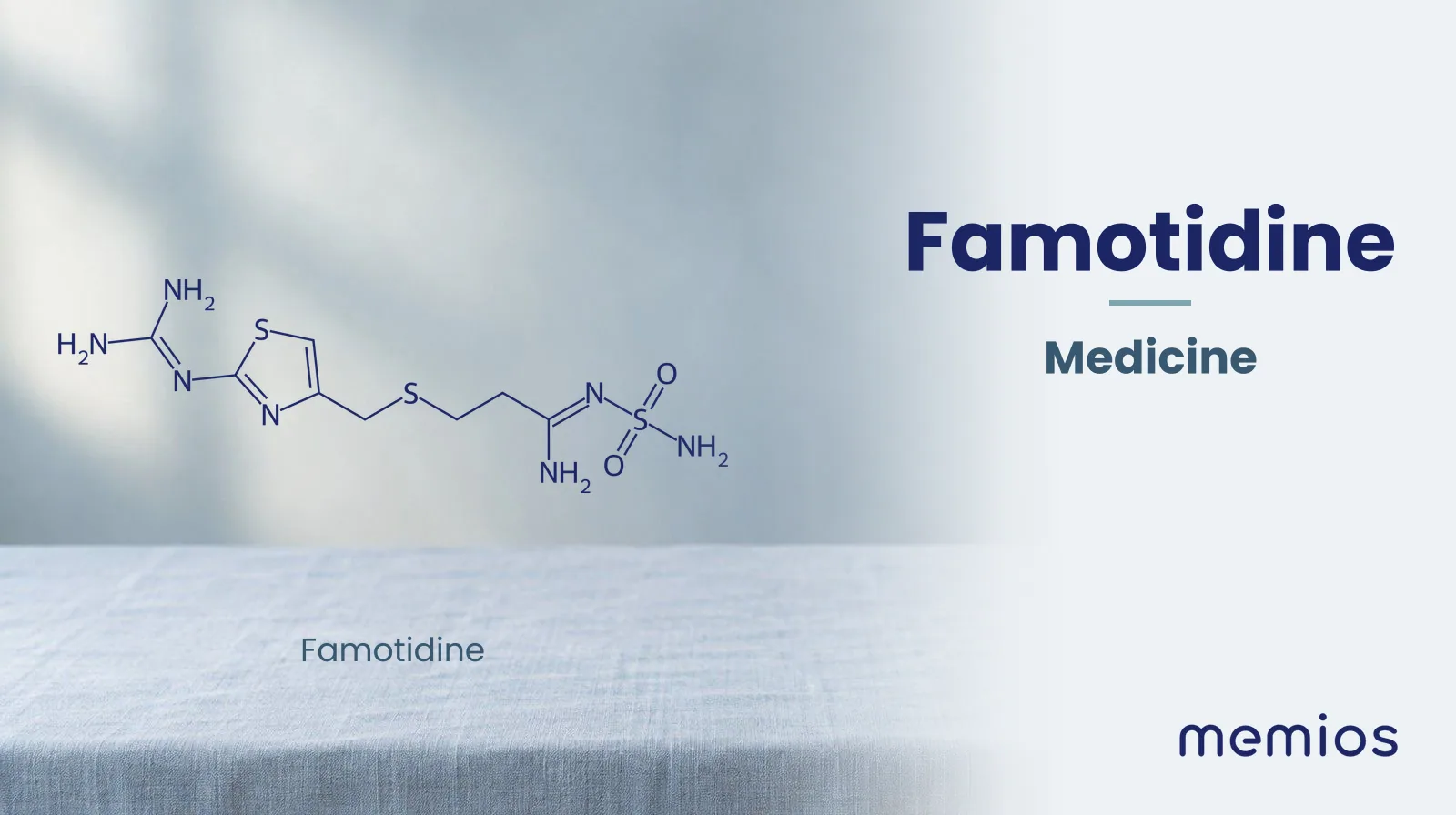
- What it is: Famotidine is a synthetic small-molecule drug that blocks the histamine H2 receptor on the acid-producing (parietal) cells of the stomach lining.
- Main use: Gastro-oesophageal reflux disease and erosive oesophagitis (limited evidence).
- Other approved uses: Active duodenal ulcer and benign gastric ulcer (evidence not rated); Pathological hypersecretory conditions (e.g. Zollinger-Ellison syndrome) (evidence not rated).
- Off-label uses (not on the FDA label): Preventing peptic ulcers and erosive oesophagitis in people taking low-dose aspirin (limited evidence); Functional (non-ulcer) dyspepsia (disputed).
- Uses NOT supported by research: COVID-19.
- Recommended dose: not established. There is no reference intake for a drug: the dose is set by the prescriber, or by the package for over-the-counter strengths.
- Studied dose (a trial dose, not a recommendation): FAMOUS gave famotidine 20 mg twice daily for 12 weeks to people taking low-dose aspirin. Findings citing that trial: 2 for.
- Upper limit: Position, not a reference upper limit: the same 2018 label's dosage table gives, for pathological hypersecretory conditions, 20 mg every 6 hours, adjusted to patient needs, with a maximum of 160 mg every 6 hours.
- What goes wrong: 3 findings on harm. Two or more years' supply of H2-receptor antagonists was associated with a modestly increased risk of a new diagnosis of vitamin B12 deficiency.
- Interactions: 3 recorded, including Drugs that need stomach acid to be absorbed (dasatinib, delavirdine, cefditoren, fosamprenavir; also atazanavir, erlotinib, ketoconazole, itraconazole, nilotinib, rilpivirine), Vitamin B12, Alcohol.
- Common myth: Famotidine is a treatment for COVID-19.
What it is
Famotidine is a synthetic small-molecule drug that blocks the histamine H2 receptor on the acid-producing (parietal) cells of the stomach lining. The US prescribing information describes it as "a competitive inhibitor of histamine-2 (H2) receptors" whose main pharmacological action is suppression of gastric acid secretion. It is sold both on prescription (tablets, oral suspension, injection) and over the counter at lower strengths, and is also combined with ibuprofen in a fixed-dose product. Its antisecretory effect begins within about an hour of an oral dose and lasts roughly 10 to 12 hours.
What the research says
The evidence is strongest for what famotidine does to stomach acid and to ulcers caused by aspirin: in one 404-patient placebo-controlled trial it cut the rate of endoscopic gastric ulcers from 15.0% to 3.4% over 12 weeks. For healing reflux oesophagitis it works but is clearly weaker than proton pump inhibitors in a 98-trial network meta-analysis. For functional (non-ulcer) dyspepsia the pooled effect on overall symptoms was not statistically significant. For COVID-19, a 10-study meta-analysis found no effect on death or recovery. Harms are uncommon but real: confusion and delirium in older people and in kidney impairment, and a modest association between two or more years of H2-blocker supply and vitamin B12 deficiency.
Evidence grade: Well established.
How it works
Drug class: Histamine H2-receptor antagonist (H2 blocker); gastric antisecretory agent
Histamine released inside the stomach wall normally switches on the acid pumps of the parietal cells. Famotidine sits on the histamine H2 receptor and blocks that signal, so the stomach makes less acid and a smaller volume of juice; pepsin output falls roughly in proportion to the volume. The effect starts within about an hour of a tablet and lasts about 10 to 12 hours, which is why it is usually taken once or twice a day. (Source 1)
What it is used for
- Famotidine heals and controls reflux oesophagitis, but a network meta-analysis of 98 randomised trials ranked famotidine 80 mg/day well below esomeprazole 40 mg/day for healing and concluded that proton pump inhibitors were strongly superior to H2 blockers. Certainty across the network was mostly low or very low. Evidence: limited. (Source 2)
- This is an approved indication in the 2018 US label, but in this run we did not retrieve the 1980s pivotal healing trials that the approval rests on, so we are recording the indication as a regulator's position and not as evidence we have read. A reviewer should add the ulcer-healing trials. Evidence: unknown. (Source 3)
- Approved in the label, which gives a starting dose of 20 mg every 6 hours and a maximum of 160 mg every 6 hours. We did not retrieve outcome trials for this rare indication. Evidence: unknown. (Source 3)
- One phase III placebo-controlled trial (FAMOUS, 404 patients, 12 weeks) found famotidine 20 mg twice daily reduced endoscopic gastric ulcers from 15.0% to 3.4%, duodenal ulcers from 8.5% to 0.5% and erosive oesophagitis from 19.0% to 4.4%. It is a single manufacturer-funded trial using endoscopic, not clinical, endpoints. Evidence: limited. (Source 4)
- A meta-analysis of 22 randomised placebo-controlled trials (2,959 patients) found the odds ratio for global improvement was 1.48 (95% CI 0.94 to 2.32) - not statistically significant - while complete relief of pain reached significance at OR 1.81 (95% CI 1.15 to 2.84). The reviewers flagged significant heterogeneity and said pooling may not have been appropriate. Evidence: disputed. (Source 5)
- A meta-analysis of 10 studies (3 randomised, 7 retrospective) found no effect on mortality (OR 0.96, 95% CI 0.34 to 2.70) or on ICU admission, and concluded famotidine should not be used for this indication. A 55-patient randomised phase 2 outpatient trial of 80 mg three times daily did not improve time to symptom resolution (p=0.4). Evidence: not-supported. (Source 6)
Interactions
- Drugs that need stomach acid to be absorbed (dasatinib, delavirdine, cefditoren, fosamprenavir; also atazanavir, erlotinib, ketoconazole, itraconazole, nilotinib, rilpivirine) (label): By raising stomach pH, famotidine can reduce how much of these medicines dissolves and enters the blood, which can make them less effective. The label advises against taking some of them with famotidine at all. (Source 3)
- Vitamin B12 (observational study (case-control) - none of the listed evidence values fit; see notes): Stomach acid helps release vitamin B12 from food protein. In a large case-control study, two or more years' supply of H2 blockers was associated with a 25% higher odds of a new vitamin B12 deficiency diagnosis. This is an association from prescribing records, not a controlled experiment, so it does not prove cause. (Source 7)
- Alcohol (pharmacokinetic study): H2 blockers including famotidine have been studied for whether they change the stomach's first-pass breakdown of alcohol, and so blood alcohol levels. The 2018 tabulated review of those studies ends by saying further work is needed. The record we could read states the direction of the effect in two opposite ways, so no direction is asserted here - see the caveat. Limit: The source contradicts itself on the direction of this effect, so no direction should be concluded from it. The abstract says the H2 blockers - cimetidine, ranitidine, famotidine and nizatidine - 'have all been found to increase the first-pass metabolism of ethanol', while the same article's title and its own closing sentence are about their ability to 'inhibit' it. Those are opposites: more first-pass metabolism in the stomach would mean less alcohol reaching the blood, and less would mean more. The 'increase' wording appears on two independent copies of this record (the National Institute of Justice and the Office of Justice Programs libraries), so it is the source's own wording rather than a transcription error, and it cannot be resolved from the abstract alone. All that can safely be taken from this article is its last sentence, that further studies are required. Do not read this entry as evidence that famotidine raises, or that it lowers, blood alcohol. Separately, the same abstract's line about drink-driving limits carries a forward reference to Utah in 2019 although the article was published in 2018, so it is not a statement of current law. (Source 8)
Stopping it
- After 34 days of nightly H2 blockade, withdrawal was followed by a significant rise in night-time stomach acidity in 42 of 46 healthy volunteers overall (+36%, 95% CI +19 to +55%). (Source 9)
- Famotidine was the one regimen in that study that did not produce a statistically significant rebound, so the rebound seen with H2 blockers as a class may be weaker for famotidine. The famotidine subgroup was only 8 people. (Source 9)
- The rebound observed after H2-blocker withdrawal was not accompanied by raised gastrin, so it is not explained by hypergastrinaemia. (Source 9)
What goes wrong
Two or more years' supply of H2-receptor antagonists was associated with a modestly increased risk of a new diagnosis of vitamin B12 deficiency. (Source 7)
- Case-control study, Low certainty.
- Size: 25,956 cases with incident vitamin B12 deficiency and 184,199 controls.
- Who: Kaiser Permanente Northern California members, 1997-2011.
- How long: Exposure measured as two or more years' supply.
- Result: H2RAs OR 1.25 (95% CI 1.17-1.34); PPIs OR 1.65 (95% CI 1.58-1.73); >1.5 PPI pills/day OR 1.95 (95% CI 1.77-2.15)
- Funding: not stated.
Limit of this finding: This is a case-control study built from prescription, laboratory and diagnosis records, not a trial, so it can show an association but cannot show that acid-blocking drugs cause B12 deficiency - people prescribed them differ from those who are not in ways the records cannot fully capture. The figure for H2 blockers as a class, odds ratio 1.25, is much smaller than the one for proton pump inhibitors. The larger 1.95 figure in the same study is for proton pump inhibitor doses above 1.5 pills a day and says nothing about famotidine dosing.
2 or more years' supply of H2RAs (OR, 1.25 [95% CI, 1.17-1.34]) were associated with an increased risk
Famotidine has been reported to cause delirium in hospitalised patients, which cleared when the drug was withdrawn. (Source 10)
- Case series, Very low certainty.
- Size: 6 cases.
- Who: Hospitalised patients, with the authors discussing implications for elderly people.
- How long: Not stated.
- Result: Six cases; delirium cleared completely on removal of famotidine. The authors note only two previously reported cases had been associated with famotidine. No denominator, so no rate can be calculated.
- Funding: not stated.
The authors report on six cases of famotidine-associated delirium in hospitalized patients who cleared completely upon removal of famotidine
The 2018 US label records central nervous system adverse reactions - including confusion, delirium and hallucinations - reported in elderly patients and in patients with moderate to severe kidney impairment. (Source 3)
- Official position, Certainty not rated.
- Size: Post-marketing reports, no denominator given.
- Who: Patients taking famotidine, particularly elderly and renally impaired.
- How long: Not stated.
- Result: No rates given. The label lists the most common adverse reactions as headache, dizziness, constipation and diarrhea, and reports the CNS reactions as occurring in elderly and renally impaired patients.
- Funding: manufacturer (label held by the marketing authorisation holder)
Central nervous system (CNS) adverse reactions, including confusion, delirium, hallucinations, disorientation, agitation, seizures, and lethargy, have been reported in elderly patients and patients with moderate and severe renal impairment treated with PEPCID.
What the evidence supports
In people taking low-dose aspirin, famotidine 20 mg twice daily reduced endoscopic gastric ulcers, duodenal ulcers and erosive oesophagitis compared with placebo over 12 weeks. (Source 4)
- Randomized trial, Moderate certainty.
- Size: 404 patients (famotidine 204, placebo 200)
- Who: Adults taking low-dose aspirin (75-325 mg daily) with no ulcer or erosive oesophagitis at baseline endoscopy.
- How long: 12 weeks.
- Result: Gastric ulcers 3.4% vs 15.0% (OR 0.20, 95% CI 0.09-0.47; p=0.0002); duodenal ulcers 0.5% vs 8.5% (OR 0.05, 0.01-0.40; p=0.0045); erosive oesophagitis 4.4% vs 19.0% (OR 0.20, 0.09-0.42; p<0.0001)
- Funding: industry-funded (Merck Laboratories and Astellas Pharma)
gastric ulcers had developed in seven (3·4%) of 204 patients compared with 30 (15·0%) of 200 patients
In the same trial, fewer adverse events occurred on famotidine than on placebo, and the upper gastrointestinal haemorrhages that did occur were in the placebo arm. (Source 4)
- Randomized trial, Low certainty.
- Size: 404 patients.
- Who: Adults taking low-dose aspirin.
- How long: 12 weeks.
- Result: Adverse events 9 (famotidine) vs 15 (placebo); four placebo patients admitted with upper gastrointestinal haemorrhage.
- Funding: industry-funded (Merck Laboratories and Astellas Pharma)
There were fewer adverse events in the famotidine group than in the placebo group (nine vs 15)
Tolerability of the active acid-suppressing drugs did not differ significantly from one another in that network meta-analysis, and all were better tolerated than placebo. (Source 2)
- Meta-analysis, Low certainty.
- Size: 98 RCTs, 45,964 participants.
- Who: Adults with gastro-oesophageal reflux disease.
- How long: Trial durations varied.
- Result: No statistically significant differences in tolerance between active drugs.
- Funding: not stated.
the comparison results among active drugs did not reach statistical significance; however, the tolerance was better than the placebo
What the evidence does not support
A randomised double-blind outpatient trial of high-dose famotidine in COVID-19 did not show a statistically significant improvement in time to symptom resolution. (Source 11)
- Randomized trial, Very low certainty.
- Size: 55 patients in the intention-to-treat group.
- Who: Non-hospitalised adults with COVID-19, median age 35 years.
- How long: 14 days of treatment.
- Result: Time to symptom resolution not statistically improved (p=0.4); five self-limiting adverse events occurred.
- Funding: not stated in the extract; philanthropic funders listed (Pershing Square Foundation, Fast Grant, Dr Lee MacCormick Edwards Charitable Foundation)
Limit of this finding: This trial's main pre-specified measure, time to symptom resolution, was not improved (p=0.4). A secondary measure, the rate at which symptoms resolved, did favour famotidine, and the authors' conclusion is phrased around that. With 55 patients and a negative primary endpoint, this trial does not show that famotidine treats COVID-19, and the larger meta-analysis of 10 studies found no effect on death.
Time to symptom resolution was not statistically improved (p=0.4)
Pooled observational studies of hospitalised COVID-19 patients found no association between famotidine use and lower mortality or a lower combined rate of death, intubation and intensive care. (Source 12)
- Meta-analysis, Very low certainty.
- Size: Four studies, reporting on 46,435 total patients and 3,110 patients treated with famotidine.
- Who: Hospitalised adults with COVID-19.
- How long: Hospital admission to discharge or death; databases searched through February 12, 2021.
- Result: Composite outcome HR 0.63 (95% CI: 0.35, 1.16). Mortality alone, across the three studies reporting it separately: HR 0.67 (95% CI: 0.26, 1.73) and OR 0.79 (95% CI: 0.19, 3.34). Heterogeneity ranged from 83.69% to 88.07%.
- Funding: The author(s) received no specific funding for this work; the authors have declared that no competing interests exist.
Based on the existing observational studies, famotidine use is not associated with a reduced risk of mortality or combined outcome of mortality, intubation, and/or intensive care services in hospitalized individuals with COVID-19
Where the evidence is mixed
For healing reflux disease, proton pump inhibitors outperformed H2 blockers including famotidine in a large network meta-analysis. (Source 2)
- Meta-analysis, Low certainty.
- Size: 98 RCTs, 45,964 participants; healing outcome from 50 studies (22,669 of 29,392 participants)
- Who: Adults with gastro-oesophageal reflux disease.
- How long: Trial durations varied (typically 4-8 weeks)
- Result: Ranking probability for healing: esomeprazole 40 mg/day 92.2%, famotidine 80 mg/day 36.9%. GRADE ratings across the network were 10 high, 40 moderate, 91 low and 91 very low.
- Funding: not stated.
the curative effects of PPIs were strongly superior to the effects of H2RAs, and the high dose was superior to the low dose
In functional dyspepsia, H2-receptor antagonists did not significantly improve the global assessment of symptoms, although complete pain relief reached statistical significance. (Source 5)
- Meta-analysis, Low certainty.
- Size: 22 randomised, double-blind, placebo-controlled trials, 2,959 patients.
- Who: Adults with functional (non-ulcer) dyspepsia.
- How long: Not stated in the record.
- Result: Global assessment of dyspepsia symptoms: OR 1.48 (95% CI 0.94, 2.32), homogeneity test P = 0.047. Complete relief of epigastric pain: OR 1.81 (95% CI 1.15, 2.84, P<0.01), homogeneity test P = 0.017.
- Funding: not stated.
Limit of this finding: The source contradicts itself here. It says a 'moderate beneficial effect' was 'demonstrated' for the global assessment of dyspepsia symptoms, but the confidence interval it gives for that same result, 0.94 to 2.32, includes 1 - which means no effect was demonstrated for that outcome. The record's own reviewers then add that it may not have been appropriate to pool those results at all, and that the authors' conclusions should be read with caution. A reader should conclude that H2 blockers were not shown to improve overall dyspepsia symptoms, and should not treat the 1.48 figure as a benefit. Note also that the commentary sentences are the CRD/DARE abstractors' words, not the meta-analysis authors'.
A moderate beneficial effect of H2-receptor antagonists was demonstrated for global assessment of dyspepsia symptoms with an OR of 1.48 (95% CI: 0.94, 2.32)
The CRD reviewers who quality-assessed that dyspepsia meta-analysis warned that its pooled results should be treated cautiously because of heterogeneity between the trials. (Source 5)
- Meta-analysis, Low certainty.
- Size: 22 trials, 2,959 patients.
- Who: Adults with functional dyspepsia.
- How long: Not stated.
- Result: Significant heterogeneity on both pooled outcomes: homogeneity test P = 0.047 for global assessment of dyspepsia symptoms and P = 0.017 for complete relief of pain; only improvement of pain was homogeneous.
- Funding: not stated.
Limit of this finding: The cautionary sentences quoted from this record were written by the Centre for Reviews and Dissemination abstractors who appraised the meta-analysis, not by the meta-analysis authors themselves. Do not attribute them to the original paper.
Therefore, it may not have been appropriate to pool the results for global assessment by the patient of treatment effect, and for complete relief of pain.
In healthy volunteers, abruptly stopping 34 days of H2-receptor blockade was followed by a significant rise in night-time stomach acidity in 42 of 46 people, without a matching rise in gastrin; the rise reached statistical significance after every regimen except famotidine. (Source 13)
- Randomized trial, Low certainty.
- Size: 46 healthy subjects across five regimens; famotidine 40 mg at night, n = 8.
- Who: Healthy volunteers, not patients.
- How long: 34 days of dosing, then 24 to 48 hours of measurement after abrupt withdrawal.
- Result: Median nocturnal integrated intragastric acidity rose in 42 of 46 subjects (+36%; 95% CI +19, +55%) versus prestudy values; median integrated plasma gastrin changed +1% (95% CI -12, +13%). The rise was statistically significant after every regimen except famotidine, where only 8 subjects were studied.
- Funding: not stated in the record retrieved.
Withdrawal of H2 blockade resulted in a significant rise in median nocturnal integrated intragastric acidity in 42 of 46 subjects (+36%; 95% CI +19, +55%) compared with prestudy values, but this rise was not associated with a significant change in the median integrated plasma gastrin concentration (+1%; 95% CI -12, +13%). A statistically significant rise in nocturnal acidity was observed after all regimens, except after dosing with famotidine.
Where the research disagrees
Whether famotidine is an adequate substitute for a proton pump inhibitor in acid-related disease
- Network meta-analysis of 98 RCTs (Scientific Reports, 2017), network meta-analysis of randomised trials with GRADE: the curative effects of PPIs were strongly superior to the effects of H2RAs, and the high dose was superior to the low dose (Source 2)
- FAMOUS investigators (Lancet, 2009), single phase III placebo-controlled randomised trial with endoscopic endpoints: Famotidine is effective in the prevention of gastric and duodenal ulcers, and erosive oesophagitis in patients taking low-dose aspirin. (Source 4)
How much
- Reference intake: There is no reference intake for a drug: the dose is set by the prescriber, or by the package for over-the-counter strengths. As a position, the FDA-approved US prescribing information for PEPCID (revised 06/2018) lists 40 mg once daily or 20 mg twice daily for active duodenal ulcer, 20 mg twice daily for GERD, and 20 mg or 40 mg twice daily for erosive oesophagitis. (Source 3)
- Upper limit: Position, not a reference upper limit: the same 2018 label's dosage table gives, for pathological hypersecretory conditions, 20 mg every 6 hours, adjusted to patient needs, with a maximum of 160 mg every 6 hours, and section 2.2 states that dosage adjustments are recommended in moderate to severe renal impairment (creatinine clearance less than 60 mL/min). (Source 3)
- Studied: FAMOUS gave famotidine 20 mg twice daily for 12 weeks to people taking low-dose aspirin. (Source 4)
- Studied: The randomised outpatient COVID-19 trial gave 80 mg famotidine orally three times a day. (Source 11)
- Studied: The withdrawal study gave famotidine 40 mg at night for 34 days to 8 healthy volunteers. (Source 9)
A common belief, and what the research shows
The belief: Famotidine is a treatment for COVID-19.
What the research shows: A meta-analysis of 10 studies found no effect on death: "Famotidine has no effect on mortality (OR 0.96; 95% CI: 0.34, 2.70; I2 = 100%)", and its authors wrote that "Famotidine is not effective in reducing mortality or increasing the rate of recovery in COVID-19 patients; hence it should not be used for this indication until large-scale RCTs have established its efficacy." The one randomised outpatient trial found that "Time to symptom resolution was not statistically improved (p=0.4)".
Questions and answers
What is it?
Famotidine is a manufactured drug, not a nutrient. It blocks one particular receptor - the histamine H2 receptor - on the acid-making cells of the stomach. It is sold as tablets, an oral liquid and an injection, on prescription at higher strengths and over the counter at lower ones. (Source 1)
What does it do in the body?
It turns down acid production in the stomach. Both the strength of the acid and the amount of juice produced fall, and pepsin output falls along with the volume. The effect begins within about an hour of a tablet and lasts roughly 10 to 12 hours. (Source 1)
Is it good or bad for you?
It depends entirely on the situation. In people taking low-dose aspirin it clearly reduced ulcers and erosive oesophagitis in a placebo-controlled trial. For reflux healing it is weaker than a proton pump inhibitor. For COVID-19 it did nothing. Against that sit confusion and delirium in older or kidney-impaired people and an association with vitamin B12 deficiency after years of use. (Source 4)
How do you get more of it?
This question does not apply the way it does to a nutrient. Famotidine only enters the body when someone takes the medicine; there is no dietary source. Whether a person takes it, and at what dose, is a prescribing decision tied to the six conditions the 2018 label lists - four of them (duodenal ulcer, gastric ulcer, non-erosive GERD and erosive oesophagitis) in adults and in children weighing 40 kg or more, and two (pathological hypersecretory conditions, and reducing the risk of duodenal ulcer recurrence) in adults only. (Source 3)
If it is harmful, what reduces it?
Famotidine is cleared by the kidneys and its acid-blocking effect wears off within about half a day of the last dose, so simply not taking the next dose removes it. Because blood levels run higher when kidney function is reduced, that clearance is slower in people with renal impairment, which is where the central nervous system reactions cluster. (Source 1)
Why might someone be low in it or missing it?
Famotidine is a medicine, not a nutrient, so nobody is naturally low in it. Someone may not be taking it, or may be on a reduced dose, because the kidneys clear it: the current US prescribing information for PEPCID, revised June 2024, says dosage adjustments are recommended when creatinine clearance is below 60 mL/min. The same label records that central nervous system reactions have been reported in older people and in people with moderate or severe kidney impairment, which is a reason prescribers stop it or avoid it in those groups. This is a regulator's position as of that revision date, not a trial result. (Source 14)
Which whole foods contain it or feed it?
No whole food contains famotidine or feeds it. The food-and-drink question the literature does address is alcohol: H2 blockers have been studied for whether they change the stomach's first-pass breakdown of alcohol, and a 2018 tabulated review of those studies concluded that further work is needed. That record states the direction of the effect in two opposite ways, so we do not report a direction - see the caveat. (Source 8)
What happens if you do not have it?
For most people, nothing - famotidine is not something the body needs. For the specific group studied in FAMOUS, people on long-term low-dose aspirin, going without it meant markedly more ulcers on endoscopy: 15.0% developed a gastric ulcer on placebo compared with 3.4% on famotidine, and four of the upper gastrointestinal bleeds requiring admission were in the placebo group. (Source 4)
How can you test for it?
There is no routine clinical blood test for famotidine, and blood levels are not monitored in ordinary care. What researchers measure instead is the drug's effect on the stomach: 24-hour intragastric acidity studies, sometimes alongside plasma gastrin, as in the 1991 Gut withdrawal study of 46 healthy volunteers. Those studies use a nasogastric tube or pH probe over a full day and night, so they are research procedures rather than tests a member would be offered. Symptoms and endoscopy, not drug levels, are what clinicians follow. (Source 13)
References
- US Food and Drug Administration (Drugs@FDA), label revised 06/2018. PEPCID (famotidine) tablets, for oral use - Prescribing Information, section 12 CLINICAL PHARMACOLOGY. 2018. Read the source
- Scientific Reports (Nature). Effectiveness and Tolerability of Different Recommended Doses of PPIs and H2RAs in GERD: Network Meta-Analysis and GRADE system. 2017. DOI 10.1038/srep41021. Read the source
- US Food and Drug Administration (Drugs@FDA), label revised 06/2018. PEPCID (famotidine) tablets, for oral use - Prescribing Information (Highlights: indications, dosage, adverse reactions, drug interactions; and Full Prescribing Information sections 2.2 Dosage in Renal Impairment and 5.1 Central Nervous System Adverse Reactions). 2018. Read the source
- The Lancet. Famotidine for the prevention of peptic ulcers and oesophagitis in patients taking low-dose aspirin (FAMOUS): a phase III, randomised, double-blind, placebo-controlled trial. 2009. PMID 19577798, DOI 10.1016/S0140-6736(09)61246-0. Read the source
- Alimentary Pharmacology and Therapeutics; quality-assessed record in the Database of Abstracts of Reviews of Effects (DARE), NCBI Bookshelf. H2-receptor antagonists in the treatment of functional (nonulcer) dyspepsia: a meta-analysis of randomized controlled clinical trials. 2001. Read the source
- Journal of Infection. No evidence of clinical efficacy of famotidine for the treatment of COVID-19: a systematic review and meta-analysis. 2022. Read the source
- JAMA. Proton Pump Inhibitor and Histamine 2 Receptor Antagonist Use and Vitamin B12 Deficiency. 2013. PMID 24327038, DOI 10.1001/jama.2013.280490. Read the source
- Expert Opinion on Drug Safety (record hosted by the US National Institute of Justice library). The Inhibition of First-Pass Metabolism of Ethanol by H2-Receptor Antagonists: a Tabulated Review. 2018. PMID 30117350, DOI 10.1080/14740338.2018.1512969. Read the source
- Gut. Rebound intragastric hyperacidity after abrupt withdrawal of histamine H2 receptor blockade. 1991. DOI 10.1136/gut.32.12.1455. Read the source
- Psychosomatics. Famotidine-Associated Delirium: A Series of Six Cases. 1996. PMID 8701013, DOI 10.1016/S0033-3182(96)71548-7. Read the source
- Gut (BMJ). Oral famotidine versus placebo in non-hospitalised patients with COVID-19: a randomised, double-blind, data-intense, phase 2 clinical trial. 2022. DOI 10.1136/gutjnl-2022-326952. Read the source
- PLOS ONE. Effect of famotidine on hospitalized patients with COVID-19: A systematic review and meta-analysis. 2021. DOI 10.1371/journal.pone.0259514. Read the source
- Gut. Rebound intragastric hyperacidity after abrupt withdrawal of histamine H2 receptor blockade. 1991. DOI 10.1136/gut.32.12.1455. Read the source
- DailyMed, US National Library of Medicine; labeler Bausch Health US LLC. PEPCID- famotidine tablet, film coated (US prescribing information). 2024. Read the source