Medications · September 29, 2026 · Memios · 20 min read
Ezetimibe
The evidence that ezetimibe lowers LDL cholesterol is solid and the size of that effect is modest; the evidence that it prevents heart attacks and strokes is real but small and contested.
TLDR
- Limited evidence. The evidence that ezetimibe lowers LDL cholesterol is solid and the size of that effect is modest; the evidence that it prevents heart attacks and strokes is real but small and contested.
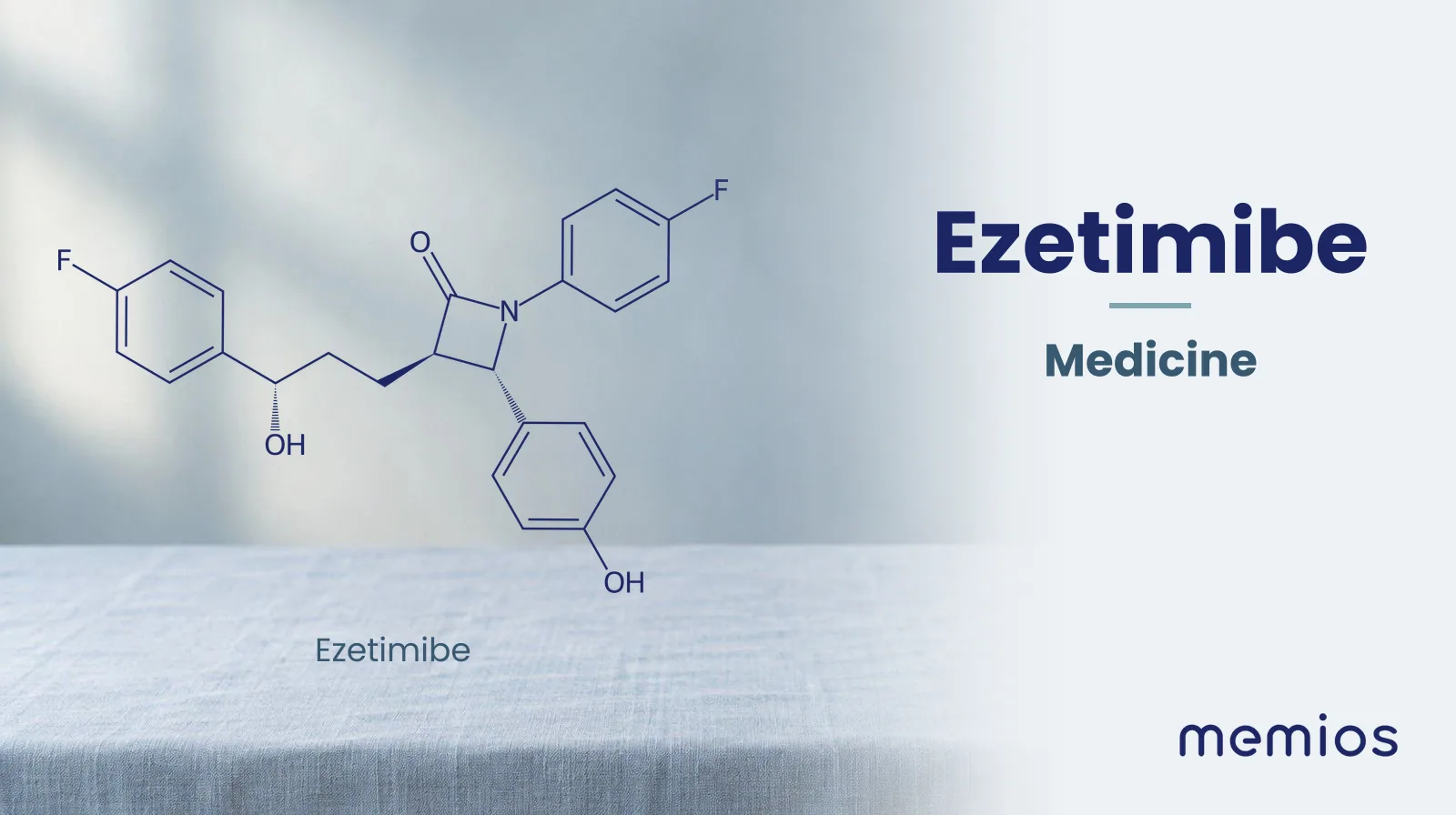
- What it is: Ezetimibe is a synthetic azetidinone, a small laboratory-made molecule taken as a 10 mg tablet once daily.
- Main use: Lowering LDL cholesterol in primary hyperlipidaemia, with a statin or alone when more LDL lowering is not otherwise possible (well supported).
- Other approved uses: Homozygous familial hypercholesterolaemia and inherited cholesterol disorders in children (limited evidence).
- Off-label uses (not on the FDA label): Reducing cardiovascular events in people with established atherosclerotic disease (disputed); Non-alcoholic fatty liver disease and steatohepatitis (limited evidence).
- Recommended dose: not established. There is no reference intake for a medicine; the dose is set by the prescriber. The FDA label, as a regulatory position, states a single dose: 10 mg orally once daily, administered with or without food.
- Studied dose (a trial dose, not a recommendation): Trials of ezetimibe in atherosclerotic disease and in fatty liver used the same 10 mg daily dose added to a statin or to usual care. No finding here cites that trial.
- Upper limit: No consumer upper limit exists.
- What goes wrong: 3 findings on harm. Ezetimibe alone does not raise liver enzymes more than placebo, but adding it to a statin slightly increases enzyme rises and stopping for liver test abnormalities.
- Interactions: 4 recorded, including Bile acid sequestrants such as cholestyramine, colesevelam and colestipol, Food, including high-fat meals, Statins (simvastatin, atorvastatin, rosuvastatin and others), Statins, immune-mediated liver injury.
- Common myth: Because ezetimibe lowers LDL cholesterol, it must cut heart attacks as much as a statin that lowers LDL by the same amount.
What it is
Ezetimibe is a synthetic azetidinone, a small laboratory-made molecule taken as a 10 mg tablet once daily. It acts in the lining of the small intestine rather than in the liver, which is what separates it from statins. It was approved in the United States in 2002 and is available generically and inside fixed-dose combinations with simvastatin, atorvastatin and rosuvastatin.
What the research says
The evidence that ezetimibe lowers LDL cholesterol is solid and the size of that effect is modest; the evidence that it prevents heart attacks and strokes is real but small and contested. Added to a statin it lowers LDL-C by roughly 14 mg/dL more than the statin alone. In the one large outcome trial the absolute difference in cardiovascular events was about 2% over seven years, and the FDA declined to approve an expanded outcomes claim after concluding the result was not robust to assumptions about missing data. Pooled analyses of randomised trials have not shown a clear effect on death.
Evidence grade: Limited evidence.
How it works
Drug class: Intestinal cholesterol absorption inhibitor (NPC1L1 inhibitor)
Cholesterol in the gut, both from food and from bile, is carried into the cells lining the small intestine by a transporter called NPC1L1. Ezetimibe blocks that transporter, so less cholesterol is absorbed. The liver responds by making more of its own cholesterol, which is why ezetimibe is usually paired with a statin that suppresses that compensation. (Source 1)
What it is used for
- This is the indication the label actually grants, and the effect is consistent: a 2023 meta-analysis found ezetimibe added to a statin lowered LDL-C by 14.06 mg/dL more than statin alone, and LiverTox describes a 22% to 24% LDL reduction when added to a maximised statin dose. Evidence: established. (Source 2)
- The label covers paediatric patients with specific familial cholesterol disorders. The trials behind this are small and use LDL-C rather than events as the endpoint; no outcome trial in this population was retrieved in this search. Evidence: limited. (Source 2)
- IMPROVE-IT reported a 2.0% absolute reduction in cardiovascular events at 7 years with simvastatin plus ezetimibe (hazard ratio 0.936). The FDA nonetheless refused an expanded approval, because about 11% of participants left follow-up early and the result did not survive alternative assumptions about that missing data. Pooled randomised data show no significant effect on clinical endpoints. Evidence: disputed. (Source 3)
- A 2024 meta-analysis of 10 randomised trials in 578 patients found ezetimibe lowered aspartate aminotransferase and gamma-GT and inflammatory markers, but also that glycated haemoglobin rose. The trials are small and the conclusion is hedged. Evidence: limited. (Source 4)
Interactions
- Bile acid sequestrants such as cholestyramine, colesevelam and colestipol (label): Sequestrants bind ezetimibe in the gut and reduce how much is absorbed, which is why the label separates the doses in time. (Source 5)
- Food, including high-fat meals (label): Meals do not change the total amount of ezetimibe absorbed, which is why the tablet can be taken with or without food. (Source 6)
- Statins (simvastatin, atorvastatin, rosuvastatin and others) (clinical trial): The combination is deliberate and is how ezetimibe is usually used, but it is not free: liver enzyme rises and discontinuation for abnormal liver tests are slightly more common on the combination than on the statin alone. (Source 7)
- Statins, immune-mediated liver injury (case reports): Cases resembling autoimmune hepatitis have been reported in people taking ezetimibe together with a statin; which drug is responsible is often impossible to say. (Source 7)
Stopping it
- No dependence, withdrawal syndrome or rebound effect for ezetimibe was found in the sources searched, and no deprescribing trial was retrieved. What the safety literature does record is that the liver enzyme rises seen on treatment are usually self-limited and not accompanied by jaundice or symptoms, so they do not by themselves establish a harm that persists after stopping. (Source 7)
- Because ezetimibe's measured benefit is a cholesterol reduction of roughly 14 mg/dL on top of a statin, stopping it removes that increment; the sources searched report no separate withdrawal phenomenon beyond loss of the lipid effect. (Source 8)
What goes wrong
An earlier meta-analysis found a non-significant tendency towards harm for ezetimibe added to another lipid-lowering drug. (Source 9)
- Meta-analysis, Very low certainty.
- Size: randomised trials with at least 24 weeks follow-up, to December 2013.
- Who: adults taking ezetimibe with or without a statin.
- How long: at least 24 weeks.
- Result: ezetimibe plus simvastatin versus simvastatin alone: all-cause death 2.52 (0.65-9.74), CV death 3.04 (0.48-19.21), MI 1.91 (0.42-8.70), stroke 2.38 (0.46-12.35), cancer 11.11 (0.62-198.29), serious adverse events 1.45 (0.95-2.23); all confidence intervals cross 1.
- Funding: The authors have no support or funding to report.
Limit of this finding: Every one of these risk ratios is statistically non-significant and several have extremely wide confidence intervals - the cancer figure of 11.11 runs from 0.62 to 198.29, which is consistent with anything from a large benefit to a large harm. The review's own authors say no firm conclusions are possible. Read this as an absence of reassurance from small trials, not as evidence that ezetimibe causes these events.
Ezetimibe+simvastatin vs. simvastatin alone showed a stronger tendency towards a higher risk for all-cause death (2.52; 0.65-9.74), CV death (3.04; 0.48-19.21), non-CV death (3.03; 0.12-73.50), MI (1.91; 0.42-8.70), stroke (2.38; 0.46-12.35), cancer (RR 11.11; 0.62-198.29), and SAEs (1.45; 0.95-2.23). Limitations include small numbers of events and inadequate power of the pooling.
Ezetimibe alone does not raise liver enzymes more than placebo, but adding it to a statin slightly increases enzyme rises and stopping for liver test abnormalities. (Source 7)
- Expert review, not systematic, Moderate certainty.
- Size: large randomised controlled trials summarised by LiverTox.
- Who: adults on lipid-lowering therapy.
- How long: varied.
- Result: serum enzyme elevations in 0.5% to 1.5% overall; no excess over placebo for ezetimibe alone; a slight increase when added to a statin.
- Funding: US government publication.
However, the addition of ezetimibe to statin therapy has been associated with a slight increase in the likelihood of serum aminotransferase elevations or rates of discontinuation due to liver test abnormalities.
Clinically obvious liver injury from ezetimibe is rare, and autoimmune-hepatitis-like cases have been described on ezetimibe plus a statin. (Source 7)
- Case series, Low certainty.
- Size: individual published cases.
- Who: patients on ezetimibe alone or with a statin.
- How long: latency 2 to 10 months.
- Result: likelihood score C (probable rare cause of clinically apparent liver injury); one reported case of vanishing bile duct syndrome.
- Funding: US government publication.
Clinically apparent acute liver injury due to ezetimibe has been reported, but is rare.
What the evidence supports
Adding ezetimibe to a statin lowers LDL cholesterol by about 14 mg/dL more than the statin alone. (Source 8)
- Meta-analysis, Moderate certainty.
- Size: 20 eligible studies.
- Who: people with atherosclerotic cardiovascular disease.
- How long: varied; trials to August 2023.
- Result: weighted mean difference -14.06 mg/dL; 95% CI -18.0 to -10.0; p = 0.0001.
- Funding: The author(s) declare that no financial support was received for the research, authorship, and/or publication of this article.
This difference in means amounted to (-14.06 mg/dL; 95% CI -18.0 to -10.0; p = 0.0001).
A 2025 review reports that in the IMPROVE-IT trial, in people hospitalised for an acute coronary syndrome, ezetimibe added to simvastatin reduced cardiovascular events by 2.0% in absolute terms over seven years. (Source 3)
- Expert review, not systematic, Moderate certainty.
- Size: IMPROVE-IT, as reported by this review.
- Who: 18,144 patients who had been hospitalised for an acute coronary syndrome.
- How long: 7 years.
- Result: absolute risk difference 2.0% at 7 years; hazard ratio 0.936.
- Funding: not stated.
In the Improved Reduction of Outcomes: Vytorin Efficacy International (IMPROVE-IT) trial, among 18,144 patients who had been hospitalised for an ACS, simvastatin 40 mg plus ezetimibe significantly reduced cardiovascular events, with an absolute risk difference of 2.0% at 7 years compared with simvastatin 40 mg (hazard ratio [HR] 0.936).
Compared with a high-intensity statin alone, statin plus ezetimibe produced fewer muscle-related adverse events and fewer liver enzyme elevations. (Source 10)
- Meta-analysis, Low certainty.
- Size: randomised trials within the 15-study review.
- Who: people with atherosclerotic cardiovascular disease.
- How long: varied.
- Result: muscle-related adverse events RR = 0.52 (95% CI 0.32 to 0.85); liver enzyme elevation RR = 0.51 (0.29 to 0.89); new-onset diabetes HR = 0.80 (0.74 to 0.87) in observational data.
- Funding: not stated in the retrieved text.
In terms of safety, the combination therapy lowered muscle-related adverse events (RR = 0.52, CI 95% [0.32, 0.85]) and number of patients with liver enzyme elevation (RR = 0.51, CI 95% [0.29, 0.89]) in the pooled analysis of RCTs
A 2025 review reports that in the RACING trial a moderate-dose statin plus ezetimibe was non-inferior to a high-dose statin alone for a three-year composite of cardiovascular death, major cardiovascular events and non-fatal stroke. (Source 11)
- Expert review, not systematic, Moderate certainty.
- Size: 3,780 patients.
- Who: adults with atherosclerotic cardiovascular disease.
- How long: 3 years.
- Result: 9.9% vs 9.1%, absolute difference - 0.78%, 90% CI - 2.39-0.83.
- Funding: not stated.
Limit of this finding: Take care with the order of the two percentages: the source prints them the wrong way round. The sentence names the moderate-dose statin plus ezetimibe arm first and then gives "(9.9% vs 9.1%)", but in the RACING trial the event rate was 9.1% in the statin-plus-ezetimibe arm and 9.9% in the high-dose rosuvastatin 20 mg arm. That is also the only reading consistent with the absolute difference of - 0.78% printed in the same brackets, which is a negative number favouring the combination. So the combination arm had slightly fewer events, not more. This was a non-inferiority trial, so the result shows the combination was not worse than the high-dose statin, not that it was better.
Among 3780 patients with atherosclerotic CVD, rosuvastatin 10 mg with ezetimibe 10 mg was non-inferior to rosuvastatin 20 mg in the risk for the 3-year composite endpoint of cardiovascular death, major cardiovascular events or non-fatal stroke (9.9% vs 9.1%, absolute difference - 0.78%, 90% CI - 2.39-0.83).
What the evidence does not support
A 2018 account of the FDA review records that about one in nine participants left the IMPROVE-IT follow-up for the primary cardiovascular endpoint early. (Source 12)
- Expert review, not systematic, Moderate certainty.
- Size: IMPROVE-IT.
- Who: post-acute-coronary-syndrome patients.
- How long: median about six years.
- Result: approximately 11% discontinued follow-up early; the FDA's tipping point analysis moved the result out of significance.
- Funding: not stated.
Approximately 11% of study participants discontinued follow-up early for the primary endpoint of cardiovascular events.
The FDA refused expanded approval for the ezetimibe/simvastatin combination because the event reduction was small enough that some experts regarded it as clinically insignificant. (Source 13)
- Expert review, not systematic, Moderate certainty.
- Size: not applicable.
- Who: regulatory review of IMPROVE-IT.
- How long: not applicable.
- Result: denial hinged on the small magnitude of event reduction; authors conclude the data is not robust to alternative assumptions regarding the missing data.
- Funding: not stated.
The denial of the approval hinged on the small magnitude of event reduction with the ezetimibe/simvastatin combination, causing the results to be viewed as clinically insignificant by some experts.
Pooled randomised trials of statin plus ezetimibe versus a high-intensity statin found no significant difference in clinical endpoints. (Source 10)
- Meta-analysis, Low certainty.
- Size: 15 studies, 251,450 participants.
- Who: people with or at high risk of atherosclerotic cardiovascular disease.
- How long: varied.
- Result: observational pooling favoured combination therapy (primary composite HR = 0.76, 95% CI 0.73 to 0.80; all-cause death HR = 0.84, 0.78 to 0.91) but the randomised pooling showed no statistically significant difference.
- Funding: not stated in the retrieved text.
However, the pooled analysis of RCTs did not demonstrate a statistically significant difference between both arms concerning clinical endpoints.
The same review found no significant effect of ezetimibe plus simvastatin versus placebo on death, stroke or cancer. (Source 9)
- Meta-analysis, Very low certainty.
- Size: as above.
- Who: as above.
- How long: at least 24 weeks.
- Result: MI 0.81 (0.66-1.00, p = 0.051), all-cause death 1.02 (0.95-1.09), CV death 0.91 (0.80-1.04), stroke 0.86 (0.72-1.04), cancer 1.18 (0.80-1.74), serious adverse events 1.01 (0.96-1.06)
- Funding: The authors have no support or funding to report.
Limit of this finding: The published paper prints the non-cardiovascular death figure as "108; 0.99-1.18". That is an error in the source: a risk ratio of 108 cannot sit inside a confidence interval of 0.99 to 1.18, and the intended value is plainly 1.08. The quote is reproduced as printed rather than silently corrected. Do not read 108 as a 108-fold risk; the interval crosses 1, so this result is not statistically significant either way.
Trials comparing Ezetimibe+simvastatin vs placebo showed non-significant effects: MI (0.81; 0.66-1.00 p = 0.051), all-cause death (1.02; 0.95-1.09), CV death (0.91; 0.80-1.04), non-CV death (108; 0.99-1.18), stroke (0.86; 0.72-1.04), cancer (1.18; 0.80-1.74), SAEs (1.01; 0.96-1.06).
A 2018 account of the FDA review records that the IMPROVE-IT result did not hold up under alternative assumptions about the participants who left follow-up early. (Source 14)
- Expert review, not systematic, Moderate certainty.
- Size: 18,144 participants in the trial under review.
- Who: post-acute-coronary-syndrome patients.
- How long: 7 years.
- Result: A tipping point analysis moved the primary result out of statistical significance under plausible assumptions about the missing data.
- Funding: not stated.
That the data is not robust to alternative assumptions regarding the missing data.
Where the evidence is mixed
In fatty liver disease ezetimibe improved liver enzymes but raised glycated haemoglobin. (Source 4)
- Meta-analysis, Low certainty.
- Size: 10 randomised trials, 578 patients (290 ezetimibe, 288 control)
- Who: adults with NAFLD or NASH.
- How long: varied, trials to April 2024.
- Result: significant reductions in aspartate aminotransferase, gamma-GT, total cholesterol, LDL-C, high-sensitivity CRP and interleukin-6 (all P < 0.01); glycated haemoglobin markedly increased (P = 0.02)
- Funding: not stated.
The results indicated that ezetimibe significantly reduced levels of aspartate aminotransferase (P < 0.01), glutamyl transferase (γ-GT) (P < 0.01), total cholesterol (P < 0.01), low-density lipoprotein cholesterol (P < 0.01), high-sensitivity C-reactive protein (P < 0.01), and interleukin-6 (P < 0.01), and markedly increased levels of glycated hemoglobin (P = 0.02).
Where the research disagrees
Whether ezetimibe added to a statin actually prevents cardiovascular events
- Drugs, 2025 review of IMPROVE-IT, large randomised outcome trial reported in a narrative review: In the Improved Reduction of Outcomes: Vytorin Efficacy International (IMPROVE-IT) trial, among 18,144 patients who had been hospitalised for an ACS, simvastatin 40 mg plus ezetimibe significantly reduced cardiovascular events, with an absolute risk difference of 2.0% at 7 years compared with simvastatin 40 mg (hazard ratio [HR] 0.936). (Source 3)
- Journal of General Internal Medicine, 2018, explaining the FDA's refusal, regulatory tipping point analysis of the same trial: the data is not robust to alternative assumptions regarding the missing data. (Source 14)
- PLOS ONE meta-analysis, 2015, meta-analysis of randomised trials predating IMPROVE-IT: Ezetimibe±simvastatin had inconsistent effects on important outcomes. No firm conclusions are possible, but findings indicative of damage suggest much more selective use of Ezetimibe±simvastatin. (Source 9)
How much
- Reference intake: There is no reference intake for a medicine; the dose is set by the prescriber. The FDA label, as a regulatory position, states a single dose: 10 mg orally once daily, administered with or without food. (Source 2)
- Upper limit: No consumer upper limit exists. Ezetimibe is marketed in one strength and the label's stated dose is also its maximum: 10 mg once daily. There is no higher approved dose, so dose escalation is not a lever the way it is with statins. (Source 2)
- Studied: Trials of ezetimibe in atherosclerotic disease and in fatty liver used the same 10 mg daily dose added to a statin or to usual care. (Source 2)
- Studied: IMPROVE-IT combined simvastatin 40 mg with ezetimibe and compared it with simvastatin 40 mg alone over 7 years in 18,144 patients hospitalised for an acute coronary syndrome. (Source 3)
A common belief, and what the research shows
The belief: Because ezetimibe lowers LDL cholesterol, it must cut heart attacks as much as a statin that lowers LDL by the same amount.
What the research shows: The LDL reduction is real and modest, but the outcome evidence is thinner than the cholesterol numbers suggest. A 2015 meta-analysis concluded: "Trials comparing Ezetimibe plus a lipid-lowering drug against the same lipidlowering drug representing the net effect of Ezetimibe, showed a nonsignificant tendency toward damage for cancer, MI, stroke and SAEs." Pooled randomised data in a 2024 review also state that "the pooled analysis of RCTs did not demonstrate a statistically significant difference between both arms concerning clinical endpoints."
Questions and answers
What is it?
Ezetimibe is a prescription tablet, a synthetic azetidinone, given as 10 mg once daily. Unlike a statin it works in the gut wall rather than the liver. It has been available since 2002 and is sold alone and in fixed combinations with statins. (Source 1)
What does it do in the body?
It blocks the transporter that carries cholesterol from the gut into the body, so less dietary and biliary cholesterol is absorbed. Blood LDL falls: LiverTox puts the reduction at 22% to 24% when ezetimibe is added on top of a maximised statin dose, which is an incremental effect on top of the statin rather than the effect of ezetimibe on its own. The liver partly compensates by making more cholesterol, which is why it is usually combined with a statin. (Source 15)
Is it good or bad for you?
For lowering LDL cholesterol the evidence is good. For preventing heart attacks and strokes it is contested: the one large outcome trial found a 2.0% absolute difference over seven years, the FDA judged that result not robust, and a pooled analysis of randomised trials found no significant difference in clinical endpoints. Serious harm is uncommon; liver enzyme rises occur in 0.5% to 1.5%. (Source 14)
How do you get more of it?
Ezetimibe is a prescription-only medicine, not a nutrient, so there is no dietary or behavioural route to more of it. The label gives one dose: 10 mg orally once daily, administered with or without food. Trials used that same 10 mg dose, usually added to a statin. (Source 2)
If it is harmful, what reduces it?
Ezetimibe is not a harmful substance that needs clearing. If it is causing a problem such as abnormal liver tests, the action is to stop the drug under medical supervision; the enzyme rises seen on treatment are usually self-limited and not accompanied by jaundice or symptoms. Bile acid sequestrants also reduce how much is absorbed if taken at the same time. (Source 7)
Why might someone be low in it or missing it?
People are not biologically low in ezetimibe; they simply are or are not prescribed it. Common reasons it is absent are that a statin alone reached the cholesterol target, that cost or access limited it, or that it was stopped because of side effects such as diarrhoea, flatulence or abnormal liver tests. (Source 16)
Which whole foods contain it or feed it?
No food contains ezetimibe. Food matters only for how the tablet behaves: meals do not change the total amount absorbed, so it can be taken with or without food. Plant sterol and stanol foods act on the same absorption pathway, but no trial of that combination was retrieved in this search. (Source 6)
What happens if you do not have it?
Nothing happens from not having ezetimibe itself. What is lost is the extra LDL reduction: about 14 mg/dL more than a statin alone, and, in the one large outcome trial in people hospitalised for an acute coronary syndrome, roughly a 2% absolute difference in cardiovascular events over seven years, a figure the FDA considered too fragile to approve as a claim. (Source 3)
How can you test for it?
There is no clinical test for ezetimibe levels. What is measured instead is the effect, a standard lipid panel showing LDL cholesterol, and liver enzymes, since enzyme rises occur in 0.5% to 1.5% of people on treatment and slightly more when ezetimibe is added to a statin. (Source 7)
References
- National Institute of Diabetes and Digestive and Kidney Diseases (NCBI Bookshelf). Ezetimibe - LiverTox: Clinical and Research Information on Drug-Induced Liver Injury. 2020. PMID 31643425. Read the source
- DailyMed, US National Library of Medicine. EZETIMIBE tablets, for oral use (FDA prescribing information): section 2 DOSAGE AND ADMINISTRATION, recommended dosage. 2024. Read the source
- Drugs. Moderate-Intensity Statin Plus Ezetimibe: Time to Rethink it as an Optimal Initial Lipid-Lowering Strategy. 2025. DOI 10.1007/s40265-024-02113-5. Read the source
- Frontiers in Endocrinology. Potential impact of ezetimibe on patients with NAFLD/NASH: a meta-analysis of randomized controlled trials. 2024. DOI 10.3389/fendo.2024.1468476. Read the source
- DailyMed, US National Library of Medicine. EZETIMIBE tablets, for oral use (FDA prescribing information): section 2 DOSAGE AND ADMINISTRATION, administration with a bile acid sequestrant. 2024. Read the source
- DailyMed, US National Library of Medicine. EZETIMIBE tablets, for oral use (FDA prescribing information): section 12 CLINICAL PHARMACOLOGY, food effect. 2024. Read the source
- National Institute of Diabetes and Digestive and Kidney Diseases (NCBI Bookshelf). Ezetimibe - LiverTox: Clinical and Research Information on Drug-Induced Liver Injury. 2020. PMID 31643425. Read the source
- Frontiers in Cardiovascular Medicine. Ezetimibe and atherosclerotic cardiovascular disease: a systematic review and meta-analysis. 2023. DOI 10.3389/fcvm.2023.1269172. Read the source
- PLOS ONE. Clinical Efficacy and Safety of Ezetimibe on Major Cardiovascular Endpoints: Systematic Review and Meta-Analysis of Randomized Controlled Trials. 2015. DOI 10.1371/journal.pone.0124587. Read the source
- BMC Cardiovascular Disorders. The clinical effectiveness and safety of low/moderate-intensity statins & ezetimibe combination therapy vs. high-intensity statin monotherapy: a systematic review and meta-analysis. 2024. DOI 10.1186/s12872-024-04144-y. Read the source
- Drugs. Moderate-Intensity Statin Plus Ezetimibe: Time to Rethink it as an Optimal Initial Lipid-Lowering Strategy. 2025. DOI 10.1007/s40265-024-02113-5. Read the source
- Journal of General Internal Medicine. If the IMPROVE-IT Trial Was Positive, as Reported, Why Did the FDA Denied Expanded Approval for Ezetimibe and Simvastatin? An Explanation of the Tipping Point Analysis. 2018. DOI 10.1007/s11606-018-4498-3. Read the source
- Journal of General Internal Medicine. If the IMPROVE-IT Trial Was Positive, as Reported, Why Did the FDA Denied Expanded Approval for Ezetimibe and Simvastatin? An Explanation of the Tipping Point Analysis. 2018. DOI 10.1007/s11606-018-4498-3. Read the source
- Journal of General Internal Medicine. If the IMPROVE-IT Trial Was Positive, as Reported, Why Did the FDA Denied Expanded Approval for Ezetimibe and Simvastatin? An Explanation of the Tipping Point Analysis. 2018. DOI 10.1007/s11606-018-4498-3. Read the source
- National Institute of Diabetes and Digestive and Kidney Diseases (NCBI Bookshelf). Ezetimibe - LiverTox: Clinical and Research Information on Drug-Induced Liver Injury. 2020. PMID 31643425. Read the source
- National Institute of Diabetes and Digestive and Kidney Diseases (NCBI Bookshelf). Ezetimibe - LiverTox: Clinical and Research Information on Drug-Induced Liver Injury. 2020. PMID 31643425. Read the source