Medications · September 29, 2026 · Memios · 17 min read
Ethinyl Estradiol; Norethindrone
The evidence supports it as effective contraception: in the pivotal study of one such product there were 5 on-treatment pregnancies in 3,565 cycles without backup contraception, a Pearl Index of 1.82.
TLDR
- Boxed warning: This risk increases with age, particularly in women over 35 years of age, and with the number of cigarettes smoked.
- Well established. The evidence supports it as effective contraception: in the pivotal study of one such product there were 5 on-treatment pregnancies in 3,565 cycles without backup contraception, a Pearl Index of 1.82.
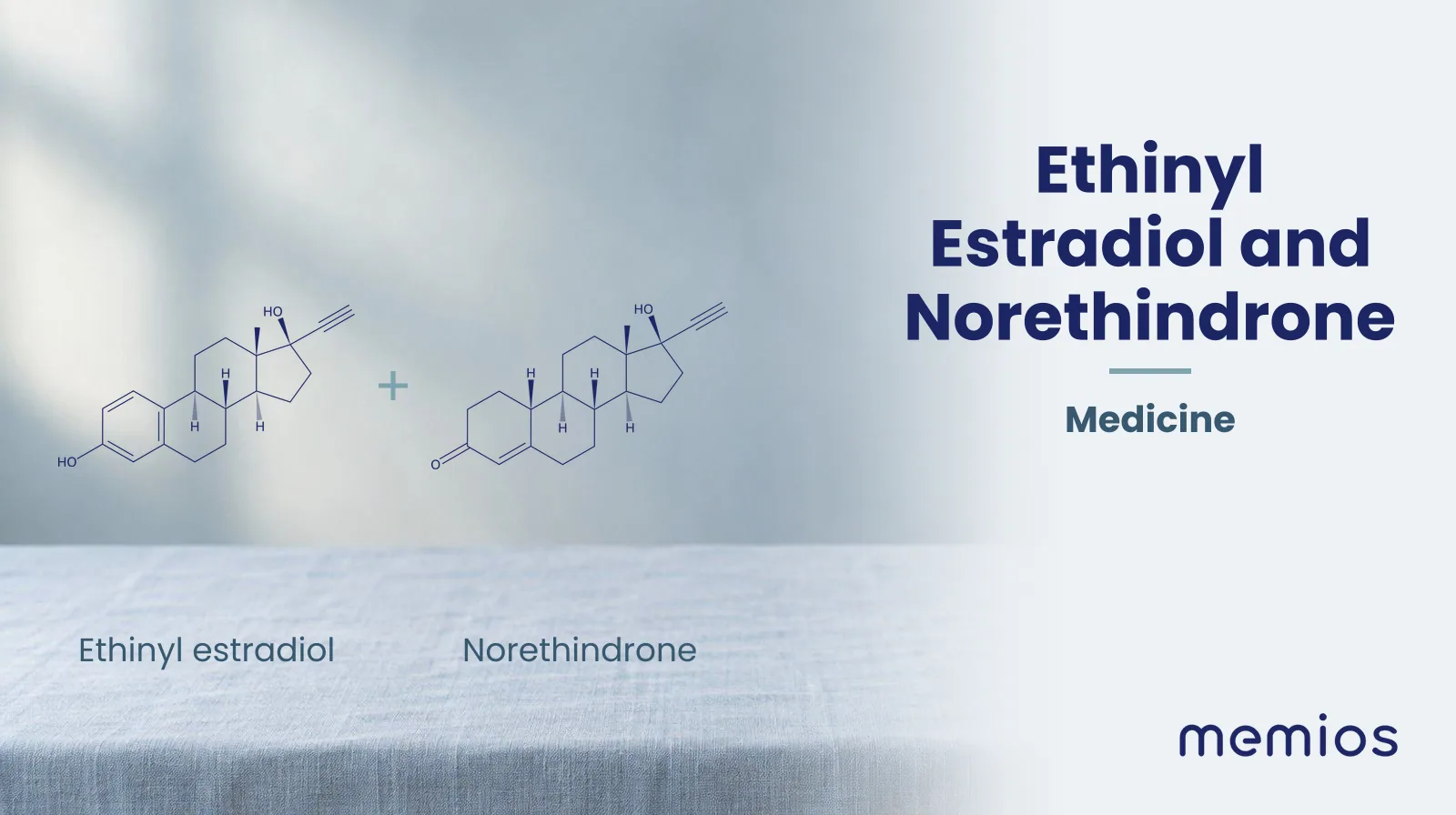
- What it is: This is a two-hormone combined oral contraceptive: a synthetic oestrogen, ethinyl estradiol, paired with a progestin from the norethindrone family (norethindrone or norethindrone acetate).
- Main use: Prevention of pregnancy (well supported).
- Off-label uses (not on the FDA label): Acne in women (well supported).
- Recommended dose (official position): There is no reference intake; this is a prescription medicine and the dose is fixed by the product, taken as one tablet a day.
- Studied dose (a trial dose, not a recommendation): The contraceptive study behind the label used the 1 mg norethindrone acetate / 0.02 mg ethinyl estradiol tablets over 3,565 treatment cycles without backup contraception. Findings citing that trial: 1 for.
- Upper limit: No upper limit is expressed as a daily amount; the regimen is one tablet daily and the label's limiting statements are contraindications rather than a maximum dose - for example that the product is contraindicated in women who smoke if over age 35.
- What goes wrong: 6 findings on harm. Combined oral contraceptives roughly triple the relative risk of venous thrombosis compared with non-use.
- Interactions: 4 recorded, including St John's wort (Hypericum perforatum), Enzyme-inducing medicines and herbal products (CYP3A4 inducers), Tobacco smoking, Hepatitis C combination antivirals containing ombitasvir/paritaprevir/ritonavir.
- Common myth: The pill makes you put on weight.
What it is
This is a two-hormone combined oral contraceptive: a synthetic oestrogen, ethinyl estradiol, paired with a progestin from the norethindrone family (norethindrone or norethindrone acetate). Products differ in the dose of each hormone and in whether the inactive tablets contain iron (ferrous fumarate). The combination has been marketed in the United States since 1968. It is taken as a daily tablet in a 28-day pack, with active tablets followed by inactive ones.
What the research says
The evidence supports it as effective contraception: in the pivotal study of one such product there were 5 on-treatment pregnancies in 3,565 cycles without backup contraception, a Pearl Index of 1.82. Combined pills of this type also reduce acne lesions in placebo-controlled trials. On the harm side the best-quantified effect is venous thrombosis: a BMJ network meta-analysis found a relative risk of about 3.5 versus non-use, and the label puts the absolute rate at 3 to 9 per 10,000 woman-years against a background of roughly 1.9 to 3.7. A large Danish cohort found a modest relative increase in breast cancer that works out to about one extra case per 7,690 women using hormonal contraception. The widely believed weight-gain effect is not supported: Cochrane found no large effect.
Evidence grade: Well established.
How it works
Drug class: Combined hormonal contraceptive: synthetic oestrogen (ethinyl estradiol) plus a 19-nortestosterone progestin (norethindrone / norethindrone acetate)
The two hormones together hold the pituitary's monthly signals flat so an egg is not released. The label states plainly that combined hormonal contraceptives lower the risk of pregnancy primarily by suppressing ovulation. Secondary effects on cervical mucus and the uterine lining are usually described as contributing. (Source 1)
Boxed warning
Cigarette smoking increases the risk of serious cardiovascular events from combination oral contraceptive (COC) use. This risk increases with age, particularly in women over 35 years of age, and with the number of cigarettes smoked. For this reason, COCs should not be used by women who are over 35 years of age and smoke [see Contraindications (4) and Warnings and Precautions (5.1)].
(Source 2)
What it is used for
- This is the approved indication. In the product's own clinical study there were 5 pregnancies in 3,565 unprotected cycles, giving a Pearl Index of 1.82 (95% CI 0.59 to 4.25). The label also records that effectiveness has not been evaluated in women with a BMI over 35 kg/m2. Evidence: established. (Source 3)
- Some combined pills carry an acne indication but most, including plain norethindrone acetate/ethinyl estradiol contraceptive products, do not, so this is usually off-label prescribing. A Cochrane review of 31 trials with 12,579 participants found the combined pills studied in placebo-controlled trials reduce inflammatory and non-inflammatory facial acne lesions, with few consistent differences between pill types. Evidence: established. (Source 4)
Interactions
- St John's wort (Hypericum perforatum) (pharmacokinetic study): St John's wort speeds up the breakdown of both hormones. In a controlled study of women taking norethindrone and ethinyl estradiol, exposure to the contraceptive fell by 13 to 15%, breakthrough bleeding increased, and there was evidence of follicle growth and probable ovulation - that is, the contraceptive effect was undermined, not just the bleeding pattern. (Source 5)
- Enzyme-inducing medicines and herbal products (CYP3A4 inducers) (label): Drugs and herbal products that switch on liver enzymes, CYP3A4 in particular, can make the pill less effective or cause breakthrough bleeding. The label names phenytoin, barbiturates, carbamazepine, rifampicin, topiramate and products containing St John's wort among them. (Source 6)
- Tobacco smoking (label): Smoking while taking a combined pill raises the risk of serious cardiovascular events, and the risk climbs with age and with the number of cigarettes. This is the subject of the boxed warning, and smoking over 35 is a contraindication rather than a caution. (Source 2)
- Hepatitis C combination antivirals containing ombitasvir/paritaprevir/ritonavir (label): This combination is contraindicated with the pill because of the potential for liver enzyme (ALT) elevations. (Source 7)
Stopping it
- There is no dependence or withdrawal syndrome with combined oral contraceptives. The thrombosis risk they add is not permanent: the label states it gradually disappears after use stops. (Source 8)
- Unplanned stopping - or simply missing tablets - removes contraceptive protection quickly, and the patient labelling treats missed active tablets as a reason to use backup contraception, especially at the start or end of a pack. (Source 9)
What goes wrong
Combined oral contraceptives roughly triple the relative risk of venous thrombosis compared with non-use. (Source 10)
- Systematic review, Moderate certainty.
- Size: 26 studies in the network meta-analysis.
- Who: Women of reproductive age using combined oral contraceptives versus non-users.
- How long: Observational follow-up.
- Result: Relative risk 3.5 (95% CI 2.9 to 4.3). Background incidence in non-users from two included cohorts was 1.9 and 3.7 per 10,000 woman-years, so the absolute excess is a few events per 10,000 woman-years.
- Funding: not stated.
Use of combined oral contraceptives increased the risk of venous thrombosis compared with non-use (relative risk 3.5, 95% confidence interval 2.9 to 4.3).
The label puts the absolute venous thromboembolism rate in COC users at 3 to 9 per 10,000 woman-years, highest in the first year of use. (Source 8)
- Official position, Moderate certainty.
- Size: not stated.
- Who: Women using combined oral contraceptives.
- How long: Highest in the first year of use.
- Result: 3 to 9 VTE events per 10,000 woman-years; risk highest in year one and falling away after discontinuation.
- Funding: industry-funded (manufacturer's label)
The risk of VTE in women using COCs is 3 to 9 per 10,000 woman-years. The risk of VTE is highest during the first year of use of a COC.
In a Danish nationwide cohort reported by ACOG, current or recent hormonal contraceptive use was associated with a 20% higher relative risk of invasive breast cancer, which ACOG says amounts to about one extra case per 7,690 users. (Source 11)
- Cohort study, Moderate certainty.
- Size: Danish nationwide prospective cohort.
- Who: Danish women aged 15 to 49 using hormonal contraception.
- How long: Prospective follow-up; risk rose with duration of use.
- Result: Overall relative risk 1.20 (95% CI 1.14 to 1.26); from 1.09 (95% CI 0.96-1.23) under one year to 1.38 (1.26-1.51) beyond ten years. Absolute: 1 extra invasive breast cancer per 7,690 users, and 1 per 50,000 in women under 35.
- Funding: not stated in the source we read.
The increased relative risk observed in the current study translates into 1 additional case of invasive breast cancer for every 7,690 women using hormonal contraception
A Danish nationwide cohort study, as reported by ACOG, found the relative risk of invasive breast cancer in current or recent users of any hormonal contraception was 1.20 compared with never-users; this is an observational association, not proof of cause. (Source 12)
- Cohort study, Moderate certainty.
- Size: Danish nationwide prospective cohort of women aged 15 to 49.
- Who: Danish women aged 15 to 49, current or recent users of any hormonal contraception versus never-users.
- How long: Prospective national follow-up.
- Result: Relative risk 1.20 (95% confidence interval 1.14 to 1.26)
- Funding: not stated in the source we read.
The authors found that compared with women who never used hormonal contraception, the overall relative risk of invasive breast cancer among women who were current or recent users of any hormonal contraception was 1.20 (95% confidence interval [CI], 1.14–1.26).
The most common adverse reactions reported in the product's clinical trials were headache, vaginal candidiasis and nausea, each in a few percent of users. (Source 13)
- Official position, Moderate certainty.
- Size: Manufacturer's clinical trial population.
- Who: Women using the product for contraception.
- How long: Trial duration not stated in the passage.
- Result: headache 6.3%, vaginal candidiasis 6.1%, nausea 4.6%, menstrual cramps 4.4%, breast tenderness 3.4%, acne 2.7%, mood swings 2.2%, weight gain 2%. No placebo comparator is given in the label passage.
- Funding: industry-funded (manufacturer's label)
headache (6.3%), vaginal candidiasis (6.1%), nausea (4.6%), menstrual cramps (4.4%), breast tenderness (3.4%)
Combined oral contraceptives can worsen glucose tolerance and lipids, which matters for people who also take insulin. (Source 14)
- Official position, Low certainty.
- Size: not stated.
- Who: Prediabetic and diabetic women, and women with dyslipidaemia.
- How long: During use.
- Result: Described as a dose-related decrease in glucose tolerance; a small proportion have adverse lipid changes; increased pancreatitis risk with hypertriglyceridaemia.
- Funding: industry-funded (manufacturer's label)
COCs may decrease glucose tolerance in a dose-related fashion. Consider alternative contraception for women with uncontrolled dyslipidemias.
What the evidence supports
In its pivotal contraceptive study the product prevented pregnancy with a Pearl Index of 1.82. (Source 15)
- Randomized trial, Moderate certainty.
- Size: 3,565 treatment cycles in which no backup contraception was used.
- Who: Females of reproductive age using the product for contraception.
- How long: Reported per treatment cycle across the study.
- Result: 5 on-treatment pregnancies in 3,565 cycles; Pearl Index 1.82 (95% CI 0.59 to 4.25)
- Funding: industry-funded (manufacturer's clinical study reported in the label)
The Pearl Index for norethindrone acetate and ethinyl estradiol tablets was 1.82 (95% confidence interval 0.59 to 4.25).
Combined oral contraceptive pills reduce inflammatory and non-inflammatory facial acne lesions compared with placebo. (Source 4)
- Systematic review, Moderate certainty.
- Size: 31 trials, 12,579 participants.
- Who: Women with acne.
- How long: Typically 3 to 6 treatment cycles in the included trials.
- Result: All placebo-controlled comparisons favoured the pill on lesion counts; the review reports few important and consistent differences between COC types.
- Funding: independent (Cochrane)
The six COCs evaluated in placebo-controlled trials are effective in reducing inflammatory and non-inflammatory facial acne lesions.
What the evidence does not support
A Cochrane review found the evidence insufficient to show that combined contraceptives cause weight gain, with no large effect evident. (Source 16)
- Systematic review, Low certainty.
- Size: 49 trials examining 85 weight-change comparisons.
- Who: Women using combination contraceptive pills or patches.
- How long: Varied by trial.
- Result: No evidence of a causal link between combination contraceptives and weight change in the placebo or no-intervention comparisons.
- Funding: independent (Cochrane)
Available evidence was insufficient to determine the effect of combination contraceptives on weight, but no large effect was evident.
The manufacturer states that effectiveness has not been evaluated in women with a body mass index above 35. (Source 17)
- Official position, Certainty not rated.
- Size: not applicable.
- Who: Women with BMI greater than 35 kg/m2.
- How long: not applicable.
- Result: No efficacy estimate exists for this group in the product's own programme.
- Funding: industry-funded (manufacturer's label)
The efficacy of norethindrone acetate and ethinyl estradiol tablets and ferrous fumarate tablets in women with a body mass index (BMI) of more than 35 kg/m2 has not been evaluated.
Where the research disagrees
How large the venous thrombosis risk actually is in absolute terms
- The FDA-approved product label (manufacturer position), position, citing observational data: The risk of VTE in women using COCs is 3 to 9 per 10,000 woman-years. (Source 8)
- Stegeman and colleagues, BMJ 2013 network meta-analysis, systematic review and network meta-analysis of observational studies: Incidence of venous thrombosis in non-users from two included cohorts was 1.9 and 3.7 per 10 000 woman years, in line with previously reported incidences of 1-6 per 10 000 woman years. (Source 18)
How much
- Reference intake: There is no reference intake; this is a prescription medicine and the dose is fixed by the product, taken as one tablet a day. The FDA label (as posted on DailyMed) states as a position that the product is indicated for females of reproductive age to prevent pregnancy, in a 28-day regimen of active tablets followed by inactive tablets. (Source 3)
- Upper limit: No upper limit is expressed as a daily amount; the regimen is one tablet daily and the label's limiting statements are contraindications rather than a maximum dose - for example that the product is contraindicated in women who smoke if over age 35. (Source 7)
- Studied: The contraceptive study behind the label used the 1 mg norethindrone acetate / 0.02 mg ethinyl estradiol tablets over 3,565 treatment cycles without backup contraception. (Source 15)
- Studied: The St John's wort interaction study gave women taking norethindrone and ethinyl estradiol an added St John's wort treatment and measured contraceptive hormone exposure, bleeding and follicle growth. (Source 5)
A common belief, and what the research shows
The belief: The pill makes you put on weight.
What the research shows: Cochrane pooled 49 trials and concluded that "Available evidence was insufficient to determine the effect of combination contraceptives on weight, but no large effect was evident." Weight gain does appear in the product's own adverse-reaction list, but at 2% and without a placebo comparison, so it cannot be separated from what would have happened anyway.
Questions and answers
What is it?
It is a daily tablet containing two synthetic hormones: ethinyl estradiol, an oestrogen, and norethindrone or norethindrone acetate, a progestin. Packs run for 28 days, with active tablets followed by inactive ones that in some brands contain iron. It is licensed to prevent pregnancy in women of reproductive age. (Source 3)
What does it do in the body?
The two hormones suppress the signals that trigger release of an egg. The label states that combined hormonal contraceptives work primarily by suppressing ovulation. Effects on cervical mucus and the womb lining are generally described as secondary contributors. (Source 1)
Is it good or bad for you?
It depends heavily on who is taking it. As contraception it works, with a Pearl Index of 1.82 in the pivotal study, and combined pills also clear acne lesions in placebo-controlled trials. Against that it roughly triples the relative risk of venous clots, adds a small absolute excess of breast cancer, and is dangerous enough in women over 35 who smoke that the label carries a boxed warning telling them not to use it. (Source 2)
How do you get more of it?
This is a prescription medicine taken as one tablet a day on a 28-day schedule, not something obtained from food or over the counter in the United States. Taking the tablets consistently is what maintains the effect; the patient labelling treats missed active tablets as a reason for backup contraception. Dose and product choice are decided by a prescriber. (Source 9)
If it is harmful, what reduces it?
The question of reducing it applies to people for whom the risks outweigh the benefit. The label's answer is not to start or to stop: it lists absolute contraindications including smoking over age 35, past deep vein thrombosis or pulmonary embolism, coronary or cerebrovascular disease, migraine with aura, hormone-sensitive breast cancer and liver disease. The added clotting risk falls away after use stops. (Source 8)
Why might someone be low in it or missing it?
Someone can lose the effect of these hormones without stopping the tablets. Enzyme-inducing drugs and herbal products speed their breakdown - St John's wort cut contraceptive exposure by 13 to 15% and allowed follicle growth and probable ovulation in a controlled study. Missed tablets, vomiting and diarrhoea do the same thing by a different route. (Source 19)
Which whole foods contain it or feed it?
No whole food contains ethinyl estradiol or norethindrone; both are synthetic and only available as medicines. The label we read names no food or drink interaction. Its only dietary note is indirect: some product packs include ferrous fumarate, an iron salt, in the inactive tablets. (Source 3)
What happens if you do not have it?
Not taking it is the normal state for most people and causes no deficiency - these are not nutrients. The consequence of stopping, or of the pill being made less effective by another drug or by missed tablets, is a return of the chance of pregnancy; the patient labelling directs backup contraception for seven days after restarting. (Source 20)
How can you test for it?
There is no routine blood test to confirm the pill is working; effectiveness is judged by use, not by measurement. What is monitored is risk: the label asks for careful monitoring of glucose in prediabetic and diabetic users, and treats blood pressure, migraine with aura and clotting history as reasons to reassess. Hormone assays are not part of routine contraceptive care. (Source 14)
References
- DailyMed (US National Library of Medicine), FDA-approved prescribing information. Norethindrone acetate and ethinyl estradiol tablets and ferrous fumarate tablets - section 12.1 Mechanism of Action. 2026. Read the source
- DailyMed (US National Library of Medicine), FDA-approved prescribing information. Norethindrone acetate and ethinyl estradiol tablets and ferrous fumarate tablets - Boxed Warning: CIGARETTE SMOKING AND SERIOUS CARDIOVASCULAR EVENTS. 2026. Read the source
- DailyMed (US National Library of Medicine), FDA-approved prescribing information. Norethindrone acetate and ethinyl estradiol tablets and ferrous fumarate tablets - section 1 Indications and Usage. 2026. Read the source
- Cochrane Database of Systematic Reviews (review summary page, cochrane.org); Authors' conclusions. Combined oral contraceptive pills for treatment of acne - Authors' conclusions. 2012. PMID 22786490, DOI 10.1002/14651858.CD004425.pub6. Read the source
- Contraception. Interaction of St. John's Wort with oral contraceptives: effects on the pharmacokinetics of norethindrone and ethinyl estradiol, ovarian activity and breakthrough bleeding - Results. 2005. PMID 15914127, DOI 10.1016/j.contraception.2004.11.004. Read the source
- DailyMed (US National Library of Medicine), FDA-approved prescribing information. Norethindrone acetate and ethinyl estradiol tablets and ferrous fumarate tablets - Drug Interactions: enzyme inducers. 2026. Read the source
- DailyMed (US National Library of Medicine), FDA-approved prescribing information. Norethindrone acetate and ethinyl estradiol tablets and ferrous fumarate tablets - section 4 Contraindications. 2026. Read the source
- DailyMed (US National Library of Medicine), FDA-approved prescribing information. Norethindrone acetate and ethinyl estradiol tablets and ferrous fumarate tablets - section 5.1 Thrombotic and Other Vascular Events. 2026. Read the source
- DailyMed (US National Library of Medicine), FDA-approved prescribing information. Norethindrone acetate and ethinyl estradiol tablets and ferrous fumarate tablets - FDA-approved patient labeling, What to Do if You Miss Tablets. 2026. Read the source
- The BMJ. Different combined oral contraceptives and the risk of venous thrombosis: systematic review and network meta-analysis. 2013. PMID 24030561, DOI 10.1136/bmj.f5298. Read the source
- American College of Obstetricians and Gynecologists (ACOG). Practice Advisory: Hormonal Contraception and Risk of Breast Cancer - absolute risk. 2018. Read the source
- American College of Obstetricians and Gynecologists (ACOG). Practice Advisory: Hormonal Contraception and Risk of Breast Cancer - relative risk, as reported by ACOG from the Danish nationwide cohort (New England Journal of Medicine, 7 December 2017). 2018. Read the source
- DailyMed (US National Library of Medicine), FDA-approved prescribing information. Norethindrone acetate and ethinyl estradiol tablets and ferrous fumarate tablets - Adverse Reactions, most common in clinical trials. 2026. Read the source
- DailyMed (US National Library of Medicine), FDA-approved prescribing information. Norethindrone acetate and ethinyl estradiol tablets and ferrous fumarate tablets - Warnings and Precautions: carbohydrate and lipid metabolic effects. 2026. Read the source
- DailyMed (US National Library of Medicine), FDA-approved prescribing information (SPL updated 18 July 2023, revised 7/2023; labeler Amneal Pharmaceuticals of New York, LLC). Norethindrone acetate and ethinyl estradiol tablets and ferrous fumarate tablets - section 14 Clinical Studies. 2023. Read the source
- Cochrane Database of Systematic Reviews (plain language summary page, cochrane.org). Combination contraceptives: effects on weight - Authors' conclusions. 2014. DOI 10.1002/14651858.CD003987.pub5. Read the source
- DailyMed (US National Library of Medicine), FDA-approved prescribing information (SPL updated 18 July 2023, revised 7/2023; labeler Amneal Pharmaceuticals of New York, LLC). Norethindrone acetate and ethinyl estradiol tablets and ferrous fumarate tablets - section 1 Indications and Usage, efficacy and body mass index. 2023. Read the source
- The BMJ. Different combined oral contraceptives and the risk of venous thrombosis: systematic review and network meta-analysis - background incidence. 2013. PMID 24030561, DOI 10.1136/bmj.f5298. Read the source
- Contraception. Interaction of St. John's Wort with oral contraceptives: effects on the pharmacokinetics of norethindrone and ethinyl estradiol, ovarian activity and breakthrough bleeding - Conclusion. 2005. PMID 15914127, DOI 10.1016/j.contraception.2004.11.004. Read the source
- DailyMed (US National Library of Medicine), FDA-approved prescribing information. Norethindrone acetate and ethinyl estradiol tablets and ferrous fumarate tablets - FDA-approved patient labeling, backup contraception after missed tablets. 2026. Read the source