Medications · September 29, 2026 · Memios · 13 min read
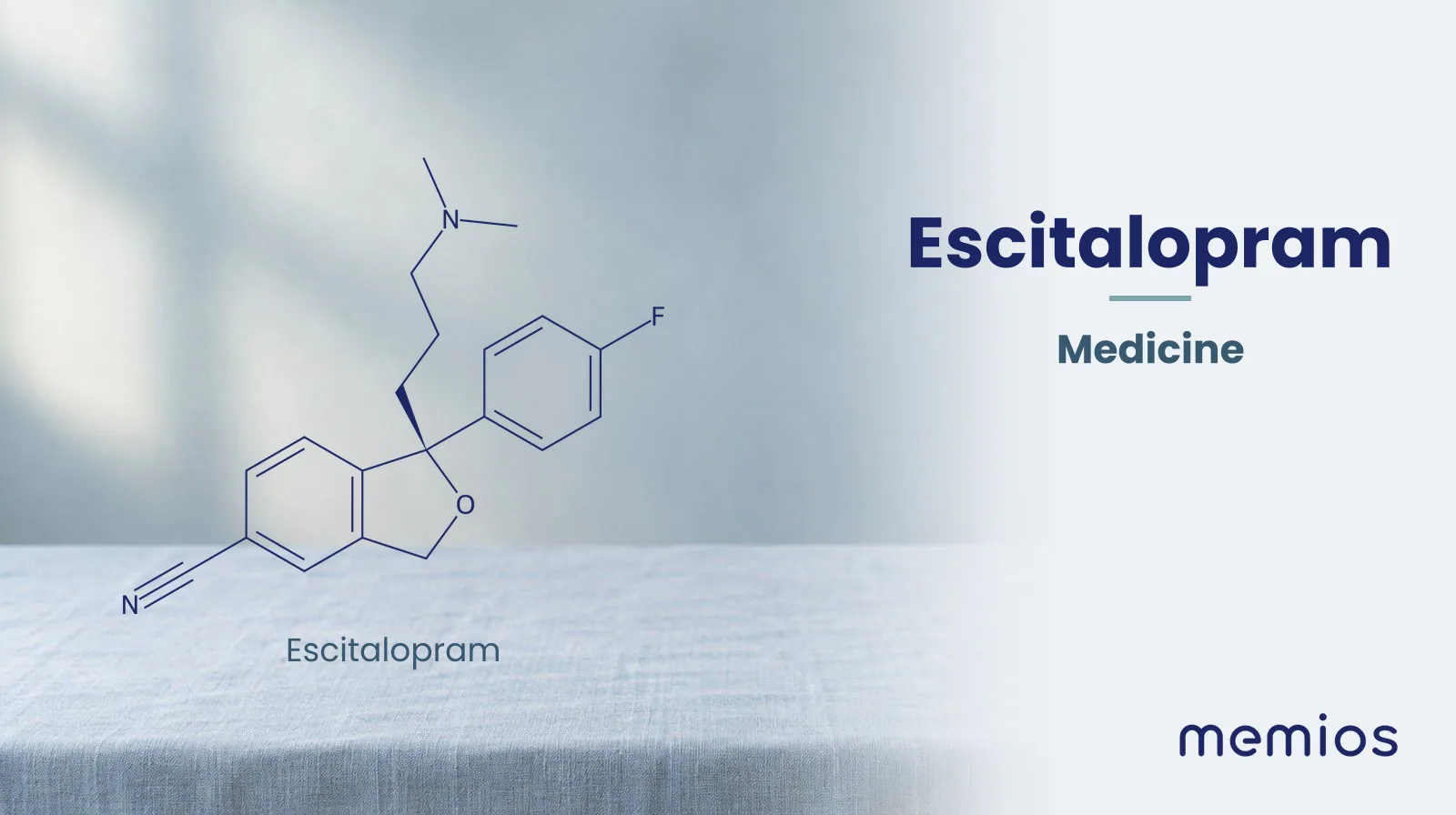
Escitalopram
Large reviews of the trials find escitalopram, like other antidepressants, beats placebo for depression, and it is among the better-tolerated ones in head-to-head trials.
TLDR
- Boxed warning: Lexapro is not approved for use in pediatric patients less than 7 years of age.
- Well established. Large reviews of the trials find escitalopram, like other antidepressants, beats placebo for depression, and it is among the better-tolerated ones in head-to-head trials.
- What it is: Escitalopram is a prescription antidepressant in the selective serotonin reuptake inhibitor (SSRI) class.
- Main use: Major depressive disorder (adults) (well supported).
- Other approved uses: Generalized anxiety disorder (limited evidence).
- Recommended dose (official position): The prescriber sets the dose. As a position, the US label (revised 10/2023) gives 10 mg once daily as the recommended adult dose for depression and anxiety.
- Studied dose (a trial dose, not a recommendation): The anxiety trials fixed the dose at 10 mg/day for 4 weeks, after which increases to 20 mg/day were allowed. Findings citing that trial: 1 for.
- Upper limit: The US label (revised 10/2023) gives 20 mg once daily as the maximum recommended adult dose.
- What goes wrong: 5 findings on harm. In a controlled QT study in 113 healthy volunteers, QTcF lengthened by about 4.5 msec at 10 mg and 10.7 msec at a supratherapeutic 30 mg.
- Interactions: 3 recorded, including St John's wort, tryptophan, triptans, tramadol, other serotonergic drugs, and MAOIs, Aspirin, NSAIDs, warfarin and other anticoagulants, Amphetamines.
- Common myth: Antidepressants like escitalopram have a large effect, and stopping them causes no problems.
What it is
Escitalopram is a prescription antidepressant in the selective serotonin reuptake inhibitor (SSRI) class. In the US it is approved for major depressive disorder in adults and adolescents aged 12 and older, and for generalized anxiety disorder in adults and children aged 7 and older.
What the research says
Large reviews of the trials find escitalopram, like other antidepressants, beats placebo for depression, and it is among the better-tolerated ones in head-to-head trials. How big the benefit is remains disputed: one independent meta-analysis of SSRIs put the average gain below its own threshold for a difference patients would notice, and found more serious adverse events. The trials in anxiety that we could reach were short and industry-funded. Harms include a dose-related lengthening of the QT interval on the ECG, bleeding risk, low sodium, sexual side effects, a boxed warning about suicidal thinking in young people, and withdrawal symptoms when the drug is stopped.
Evidence grade: Well established.
How it works
Drug class: Selective serotonin reuptake inhibitor (SSRI) antidepressant
Escitalopram blocks the reuptake of serotonin by nerve cells, so more serotonin stays active in the brain. The label says its antidepressant action is presumed to be linked to this boost in serotonin activity. (Source 1)
Boxed warning
Antidepressants increased the risk of suicidal thoughts and behaviors in pediatric and young adult patients in short-term studies. Closely monitor all antidepressant-treated patients for clinical worsening, and for emergence of suicidal thoughts and behaviors. Lexapro is not approved for use in pediatric patients less than 7 years of age.
(Source 1)
What it is used for
- A network meta-analysis of 522 trials found every antidepressant, escitalopram included, beat placebo, and escitalopram came out among the more effective and better-tolerated drugs in head-to-head trials. The certainty of that evidence was rated moderate to very low, and how big the benefit is remains disputed. Evidence: established. (Source 2)
- A pooled analysis of three industry-funded 8-week trials (about 850 patients) found escitalopram beat placebo on the Hamilton Anxiety Scale. We could not reach the independent network meta-analyses, so this rating rests on short, sponsor-run trials. Evidence: limited. (Source 3)
Interactions
- St John's wort, tryptophan, triptans, tramadol, other serotonergic drugs, and MAOIs (label): Taking it alongside other serotonergic substances, including St John's wort and tryptophan supplements, raises the risk of serotonin syndrome, which can be life-threatening. (Source 1)
- Aspirin, NSAIDs, warfarin and other anticoagulants (label): Adds to the bleeding risk that SSRIs already carry. (Source 1)
- Amphetamines (label): The label lists amphetamines among the serotonergic drugs that raise the risk of serotonin syndrome. (Source 1)
Stopping it
- According to a press release on Henssler et al. (Lancet Psychiatry 2024), about 31% of people who stop an antidepressant report at least one symptom such as dizziness, headache, nausea, insomnia or irritability. About 17% of people stopping placebo also report such symptoms, so the authors estimate about 15% are directly caused by the drug. (Source 4)
- The label advises lowering the dose gradually rather than stopping abruptly, and says that if symptoms are intolerable the previous dose can be resumed and then reduced more slowly. (Source 1)
What goes wrong
The same meta-analysis found SSRIs raised the risk of serious adverse events: about 31 per 1000 people on an SSRI against 22 per 1000 on placebo. (Source 5)
- Meta-analysis, Low certainty.
- Size: 44 trials reporting serious adverse events.
- Who: Adults with major depressive disorder taking SSRIs.
- How long: Mostly short-term trials.
- Result: OR 1.37 (95% CI 1.08 to 1.75), which is 31/1000 versus 22/1000, or roughly 9 extra serious adverse events per 1000 people treated.
- Funding: Independent (Copenhagen Trial Unit)
This corresponds to 31/1000 SSRI participants will experience a serious adverse event compared with 22/1000 control participants.
In a study of 38,397 patients' ECGs, higher escitalopram doses went with a longer QTc interval. This is an association in routine-care records and does not show that the drug caused the change in each patient. (Source 6)
- Survey study, Low certainty.
- Size: 38,397 adults.
- Who: Adults with an ECG recorded after an antidepressant or methadone prescription, New England health system.
- How long: Records from 1990 to 2011.
- Result: Dose-response with QTc for escitalopram: adjusted beta 0.58 (SE 0.15), P<0.001. The authors call the effect for citalopram modest and describe escitalopram as carrying a similar observed risk.
- Funding: Not stated in the extracted text.
Limit of this finding: The study abstract prints the bupropion result as "adjusted beta 0.02" with no minus sign, while the paper's own results text gives it as −0.02, a shortening of QTc. The abstract figure should not be read as a lengthening effect for bupropion. The escitalopram figure used here is not affected.
escitalopram (adjusted beta 0.58 (0.15), P<0.001)
In a controlled QT study in 113 healthy volunteers, QTcF lengthened by about 4.5 msec at 10 mg and 10.7 msec at a supratherapeutic 30 mg. Blood levels at 30 mg are similar to those expected at 20 mg in people who break the drug down slowly through the CYP2C19 enzyme. (Source 1)
- Randomized trial, Moderate certainty.
- Size: 113 healthy subjects.
- Who: Healthy adults.
- How long: Escalating multiple-dose crossover.
- Result: Maximum mean difference from placebo 4.5 (upper bound 6.4) msec at 10 mg and 10.7 (12.7) msec at 30 mg; predicted 6.6 msec at 20 mg.
- Funding: Manufacturer study reported in the FDA label.
The maximum mean (95% upper confidence bound) difference from placebo arm were 4.5 (6.4) and 10.7 (12.7) msec for 10 mg and supratherapeutic 30 mg escitalopram given once daily, respectively.
A meta-analysis of 79 studies (Henssler et al., Lancet Psychiatry 2024, as reported in a press release) found about 31% of people stopping an antidepressant reported at least one discontinuation symptom, against 17% stopping placebo. The authors put the share caused by the drug itself at about 15%, with severe symptoms in about 3%. (Source 4)
- Meta-analysis, Low certainty.
- Size: 79 studies, 21,002 patients.
- Who: People stopping antidepressants or placebo.
- How long: Varied.
- Result: 31% had at least one symptom after stopping an antidepressant; 17% after stopping placebo in RCTs; severe symptoms in about 3% (1 in 35).
- Funding: No funding source.
Overall, the analysis found that a third (31%) of people who stopped taking an antidepressant experienced at least one symptom, such as dizziness, headache, nausea, insomnia and irritability. Severe symptoms occurred in about 3% (one in 35).
The FDA label states that SSRIs, escitalopram included, raise bleeding risk, and more so when combined with aspirin, NSAIDs or blood thinners. It also lists low sodium (hyponatremia) and sexual dysfunction. (Source 1)
- Official position, Certainty not rated.
- Size: Not applicable.
- Who: People taking escitalopram.
- How long: Not applicable.
- Result: The label gives these as warnings; no rates are quoted here.
- Funding: Regulatory label.
Drugs that interfere with serotonin reuptake inhibition, including Lexapro, increase the risk of bleeding events.
What the evidence supports
In a network meta-analysis of 522 trials, all 21 antidepressants, escitalopram included, were more effective than placebo for adults with major depression, and escitalopram was among the more effective and better-tolerated drugs in head-to-head trials. (Source 2)
- Meta-analysis, Low certainty.
- Size: 522 trials, 116,477 participants.
- Who: Adults with major depressive disorder.
- How long: Acute treatment, about 8 weeks.
- Result: All antidepressants beat placebo, with odds ratios from 1.38 to 2.13. In head-to-head trials escitalopram was among the more effective drugs (OR range 1.12 to 2.00) and among those with fewer dropouts (OR range 0.42 to 0.81). The authors rated certainty moderate to very low.
- Funding: Independent academic review; many included trials were industry-sponsored.
In head-to-head studies, agomelatine, amitriptyline, escitalopram, mirtazapine, paroxetine, sertraline, venlafaxine and vortioxetine were more effective than other antidepressants (OR range: 1.12-2.00)
A pooled analysis of three identical 8-week trials in generalized anxiety disorder found escitalopram beat placebo on the Hamilton Anxiety Scale in each trial. The trials were short, excluded people with other psychiatric or medical illness, and were funded by the manufacturer. (Source 3)
- Randomized trial, Low certainty.
- Size: About 850 patients across 3 RCTs.
- Who: Adults aged 18 to 80 with DSM-IV generalized anxiety disorder, without major depression.
- How long: 8 weeks.
- Result: Escitalopram was superior to placebo in each trial (p<0.05) on change in HAMA score. The abstract gives no between-group point difference.
- Funding: Industry-funded (Forest Laboratories)
In each individual study, escitalopram was significantly superior to placebo (p <0.05) as measured by change from baseline in HAMA score.
What the evidence does not support
A meta-analysis of 131 placebo-controlled SSRI trials found the average improvement on the Hamilton depression scale (1.94 points) was below the authors' threshold for a difference patients would notice, and every trial was at high risk of bias. (Source 5)
- Meta-analysis, Low certainty.
- Size: 131 trials, 27,422 participants.
- Who: Adults with major depressive disorder (all SSRIs, escitalopram included)
- How long: Mostly short-term trials.
- Result: Mean difference -1.94 HDRS points (95% CI -2.50 to -1.37), against a clinical-significance threshold of 3 points set in advance.
- Funding: Independent (Copenhagen Trial Unit)
The effect estimate, however, was below our predefined threshold for clinical significance of 3 HDRS points.
Where the evidence is mixed
The same review rated its own evidence moderate to very low certainty and found only small differences between drugs once placebo-controlled trials were included. (Source 2)
- Meta-analysis, Low certainty.
- Size: 522 trials, 116,477 participants.
- Who: Adults with major depressive disorder.
- How long: Acute treatment.
- Result: Differences in odds ratios between antidepressants ranged from 1.15 to 1.55 for efficacy, with wide confidence intervals.
- Funding: Independent academic review.
The certainty of evidence was moderate to very low.
Where the research disagrees
Whether the antidepressant benefit of SSRIs such as escitalopram is clinically meaningful
- Cipriani et al., network meta-analysis, 2018, Network meta-analysis of 522 double-blind RCTs: All antidepressants were more efficacious than placebo in adults with major depressive disorder. (Source 2)
- Jakobsen et al., meta-analysis with trial sequential analysis, 2017, Meta-analysis of 131 placebo-controlled RCTs: SSRIs might have statistically significant effects on depressive symptoms, but all trials were at high risk of bias and the clinical significance seems questionable. (Source 5)
How much
- Reference intake: The prescriber sets the dose. As a position, the US label (revised 10/2023) gives 10 mg once daily as the recommended adult dose for depression and anxiety. (Source 1)
- Upper limit: The US label (revised 10/2023) gives 20 mg once daily as the maximum recommended adult dose. The label's QT study used a supratherapeutic 30 mg dose. (Source 1)
- Studied: The anxiety trials fixed the dose at 10 mg/day for 4 weeks, after which increases to 20 mg/day were allowed. (Source 3)
- Studied: The QT study gave healthy volunteers 10 mg and 30 mg once daily. (Source 1)
A common belief, and what the research shows
The belief: Antidepressants like escitalopram have a large effect, and stopping them causes no problems.
What the research shows: On average the benefit over placebo is small. One meta-analysis found "The effect estimate, however, was below our predefined threshold for clinical significance of 3 HDRS points." Stopping is not symptom-free either: "a third (31%) of people who stopped taking an antidepressant experienced at least one symptom".
Questions and answers
What is it?
Escitalopram is a prescription antidepressant in the SSRI (selective serotonin reuptake inhibitor) class. In the US it is approved for depression and for generalized anxiety disorder. (Source 1)
What does it do in the body?
It blocks the reuptake of serotonin, so more serotonin stays active in the brain. The label says its antidepressant action is presumed to be linked to this boost in serotonin activity. (Source 1)
Is it good or bad for you?
On average, trials find it helps depression more than placebo, and it is among the better-tolerated antidepressants. The average benefit is small and disputed, and it carries real risks: more serious adverse events than placebo in pooled SSRI trials, a dose-related longer QT interval, bleeding, low sodium, sexual side effects, and withdrawal symptoms. Whether it is good for a given person depends on how severe their illness is and how they respond, which is a decision for them and their prescriber. (Source 5)
How do you get more of it?
Does not apply in the usual sense. Escitalopram is a prescription medicine; the prescriber sets the dose, and the label gives 10 mg daily as the usual adult dose and 20 mg as the maximum. (Source 1)
If it is harmful, what reduces it?
People come off escitalopram by lowering the dose, and the label recommends doing it gradually with the prescriber rather than stopping suddenly. Withdrawal symptoms are common, and severe ones occur in about 3% of people stopping an antidepressant. (Source 1)
Why might someone be low in it or missing it?
Does not apply. Escitalopram is a medicine, not a nutrient or something the body makes, so no one is 'low' in it. Depression is not shown to be a shortage of the drug. (Source 1)
Which whole foods contain it or feed it?
No food contains escitalopram. Supplements matter, though: St John's wort and tryptophan are listed as raising the risk of serotonin syndrome when combined with it. (Source 1)
What happens if you do not have it?
For someone who has been taking it, stopping can bring discontinuation symptoms such as dizziness, headache, nausea, insomnia and irritability. People who never take it are not deficient in anything. (Source 4)
How can you test for it?
Blood levels of escitalopram are not routinely measured. The testing the literature points to is an ECG, because the QT interval lengthens with dose, and people who break the drug down slowly through CYP2C19 reach higher levels. The CYP2C19 link comes from the label. We did not assess how reliable genetic testing is. (Source 1)
References
- US FDA / AbbVie via DailyMed (revised 10/2023). LEXAPRO (escitalopram) prescribing information, DailyMed. 2023. Read the source
- The Lancet (University of Bristol repository record). Comparative efficacy and acceptability of 21 antidepressant drugs for the acute treatment of adults with major depressive disorder: a systematic review and network meta-analysis (accepted manuscript abstract). 2018. DOI 10.1016/S0140-6736(17)32802-7. Read the source
- Journal of Affective Disorders. Treatment of generalized anxiety disorder with escitalopram: Pooled results from double-blind, placebo-controlled trials. 2005. Read the source
- EurekAlert! / The Lancet Psychiatry. The Lancet Psychiatry: One in six people who stop antidepressants will experience discontinuation symptoms as a direct result (press release on Henssler et al., Lancet Psychiatry 2024). 2024. DOI 10.1016/S2215-0366(24)00133-0. Read the source
- BMC Psychiatry. Selective serotonin reuptake inhibitors versus placebo in patients with major depressive disorder. A systematic review with meta-analysis and Trial Sequential Analysis. 2017. DOI 10.1186/s12888-016-1173-2. Read the source
- BMJ. QT interval and antidepressant use: a cross sectional study of electronic health records. 2013. PMID 23360890, DOI 10.1136/bmj.f288. Read the source