Medications · September 30, 2026 · Memios · 13 min read
Empagliflozin
Large placebo-controlled outcome trials, all funded by the manufacturers, show fewer heart failure hospitalisations and cardiovascular deaths in heart failure (reduced and preserved ejection fraction).
TLDR
- Well established. Large placebo-controlled outcome trials, all funded by the manufacturers, show fewer heart failure hospitalisations and cardiovascular deaths in heart failure (reduced and preserved ejection fraction), slower kidney decline in chronic kidney disease.
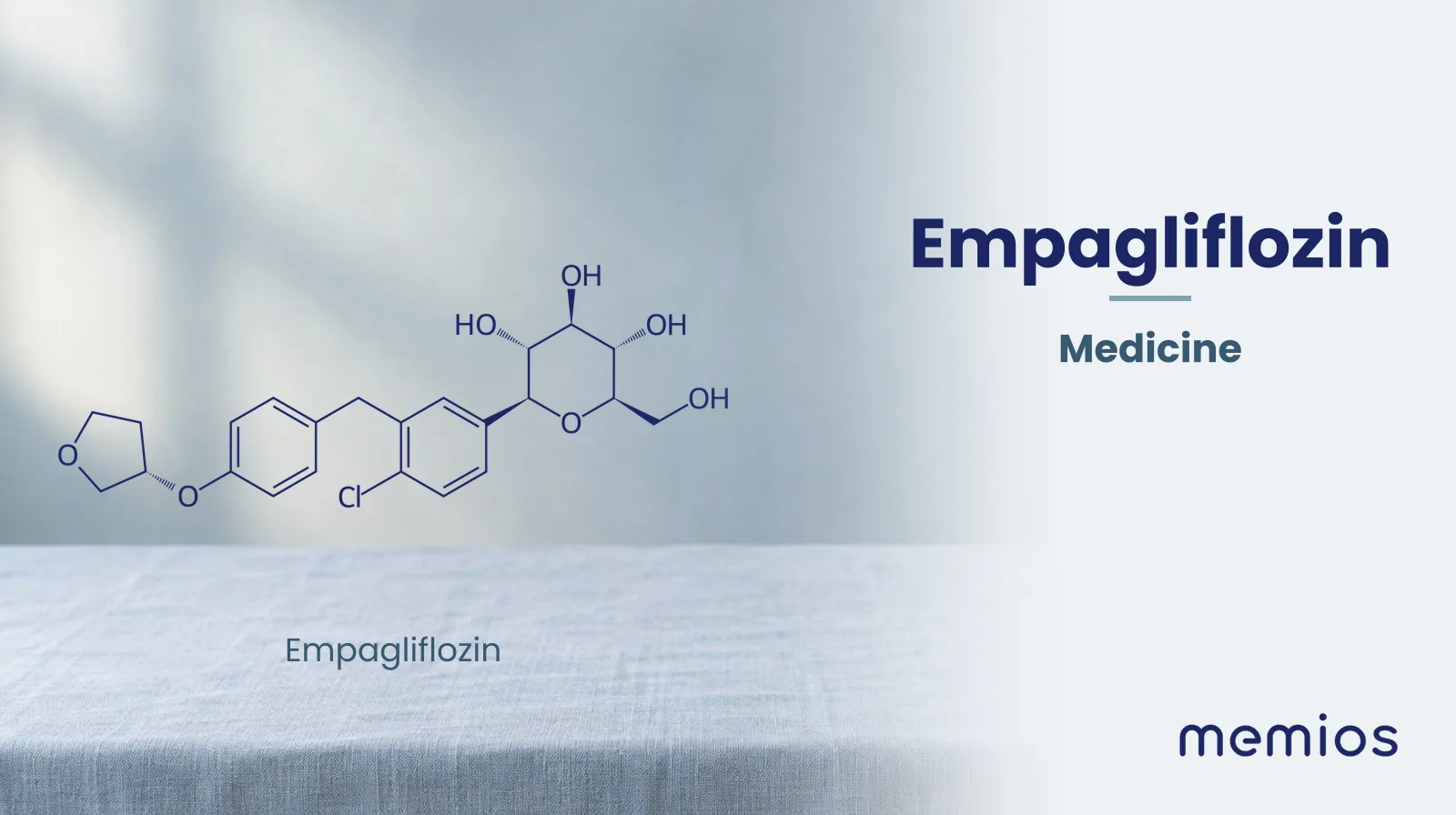
- What it is: Empagliflozin is a prescription tablet in the SGLT2 inhibitor class.
- Main use: Type 2 diabetes with established cardiovascular disease (reduce cardiovascular death) (well supported).
- Other approved uses: Heart failure with reduced ejection fraction (well supported); Heart failure with preserved ejection fraction (well supported); Chronic kidney disease at risk of progression (well supported) and 1 more.
- Uses NOT supported by research: After an acute heart attack (people at risk of heart failure); Type 1 diabetes.
- Recommended dose (official position): Dosing is set by the prescriber. As a position, the US label (revised 1/2026) gives 10 mg once daily, which may be raised to 25 mg for additional blood sugar control.
- Studied dose (a trial dose, not a recommendation): EMPA-REG OUTCOME gave 10 mg or 25 mg once daily versus placebo. Findings citing that trial: 1 for, 1 against, 1 on harm.
- Upper limit: The label's highest listed dose is 25 mg once daily (FDA label, revised 1/2026).
- What goes wrong: 6 findings on harm. Empagliflozin increased genital infections in EMPA-REG OUTCOME, without an increase in other adverse events.
- Interactions: 3 recorded, including Alcohol (heavy use), Ketogenic diet or very low calorie intake, Insulin and insulin secretagogues (e.g. sulfonylureas).
- Common myth: Empagliflozin is only a diabetes drug.
What it is
Empagliflozin is a prescription tablet in the SGLT2 inhibitor class. The FDA label (revised 1/2026) lists four uses: heart failure, chronic kidney disease at risk of progression, lowering cardiovascular death in type 2 diabetes with established cardiovascular disease, and blood sugar control in type 2 diabetes.
What the research says
Large placebo-controlled outcome trials, all funded by the manufacturers, show fewer heart failure hospitalisations and cardiovascular deaths in heart failure (reduced and preserved ejection fraction), slower kidney decline in chronic kidney disease, and fewer cardiovascular deaths in type 2 diabetes with heart disease. It did not significantly reduce the combined outcome in people who had just had a heart attack. Known harms include genital fungal infections, volume depletion and a rare but serious risk of ketoacidosis.
Evidence grade: Well established.
How it works
Drug class: Sodium-glucose cotransporter 2 (SGLT2) inhibitor
Empagliflozin blocks SGLT2, the main transporter in the kidney that pulls filtered glucose back into the blood, so more glucose (and some sodium) leaves in the urine. This lowers blood sugar and has a mild diuretic effect. (Source 1)
What it is used for
- In EMPA-REG OUTCOME (7020 patients, 3.1 years) the main cardiovascular outcome fell from 12.1% to 10.5% (about 1.6 percentage points absolute) and cardiovascular death from 5.9% to 3.7%; heart attack and stroke rates were not significantly different. Evidence: established. (Source 2)
- In EMPEROR-Reduced (3730 patients, median 16 months) cardiovascular death or heart failure hospitalisation occurred in 19.4% on empagliflozin vs 24.7% on placebo, an absolute difference of about 5.3 percentage points. Evidence: established. (Source 3)
- In EMPEROR-Preserved (5988 patients, median 26 months) the primary outcome occurred in 13.8% vs 17.1%, about 3.3 percentage points absolute, driven mainly by fewer heart failure hospitalisations. Evidence: established. (Source 4)
- In EMPA-KIDNEY (6609 patients, median 2 years) kidney progression or cardiovascular death occurred in 13.1% vs 16.9%, about 3.8 percentage points absolute; all-cause death was not significantly different. Evidence: established. (Source 5)
- Approved as an adjunct to diet and exercise; this write-up did not retrieve the glycaemic trials themselves, so the label position is recorded here rather than trial numbers. Evidence: established. (Source 1)
- EMPACT-MI (6522 patients) found no significant reduction in the combined outcome of heart failure hospitalisation or death (8.2% vs 9.1%). Evidence: not-supported. (Source 6)
- The US label states it is not indicated in type 1 diabetes because it markedly increases the risk of ketoacidosis, which has been fatal. Evidence: not-supported. (Source 1)
Interactions
- Alcohol (heavy use) (label): Alcohol abuse is listed as a precipitating condition for ketoacidosis in people taking empagliflozin. (Source 1)
- Ketogenic diet or very low calorie intake (label): Reduced caloric intake and ketogenic diets are listed as precipitating conditions for ketoacidosis. (Source 1)
- Insulin and insulin secretagogues (e.g. sulfonylureas) (label): Adding empagliflozin to these raises the chance of low blood sugar. (Source 1)
Stopping it
- The label advises withholding empagliflozin for at least 3 days, where possible, before surgery or procedures with prolonged fasting, because of ketoacidosis risk. (Source 1)
- When empagliflozin was withdrawn in a blinded way after the EMPEROR heart failure trials, the benefit dissipated within about 30 days; the authors conclude that even short breaks may be harmful. (Source 7)
What goes wrong
Empagliflozin increased genital infections in EMPA-REG OUTCOME, without an increase in other adverse events. (Source 2)
- Randomized trial, High certainty.
- Size: 7020 patients.
- Who: Adults with type 2 diabetes at high cardiovascular risk.
- How long: median 3.1 years.
- Result: Increased rate of genital infection (rate not given in abstract)
- Funding: industry-funded (Boehringer Ingelheim and Eli Lilly)
Among patients receiving empagliflozin, there was an increased rate of genital infection but no increase in other adverse events.
In EMPEROR-Reduced, uncomplicated genital tract infection was more frequent with empagliflozin. (Source 3)
- Randomized trial, High certainty.
- Size: 3730 patients.
- Who: Heart failure with reduced ejection fraction.
- How long: median 16 months.
- Result: More uncomplicated genital infections (rate not given in abstract)
- Funding: industry-funded.
Uncomplicated genital tract infection was reported more frequently with empagliflozin.
In EMPEROR-Preserved, genital and urinary infections and low blood pressure were more common on empagliflozin. (Source 4)
- Randomized trial, High certainty.
- Size: 5988 patients.
- Who: Heart failure with preserved ejection fraction.
- How long: median 26.2 months.
- Result: More uncomplicated genital and urinary tract infections and hypotension (rates not in abstract)
- Funding: industry-funded.
Uncomplicated genital and urinary tract infections and hypotension were reported more frequently with empagliflozin.
Across trials and cohort studies, SGLT2 inhibitors as a class raised the risk of diabetic ketoacidosis about 2.5-fold, though the absolute rate stayed low (0.6 to 2.2 per 1000 person-years in trials). (Source 8)
- Meta-analysis, Moderate certainty.
- Size: 7 RCTs (42,375 participants) and 5 cohort studies (318,636 participants)
- Who: Adults with type 2 diabetes.
- How long: trial and cohort follow-up.
- Result: RR 2.46 (95% CI 1.16-5.21) in RCTs; RR 1.74 (95% CI 1.01-2.93) in observational studies.
- Funding: independent (no funding source)
Among the 7 randomized controlled trials, the absolute rate of DKA among patients randomized to an SGLT2 inhibitor ranged from 0.6 to 2.2 events per 1000 person years.
The US label warns that empagliflozin can cause volume depletion, showing as symptomatic low blood pressure or acute changes in creatinine, with postmarketing reports of acute kidney injury. (Source 1)
- Official position, Certainty not rated.
- Size: label and postmarketing reports.
- Who: People taking empagliflozin.
- How long: not stated.
- Result: No rate given in the text read.
- Funding: label (manufacturer)
JARDIANCE can cause intravascular volume depletion which may sometimes manifest as symptomatic hypotension or acute transient changes in creatinine.
The label warns of postmarketing fatal ketoacidosis and acute kidney injury reports with SGLT2 inhibitors including empagliflozin. (Source 1)
- Official position, Certainty not rated.
- Size: postmarketing reports.
- Who: People with type 2 diabetes.
- How long: postmarketing.
- Result: Case reports; no rate.
- Funding: label.
There have been postmarketing reports of fatal events of ketoacidosis in patients with type 2 diabetes mellitus using SGLT2 inhibitors, including JARDIANCE.
What the evidence supports
In type 2 diabetes with high cardiovascular risk, empagliflozin lowered the composite of cardiovascular death, heart attack or stroke from 12.1% to 10.5%, and cardiovascular death from 5.9% to 3.7%. (Source 2)
- Randomized trial, High certainty.
- Size: 7020 patients.
- Who: Adults with type 2 diabetes at high cardiovascular risk.
- How long: median 3.1 years.
- Result: Primary outcome 10.5% vs 12.1%, HR 0.86 (95.02% CI 0.74 to 0.99); CV death 3.7% vs 5.9%; all-cause death 5.7% vs 8.3%.
- Funding: industry-funded (Boehringer Ingelheim and Eli Lilly)
The primary outcome occurred in 490 of 4687 patients (10.5%) in the pooled empagliflozin group and in 282 of 2333 patients (12.1%) in the placebo group (hazard ratio in the empagliflozin group, 0.86; 95.02% confidence interval, 0.74 to 0.99; P=0.04 for superiority).
In heart failure with ejection fraction 40% or less, cardiovascular death or heart failure hospitalisation occurred in 19.4% on empagliflozin vs 24.7% on placebo. (Source 3)
- Randomized trial, High certainty.
- Size: 3730 patients.
- Who: Class II-IV heart failure, ejection fraction 40% or less, with or without diabetes.
- How long: median 16 months.
- Result: HR 0.75 (95% CI 0.65 to 0.86); absolute difference about 5.3 percentage points.
- Funding: industry-funded (Boehringer Ingelheim and Eli Lilly)
a primary outcome event occurred in 361 of 1863 patients (19.4%) in the empagliflozin group and in 462 of 1867 patients (24.7%) in the placebo group (hazard ratio for cardiovascular death or hospitalization for heart failure, 0.75; 95% confidence interval [CI], 0.65 to 0.86; P<0.001)
In heart failure with ejection fraction above 40%, the primary outcome occurred in 13.8% vs 17.1%, mainly through fewer heart failure hospitalisations. (Source 4)
- Randomized trial, High certainty.
- Size: 5988 patients.
- Who: Class II-IV heart failure, ejection fraction above 40%.
- How long: median 26.2 months.
- Result: HR 0.79 (95% CI 0.69 to 0.90); absolute difference about 3.3 percentage points.
- Funding: industry-funded.
a primary outcome event occurred in 415 of 2997 patients (13.8%) in the empagliflozin group and in 511 of 2991 patients (17.1%) in the placebo group (hazard ratio, 0.79; 95% confidence interval [CI], 0.69 to 0.90; P<0.001). This effect was mainly related to a lower risk of hospitalization for heart failure in the empagliflozin group.
In chronic kidney disease, kidney disease progression or cardiovascular death occurred in 13.1% on empagliflozin vs 16.9% on placebo. (Source 5)
- Randomized trial, High certainty.
- Size: 6609 patients.
- Who: Chronic kidney disease with eGFR 20-45, or 45-90 with albuminuria, with or without diabetes.
- How long: median 2.0 years.
- Result: HR 0.72 (95% CI 0.64 to 0.82); absolute difference about 3.8 percentage points.
- Funding: industry-funded (Boehringer Ingelheim and others)
progression of kidney disease or death from cardiovascular causes occurred in 432 of 3304 patients (13.1%) in the empagliflozin group and in 558 of 3305 patients (16.9%) in the placebo group (hazard ratio, 0.72; 95% confidence interval [CI], 0.64 to 0.82; P<0.001)
What the evidence does not support
EMPA-REG OUTCOME found no significant difference in heart attack or stroke rates, nor in its key secondary outcome. (Source 2)
- Randomized trial, High certainty.
- Size: 7020 patients.
- Who: Adults with type 2 diabetes at high cardiovascular risk.
- How long: median 3.1 years.
- Result: No significant between-group difference in MI or stroke; key secondary outcome P=0.08.
- Funding: industry-funded (Boehringer Ingelheim and Eli Lilly)
There were no significant between-group differences in the rates of myocardial infarction or stroke
EMPA-KIDNEY found no significant difference in heart failure hospitalisation or cardiovascular death, or in death from any cause. (Source 5)
- Randomized trial, High certainty.
- Size: 6609 patients.
- Who: Chronic kidney disease.
- How long: median 2.0 years.
- Result: HF hospitalisation or CV death 4.0% vs 4.6%; all-cause death 4.5% vs 5.1%, not significant.
- Funding: industry-funded.
there were no significant between-group differences with respect to the composite outcome of hospitalization for heart failure or death from cardiovascular causes (which occurred in 4.0% in the empagliflozin group and 4.6% in the placebo group) or death from any cause (in 4.5% and 5.1%, respectively)
After an acute heart attack, empagliflozin did not significantly lower heart failure hospitalisation or death (8.2% vs 9.1%). (Source 6)
- Randomized trial, High certainty.
- Size: 6522 patients.
- Who: Adults hospitalised for acute myocardial infarction at risk of heart failure.
- How long: median 17.9 months.
- Result: HR 0.90 (95% CI 0.76 to 1.06); P = 0.21.
- Funding: industry-funded (Boehringer Ingelheim and Eli Lilly)
Among patients at increased risk for heart failure after acute myocardial infarction, treatment with empagliflozin did not lead to a significantly lower risk of a first hospitalization for heart failure or death from any cause than placebo.
Where the research disagrees
Whether empagliflozin helps soon after a heart attack
- EMPACT-MI investigators (2024), rct: Among patients at increased risk for heart failure after acute myocardial infarction, treatment with empagliflozin did not lead to a significantly lower risk of a first hospitalization for heart failure or death from any cause than placebo. (Source 6)
- Same trial, secondary component, rct (secondary component, not primary): a first hospitalization for heart failure occurred in 118 patients (3.6%) in the empagliflozin group and in 153 patients (4.7%) in the placebo group (hazard ratio, 0.77; 95% CI, 0.60 to 0.98) (Source 6)
How much
- Reference intake: Dosing is set by the prescriber. As a position, the US label (revised 1/2026) gives 10 mg once daily, which may be raised to 25 mg for additional blood sugar control. (Source 1)
- Upper limit: The label's highest listed dose is 25 mg once daily (FDA label, revised 1/2026). (Source 1)
- Studied: EMPA-REG OUTCOME gave 10 mg or 25 mg once daily versus placebo. (Source 2)
- Studied: EMPEROR-Reduced, EMPEROR-Preserved, EMPA-KIDNEY and EMPACT-MI gave 10 mg once daily versus placebo. (Source 3)
A common belief, and what the research shows
The belief: Empagliflozin is only a diabetes drug.
What the research shows: Trials in people with and without diabetes showed benefit in heart failure and kidney disease: "The effect of empagliflozin on the primary outcome was consistent in patients regardless of the presence or absence of diabetes."
Questions and answers
What is it?
Empagliflozin is a prescription tablet that blocks a kidney transporter called SGLT2. It is approved in the US for heart failure, chronic kidney disease, and type 2 diabetes. (Source 1)
What does it do in the body?
By stopping the kidney from reabsorbing glucose, it makes the body pass more glucose and some salt and water in the urine. This lowers blood sugar and takes some fluid off. (Source 1)
Is it good or bad for you?
In heart failure, chronic kidney disease and type 2 diabetes with heart disease, large manufacturer-funded trials show fewer hospitalisations and deaths than placebo. It did not help significantly after a recent heart attack, and it carries risks of genital infections, dehydration and rare ketoacidosis. (Source 3)
How do you get more of it?
Does not apply as a nutrient. It is only available on prescription for the approved conditions; there is no food or behaviour that provides it. (Source 1)
If it is harmful, what reduces it?
It is stopped or paused by the prescriber. The label says to withhold it for at least 3 days before surgery or prolonged fasting, and trial data suggest the heart benefit fades within weeks of stopping. (Source 1)
Why might someone be low in it or missing it?
Does not apply. Empagliflozin is a medicine, not something the body makes or needs from diet. (Source 1)
We searched: FDA label and outcome trials; the concept of deficiency does not apply to a synthetic drug
Which whole foods contain it or feed it?
No food contains empagliflozin. The label notes it can be taken with or without food, and lists ketogenic diets and low calorie intake as ketoacidosis triggers. (Source 1)
What happens if you do not have it?
In the trials, people with heart failure given placebo instead had more cardiovascular deaths and heart failure hospitalisations (for example 17.1% vs 13.8% over about two years in preserved ejection fraction). (Source 4)
How can you test for it?
There is no routine blood test for empagliflozin levels in the sources we read. It causes glucose to appear in urine, which the drug's mechanism explains; monitoring is of kidney function, blood sugar and ketones as clinically needed. (Source 1)
We searched: Jardiance label (DailyMed) and the outcome trial abstracts; no drug-level test described
References
- US FDA label via DailyMed (Boehringer Ingelheim). JARDIANCE (empagliflozin) tablets, prescribing information (DailyMed), Revised 1/2026. 2026. Read the source
- The New England Journal of Medicine. Empagliflozin, Cardiovascular Outcomes, and Mortality in Type 2 Diabetes. 2015. PMID 26378978, DOI 10.1056/NEJMoa1504720. Read the source
- New England Journal of Medicine. Cardiovascular and Renal Outcomes with Empagliflozin in Heart Failure. 2020. PMID 32865377, DOI 10.1056/NEJMoa2022190. Read the source
- New England Journal of Medicine. Empagliflozin in Heart Failure with a Preserved Ejection Fraction. 2021. PMID 34449189, DOI 10.1056/NEJMoa2107038. Read the source
- New England Journal of Medicine. Empagliflozin in Patients with Chronic Kidney Disease. 2023. PMID 36331190, DOI 10.1056/NEJMoa2204233. Read the source
- N Engl J Med. Empagliflozin after Acute Myocardial Infarction. 2024. PMID 38587237, DOI 10.1056/NEJMoa2314051. Read the source
- Circulation. Blinded Withdrawal of Long-Term Randomized Treatment With Empagliflozin or Placebo in Patients With Heart Failure. 2023. DOI 10.1161/CIRCULATIONAHA.123.065748. Read the source
- medRxiv. SGLT2 inhibitors and the risk of diabetic ketoacidosis among adults with Type 2 Diabetes: A systematic review and meta-analysis (preprint). 2021. DOI 10.1101/2021.03.17.21253796. Read the source