Medications · September 29, 2026 · Memios · 17 min read
Duloxetine
Well established. It blocks the reabsorption of the brain chemicals serotonin and norepinephrine.
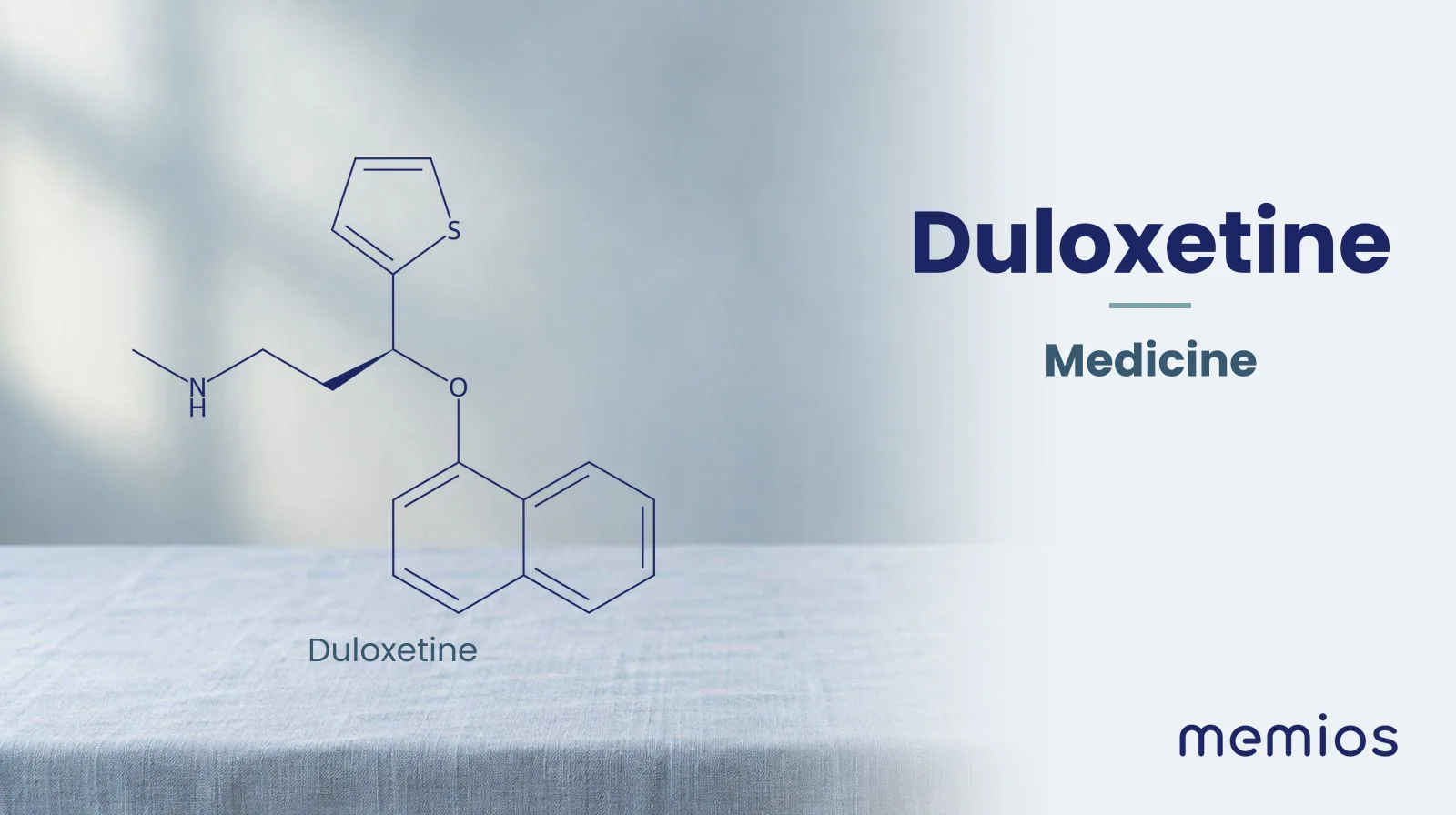
TLDR
- Boxed warning: WARNING: SUICIDAL THOUGHTS AND BEHAVIORS.
- Well established. It blocks the reabsorption of the brain chemicals serotonin and norepinephrine.
- What it is: Duloxetine is a prescription antidepressant of the SNRI class, sold in the US as Cymbalta delayed-release capsules.
- Main use: Major depressive disorder (adults) (well supported).
- Other approved uses: Generalized anxiety disorder (well supported); Diabetic peripheral neuropathic pain (well supported); Fibromyalgia (limited evidence) and 1 more.
- Off-label uses (not on the FDA label): Chemotherapy-induced painful peripheral neuropathy (limited evidence); Stress urinary incontinence in women (approved in the EU, off-label in the US) (disputed).
- Uses NOT supported by research: Central neuropathic pain.
- Recommended dose (official position): Dosing is set by the prescriber. The US label (Cymbalta, revised 8/2023) is a regulator position, not evidence.
- Studied dose (a trial dose, not a recommendation): The Cochrane review found 60 mg and 120 mg a day effective for diabetic nerve pain; lower daily doses were not. Findings citing that trial: 2 for, 1 against, 1 on harm.
- Upper limit: Label maximum (position, 8/2023): 120 mg/day for MDD/GAD, 60 mg/day for DPNP, fibromyalgia and chronic musculoskeletal pain.
- What goes wrong: 6 findings on harm. Across the pain trials, adverse events were more common on duloxetine than placebo and rose with dose.
- Interactions: 5 recorded, including St John's wort, Tryptophan, Alcohol, Fluvoxamine and other potent CYP1A2 inhibitors.
- Common myth: Duloxetine is a strong painkiller for all chronic pain.
What it is
Duloxetine is a prescription antidepressant of the SNRI class, sold in the US as Cymbalta delayed-release capsules. The US label (revised 8/2023) lists it for major depressive disorder, generalized anxiety disorder, diabetic peripheral neuropathic pain, fibromyalgia and chronic musculoskeletal pain.
What the research says
It blocks the reabsorption of the brain chemicals serotonin and norepinephrine. For depression and generalized anxiety, network meta-analyses find it works better than placebo, though duloxetine was among the antidepressants with the highest dropout rates. For diabetic nerve pain the benefit is well shown (about 1 extra person in 5 gets at least half their pain relieved), but almost every trial was run by the manufacturer. For fibromyalgia and back pain the benefit is smaller, and for back pain it is judged not clinically important. Stopping it suddenly often causes withdrawal symptoms.
Evidence grade: Well established.
How it works
Drug class: Serotonin and norepinephrine reuptake inhibitor (SNRI) antidepressant
Duloxetine blocks the nerve-cell pumps that take serotonin and norepinephrine back up, so more of these messengers stay active outside the cell. Laboratory (preclinical) studies describe it as a less potent inhibitor of dopamine reuptake. (Source 1)
Boxed warning
WARNING: SUICIDAL THOUGHTS AND BEHAVIORS
(Source 2)
What it is used for
- A network meta-analysis of 522 trials found every antidepressant, duloxetine included, worked better than placebo. Duloxetine was among the drugs with the highest dropout rates, and certainty of the evidence ranged from moderate to very low. Evidence: established. (Source 3)
- In a network meta-analysis of 89 trials, duloxetine lowered anxiety scores more than placebo (mean difference -3.13 HAM-A points) and was reasonably well tolerated. Evidence: established. (Source 4)
- A Cochrane review found 60 mg a day works over 12 weeks: about 1 extra person in every 5 treated gets at least 50% pain relief (NNTB 5). Almost every study was run or paid for by the manufacturer. Evidence: established. (Source 5)
- Cochrane found a benefit (NNTB 8) with lower-quality evidence, and said an NNTB of 8 does not show substantial efficacy. Evidence: limited. (Source 5)
- An independent BMJ meta-analysis found SNRIs lowered back pain scores, but by a small amount that is not clinically important. For osteoarthritis the certainty was low, and an important effect could not be ruled out. Evidence: disputed. (Source 6)
- One phase III placebo-controlled trial (CALGB 170601, 231 patients) found a larger average fall in pain with duloxetine (-1.09 vs -0.33 points). Grade 2 or worse fatigue was more common on the drug. Evidence: limited. (Source 7)
- A meta-analysis of the clinical study reports held by the European Medicines Agency found a small benefit (number needed to treat 8, in a sensitivity analysis with one trial removed) and frequent harm (number needed to harm 7 for stopping because of an adverse event, i.e. one extra discontinuation for every 7 women treated). The authors concluded the harms outweighed the benefits. Evidence: disputed. (Source 8)
- One small, high-quality trial in the Cochrane review found no effect. Evidence: not-supported. (Source 5)
Interactions
- St John's wort (label): Taking it with duloxetine raises the risk of serotonin syndrome, a potentially life-threatening reaction. (Source 9)
- Tryptophan (label): The label lists tryptophan among the serotonergic substances that raise serotonin syndrome risk when combined with duloxetine. (Source 9)
- Alcohol (label): Duloxetine and alcohol may act together to injure the liver, so the label says it should not be prescribed to people with substantial alcohol use. (Source 10)
- Fluvoxamine and other potent CYP1A2 inhibitors (pharmacokinetic study): In a study of healthy volunteers, fluvoxamine raised duloxetine blood exposure (AUC) by 460%, because duloxetine is broken down mainly by the liver enzyme CYP1A2. (Source 11)
- MAO inhibitors (label): Drugs that stop serotonin being broken down (MAOIs) raise serotonin syndrome risk. (Source 9)
Stopping it
- The label recommends reducing the dose gradually rather than stopping abruptly. If symptoms are intolerable, the previous dose may be resumed and then tapered more slowly. (Source 12)
- In pooled depression trials, most withdrawal events that resolved did so within a week. The authors (manufacturer data) recommended tapering over no less than 2 weeks. (Source 13)
- Withdrawal symptoms were mostly mild or moderate. Of the events that resolved, 65% did so within 7 days. (Source 13)
What goes wrong
Across the pain trials, adverse events were more common on duloxetine than placebo and rose with dose. 16% of participants stopped the drug because of adverse effects. (Source 5)
- Systematic review, Moderate certainty.
- Size: 6,407 participants in 18 trials.
- Who: Adults with chronic pain conditions.
- How long: 12 to 28 weeks.
- Result: 16% stopped because of adverse effects; serious adverse events rare.
- Funding: industry-funded.
Most adverse effects were minor, but 16% of participants stopped the drug due to adverse effects. Serious adverse events were rare.
In head-to-head trials duloxetine was among the antidepressants with the highest dropout rates, and certainty of the evidence was moderate to very low. (Source 3)
- Meta-analysis, Low certainty.
- Size: 522 trials.
- Who: Adults with major depressive disorder.
- How long: acute treatment.
- Result: Dropout OR range 1.30 to 2.32 for the least tolerated group, which included duloxetine.
- Funding: independent.
whereas amitriptyline, clomipramine, duloxetine, fluvoxamine, reboxetine, trazodone, and venlafaxine had the highest dropout rates (1·30-2·32)
In the chemotherapy neuropathy trial, grade 2 or worse fatigue was significantly more common on duloxetine than on placebo. (Source 7)
- Randomized trial, Moderate certainty.
- Size: 231.
- Who: Cancer survivors with painful chemotherapy neuropathy.
- How long: 5 weeks.
- Result: 11% vs 3%, p = 0.029.
- Funding: not stated in abstract.
The incidence of Grade 2+ fatigue, the most commonly reported side effect, was significantly higher in the duloxetine arm as compared to placebo (11% vs. 3%, p = 0.029).
In women with stress urinary incontinence, an analysis of the regulator's full trial reports found that for every 7 women treated with duloxetine rather than placebo there was one extra discontinuation because of an adverse event, and one extra activation event. (Source 8)
- Meta-analysis, Certainty not rated.
- Size: 1,913 patients in 4 trials.
- Who: Women with stress urinary incontinence.
- How long: trial length not stated in abstract.
- Result: Number needed to harm 7 (95% CI 6 to 8) for discontinuing because of an adverse event and 7 (95% CI 6 to 9) for an activation event; number needed to treat 8 (95% CI 6 to 13) for a Patient Global Impression of Improvement rating of much better or very much better, in a sensitivity analysis with one trial removed.
- Funding: not stated in the text we read.
The numbers needed to harm were 7 (95% CI 6 to 8) for discontinuing because of an adverse event and 7 (95% CI 6 to 9) for experiencing an activation event.
In a pooled analysis of manufacturer trials, stopping duloxetine abruptly produced withdrawal ('discontinuation-emergent') symptoms in 44.3% of patients, against 22.9% on placebo. (Source 13)
- Meta-analysis, Low certainty.
- Size: pooled post-hoc analysis of 6 short-term trials plus 3 long-term studies (manufacturer data)
- Who: Adults with major depressive disorder.
- How long: short-term trials of about 8-9 weeks.
- Result: 44.3% vs 22.9% (p < 0.05); dizziness 12.4%, nausea 5.9%, headache 5.3%.
- Funding: not stated in abstract (manufacturer trial data)
discontinuation-emergent adverse events (DEAEs) were reported by 44.3% and 22.9% of duloxetine- and placebo-treated patients, respectively (p < 0.05)
In the manufacturer's placebo-controlled trials, a rise in the liver enzyme ALT to more than 3 times normal occurred in 1.25% of people on duloxetine versus 0.45% on placebo. (Source 10)
- Official position, Certainty not rated.
- Size: 11,496 duloxetine and 8,716 placebo patients.
- Who: Adults in placebo-controlled trials.
- How long: trial durations.
- Result: 1.25% vs 0.45%.
- Funding: industry-funded (manufacturer label)
elevation of ALT >3 times the ULN occurred in 1.25% (144/11,496) of CYMBALTA-treated patients compared to 0.45% (39/8716) of placebo-treated patients
What the evidence supports
Duloxetine 60 mg daily reduced painful diabetic neuropathy over 12 weeks, but almost every trial was run or sponsored by the manufacturer. (Source 5)
- Systematic review, Moderate certainty.
- Size: 6,407 participants in 18 trials (2,728 with diabetic neuropathy in 8 trials)
- Who: Adults with painful diabetic neuropathy, fibromyalgia, pain with depression, or central neuropathic pain.
- How long: 12 weeks (some fibromyalgia data to 28 weeks)
- Result: RR 1.73 (95% CI 1.44 to 2.08) for at least 50% pain reduction; NNTB 5 (95% CI 4 to 7)
- Funding: industry-funded (almost every study performed or sponsored by the manufacturer)
Duloxetine at 60 mg daily is effective in treating painful diabetic peripheral neuropathy in the short term, with a risk ratio (RR) for ≥ 50% pain reduction at 12 weeks of 1.73 (95% CI 1.44 to 2.08). The related NNTB is 5 (95% CI 4 to 7).
Duloxetine also helped fibromyalgia pain and painful symptoms in depression, but with an NNTB of 8 for each. (Source 5)
- Systematic review, Low certainty.
- Size: 2,249 participants with fibromyalgia in 6 trials.
- Who: Adults with fibromyalgia or depression with painful physical symptoms.
- How long: 12 to 28 weeks.
- Result: Fibromyalgia RR 1.57 (95% CI 1.20 to 2.06), NNTB 8; depression-related pain RR 1.37 (95% CI 1.19 to 1.59), NNTB 8.
- Funding: industry-funded.
Duloxetine at 60 mg daily is also effective for fibromyalgia over 12 weeks (RR for ≥ 50% reduction in pain 1.57, 95% CI 1.20 to 2.06; NNTB 8, 95% CI 4 to 21)
In major depression, all 21 antidepressants studied, duloxetine among them, beat placebo on response rate. Duloxetine was among those with the highest dropout rates. (Source 3)
- Meta-analysis, Low certainty.
- Size: 116,477 participants in 522 trials.
- Who: Adults with major depressive disorder.
- How long: acute treatment (about 8 weeks)
- Result: Efficacy ORs versus placebo ranged from 1.37 to 2.13 across drugs; duloxetine was in the group with dropout ORs of 1.30 to 2.32 in head-to-head comparisons.
- Funding: independent (NIHR Oxford Health Biomedical Research Centre; Japan Society for the Promotion of Science)
In terms of efficacy, all antidepressants were more effective than placebo, with ORs ranging between 2·13 (95% credible interval [CrI] 1·89-2·41) for amitriptyline and 1·37 (1·16-1·63) for reboxetine.
In generalized anxiety disorder, duloxetine lowered anxiety scores more than placebo, with relatively good acceptability. (Source 4)
- Meta-analysis, Certainty not rated.
- Size: 25,441 patients in 89 trials.
- Who: Adults with generalized anxiety disorder.
- How long: acute trials.
- Result: HAM-A mean difference -3.13 (95% CrI -4.13 to -2.13) versus placebo.
- Funding: independent (no funding received)
Duloxetine (MD −3·13, 95% credible interval [CrI] −4·13 to −2·13), pregabalin (MD −2·79, 95% CrI −3·69 to −1·91), venlafaxine (MD −2·69, 95% CrI −3·50 to −1·89), and escitalopram (MD −2·45, 95% CrI −3·27 to −1·63) were more efficacious than placebo with relatively good acceptability.
Off-label for chemotherapy nerve pain, one phase III trial found duloxetine lowered pain more than placebo. Moderate fatigue was more common on the drug. (Source 7)
- Randomized trial, Moderate certainty.
- Size: 231 randomized.
- Who: Adults with painful neuropathy after taxane or platinum chemotherapy.
- How long: 5 weeks of treatment per crossover period.
- Result: Mean pain change -1.09 vs -0.33 (p = 0.004); grade 2+ fatigue 11% vs 3%.
- Funding: not stated in abstract (cooperative-group trial, CALGB)
Individuals receiving duloxetine over the initial treatment period had a larger average decrease in pain score (mean change score = -1.09; S.E. = 0.19) than those receiving placebo (mean change score = -0.33; S.E. = 0.18) (p = 0.004).
What the evidence does not support
In one small trial, duloxetine had no effect on central neuropathic pain. (Source 5)
- Randomized trial, Low certainty.
- Size: one small trial.
- Who: Adults with central neuropathic pain.
- How long: not stated in abstract.
- Result: No effect.
- Funding: not stated.
There was no effect on central neuropathic pain in a single, small, high quality trial.
For back pain, SNRIs such as duloxetine reduced pain scores by an amount judged small and not clinically important. (Source 6)
- Meta-analysis, Moderate certainty.
- Size: 5,318 participants in 33 trials (all antidepressant classes)
- Who: Adults with back pain or hip or knee osteoarthritis.
- How long: 3 to 13 weeks.
- Result: Back pain mean difference -5.30 (95% CI -7.31 to -3.30) on a 0-100 scale; osteoarthritis -9.72 (-12.75 to -6.69), low certainty.
- Funding: independent (no specific grant)
Moderate certainty evidence shows that the effect of SNRIs on pain and disability scores is small and not clinically important for back pain, but a clinically important effect cannot be excluded for osteoarthritis.
The same analysis concluded that for stress urinary incontinence the harms outweighed the benefits. (Source 8)
- Meta-analysis, Certainty not rated.
- Size: 1,913 patients in 4 trials.
- Who: Women with stress urinary incontinence.
- How long: not stated.
- Result: Harms outweighed benefits per the authors.
- Funding: not stated in the text we read.
Although duloxetine is effective for stress urinary incontinence in women, the rates of associated harm were high when individual patient data were analyzed, and the harms outweighed the benefits.
Where the research disagrees
Whether duloxetine should be used for stress urinary incontinence in women
- Maund et al., CMAJ 2017 (analysis of clinical study reports submitted to the European Medicines Agency), meta-analysis of 4 RCTs from regulatory clinical study reports: Although duloxetine is effective for stress urinary incontinence in women, the rates of associated harm were high when individual patient data were analyzed, and the harms outweighed the benefits. (Source 8)
How much
- Reference intake: Dosing is set by the prescriber. The US label (Cymbalta, revised 8/2023) is a regulator position, not evidence. It gives a maximum of 120 mg/day for depression and generalized anxiety and 60 mg/day for diabetic nerve pain, fibromyalgia and chronic musculoskeletal pain. (Source 2)
- Upper limit: Label maximum (position, 8/2023): 120 mg/day for MDD/GAD, 60 mg/day for DPNP, fibromyalgia and chronic musculoskeletal pain. (Source 2)
- Studied: The Cochrane review found 60 mg and 120 mg a day effective for diabetic nerve pain; lower daily doses were not. (Source 5)
- Studied: The chemotherapy neuropathy trial gave 30 mg a day for one week, then 60 mg a day for four weeks. (Source 7)
A common belief, and what the research shows
The belief: Duloxetine is a strong painkiller for all chronic pain.
What the research shows: Benefit varies by condition. Cochrane found clear short-term benefit for diabetic nerve pain (NNTB 5) but said that for fibromyalgia and depression-related pain 'the NNTB of 8 in fibromyalgia and depression is not an indication of substantial efficacy'. For back pain an independent meta-analysis found the effect 'small and not clinically important for back pain'.
Questions and answers
What is it?
Duloxetine is a prescription antidepressant (an SNRI), sold in the US as Cymbalta. The US label lists it for depression, generalized anxiety, diabetic nerve pain, fibromyalgia and chronic musculoskeletal pain. (Source 9)
What does it do in the body?
Laboratory studies described in the label show it blocks nerve cells from taking back two chemical messengers, serotonin and norepinephrine, so more of them stay active. The same preclinical studies describe a less potent effect on dopamine reuptake. (Source 1)
Is it good or bad for you?
It depends on the use. For depression, anxiety and diabetic nerve pain, trials show it beats placebo. For back pain the gain is small and not clinically important, and for stress incontinence the harms outweighed the benefits. Side effects are common: in the pain trials 16% stopped because of them. Sudden stopping often causes withdrawal symptoms. (Source 5)
How do you get more of it?
Duloxetine is available only on prescription, and the dose is set by the prescriber. In the pain trials, 60 mg a day was the dose that worked for diabetic nerve pain. (Source 5)
If it is harmful, what reduces it?
When duloxetine is stopped, the label recommends a gradual dose reduction because abrupt stopping can cause withdrawal symptoms. Any change is made with the prescriber. (Source 12)
Why might someone be low in it or missing it?
Does not apply. Duloxetine is a man-made medicine, not a nutrient or body substance, so no one is 'low' in it. The only relevant point in what we read is that the body clears it through the liver enzyme CYP1A2, so levels depend on other drugs such as fluvoxamine. (Source 11)
Which whole foods contain it or feed it?
Does not apply. Duloxetine is a synthetic drug found in no food. No whole food substitutes for it in the literature we searched. (Source 9)
We searched: US label (DailyMed, Cymbalta 8/2023), Cochrane 2014 review, Cipriani 2018, Lobo 2008 pharmacokinetic study
What happens if you do not have it?
For someone who has been taking it, stopping suddenly is the main risk: in depression trials, 44.3% had withdrawal symptoms such as dizziness, nausea and headache, against 22.9% on placebo. For someone who never takes it, no deficiency state exists. (Source 13)
How can you test for it?
The sources we read describe no routine blood test for duloxetine levels. The label's safety data rest on liver enzyme (ALT) tests, which rose to more than 3 times normal in 1.25% on the drug versus 0.45% on placebo. (Source 10)
References
- Eli Lilly and Company (US prescribing information PDF). CYMBALTA (duloxetine) prescribing information, Section 12.2 Pharmacodynamics. Revised 8/2023. 2023. Read the source
- DailyMed, US National Library of Medicine (FDA label). CYMBALTA (duloxetine) delayed-release capsules, prescribing information (Eli Lilly), Boxed Warning. Revised 8/2023. 2023. Read the source
- Lancet. Comparative efficacy and acceptability of 21 antidepressant drugs for the acute treatment of adults with major depressive disorder: a systematic review and network meta-analysis. 2018. PMID 29477251, DOI 10.1016/S0140-6736(17)32802-7. Read the source
- Lancet. Pharmacological treatments for generalised anxiety disorder: a systematic review and network meta-analysis. 2019. PMID 30712879, DOI 10.1016/S0140-6736(18)31793-8. Read the source
- Cochrane Database of Systematic Reviews. Duloxetine for treating painful neuropathy, chronic pain or fibromyalgia. 2014. PMID 24385423, DOI 10.1002/14651858.CD007115.pub3. Read the source
- BMJ. Efficacy and safety of antidepressants for the treatment of back pain and osteoarthritis: systematic review and meta-analysis. 2021. PMID 33472813, DOI 10.1136/bmj.m4825. Read the source
- Journal of Clinical Oncology (ASCO abstract CRA9013), via Duke Scholars. CALGB 170601: A phase III double blind trial of duloxetine to treat painful chemotherapy-induced peripheral neuropathy (CIPN) (conference abstract; full report Smith et al., JAMA 2013;309:1359-67). 2012. Read the source
- CMAJ. Considering benefits and harms of duloxetine for treatment of stress urinary incontinence: a meta-analysis of clinical study reports. 2017. DOI 10.1503/cmaj.151104. Read the source
- DailyMed, US National Library of Medicine (FDA label). CYMBALTA (duloxetine) prescribing information, Sections 1 (Indications), 5.4 (Serotonin Syndrome) and 6.1 (Adverse Reactions). Revised 8/2023. 2023. Read the source
- DailyMed, US National Library of Medicine (FDA label). CYMBALTA (duloxetine) prescribing information, Section 5.2 Hepatotoxicity. Revised 8/2023. 2023. Read the source
- Clinical Pharmacokinetics. In vitro and in vivo evaluations of cytochrome P450 1A2 interactions with duloxetine. 2008. DOI 10.2165/00003088-200847030-00005. Read the source
- DailyMed, US National Library of Medicine (FDA label). CYMBALTA (duloxetine) delayed-release capsules, prescribing information (Eli Lilly), Section 5.7 Discontinuation Syndrome. Revised 8/2023. 2023. Read the source
- Journal of Affective Disorders. Symptoms following abrupt discontinuation of duloxetine treatment in patients with major depressive disorder. 2005. PMID 16266753. Read the source