Medications · September 30, 2026 · Memios · 17 min read
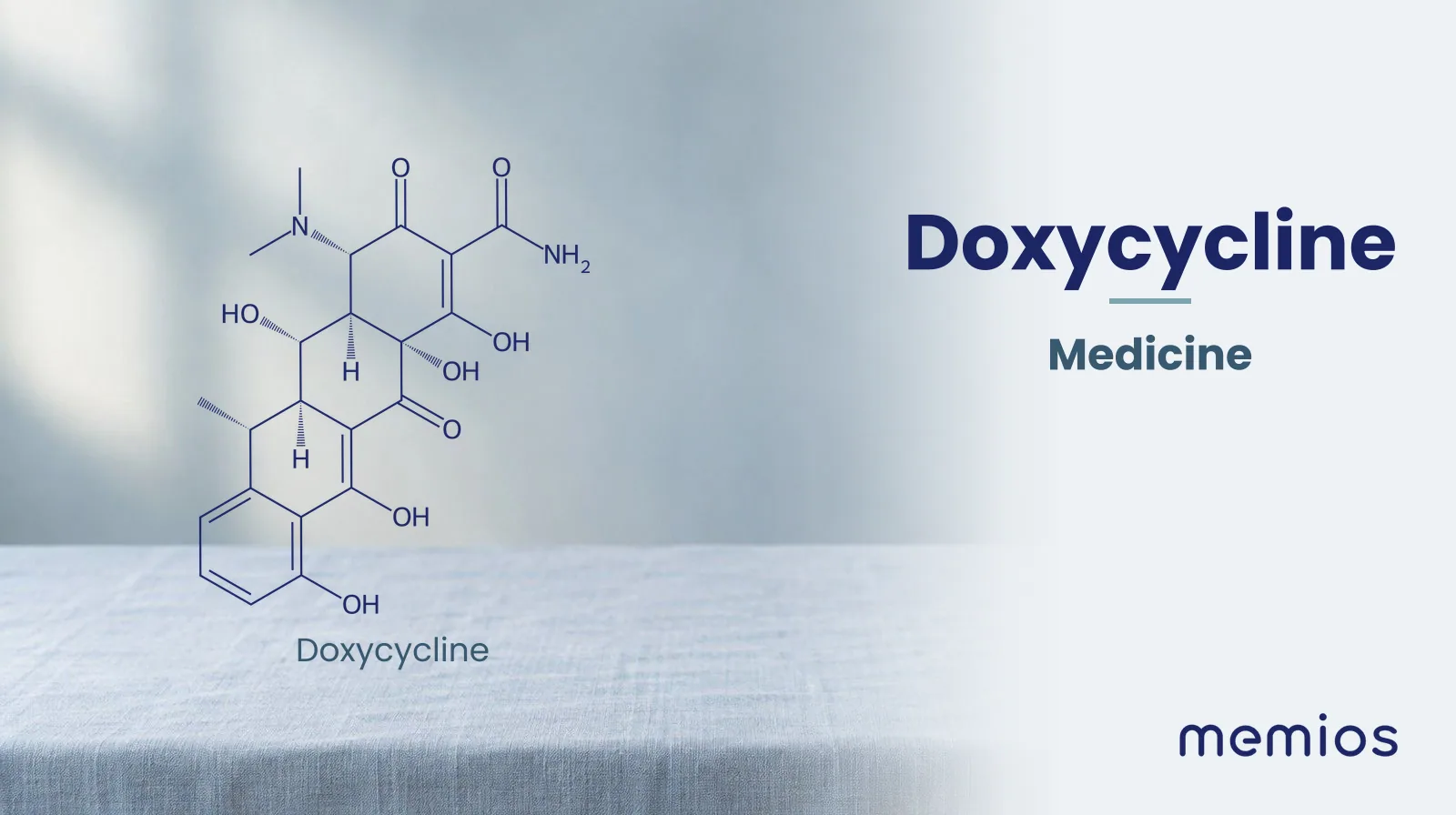
Doxycycline
For the uses where randomised evidence exists the effect sizes differ a lot by condition. Randomised placebo-controlled trials give it a protective efficacy of 84% to 96% against Plasmodium falciparum infection when taken daily for malaria prophylaxis.
TLDR
- Well established. For the uses where randomised evidence exists the effect sizes differ a lot by condition. Randomised placebo-controlled trials give it a protective efficacy of 84% to 96% against Plasmodium falciparum infection when taken daily for malaria prophylaxis.
- What it is: Doxycycline is a semisynthetic tetracycline-class antibacterial taken by mouth or given intravenously, usually as the hyclate or monohydrate salt.
- Main use: Malaria chemoprophylaxis (well supported).
- Other approved uses: Acne vulgaris (limited evidence).
- Off-label uses (not on the FDA label): Post-exposure prophylaxis against bacterial sexually transmitted infections (well supported).
- Uses NOT supported by research: COVID-19 treated in the community.
- Recommended dose (official position): There is no reference intake for a prescription antibiotic; the dose is set by the prescriber. The US label records the usual dose for ADULTS as a position, revised 05/2024; it is not the paediatric dose.
- Studied dose (a trial dose, not a recommendation): 100 mg daily in the randomised placebo-controlled malaria prophylaxis studies. Findings citing that trial: 1 for.
- Upper limit: The US label does not set an upper limit in the way a nutrient reference does; it states the usual ADULT regimen of 200 mg on day one followed by 100 mg/day, as a regulatory position dated 05/2024.
- What goes wrong: 4 findings on harm. Doxycycline for malaria prophylaxis is associated with frequent gastrointestinal symptoms and a sun-exposed rash in up to about one in five users.
- Interactions: 6 recorded, including Calcium, magnesium and aluminium antacids, and iron preparations, Ferrous sulphate (iron supplement), Milk and dairy, Activated charcoal.
- Common myth: Doxycycline must never be given to a child under 8 because it will stain their teeth.
What it is
Doxycycline is a semisynthetic tetracycline-class antibacterial taken by mouth or given intravenously, usually as the hyclate or monohydrate salt. It is bacteriostatic rather than bactericidal: it stops bacteria multiplying rather than killing them outright. It is used for a wide range of bacterial infections and, at sub-antimicrobial doses, for inflammatory skin conditions.
What the research says
For the uses where randomised evidence exists the effect sizes differ a lot by condition. Randomised placebo-controlled trials give it a protective efficacy of 84% to 96% against Plasmodium falciparum infection when taken daily for malaria prophylaxis; an open-label randomised trial found post-exposure doxycycline cut quarterly bacterial STI diagnoses from 31.9% to 10.7% of visits in men who have sex with men on HIV PrEP. In acne it performs no better than azithromycin and worse than isotretinoin on grading scores. In community COVID-19 it did not work. The harms that matter in practice are gastrointestinal upset, sunburn-like photosensitivity, pill-induced oesophagitis, and selection of tetracycline-resistant organisms.
Evidence grade: Well established.
How it works
Drug class: Tetracycline-class antibacterial (protein synthesis inhibitor)
It binds reversibly to the 30S subunit of the bacterial ribosome and blocks transfer RNA from docking, so the bacterium cannot build proteins and stops multiplying. It also binds mitochondrial ribosomes, which is part of why it has effects beyond killing bacteria. (Source 1)
What it is used for
- Three randomised, double-blind, placebo-controlled studies in semi-immune people found daily doxycycline 100 mg gave 84% to 96% protective efficacy against P. falciparum infection. The same report records nausea in 4-33% and a sun-exposed rash in 7.3-21.2% of users. Evidence: established. (Source 2)
- A 2026 systematic review of 23 randomised trials (2,672 patients) found doxycycline no better than azithromycin for treatment success or inflammatory lesion reduction, and worse than some comparators on acne grading scores, with more adverse events reported on doxycycline. Heterogeneity was very high (I2 up to 97%). Evidence: limited. (Source 3)
- In an open-label randomised trial, an STI was diagnosed at 10.7% of quarterly visits on doxycycline versus 31.9% on standard care in the HIV PrEP cohort, an absolute difference of -21.2 percentage points. The same trial found more tetracycline-resistant gonorrhoea in the doxycycline arm. This use is not on the US product label. Evidence: established. (Source 4)
- The PRINCIPLE randomised platform trial stopped randomisation to doxycycline for futility and reported that it is not generally effective for shortening recovery or reducing hospital admission. Evidence: not-supported. (Source 5)
Interactions
- Calcium, magnesium and aluminium antacids, and iron preparations (label): These minerals bind doxycycline in the gut and reduce how much is absorbed. Bismuth subsalicylate does the same. (Source 6)
- Ferrous sulphate (iron supplement) (pharmacokinetic study): In a crossover study in healthy volunteers, iron shortened doxycycline's half-life and lowered its AUC at the lower dose, but the authors concluded a therapeutic level could still be maintained if the two were taken several hours apart. (Source 7)
- Milk and dairy (pharmacokinetic study): Taking doxycycline with milk lowered peak plasma concentration by about a quarter and total absorption by an average of about a third. (Source 8)
- Activated charcoal (pharmacokinetic study): Charcoal adsorbed doxycycline completely in a test tube, but in the volunteers it did not change any measured pharmacokinetic parameter when given after the dose. (Source 7)
- Alcohol (long-term heavy use) (pharmacokinetic study): In people with long-term heavy alcohol use, doxycycline was cleared faster and blood levels could fall below the level needed to work. (Source 9)
- Sunlight and ultraviolet light (label): Not a food or supplement, but the most common avoidable exposure: doxycycline can cause an exaggerated sunburn reaction. Recorded here because the label treats it as an exposure to be managed. (Source 10)
Stopping it
- No dependence or withdrawal syndrome is described for doxycycline in the sources we reached. The stopping question for antibiotics is instead about course length, and a 2017 BMJ analysis argued that the standard advice to always finish the course is not supported by evidence. (Source 11)
- The label ties stopping to one specific harm: treatment should be stopped at the first sign of a sun-related skin reaction. (Source 10)
What goes wrong
Doxycycline for malaria prophylaxis is associated with frequent gastrointestinal symptoms and a sun-exposed rash in up to about one in five users. (Source 12)
- Expert review, not systematic, Low certainty.
- Size: ranges pooled across studies; individual study sizes not given in the passage read.
- Who: people taking doxycycline for malaria prophylaxis.
- How long: prophylaxis courses.
- Result: nausea 4-33%, abdominal pain 12-33%, erythematous rash in sun-exposed areas 7.3-21.2%.
- Funding: not stated; report of a CDC expert meeting.
Gastrointestinal symptoms are usually mild to moderate and include nausea (4–33%) and abdominal pain (12–33%). Nausea has been noted to be more common when doxycycline is ingested without food. An erythematous rash in sun-exposed areas has been reported to occur in 7.3–21.2% of persons taking doxycycline for malaria prophylaxis.
A systematic review of doxycycline phototoxicity found the clinical picture ranges from a sunburn-like sensation to large-area photodermatitis, and that the evidence base is thin. (Source 13)
- Systematic review, Very low certainty.
- Size: not stated; the review says the number of publications is low.
- Who: people taking doxycycline, including travellers on malaria prophylaxis.
- How long: not applicable.
- Result: no pooled rate given; triggering spectrum reported as mainly UVA1 (340-400 nm)
- Funding: not stated.
Clinical symptoms vary from light sunburn-like sensation (burning, erythema) to large-area photodermatitis. Also, onycholysis is possible. The triggering UV spectrum seems to consist mainly of UVA1 (340-400 nm), so UV-protective products should be used that cover this range.
Doxycycline is one of the drugs most often implicated in pill-induced oesophageal injury. (Source 14)
- Case report, Very low certainty.
- Size: one case plus a literature review.
- Who: people taking tetracycline-class capsules or tablets.
- How long: onset typically within hours to days of starting.
- Result: antibiotics account for 50-60% of drug-related oesophageal toxicity; no denominator-based rate is given.
- Funding: not stated.
Antibiotics account for 50-60% of drug related esophageal toxicity and tetracyclines, in particular doxycycline, are commonly implicated.
In the doxyPEP trial tetracycline-resistant gonorrhoea was more common among cultured isolates in the doxycycline arms. (Source 4)
- Randomized trial, Very low certainty.
- Size: 29 participants with gonorrhoea culture available.
- Who: trial participants with culturable N. gonorrhoeae.
- How long: trial follow-up.
- Result: 5 of 13 in the doxycycline groups versus 2 of 16 in the standard-care groups.
- Funding: not stated in the passage read.
Of the participants with gonorrhea culture available, tetracycline-resistant gonorrhea occurred in 5 of 13 in the doxycycline groups and 2 of 16 in the standard-care groups.
What the evidence supports
In randomised placebo-controlled trials in semi-immune people, daily doxycycline 100 mg was reported to give protective efficacy against P. falciparum infection of 84%, 92.6% and 96%, with confidence intervals that the report itself prints inconsistently. (Source 2)
- Expert review, not systematic, Moderate certainty.
- Size: three randomised, double-blinded, placebo-controlled studies (numbers not given in the passage read)
- Who: semi-immune adults in malaria-endemic areas.
- How long: not stated in the passage read.
- Result: protective efficacy 84% (95% CI 79.9-97.5%), 92.6% (95% CI 79.9-97.5%) and 96% (95% CI 85.4-99.6%)
- Funding: not stated; report of a CDC expert meeting.
Limit of this finding: The CDC report prints an impossible set of numbers here, and the quote reproduces them as printed rather than tidying them up. It gives the same 95% confidence interval, 79.9 to 97.5%, for two different results, 84% and 92.6%. A range of 79.9 to 97.5% cannot sit around a figure of 84%, so at least one of these intervals is wrong in the published report. Read the three efficacy figures as showing that daily doxycycline gave substantial protection in these trials, and do not read any precision into the intervals. A second limit: the people studied were semi-immune, meaning they had lived with repeated malaria exposure, so these figures do not transfer to a traveller with no previous exposure.
Three randomized, double-blinded, placebo-controlled studies showed that in semi-immune patients, 100 mg of doxycycline daily had a protective efficacy of 84% (95% confidence interval [CI] = 79.9–97.5%), 92.6% (95% CI = 79.9–97.5%), and 96% (95% CI = 85.4–99.6%) for P. falciparum infections.
Post-exposure doxycycline reduced the proportion of quarterly visits at which a bacterial STI was diagnosed, with the absolute difference reported. (Source 4)
- Randomized trial, Moderate certainty.
- Size: 501 participants (327 PrEP cohort, 174 people living with HIV)
- Who: men who have sex with men and transgender women with a bacterial STI in the past year.
- How long: quarterly visits over the trial period.
- Result: PrEP cohort 10.7% vs 31.9% of visits, absolute difference -21.2 percentage points, RR 0.34 (95% CI 0.24-0.46; P<0.001); PLWH cohort 11.8% vs 30.5%, absolute difference -18.7 percentage points, RR 0.38 (95% CI 0.24-0.60)
- Funding: not stated in the passage read; open-label design.
In the PrEP cohort, an STI was diagnosed in 61 of 570 quarterly visits (10.7%) in the doxycycline group and 82 of 257 quarterly visits (31.9%) in the standard-care group, for an absolute difference of −21.2 percentage points and a relative risk of 0.34 (95% confidence interval [CI], 0.24 to 0.46; P<0.001).
What the evidence does not support
A 2026 meta-analysis found doxycycline no better than azithromycin for acne and found no significant difference in inflammatory lesion reduction. (Source 3)
- Meta-analysis, Low certainty.
- Size: 23 RCTs, 2,672 patients.
- Who: people with acne vulgaris.
- How long: not stated in the abstract read.
- Result: treatment success OR 1.28 (95% CI 0.54-3.04), p=0.57, I2=60%; inflammatory lesion reduction MD -0.71 (95% CI -8.61 to 7.19), p=0.86, I2=97%.
- Funding: not stated in the abstract read.
Doxycycline showed similar efficacy to azithromycin in achieving treatment success (OR 1.28; 95% CI [0.54, 3.04], p = 0.57; I2 = 60%), with no significant difference in inflammatory lesion reduction (MD -0.71; 95% CI [-8.61, 7.19], p = 0.86; I2 = 97%).
The PRINCIPLE randomised platform trial found doxycycline was not generally effective for community-treated COVID-19. (Source 5)
- Randomized trial, Moderate certainty.
- Size: 798 allocated doxycycline vs 994 usual care (numbers from the trial's own results page)
- Who: UK community patients at higher risk of adverse outcomes with suspected COVID-19.
- How long: time to self-reported recovery and 28-day hospitalisation.
- Result: randomisation stopped for futility; benefit judged less than 1 day on recovery and less than 2% on hospitalisation.
- Funding: UK National Institute for Health Research (platform trial)
Doxycycline is not generally an effective treatment for reducing the time to recovery or risk of hospital admission from COVID-19.
Where the evidence is mixed
Ferrous sulphate lowered doxycycline serum half-life and AUC at the lower dose but did not change serum levels at the higher dose, so the iron interaction is dose- and timing-dependent rather than absolute. (Source 7)
- Blood level study, Low certainty.
- Size: two small groups of healthy volunteers (numbers not stated in the abstract)
- Who: healthy volunteers.
- How long: 24-hour sampling, repeated at one-week intervals.
- Result: no change in serum level or urinary excretion after 200 mg + 200 mg; reduced 24-h urinary excretion, half-life and AUC after 100 mg + 100 mg.
- Funding: not stated.
Ferrous sulphate or charcoal did not modify the serum level or urinary excretion of DC after the 200 mg+200 mg dose, but ferrous sulphate did reduce the 24-h urinary excretion of DC after the 100 mg+100 mg dose.
A 2025 systematic review and meta-analysis of short-course doxycycline in children under 8 reported a pooled proportion of adverse events of 0.21 and concluded tooth-related adverse events were minimal. (Source 15)
- Meta-analysis, Very low certainty.
- Size: five studies, 162 children under 8 years.
- Who: children under 8 given short courses of doxycycline.
- How long: median treatment duration 8.5 days.
- Result: pooled proportion of adverse events 0.21 (95% CI 0.13-0.28)
- Funding: Model Rural Health Research Unit scheme, Department of Health Research, Government of India.
We found a pooled proportion of adverse events of 0.21 (95% CI: 0.13–0.28).
Where the research disagrees
Whether doxycycline stains the teeth of children under 8 the way older tetracyclines did
- US Food and Drug Administration product label, revised 05/2024, position: The use of drugs of the tetracycline class, including doxycycline, during tooth development (last half of pregnancy, infancy and childhood to the age of 8 years) may cause permanent discoloration of the teeth (yellow-gray-brown). (Source 16)
- Systematic review and meta-analysis of short-term doxycycline in children under 8 (Frontiers in Pharmacology, 2025), meta-analysis of five studies in 162 children: This review suggests that the occurrence of teeth-related adverse events with short-term doxycycline use is minimal, with a low incidence reported. While these findings offer a preliminary basis for the use of doxycycline in children under 8 years of age, the limited number of studies underscore the need for further research to evaluate its therapeutic use and implication for paediatric guidelines. (Source 17)
How much
- Reference intake: There is no reference intake for a prescription antibiotic; the dose is set by the prescriber. The US label records the usual dose for ADULTS as a position, revised 05/2024; it is not the paediatric dose. (Source 18)
- Upper limit: The US label does not set an upper limit in the way a nutrient reference does; it states the usual ADULT regimen of 200 mg on day one followed by 100 mg/day, as a regulatory position dated 05/2024. (Source 18)
- Studied: 100 mg daily in the randomised placebo-controlled malaria prophylaxis studies (Source 2)
- Studied: 0.2 g as a single oral dose in the milk bioavailability crossover study (Source 8)
- Studied: 100 mg or 200 mg twice-daily regimens in the iron and charcoal pharmacokinetic study (Source 7)
A common belief, and what the research shows
The belief: Doxycycline must never be given to a child under 8 because it will stain their teeth.
What the research shows: The tooth-staining warning was built on older tetracyclines, and the label still carries it: "The use of drugs of the tetracycline class, including doxycycline, during tooth development (last half of pregnancy, infancy and childhood to the age of 8 years) may cause permanent discoloration of the teeth (yellow-gray-brown)." The recent paediatric literature is more reassuring about short courses: a 2025 meta-analysis of five studies in 162 children states that "This review suggests that the occurrence of teeth-related adverse events with short-term doxycycline use is minimal, with a low incidence reported." The same authors immediately add that "the limited number of studies underscore the need for further research to evaluate its therapeutic use and implication for paediatric guidelines." That evidence base is small (162 children) and the pooled adverse-event proportion was still 0.21, so this is a revision of the old certainty rather than a clearance.
Questions and answers
What is it?
Doxycycline is a tetracycline-class antibiotic given as a capsule, tablet or injection. It works by jamming the machinery bacteria use to make proteins. Because it stops bacteria multiplying rather than killing them, it is described as bacteriostatic. (Source 1)
What does it do in the body?
In the body it blocks bacterial protein synthesis, and it also acts on mitochondrial ribosomes, which is thought to underlie some of its anti-inflammatory effects used in skin conditions. The practical result is that susceptible bacteria stop multiplying while the immune system clears them. (Source 1)
Is it good or bad for you?
It depends entirely on the situation. For malaria prevention and for bacterial STI post-exposure prophylaxis the randomised evidence shows substantial benefit. For community COVID-19 it did nothing. Against that, gastrointestinal symptoms and sun-related rash are common enough that a sizeable minority of long-term users get one. (Source 12)
How do you get more of it?
Doxycycline is a prescription medicine, not a nutrient, so there is no way to get more of it from food or lifestyle and no reason to try. The amount a person takes is decided by the prescriber. The US label records the usual ADULT regimen as a regulatory position dated 05/2024; paediatric dosing is set separately and by weight. (Source 18)
If it is harmful, what reduces it?
Nothing in the literature we reached is used deliberately to clear doxycycline from the body. Several ordinary things reduce how much gets absorbed in the first place: milk lowered peak levels by about a quarter, and calcium, magnesium, aluminium and iron products bind it in the gut. Stopping the drug is the way it leaves the body, over roughly half a day to a day. (Source 8)
Why might someone be low in it or missing it?
The question of being low in it applies only while taking it. Blood levels can end up lower than intended if it is swallowed with milk, calcium, magnesium, aluminium antacids or iron, and in people with long-term heavy alcohol use it is cleared faster. (Source 6)
Which whole foods contain it or feed it?
No whole food contains doxycycline. The food question that does matter is the opposite one: dairy taken at the same time reduces absorption, and the pharmacokinetic study that measured this concluded the two should not be taken together. (Source 8)
What happens if you do not have it?
Not having doxycycline is the normal state; it is only relevant when there is an infection to treat or prevent. Stopping a course is a separate question from never taking it, and the evidence does not support the common claim that stopping early drives resistance. (Source 11)
How can you test for it?
There is no routine clinical test for doxycycline levels. Blood concentrations can be measured, and research studies do so: the pharmacokinetic work on iron and charcoal used fluorimetric assay of serum samples over 24 hours. In ordinary care, treatment is judged by whether the infection resolves, not by a drug level. (Source 7)
References
- Clinical Medicine: Therapeutics (SAGE). Safety and Efficacy Review of Doxycycline. 2009. DOI 10.4137/CMT.S2035. Read the source
- American Journal of Tropical Medicine and Hygiene. Doxycycline for Malaria Chemoprophylaxis and Treatment: Report from the CDC Expert Meeting on Malaria Chemoprophylaxis. 2011. PMID 21460003, DOI 10.4269/ajtmh.2011.10-0285. Read the source
- Saudi Pharmaceutical Journal (Springer). Efficacy and safety of oral doxycycline for acne vulgaris treatment: A systematic review and meta-analysis. 2026. PMID 41843344, DOI 10.1007/s44446-026-00066-2. Read the source
- New England Journal of Medicine. Postexposure Doxycycline to Prevent Bacterial Sexually Transmitted Infections. 2023. PMID 37018493, DOI 10.1056/NEJMoa2211934. Read the source
- PRINCIPLE Trial, University of Oxford. Results — PRINCIPLE Trial (doxycycline arm). 2021. Read the source
- US Food and Drug Administration. Doxycycline Capsules, USP — prescribing information (DRUG INTERACTIONS). 2024. Read the source
- European Journal of Clinical Pharmacology (Springer) 1978;14(4):277-280. Modification of the pharmacokinetics of doxycycline in man by ferrous sulphate or charcoal. 1978. PMID 729621, DOI 10.1007/BF00560462. Read the source
- Infection (Springer). Influence of milk on the bioavailability of doxycycline — new aspects. 1989. PMID 2767766, DOI 10.1007/BF01639529. Read the source
- Antimicrobial Agents and Chemotherapy. Fact versus Fiction: a Review of the Evidence behind Alcohol and Antibiotic Interactions. 2020. PMID 31871085, DOI 10.1128/AAC.02167-19. Read the source
- US Food and Drug Administration. Doxycycline Capsules, USP — prescribing information (photosensitivity). 2024. Read the source
- BMJ. The antibiotic course has had its day. 2017. PMID 28747365, DOI 10.1136/bmj.j3418. Read the source
- American Journal of Tropical Medicine and Hygiene. Doxycycline for Malaria Chemoprophylaxis and Treatment: Report from the CDC Expert Meeting on Malaria Chemoprophylaxis. 2011. PMID 21460003, DOI 10.4269/ajtmh.2011.10-0285. Read the source
- Skin Pharmacology and Physiology (Karger). Phototoxicity of Doxycycline: A Systematic Review on Clinical Manifestations, Frequency, Cofactors, and Prevention. 2017. PMID 28291967, DOI 10.1159/000458761. Read the source
- Gastroenterology Research. Simultaneous Esophageal and Gastric Ulceration Due to Doxycycline Ingestion: Case Report and Review of the Literature. 2012. PMID 27785214, DOI 10.4021/gr498w. Read the source
- Frontiers in Pharmacology. Dental safety of short-term doxycycline use in children under 8 years: a systematic review and meta-analysis. 2025. DOI 10.3389/fphar.2025.1646638. Read the source
- US Food and Drug Administration. Doxycycline Capsules, USP — prescribing information (tooth development). 2024. Read the source
- Frontiers in Pharmacology. Dental safety of short-term doxycycline use in children under 8 years: a systematic review and meta-analysis. 2025. DOI 10.3389/fphar.2025.1646638. Read the source
- US Food and Drug Administration. Doxycycline Capsules, USP — prescribing information (DOSAGE AND ADMINISTRATION). 2024. Read the source