Medications · September 29, 2026 · Memios · 24 min read
Diclofenac
Diclofenac is among the most effective oral anti-inflammatory painkillers and among the most cardiovascularly risky.
TLDR
- Boxed warning: These events can occur at any time during use and without warning symptoms.
- Well established. Diclofenac is among the most effective oral anti-inflammatory painkillers and among the most cardiovascularly risky.
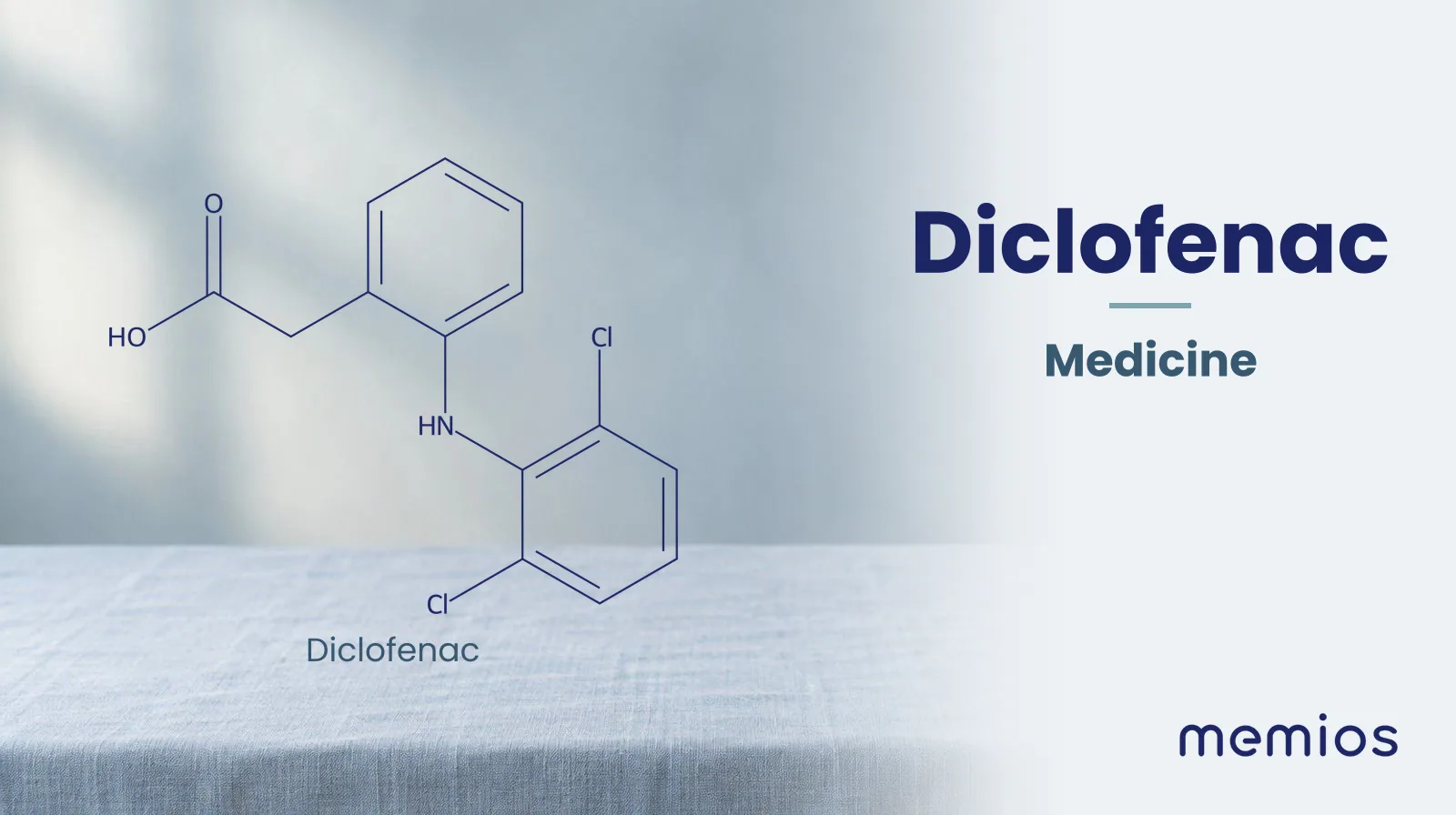
- What it is: Diclofenac is a phenylacetic acid derivative and one of the most widely used non-steroidal anti-inflammatory drugs in the world.
- Main use: Osteoarthritis (oral) (well supported).
- Other approved uses: Rheumatoid arthritis (oral) (limited evidence); Ankylosing spondylitis (oral) (limited evidence); Knee osteoarthritis (topical gel, solution or patch) (well supported).
- Off-label uses (not on the FDA label): Acute sprains, strains and soft tissue injuries (topical) (limited evidence).
- Recommended dose (official position): There is no reference intake for a medicine. The dose is set by the prescriber, and the FDA label states it as a regulatory position: for the relief of osteoarthritis, the recommended dosage is 100-150 mg/day in divided doses (50 mg b.i.d. or t.i.d., or 75 mg b.i.d.).
- Studied dose (a trial dose, not a recommendation): The 2021 network meta-analysis evaluated oral diclofenac at 150 mg/day and topical diclofenac at 70-81 and 140-160 mg/day in knee and hip osteoarthritis. Findings citing that trial: 1 for, 1 on harm.
- Upper limit: No consumer upper limit exists.
- What goes wrong: 11 findings on harm. Against placebo, diclofenac increased major vascular events by about a third in randomised trials.
- Interactions: 7 recorded, including Alcohol, Selective serotonin reuptake inhibitor antidepressants, Warfarin and other anticoagulants, Aspirin and other antiplatelet drugs.
- Common myth: Diclofenac is an ordinary painkiller, so a short course or a low dose is harmless.
What it is
Diclofenac is a phenylacetic acid derivative and one of the most widely used non-steroidal anti-inflammatory drugs in the world. It is taken by mouth as delayed-release or extended-release tablets, and is also applied to the skin as a gel, solution or patch, given by injection, and used as eye drops. The oral sodium salt is the form carrying the boxed warning quoted below.
What the research says
Diclofenac is among the most effective oral anti-inflammatory painkillers and among the most cardiovascularly risky. A 192-trial network meta-analysis put diclofenac 150 mg/day among the five oral preparations most likely to beat the minimum clinically important pain reduction in knee and hip osteoarthritis. The same drug roughly doubles heart failure hospitalisation, raises major vascular events by about a third against placebo, and in Danish nationwide data raised the rate of cardiovascular events by 50% against non-users. Applied to the skin it keeps much of the pain effect with far less systemic exposure.
Evidence grade: Well established.
How it works
Drug class: Non-steroidal anti-inflammatory drug (NSAID), phenylacetic acid derivative, non-selective cyclo-oxygenase inhibitor with relative COX-2 preference
Injured or inflamed tissue makes prostaglandins, signalling chemicals that produce pain, swelling and fever. Diclofenac blocks the enzyme that manufactures them. The same enzyme protects the stomach lining and helps platelets and blood vessels behave normally, which is why the pain relief and the bleeding and cardiovascular risks come from one mechanism, not two. (Source 1)
Boxed warning
CARDIOVASCULAR RISK Cardiovascular Thrombotic Events Nonsteroidal anti-inflammatory drugs (NSAIDs) cause an increased risk of serious cardiovascular thrombotic events, including myocardial infarction and stroke, which can be fatal. This risk may occur early in treatment and may increase with duration of use [see WARNINGS and PRECAUTIONS]. Diclofenac sodium delayed-release tablets are contraindicated in the setting of coronary artery bypass graft (CABG) surgery [see CONTRAINDICATIONS and WARNINGS]. GASTROINTESTINAL RISK NSAIDs cause an increased risk of serious gastrointestinal adverse events including inflammation, bleeding, ulceration, and perforation of the stomach or intestines, which can be fatal. These events can occur at any time during use and without warning symptoms. Elderly patients are at greater risk for serious gastrointestinal events. [see WARNINGS].
(Source 2)
What it is used for
- A network meta-analysis of 192 trials in 102,829 participants found diclofenac 150 mg/day among the most effective oral NSAIDs for pain and function in knee and hip osteoarthritis, with at least 99% probability of exceeding the minimal clinically relevant pain reduction. The same analysis found an increased risk of dropping out because of adverse events at that dose. Evidence: established. (Source 3)
- The label approves diclofenac for relief of the signs and symptoms of rheumatoid arthritis at 150-200 mg/day. The outcome literature retrieved in this search covers knee and hip osteoarthritis rather than rheumatoid arthritis, so the strength of evidence for this specific indication is not established from the sources here. Evidence: limited. (Source 4)
- An approved indication at 100-125 mg/day, but again no systematic review specific to ankylosing spondylitis was retrieved here; this use rests on the label as a regulatory position rather than on trials read in this search. Evidence: limited. (Source 4)
- A 2025 meta-analysis of topical diclofenac formulations found the patch gave the largest short-term pain relief (standardised mean difference -0.64) with skin and systemic adverse events and withdrawals remaining low, and graded the evidence moderate to high. The 2021 network meta-analysis recommends topical diclofenac 70-81 mg/day as first-line pharmacological treatment for knee osteoarthritis. Evidence: established. (Source 5)
- US topical diclofenac products are indicated for arthritis, so use on an acute sprain is off-label there. A meta-analysis of 26 placebo-controlled trials of topical NSAIDs as a class in acute pain found a pooled relative benefit of 1.6 and a number needed to treat of 3.8, with adverse events no different from placebo. The evidence is class-level rather than diclofenac-specific. Evidence: limited. (Source 6)
Interactions
- Alcohol (cohort study): Drinking raises the gastrointestinal bleeding risk that NSAIDs already create, and the effect grows with the amount drunk. In a 26-year cohort of men, the bleeding risk in NSAID or aspirin users rose steadily with alcohol intake. (Source 7)
- Selective serotonin reuptake inhibitor antidepressants (systematic review and network meta-analysis of observational studies): Both NSAIDs and SSRIs impair platelet function. Taking them together raised the odds of gastrointestinal bleeding by about half compared with an NSAID alone. (Source 8)
- Warfarin and other anticoagulants (label): The bleeding effects multiply rather than add: people on both a coumarin anticoagulant and an NSAID bleed from the gut more often than people on either drug by itself. (Source 9)
- Aspirin and other antiplatelet drugs (case-control study): In a large European case-control study the risk of upper gastrointestinal bleeding was significantly higher in people taking antiplatelet drugs, and higher again in people with a past peptic ulcer or bleed. (Source 10)
- Food (pharmacokinetic study): Eating does not reduce how much diclofenac is absorbed overall; it delays the start of absorption by one to four and a half hours and lowers the peak slightly. Taking it with food therefore changes when it works, not how much drug you get, and does not remove the bleeding risk. (Source 1)
- Angiotensin receptor blockers and ACE inhibitors, for example valsartan (label): Combining an NSAID with a renin-angiotensin blocker can worsen kidney function, including possible acute kidney failure, and blunts the blood pressure control. (Source 11)
- Aspirin (label): The label states that aspirin reduces diclofenac's protein binding, that the clinical significance of this is not known, and that taking the two together is not generally recommended because of the potential for increased adverse effects. (Source 12)
Stopping it
- Diclofenac does not cause dependence in the sense opioids do, but regular use for headache can create medication-overuse headache. The review, describing the International Classification of Headache Disorders, sets the threshold for simple analgesics including NSAIDs at 15 or more days per month for more than 3 months. (Source 13)
- When an overused analgesic is withdrawn there is a definite withdrawal period, described as lasting up to about ten days for analgesics, after which headache frequency and intensity generally improve. (Source 14)
- Withdrawal is the treatment rather than a reason to avoid stopping: the review states that, generally, drug withdrawal and detoxification will improve headache intensity and frequency. (Source 15)
What goes wrong
The same analysis judged oral diclofenac unsuitable for long-term use or for people with other conditions, and found more dropouts from adverse events. (Source 3)
- Meta-analysis, Moderate certainty.
- Size: as above.
- Who: adults with knee or hip osteoarthritis.
- How long: as above.
- Result: 29.8% of oral NSAIDs showed an increased risk of any adverse event and 18.5% an increased risk of dropouts due to adverse events, against 0% of topical NSAIDs.
- Funding: not stated in the retrieved text.
However, these treatments are probably not appropriate for patients with comorbidities or for long term use because of the slight increase in the risk of adverse events. Additionally, an increased risk of dropping out due to adverse events was found for diclofenac 150 mg/day.
Against placebo, diclofenac increased major vascular events by about a third in randomised trials. (Source 16)
- Meta-analysis, High certainty.
- Size: individual participant data from 280 trials of NSAID versus placebo and 474 of one NSAID versus another.
- Who: adults in randomised NSAID trials, largely arthritis populations.
- How long: trials of at least four weeks.
- Result: diclofenac rate ratio for major vascular events 1·41 (1·12–1·78, p=0·0036)
- Funding: UK Medical Research Council and British Heart Foundation, per the collaboration's reports; not stated in the retrieved passage.
Compared with placebo (or, in a few cases, allocation to no NSAID treatment), the risk of major vascular events was increased by about a third in those allocated to a coxib (307 [1·15% per annum] coxib vs 175 [0·82% per annum] placebo; rate ratio [RR] 1·37, 95% CI 1·14–1·66, p=0·0009) or diclofenac (1·41, 1·12–1·78, p=0·0036)
The absolute size of that vascular harm is about three extra major vascular events per 1000 people treated for a year, one of them fatal. (Source 17)
- Meta-analysis, High certainty.
- Size: as above.
- Who: as above.
- How long: per year of treatment.
- Result: three more major vascular events per 1000 patients allocated to a coxib or diclofenac for a year, one of which was fatal.
- Funding: not stated in the retrieved passage.
Compared with placebo, of 1000 patients allocated to a coxib or diclofenac for a year, three more had major vascular events, one of which was fatal.
In this pooled trial data every NSAID regimen studied, diclofenac among them, roughly doubled hospitalisation for heart failure. (Source 18)
- Meta-analysis, High certainty.
- Size: as above.
- Who: as above.
- How long: trial durations.
- Result: coxib 2·28 (95% CI 1·62–3·20); diclofenac 1·85 (1·17–2·94); ibuprofen 2·49 (1·19–5·20); naproxen 1·87 (1·10–3·16)
- Funding: not stated in the retrieved passage.
The risk of hospitalisation due to heart failure was roughly doubled by all NSAID regimens studied (coxib 2·28, 95% CI 1·62–3·20, p<0·0001; diclofenac 1·85, 1·17–2·94, p=0·0088; ibuprofen 2·49, 1·19–5·20, p=0·0155; naproxen 1·87, 1·10–3·16, p=0·0197)
In Danish nationwide data, people starting diclofenac had 50% more cardiovascular events than people starting nothing, and more than people starting paracetamol, ibuprofen or naproxen. (Source 19)
- Cohort study, Moderate certainty.
- Size: a series of nationwide cohorts of Danish adults.
- Who: adults initiating diclofenac, paracetamol, ibuprofen, naproxen, or nothing.
- How long: 30-day follow-up after initiation.
- Result: incidence rate ratio 1.5 (95% CI 1.4 to 1.7) versus non-initiators, 1.2 (1.1 to 1.3) versus paracetamol and versus ibuprofen, 1.3 (1.1 to 1.5) versus naproxen.
- Funding: The funding sources had no role in the design, conduct, analysis, or reporting of the study.
The adverse event rate among diclofenac initiators increased by 50% compared with non-initiators (incidence rate ratio 1.5, 95% confidence interval 1.4 to 1.7), 20% compared with paracetamol or ibuprofen initiators (both 1.2, 1.1 to 1.3), and 30% compared with naproxen initiators (1.3, 1.1 to 1.5).
The excess applied to every component of the endpoint, including myocardial infarction and cardiac death, and to low doses. (Source 19)
- Cohort study, Moderate certainty.
- Size: as above.
- Who: as above.
- How long: 30 days.
- Result: 1.2 (1.1 to 1.4) atrial fibrillation/flutter, 1.6 (1.3 to 2.0) ischaemic stroke, 1.7 (1.4 to 2.0) heart failure, 1.9 (1.6 to 2.2) myocardial infarction, 1.7 (1.4 to 2.1) cardiac death.
- Funding: as above.
The event rate for diclofenac initiators increased for each component of the combined endpoint (1.2 (1.1 to 1.4) for atrial fibrillation/flutter, 1.6 (1.3 to 2.0) for ischaemic stroke, 1.7 (1.4 to 2.0) for heart failure, 1.9 (1.6 to 2.2) for myocardial infarction, and 1.7 (1.4 to 2.1) for cardiac death) as well as for low doses of diclofenac, compared with non-initiators.
Starting diclofenac raised the risk of upper gastrointestinal bleeding about 4.5-fold within 30 days compared with not starting it. (Source 19)
- Cohort study, Moderate certainty.
- Size: as above.
- Who: as above.
- How long: 30 days.
- Result: approximately 4.5-fold versus no initiation, 2.5-fold versus ibuprofen or paracetamol initiation, similar to naproxen.
- Funding: as above.
Diclofenac initiation also increased the risk of upper gastrointestinal bleeding at 30 days, by approximately 4.5-fold compared with no initiation, 2.5-fold compared with initiation of ibuprofen or paracetamol, and to a similar extent as naproxen initiation.
Pooled observational studies put diclofenac's relative risk of upper gastrointestinal complications at 3.34, in the middle of the NSAID range. (Source 20)
- Meta-analysis, Moderate certainty.
- Size: 28 cohort and case-control studies published 1980 to 2011.
- Who: NSAID users compared with non-users.
- How long: varied.
- Result: diclofenac RR 3.34 (95% CI 2.79, 3.99), against ibuprofen 1.84 (1.54, 2.20), naproxen 4.10 (3.22, 5.23), piroxicam 7.43 (5.19, 10.63) and ketorolac 11.50 (5.56, 23.78)
- Funding: European Community's Seventh Framework Programme (SOS project)
2 to less than 4 for rofecoxib (RR 2.32; 95% CI 1.89, 2.86), sulindac (RR 2.89; 95% CI 1.90, 4.42), diclofenac (RR 3.34; 95% CI 2.79, 3.99)
NSAIDs as a class accounted for 38% of hospital-treated upper gastrointestinal bleeds in a large European case-control study. (Source 10)
- Case-control study, Moderate certainty.
- Size: 2,813 cases and 7,193 matched controls from 18 hospitals in Spain and Italy.
- Who: community cases of upper gastrointestinal bleeding in adults over 18.
- How long: study experience of 10,734,897 person-years.
- Result: incidence 401.4 per million adults per year; 38% of cases attributable to NSAIDs; risks dose dependent.
- Funding: not stated in the retrieved text.
The incidence of upper gastrointestinal bleeding was 401.4 per million inhabitants aged >18 years. Thirty-eight percent of cases were attributable to NSAIDs. Individual risks for each NSAID were dose dependent.
Raised liver enzymes are common on chronic oral diclofenac, while clinically apparent liver disease with jaundice is rare. (Source 21)
- Expert review, not systematic, Moderate certainty.
- Size: LiverTox synthesis of trials, registries and case reports.
- Who: people taking oral diclofenac chronically.
- How long: onset usually within 2 to 6 months.
- Result: aminotransferase elevations in up to 15%, above three times the upper limit of normal in 2% to 4%; clinically apparent injury in 1 to 5 cases per 100,000 prescriptions.
- Funding: US government publication.
Elevated serum aminotransferase levels have been reported in up to 15% of patients taking oral diclofenac chronically, but are greater than 3 times the upper limit of normal in only 2% to 4% (Cases 1 and 2). Clinically apparent and symptomatic liver disease with jaundice due to diclofenac is rare (1 to 5 cases per 100,000 prescriptions, occurring in 1 to 5 persons per 10,000 exposed).
Women appear more susceptible to diclofenac liver injury than men. (Source 22)
- Expert review, not systematic, Low certainty.
- Size: case series summarised by LiverTox.
- Who: people with diclofenac hepatotoxicity.
- How long: not applicable.
- Result: greater susceptibility among women; genetic linkage suggested with variants of UGT 2B7, CYP 2C8 and ABC C2.
- Funding: US government publication.
There seems to be greater susceptibility for diclofenac liver injury among women than men.
What the evidence supports
Diclofenac 150 mg/day is among the most effective oral NSAIDs for osteoarthritis pain and function. (Source 3)
- Meta-analysis, Moderate certainty.
- Size: 192 trials, 102,829 participants.
- Who: adults with knee or hip osteoarthritis.
- How long: trial durations varied.
- Result: diclofenac 150 mg/day among five oral preparations with at least 99% probability of a treatment effect more pronounced than the minimal clinically relevant reduction in pain; topical diclofenac 70-81 and 140-160 mg/day at least 92.3% probability.
- Funding: not stated in the retrieved text.
Five oral preparations (diclofenac 150 mg/day, etoricoxib 60 and 90 mg/day, and rofecoxib 25 and 50 mg/day) had ≥99% probability of more pronounced treatment effects than the minimal clinically relevant reduction in pain.
Topical diclofenac has been associated with only a low rate of serum enzyme elevations, generally under 1%, which may be no greater than with placebo or vehicle. (Source 23)
- Expert review, not systematic, Low certainty.
- Size: LiverTox synthesis.
- Who: users of topical diclofenac.
- How long: not applicable.
- Result: generally less than 1% serum enzyme elevations with topical forms.
- Funding: US government publication.
Topical forms of diclofenac (solutions, gels, creams, patches) have been associated with only a low rate of serum enzyme elevations (generally less than 1%) that may be no greater than occurs with placebo or vehicle application.
Topical NSAIDs in acute pain beat placebo, with a number needed to treat of 3.8 for at least half pain relief at seven days. (Source 6)
- Meta-analysis, Low certainty.
- Size: 26 placebo-controlled trials, 2,853 patients.
- Who: adults with acute painful conditions such as sprains and strains.
- How long: about one week.
- Result: pooled relative benefit 1.6 (95% CI 1.4 to 1.7); NNT 3.8 (95% CI 3.4 to 4.4) for half pain relief at seven days.
- Funding: not stated.
Topical NSAID was significantly better than placebo in 19 of the 26 trials, with a pooled relative benefit of 1.6 (95% confidence interval 1.4 to 1.7), and NNT of 3.8 (95% confidence interval 3.4 to 4.4) compared with placebo for the outcome of half pain relief at seven days.
What the evidence does not support
In a meta-analysis of topical diclofenac formulations for knee osteoarthritis, skin reactions, systemic side effects and withdrawal rates all stayed low across every formulation. (Source 5)
- Meta-analysis, Moderate certainty.
- Size: randomised trials of gel, solution and patch.
- Who: adults with knee osteoarthritis.
- How long: 1 to 12 weeks.
- Result: patch standardised mean difference for pain -0.64 (95% CI -0.90 to -0.39) at 1-2 weeks; skin-related adverse events, systemic side effects and withdrawal rates low across all formulations.
- Funding: not stated.
skin-related adverse events, systemic side effects and withdrawal rates remained low across all formulations
In the same meta-analysis, adverse events and withdrawals due to adverse events with topical NSAIDs were rare and no different from placebo. (Source 24)
- Meta-analysis, Moderate certainty.
- Size: 2,853 patients across 26 double blind placebo controlled trials.
- Who: adults with acute pain from sprains, strains and other soft tissue injury.
- How long: up to seven days.
- Result: local adverse events, systemic adverse events and withdrawals for adverse events were rare and no different between topical NSAID and placebo.
- Funding: not stated.
Local adverse events, systemic adverse events, or withdrawals due to an adverse event were rare, and no different between topical NSAID and placebo.
Where the research disagrees
Whether oral diclofenac should still be a routine choice for osteoarthritis pain
- BMJ network meta-analysis, 2021, network meta-analysis of 192 randomised trials: Etoricoxib 60 mg/day and diclofenac 150 mg/day seem to be the most effective oral NSAIDs for pain and function in patients with osteoarthritis. (Source 3)
- Coxib and traditional NSAID Trialists' Collaboration, 2013, meta-analysis of individual participant data from randomised trials: The vascular risks of high-dose diclofenac, and possibly ibuprofen, are comparable to coxibs, whereas high-dose naproxen is associated with less vascular risk than other NSAIDs. (Source 25)
- Danish nationwide cohort studies, 2018, series of nationwide cohort studies: Diclofenac poses a cardiovascular health risk compared with non-use, paracetamol use, and use of other traditional non-steroidal anti-inflammatory drugs. (Source 19)
Whether the same risk applies to diclofenac on the skin as to diclofenac swallowed
- BMJ network meta-analysis, 2021, network meta-analysis: Topical diclofenac 70-81 mg/day seems to be effective and generally safer because of reduced systemic exposure and lower dose, and should be considered as first line pharmacological treatment for knee osteoarthritis. (Source 3)
- LiverTox, narrative review of trials, registries and case reports: only a low rate of serum enzyme elevations (generally less than 1%) (Source 21)
How much
- Reference intake: There is no reference intake for a medicine. The dose is set by the prescriber, and the FDA label states it as a regulatory position: for the relief of osteoarthritis, the recommended dosage is 100-150 mg/day in divided doses (50 mg b.i.d. or t.i.d., or 75 mg b.i.d.). (Source 26)
- Upper limit: No consumer upper limit exists. The highest daily dose the label states for any indication is the rheumatoid arthritis range of 150-200 mg/day in divided doses; ankylosing spondylitis is 100-125 mg/day. These are regulatory maxima, not safety thresholds derived from the harms literature, which finds risk at low doses too. (Source 26)
- Studied: The 2021 network meta-analysis evaluated oral diclofenac at 150 mg/day and topical diclofenac at 70-81 and 140-160 mg/day in knee and hip osteoarthritis. (Source 3)
- Studied: The Danish cohort studies found the increased cardiovascular event rate applied to low doses of diclofenac as well as higher ones. (Source 19)
A common belief, and what the research shows
The belief: Diclofenac is an ordinary painkiller, so a short course or a low dose is harmless.
What the research shows: Dose and duration do not remove the cardiovascular signal. The Danish cohort studies report the excess applied "as well as for low doses of diclofenac, compared with non-initiators", and the harm was measured over a 30-day window. In randomised trials the absolute size is small but real: "The absolute excess risks were small but serious: compared with placebo, allocation to a coxib or diclofenac caused around three additional major vascular events per 1000 participants per year, with one such event causing death."
Questions and answers
What is it?
Diclofenac is a non-steroidal anti-inflammatory drug, sold as tablets, skin gels and solutions, patches, injections and eye drops. It is one of the most widely used anti-inflammatory painkillers in the world. In the United States the oral delayed-release tablets are prescription-only and carry a boxed warning. (Source 1)
What does it do in the body?
It blocks the enzyme that makes prostaglandins, the chemicals that drive pain, swelling and fever in inflamed tissue. Because the same prostaglandins protect the stomach lining and help regulate platelets and blood vessels, blocking them is also what produces the bleeding and cardiovascular risks. (Source 1)
Is it good or bad for you?
Both, and the balance depends on the route and the person. Oral diclofenac 150 mg/day is among the most effective NSAIDs for osteoarthritis pain, but the boxed warning records an increased risk of fatal heart attacks, strokes and gastrointestinal bleeds, and the trial data put the excess at about three major vascular events per 1000 people per year. Topical diclofenac keeps much of the benefit with far lower systemic exposure. (Source 2)
How do you get more of it?
Diclofenac is a medicine, not something the body needs, so there is no reason to seek more of it. Doses are set by the label and the prescriber: for the relief of osteoarthritis 100-150 mg/day in divided doses, and for rheumatoid arthritis 150-200 mg/day. Trials of the topical forms used 70-81 or 140-160 mg/day. (Source 26)
If it is harmful, what reduces it?
Where diclofenac is doing harm, the route is to reduce exposure: use the topical form instead of the oral one where the condition allows, since systemic exposure is much lower, or stop the drug. The 2021 network meta-analysis concluded that topical diclofenac 70-81 mg/day is effective and generally safer because of reduced systemic exposure and lower dose. (Source 3)
Why might someone be low in it or missing it?
Not applicable in the nutritional sense; nobody is deficient in diclofenac. People stop or never start it for good reasons: a history of heart disease, heart failure, stomach ulcer or bleeding, kidney impairment, pregnancy, recent coronary artery bypass surgery, or bleeding while on an anticoagulant or an SSRI. (Source 2)
Which whole foods contain it or feed it?
No food contains diclofenac. Food changes its timing rather than its total absorption, delaying onset by one to four and a half hours. Alcohol is the dietary exposure that matters most: in a 26-year cohort, gastrointestinal bleeding risk in NSAID and aspirin users rose with the amount drunk. (Source 7)
What happens if you do not have it?
Nothing is lost physiologically. What changes is pain control: in knee and hip osteoarthritis, diclofenac 150 mg/day was one of only five oral preparations with at least a 99% probability of beating the minimal clinically relevant pain reduction, so people without it may need another option for equivalent relief. (Source 3)
How can you test for it?
There is no routine test for diclofenac levels. Monitoring targets the harms instead: liver enzymes, because aminotransferase rises occur in up to 15% of chronic oral users and exceed three times the upper limit in 2% to 4%; plus blood count, kidney function and blood pressure. None of these predicts who will have a cardiovascular event. (Source 21)
References
- DailyMed, US National Library of Medicine (labeler: NuCare Pharmaceuticals, Inc.). DICLOFENAC SODIUM DELAYED RELEASE tablet (FDA prescribing information): clinical pharmacology and adverse reactions. 2024. Read the source
- DailyMed, US National Library of Medicine (labeler: RedPharm Drug, Inc.). DICLOFENAC SODIUM tablet, delayed release (FDA prescribing information): BOXED WARNING. 2025. Read the source
- BMJ. Effectiveness and safety of non-steroidal anti-inflammatory drugs and opioid treatment for knee and hip osteoarthritis: network meta-analysis. 2021. PMID 34642179, DOI 10.1136/bmj.n2321. Read the source
- DailyMed, US National Library of Medicine (labeler: RedPharm Drug, Inc.). DICLOFENAC SODIUM tablet, delayed release (FDA prescribing information): INDICATIONS AND USAGE. 2025. Read the source
- BMC Musculoskeletal Disorders. Efficacy and safety of different topical diclofenac formulations for the treatment of knee osteoarthritis: a meta-analysis of short-term and long-term treatment comparisons. 2025. DOI 10.1186/s12891-025-08465-7. Read the source
- BMC Family Practice. Topical NSAIDs for acute pain: a meta-analysis — Abstract Results: efficacy. 2004. DOI 10.1186/1471-2296-5-10. Read the source
- PLOS ONE. A Prospective Study of Alcohol Consumption and Smoking and the Risk of Major Gastrointestinal Bleeding in Men. 2016. DOI 10.1371/journal.pone.0165278. Read the source
- Digestive Diseases and Sciences. Risk of Gastrointestinal Bleeding with Concurrent Use of NSAID and SSRI: A Systematic Review and Network Meta-Analysis. 2023. DOI 10.1007/s10620-022-07788-y. Read the source
- DailyMed, US National Library of Medicine (labeler: Direct_Rx). VOLTAREN- diclofenac sodium d/r tablet, delayed release (FDA prescribing information): DRUG INTERACTIONS, warfarin. 2023. Read the source
- Drug Safety. Upper Gastrointestinal Bleeding Associated with the Use of NSAIDs: Newer Versus Older Agents. 2004. DOI 10.2165/00002018-200427060-00005. Read the source
- DailyMed, US National Library of Medicine. VALSARTAN- valsartan tablet, film coated (FDA prescribing information): section 7 DRUG INTERACTIONS, NSAIDs including selective COX-2 inhibitors. 2023. Read the source
- DailyMed, US National Library of Medicine (labeler: Direct_Rx). VOLTAREN- diclofenac sodium d/r tablet, delayed release (FDA prescribing information): DRUG INTERACTIONS, aspirin. 2023. Read the source
- Frontiers in Pain Research. Medication overuse headache: a review of current evidence and management strategies. 2023. DOI 10.3389/fpain.2023.1194134. Read the source
- Frontiers in Pain Research. Medication overuse headache: a review of current evidence and management strategies. 2023. DOI 10.3389/fpain.2023.1194134. Read the source
- Frontiers in Pain Research. Medication overuse headache: a review of current evidence and management strategies. 2023. DOI 10.3389/fpain.2023.1194134. Read the source
- Lancet. Vascular and upper gastrointestinal effects of non-steroidal anti-inflammatory drugs: meta-analyses of individual participant data from randomised trials — Results: major vascular events. 2013. PMID 23726390, DOI 10.1016/S0140-6736(13)60900-9. Read the source
- Lancet. Vascular and upper gastrointestinal effects of non-steroidal anti-inflammatory drugs: meta-analyses of individual participant data from randomised trials — Findings: absolute excess risk. 2013. PMID 23726390, DOI 10.1016/S0140-6736(13)60900-9. Read the source
- Lancet. Vascular and upper gastrointestinal effects of non-steroidal anti-inflammatory drugs: meta-analyses of individual participant data from randomised trials — Results: heart failure. 2013. PMID 23726390, DOI 10.1016/S0140-6736(13)60900-9. Read the source
- BMJ. Diclofenac use and cardiovascular risks: series of nationwide cohort studies. 2018. PMID 30181258, DOI 10.1136/bmj.k3426. Read the source
- Drug Safety. Individual NSAIDs and Upper Gastrointestinal Complications: A Systematic Review and Meta-Analysis of Observational Studies (the SOS Project). 2012. DOI 10.1007/BF03261999. Read the source
- National Institute of Diabetes and Digestive and Kidney Diseases (NCBI Bookshelf). Diclofenac - LiverTox: Clinical and Research Information on Drug-Induced Liver Injury. 2020. PMID 31643286. Read the source
- National Institute of Diabetes and Digestive and Kidney Diseases (NCBI Bookshelf). Diclofenac - LiverTox: Clinical and Research Information on Drug-Induced Liver Injury. 2020. PMID 31643286. Read the source
- National Institute of Diabetes and Digestive and Kidney Diseases (NCBI Bookshelf). Diclofenac - LiverTox: Clinical and Research Information on Drug-Induced Liver Injury (topical preparations). 2020. PMID 31643286. Read the source
- BMC Family Practice. Topical NSAIDs for acute pain: a meta-analysis — Abstract Results: comparison with oral NSAIDs and adverse events. 2004. DOI 10.1186/1471-2296-5-10. Read the source
- Lancet. Vascular and upper gastrointestinal effects of non-steroidal anti-inflammatory drugs: meta-analyses of individual participant data from randomised trials — Interpretation. 2013. PMID 23726390, DOI 10.1016/S0140-6736(13)60900-9. Read the source
- DailyMed, US National Library of Medicine (labeler: Direct_Rx). VOLTAREN- diclofenac sodium d/r tablet, delayed release (FDA prescribing information): DOSAGE AND ADMINISTRATION. 2023. Read the source