Supplements · September 29, 2026 · Memios · 17 min read
DHEA
Disputed. The evidence is mixed and mostly disappointing.
TLDR
- Disputed. The evidence is mixed and mostly disappointing.
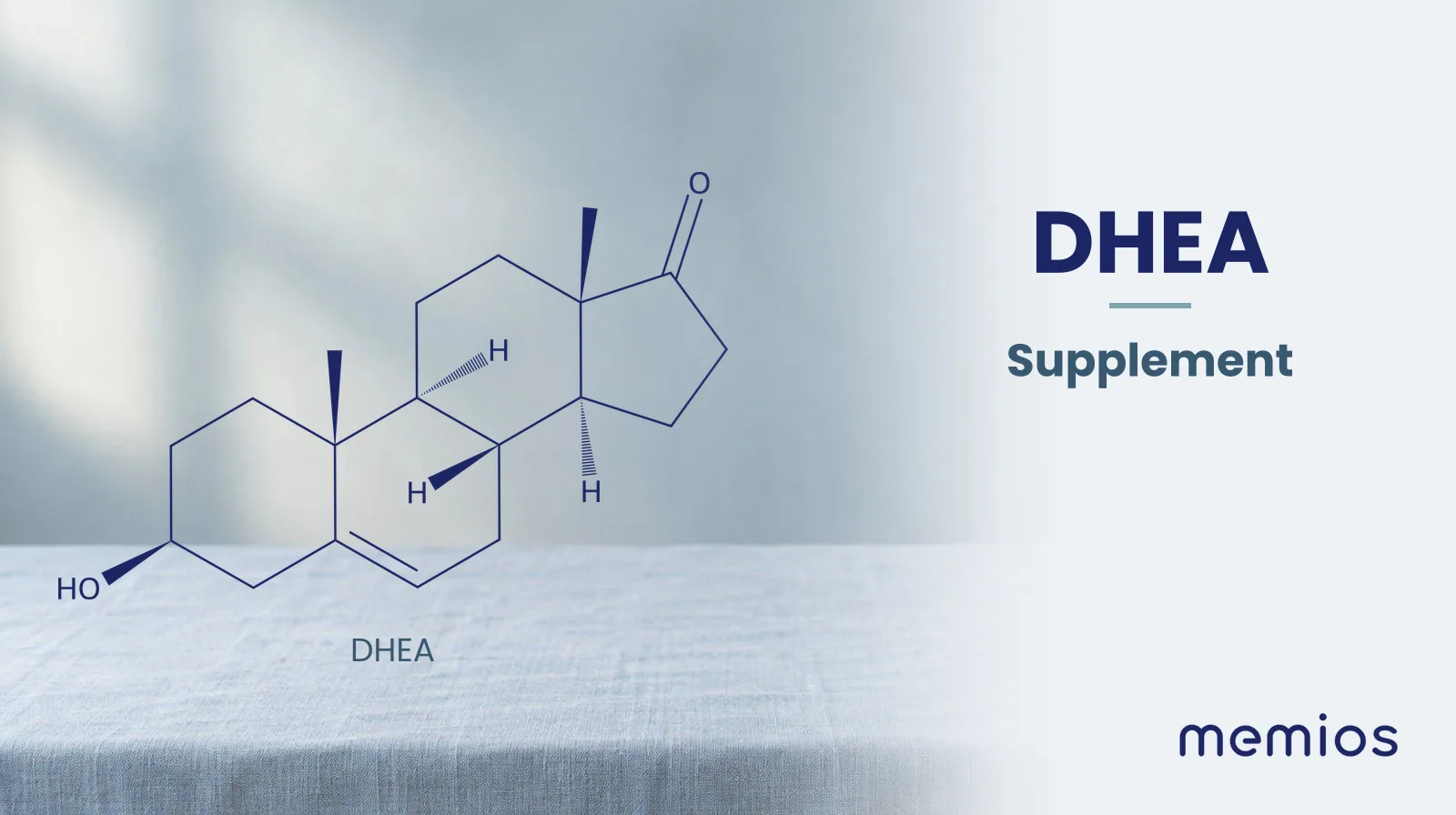
- What it is: DHEA is a steroid hormone the body makes in the adrenal gland, and in smaller amounts in the gonads and brain, and it is a precursor the body converts into testosterone and oestrogen. Blood levels peak in early adulthood and fall with age.
- Main use, supported: A 2025 review describes DHEA and DHEAS as adrenal steroid precursors of sex steroids whose levels fall with age.
- Claim NOT supported by research: A Cochrane review of menopausal women found no evidence that DHEA improves quality of life. (moderate certainty)
- Another claim NOT supported: A 2024 Cochrane review found DHEA pre-treatment likely makes little or no difference to live birth or ongoing pregnancy in women undergoing assisted reproduction. (moderate certainty)
- Recommended dose: not established. No reference intake such as an RDA or AI exists for DHEA, because it is a hormone the body makes rather than a nutrient obtained from food; a JAMA research letter states it does not occur naturally in the human food chain.
- Studied dose (a trial dose, not a recommendation): In the Cochrane review of menopausal women, more than 80% of trials gave DHEA orally at daily doses between 10 mg and 1600 mg, for one week to one year. No finding here cites that trial.
- Upper limit: We found no tolerable upper intake level or acceptable daily intake set by any body for DHEA.
- What goes wrong: 8 findings on harm. The same Cochrane review found DHEA roughly trebled the odds of androgenic side effects, mainly acne, compared with placebo.
- Common myth: DHEA is a natural anti-ageing hormone you can top up safely, and you can get it from wild yam.
What it is
DHEA is a steroid hormone the body makes in the adrenal gland, and in smaller amounts in the gonads and brain, and it is a precursor the body converts into testosterone and oestrogen. Blood levels peak in early adulthood and fall with age. The DHEA sold in supplements is made synthetically in a laboratory and sold as tablets, capsules, powders, creams and gels. It is not a nutrient and, according to a JAMA research letter, it does not occur in the human food chain.
What the research says
The evidence is mixed and mostly disappointing. Controlled trials show oral DHEA raises testosterone and oestradiol, but pooled trial data in older men found no benefit for lipids, glucose, bone, sexual function or quality of life, and only a small fat-mass change that disappeared once hormone rises were accounted for. In menopausal women a Cochrane review found no evidence of improved quality of life, possible slight improvement in sexual function, and a clear increase in androgenic side effects such as acne. In IVF, a 2024 Cochrane review found DHEA likely makes little or no difference to live birth. A separate Cochrane review found no support for a benefit on cognition.
Evidence grade: Disputed.
What goes wrong
The same Cochrane review found DHEA roughly trebled the odds of androgenic side effects, mainly acne, compared with placebo. (Source 1)
- Systematic review, Moderate certainty.
- Size: 376 women across 5 studies.
- Who: peri- and postmenopausal women.
- How long: one week to one year across the review.
- Result: OR 3.77, 95% CI 1.36 to 10.4, P = 0.01, I² = 10%, moderate quality evidence; no associations found with other adverse effects.
- Funding: not stated.
DHEA was found to be associated with androgenic side effects (mainly acne) (odds ratio (OR) 3.77, 95% CI 1.36 to 10.4, P = 0.01, 5 studies, 376 women, I² = 10%, moderate quality evidence) when compared to placebo.
The same cognition review reported one trial in which DHEA significantly impaired visual memory recall relative to placebo. (Source 2)
- Systematic review, Very low certainty.
- Size: 75 healthy volunteers (37 women and 38 men aged 59-81) in the trial concerned.
- Who: healthy older volunteers exposed to a psychosocial stressor.
- How long: two weeks of treatment.
- Result: significant impairment on a visual memory recall test (p<0.01) following the stressor.
- Funding: not stated.
However, when compared with placebo, DHEA was associated with a significant impairment on a visual memory recall test (p<0.01) following the stressor.
A cancer centre monograph lists increased acne and mania after high-dose DHEA among reported adverse reactions. (Source 3)
- Expert review, not systematic, Very low certainty.
- Size: not stated; monograph summarising published reports.
- Who: people taking DHEA supplements.
- How long: not stated.
- Result: no rates given in the monograph.
- Funding: not stated.
Mania secondary to supplementation with high doses of DHEA
The same monograph lists medicines reported to raise or lower DHEA and DHEA-S blood concentrations, with clinical relevance unknown. (Source 4)
- Expert review, not systematic, Very low certainty.
- Size: not stated.
- Who: people taking DHEA with prescription medicines.
- How long: not stated.
- Result: direction of change only; no effect sizes given.
- Funding: not stated.
Serum concentrations of DHEA and DHEA-S can be increased by alprazolam, amlodipine, diltiazem, and metformin. Clinical relevance is not known.
The United States Anti-Doping Agency states DHEA is prohibited in sport at all times and that its androgenic effects include facial hair growth, acne, voice deepening and raised blood pressure, with a stated increased risk of hormone-sensitive cancers. (Source 5)
- Official position, Certainty not rated.
- Size: not applicable.
- Who: athletes and supplement users.
- How long: not applicable.
- Result: no rates given; position statement last modified 26 February 2026.
- Funding: not stated.
Side effects include growth of facial hair and loss of scalp hair, acne, deepening of the voice, and rising blood pressure, among other side effects.
USADA states that DHEA is prohibited at all times both in and out of competition as an anabolic agent. (Source 6)
- Official position, Certainty not rated.
- Size: not applicable.
- Who: athletes.
- How long: not applicable.
- Result: prohibited under category S1 of the WADA Prohibited List; page last modified 26 February 2026.
- Funding: not stated.
Yes, DHEA is prohibited at all times, both in and out of competition, under the category of Anabolic Agents (S1) on the World Anti-Doping Agency Prohibited List.
USADA states that DHEA supplement products other than the single prescription medicine are made outside drug regulations and may contain varying amounts of DHEA. (Source 6)
- Official position, Certainty not rated.
- Size: not applicable.
- Who: supplement users.
- How long: not applicable.
- Result: no quantitative data given on the page; page last modified 26 February 2026.
- Funding: not stated.
all other DHEA products are manufactured outside of drug regulations and could contain varying levels of DHEA
Laboratory assays for DHEA sulphate differ in accuracy, with several commercial immunoassays showing standardisation problems against mass spectrometry. (Source 7)
- Survey study, Certainty not rated.
- Size: 7 commercial assays compared on 75 serum samples.
- Who: human serum samples across 0.06-20.6 micromol/L.
- How long: not applicable.
- Result: 3 methods agreed well (R 0.93-0.99, slopes 0.92-1.07); 4 methods had slopes of 0.84, 1.14, 1.20 and 1.28; one assay had an intra-assay CV of 18%.
- Funding: not stated.
Four methods showed standardization problems (slopes were 0.84, 1.14, 1.20 and 1.28).
What the evidence supports
A 2025 review describes DHEA and DHEAS as adrenal steroid precursors of sex steroids whose levels fall with age. (Source 8)
- Expert review, not systematic, Certainty not rated.
- Size: not applicable.
- Who: not applicable.
- How long: not applicable.
- Result: no effect size; descriptive review of physiology.
- Funding: not stated.
DHEA/DHEAS serve as precursors to sex steroids and exhibit neuroprotective, anti-inflammatory, and immune-modulating effects.
What the evidence does not support
The same meta-analysis reported that DHEA produced no benefit over placebo across a range of clinical outcomes including sexual function. (Source 9)
- Meta-analysis, Certainty not rated.
- Size: 1353 elderly men across 25 double-blind placebo-controlled randomised trials.
- Who: elderly men.
- How long: mean follow-up of 36 weeks.
- Result: no effect reported for lipid and glycemic metabolism, bone health, sexual function and quality of life.
- Funding: not stated.
no effect of DHEA supplementation in comparison with placebo was observed for various clinical parameters including lipid and glycemic metabolism, bone health, sexual function, and quality of life
A Cochrane review of menopausal women found no evidence that DHEA improves quality of life. (Source 1)
- Systematic review, Moderate certainty.
- Size: 287 women in 8 studies for the quality-of-life outcome; 28 trials and 1273 women in the review overall.
- Who: peri- and postmenopausal women, over 95% postmenopausal, aged 36 to 80.
- How long: one week to one year.
- Result: SMD 0.16, 95% CI -0.03 to 0.34, P = 0.10, I² = 0%, moderate quality evidence.
- Funding: not stated.
Compared to placebo, DHEA did not improve quality of life (standardised mean difference (SMD) 0.16, 95% confidence interval (CI) -0.03 to 0.34, P = 0.10, 8 studies, 287 women
A 2024 Cochrane review found DHEA pre-treatment likely makes little or no difference to live birth or ongoing pregnancy in women undergoing assisted reproduction. (Source 10)
- Systematic review, Moderate certainty.
- Size: 1433 women across 9 randomised trials for the live birth outcome.
- Who: women undergoing IVF, mostly identified as poor responders.
- How long: pre-treatment before IVF cycles.
- Result: OR 1.30, 95% CI 0.95 to 1.76, I² = 16%, moderate certainty evidence; miscarriage OR 0.85, 95% CI 0.53 to 1.37, moderate certainty.
- Funding: not stated.
DHEA likely results in little to no difference in live birth/ongoing pregnancy rates (OR 1.30, 95% confidence interval (CI) 0.95 to 1.76; I² = 16%, 9 RCTs, N = 1433, moderate certainty evidence)
The same Cochrane review found DHEA likely does not reduce miscarriage rates in women undergoing IVF. (Source 10)
- Systematic review, Moderate certainty.
- Size: 1601 women across 10 randomised trials.
- Who: women undergoing IVF, mostly poor responders.
- How long: pre-treatment before IVF cycles.
- Result: OR 0.85, 95% CI 0.53 to 1.37, I² = 0%, moderate certainty evidence.
- Funding: not stated.
DHEA likely does not decrease miscarriage rates (OR 0.85, 95% CI 0.53 to 1.37; I² = 0%, 10 RCTs, N =1601, moderate certainty evidence).
A Cochrane review of DHEA for cognition in non-demented older people found no support for benefit, and one trial found worse visual memory recall on DHEA than placebo. (Source 2)
- Systematic review, Very low certainty.
- Size: three parallel-group trials, one of 75 healthy volunteers and one of 46 men.
- Who: people over 50 without dementia, including perimenopausal women and men aged 59-81 and 62-76.
- How long: two weeks to three months.
- Result: no significant effect at 3 months in one trial; no effect on cognitive function in 46 men over three months; significant impairment on a visual memory recall test (p<0.01) after a stressor in a third trial.
- Funding: not stated.
van Niekerk 2001 found no effect on cognitive function in 46 men aged 62-76 from three months of DHEA supplementation.
A JAMA research letter states DHEA is not a food and does not occur naturally in the human food chain. (Source 11)
- Expert review, not systematic, Certainty not rated.
- Size: not applicable.
- Who: not applicable.
- How long: not applicable.
- Result: no effect size; a statement about the nature of the substance.
- Funding: not stated.
DHEA is not a food; it does not occur naturally in the human food chain
Where the evidence is mixed
Pooled placebo-controlled trials in elderly men found a small reduction in fat mass with DHEA, but no effect on metabolic, bone, sexual or quality-of-life outcomes. (Source 9)
- Meta-analysis, Certainty not rated.
- Size: 1353 elderly men across 25 double-blind placebo-controlled randomised trials.
- Who: elderly men.
- How long: mean follow-up of 36 weeks.
- Result: Fat mass standardized mean difference -0.35 (-0.65 to -0.05); P = .02; association lost after adjusting for testosterone and oestradiol rises; no effect on lipid and glycemic metabolism, bone health, sexual function or quality of life.
- Funding: not stated.
DHEA supplementation was associated with a reduction of fat mass (standardized mean difference of -0.35 [-0.65 to -0.05]; P = .02).
The same review found a small improvement in sexual function with DHEA, from trials the authors rated moderate to low quality. (Source 1)
- Systematic review, Low certainty.
- Size: 261 women across 5 studies.
- Who: peri- and postmenopausal women.
- How long: one week to one year across the review.
- Result: SMD 0.31, 95% CI 0.07 to 0.55, P = 0.01, I² = 0%.
- Funding: not stated.
The overall quality of the studies was moderate to low with the majority of studies that were included in the meta-analysis having reasonable methodology.
Where the research disagrees
Whether DHEA supplementation does anything useful for ageing adults
- Corona and colleagues, meta-analysis of 25 placebo-controlled trials in elderly men, meta-analysis of randomised placebo-controlled trials: no effect of DHEA supplementation in comparison with placebo was observed for various clinical parameters including lipid and glycemic metabolism, bone health, sexual function, and quality of life (Source 9)
- Authors of a 2025 narrative review in International Journal of Molecular Sciences, narrative review with no stated systematic method; the same sentence pair restricts the favourable reading to DHEA given intravaginally, not to the oral supplements sold over the counter: Particularly in postmenopausal women, DHEA has shown potential benefits in treating genitourinary syndrome of menopause (GSM), including improved vaginal health, lubrication, and sexual function. While intravaginal DHEA appears effective and safer than systemic estrogen therapy, especially for women with estrogen sensitivity, results remain mixed for oral administration. (Source 8)
How much
- Reference intake: No reference intake such as an RDA or AI exists for DHEA, because it is a hormone the body makes rather than a nutrient obtained from food; a JAMA research letter states it does not occur naturally in the human food chain. (Source 11)
- Upper limit: We found no tolerable upper intake level or acceptable daily intake set by any body for DHEA. The United States Anti-Doping Agency states instead that DHEA is prohibited in sport at all times as an anabolic agent (page last modified 26 February 2026). (Source 6)
- Studied: In the Cochrane review of menopausal women, more than 80% of trials gave DHEA orally at daily doses between 10 mg and 1600 mg, for one week to one year. (Source 12)
- Studied: The meta-analysis in elderly men pooled 25 double-blind placebo-controlled trials in 1353 men with a mean follow-up of 36 weeks. (Source 9)
A common belief, and what the research shows
The belief: DHEA is a natural anti-ageing hormone you can top up safely, and you can get it from wild yam.
What the research shows: Trials do not bear this out and the yam route does not work. Pooled trials in older men found "no effect of DHEA supplementation in comparison with placebo was observed for various clinical parameters including lipid and glycemic metabolism, bone health, sexual function, and quality of life". On wild yam, USADA states that "the conversion of diosgenin into DHEA is not believed to occur in the body, so consuming wild yam or diosgenin is unlikely to increase DHEA levels." A Cochrane review also found DHEA raised the odds of androgenic side effects: "DHEA was found to be associated with androgenic side effects (mainly acne) (odds ratio (OR) 3.77, 95% CI 1.36 to 10.4, P = 0.01, 5 studies, 376 women, I² = 10%, moderate quality evidence) when compared to placebo."
Questions and answers
What is it?
DHEA is a steroid hormone made mainly by the adrenal gland, with smaller amounts from the gonads and brain. The body uses it as a precursor for testosterone and oestrogen. Natural blood levels are highest in early adulthood and fall with age. The DHEA in supplements is made synthetically and sold as tablets, capsules, powders, creams and gels. (Source 13)
What does it do in the body?
In the body DHEA acts mainly as a precursor that tissues convert into androgens and oestrogens, and it also has reported neuroactive, anti-inflammatory and immune-modulating actions described in review articles. What it does when taken as a supplement is a separate question, and the trial evidence there is weak. Pooled placebo-controlled trials in elderly men found the only signal, a small fat-mass reduction, disappeared once the rise in testosterone and oestradiol was accounted for. (Source 8)
Is it good or bad for you?
As a hormone the body makes, DHEA is simply part of normal physiology. As a supplement the balance in controlled trials is unfavourable: Cochrane found no evidence of improved quality of life in menopausal women, little or no difference to IVF live birth, and no support for better cognition, while androgenic side effects such as acne were roughly three times more likely on DHEA than placebo. Anti-doping bodies prohibit it in sport at all times. (Source 1)
How do you get more of it?
There is no food source, so the only routes studied are oral or topical DHEA products and, in the United States, one prescription vaginal prasterone medicine. Trials in menopausal women mostly used oral DHEA at 10 mg to 1600 mg daily. USADA notes that supplement products other than the prescription medicine are made outside drug regulations, so the amount in a product may not match the label. This is a description of what was studied, not a recommendation. (Source 6)
If it is harmful, what reduces it?
In the case and trial literature we searched, the only described way of reducing supplemental DHEA exposure is stopping the product; we found no study of an intervention that lowers DHEA in the body. Levels the body makes itself fall naturally with age without any intervention. (Source 13)
Why might someone be low in it or missing it?
The commonest reason for low DHEA is simply age: production peaks in early adulthood and declines thereafter. Low DHEA sulphate is also measured clinically in adrenal disease, including adrenal insufficiency. Medicines can shift levels too: a cancer centre monograph lists dexamethasone, insulin and morphine among drugs reported to lower DHEA and DHEA-S concentrations. (Source 13)
Which whole foods contain it or feed it?
No whole food supplies DHEA. Soy and wild yam contain diosgenin, a chemical that laboratories can convert into DHEA, and these foods are sometimes marketed on that basis, but USADA states that conversion does not happen inside the body. A JAMA research letter likewise states DHEA does not occur naturally in the human food chain. (Source 13)
What happens if you do not have it?
Low DHEA sulphate is a marker used in diagnosing adrenal disease rather than a deficiency state with its own symptoms in otherwise healthy people. Trials that replaced DHEA in older adults did not show the benefits that a true deficiency state would predict: pooled data in elderly men found no effect on lipids, glucose, bone, sexual function or quality of life. (Source 14)
How can you test for it?
A blood test for DHEA sulphate is available and is used clinically in adrenal disease. Its reliability depends on the assay: when seven commercial immunoassays were compared against isotope-dilution mass spectrometry on 75 serum samples, three agreed well but four showed standardisation problems and one had an intra-assay coefficient of variation of 18%. Results from different laboratories are therefore not always interchangeable. (Source 7)
References
- Cochrane Database of Systematic Reviews. Dehydroepiandrosterone for women in the peri- or postmenopausal phase. 2015. DOI 10.1002/14651858.CD011066.pub2. Read the source
- Cochrane Database of Systematic Reviews. Dehydroepiandrosterone (DHEA) supplementation for cognitive function in healthy elderly people.. 2006. PMID 17054283, DOI 10.1002/14651858.CD006221. Read the source
- Memorial Sloan Kettering Cancer Center, About Herbs. Dehydroepiandrosterone (Adverse Reactions section). 2023. Read the source
- Memorial Sloan Kettering Cancer Center, About Herbs. Dehydroepiandrosterone (Herb-Drug Interactions section). 2023. Read the source
- United States Anti-Doping Agency (USADA). What Should Athletes Know about DHEA? (side effects section). 2026. Read the source
- United States Anti-Doping Agency (USADA). What Should Athletes Know about DHEA? (prohibited status and product regulation sections). 2026. Read the source
- Clinica Chimica Acta. Measurement of dehydroepiandrosterone sulphate (DHEAS): a comparison of Isotope-Dilution Liquid Chromatography Tandem Mass Spectrometry (ID-LC-MS/MS) and seven currently available immunoassays (Results). 2013. PMID 23665079, DOI 10.1016/j.cca.2013.04.028. Read the source
- International Journal of Molecular Sciences. The Sex Hormone Precursors Dehydroepiandrosterone (DHEA) and Its Sulfate Ester Form (DHEAS): Molecular Mechanisms and Actions on Human Body. 2025. DOI 10.3390/ijms26178568. Read the source
- The Journal of Clinical Endocrinology and Metabolism. Dehydroepiandrosterone supplementation in elderly men: a meta-analysis study of placebo-controlled trials.. 2013. PMID 23824417, DOI 10.1210/jc.2013-1358. Read the source
- Cochrane Database of Systematic Reviews. Androgens (dehydroepiandrosterone or testosterone) for women undergoing assisted reproduction.. 2024. PMID 38837771, DOI 10.1002/14651858.CD009749.pub3. Read the source
- JAMA. Quality Control of Dehydroepiandrosterone Dietary Supplement Products. 1998. DOI 10.1001/jama.280.18.1565. Read the source
- Cochrane Database of Systematic Reviews. Dehydroepiandrosterone for women in the peri- or postmenopausal phase (plain language summary, study characteristics section). 2015. DOI 10.1002/14651858.CD011066.pub2. Read the source
- United States Anti-Doping Agency (USADA). What Should Athletes Know about DHEA?. 2026. Read the source
- Clinica Chimica Acta. Measurement of dehydroepiandrosterone sulphate (DHEAS): a comparison of Isotope-Dilution Liquid Chromatography Tandem Mass Spectrometry (ID-LC-MS/MS) and seven currently available immunoassays (Background). 2013. PMID 23665079, DOI 10.1016/j.cca.2013.04.028. Read the source