Medications · September 29, 2026 · Memios · 13 min read
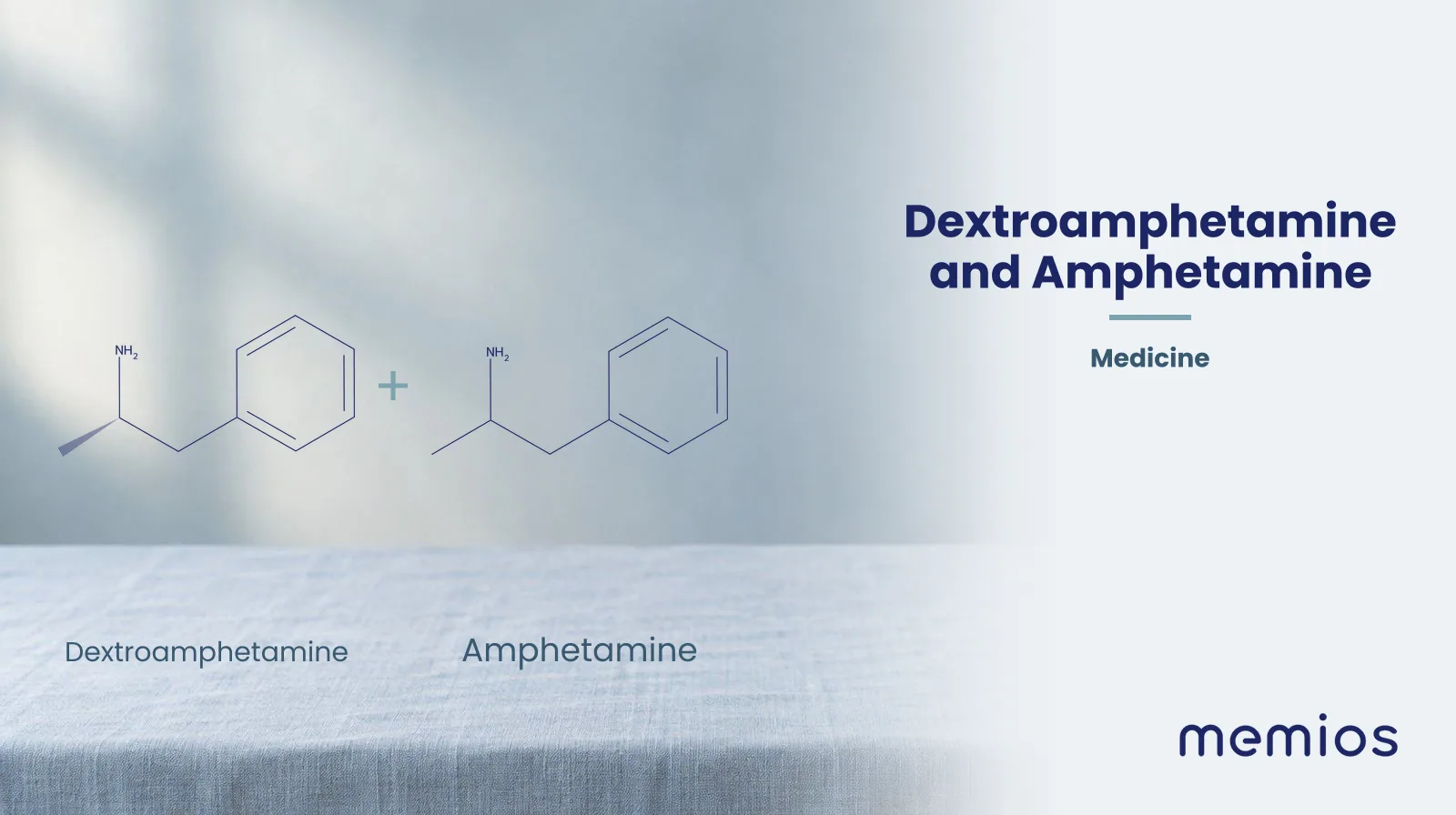
Dextroamphetamine; Amphetamine
In short-term trials, amphetamines reduce clinician-rated ADHD symptoms more than placebo in both children and adults, with large effects on average.
TLDR
- Boxed warning: Adderall® has a high potential for abuse and misuse, which can lead to the development of a substance use disorder, including addiction.
- Well established. In short-term trials, amphetamines reduce clinician-rated ADHD symptoms more than placebo in both children and adults, with large effects on average.
- What it is: This is a prescription mix of dextroamphetamine and amphetamine salts, a central nervous system stimulant sold as Adderall.
- Main use: ADHD in children and adolescents (well supported).
- Other approved uses: ADHD in adults (well supported); Narcolepsy (evidence not rated).
- Recommended dose (official position): The prescriber sets the dose. As a position, the Adderall tablet label (May 2024) gives a starting dose of 5 mg once or twice daily for children aged 6 and older with ADHD, raised in 5 mg weekly steps.
- Studied dose (a trial dose, not a recommendation): The network meta-analysis pooled double-blind trials at timepoints closest to 12 weeks. Findings citing that trial: 2 for, 1 against, 1 on harm.
- Upper limit: The Adderall tablet label (May 2024) says only in rare cases will it be necessary to exceed a total of 40 mg per day for ADHD.
- What goes wrong: 6 findings on harm. More people stopped amphetamines than placebo because of side effects, in both children and adults.
- Interactions: 4 recorded, including MAO inhibitors, Serotonergic drugs (for example SSRIs such as escitalopram, and St John's wort), Acidifying agents (such as ascorbic acid and fruit juices, per the label's category), Alkalinizing agents (such as antacids).
- Common myth: ADHD stimulants have been proven to help for years at a time.
What it is
This is a prescription mix of dextroamphetamine and amphetamine salts, a central nervous system stimulant sold as Adderall. In the US it is approved for ADHD and narcolepsy, and it carries a boxed warning about abuse, misuse and addiction.
What the research says
In short-term trials, amphetamines reduce clinician-rated ADHD symptoms more than placebo in both children and adults, with large effects on average. More people stop amphetamines than placebo because of side effects, and there is little trial evidence beyond 12 weeks. Observational studies link long-term stimulant use to higher rates of hypertension and cardiovascular disease, though an earlier large US cohort found no rise in heart attack, stroke or sudden death. Psychosis is uncommon but was more frequent with amphetamine than methylphenidate in young people. Long-term stimulant use in childhood is associated with slightly shorter adult height. About 2% of US adults misuse prescription stimulants each year.
Evidence grade: Well established.
How it works
Drug class: Central nervous system stimulant (amphetamine)
Amphetamines block the reuptake of the brain messengers norepinephrine and dopamine and increase their release, raising their activity between nerve cells. (Source 1)
Boxed warning
WARNING: ABUSE, MISUSE, AND ADDICTION. Adderall® has a high potential for abuse and misuse, which can lead to the development of a substance use disorder, including addiction.
(Source 1)
What it is used for
- In a network meta-analysis of RCTs, amphetamines reduced clinician-rated ADHD symptoms more than placebo (SMD -1.02) at about 12 weeks. More people dropped out because of side effects, and long-term data were insufficient. Evidence: established. (Source 2)
- In adults, amphetamines beat placebo on clinician ratings (SMD -0.79) and were the preferred first choice in that analysis. They were less well tolerated than placebo. Evidence: established. (Source 2)
- This use is approved on the label, but we did not research the trial evidence for narcolepsy in this run. Evidence: unknown. (Source 1)
Interactions
- MAO inhibitors (label): Risk of dangerously high blood pressure (hypertensive crisis). The label says not to combine them, or to use amphetamine within 14 days of stopping an MAOI. (Source 1)
- Serotonergic drugs (for example SSRIs such as escitalopram, and St John's wort) (label): Raises the risk of serotonin syndrome. St John's wort is included here because the escitalopram label lists it and amphetamines among serotonergic agents; for this specific combination that inference is theoretical. (Source 1)
- Acidifying agents (such as ascorbic acid and fruit juices, per the label's category) (label): Agents that acidify lower amphetamine blood levels and effect. The label names ascorbic acid and fruit juices in this category. The extracted text confirmed the effect statement but not the list of examples. (Source 1)
- Alkalinizing agents (such as antacids) (label): Agents that make urine or the gut more alkaline raise amphetamine levels and strengthen its effect. (Source 1)
What goes wrong
More people stopped amphetamines than placebo because of side effects, in both children and adults. (Source 2)
- Meta-analysis, Moderate certainty.
- Size: Tolerability analysis in 11,018 children and adolescents and 5,362 adults.
- Who: Children, adolescents and adults with ADHD.
- How long: About 12 weeks.
- Result: Dropout for side effects: OR 2.30 (95% CI 1.36 to 3.89) in children and adolescents; OR 3.26 (1.54 to 6.92) in adults.
- Funding: Independent (Eunethydis; UK NIHR)
With respect to tolerability, amphetamines were inferior to placebo in both children and adolescents (odds ratio [OR] 2·30, 95% CI 1·36-3·89) and adults (3·26, 1·54-6·92)
In a Swedish case-control study of 278,027 people with ADHD, longer cumulative use of ADHD medication was associated with more cardiovascular disease, especially hypertension, at about 4% more risk per year of use. This is an association and does not show cause. (Source 3)
- Case-control study, Low certainty.
- Size: 278,027 individuals with ADHD; 10,388 CVD cases and 51,672 matched controls.
- Who: People aged 6 to 64 in Sweden with ADHD.
- How long: Up to 14 years of cumulative use; median follow-up 4.1 years.
- Result: AOR 1.04 per year of use (95% CI 1.03 to 1.05); more than 5 years' use AOR 1.23 for CVD and 1.80 for hypertension. The results cover all ADHD medicines, not amphetamine alone.
- Funding: Independent (Swedish Research Council; EU Horizon 2020)
Across the 14-year follow-up, each 1-year increase of ADHD medication use was associated with a 4% increased risk of CVD (AOR, 1.04 [95% CI, 1.03-1.05])
Among adolescents and young adults starting a stimulant for ADHD, psychosis was more common with amphetamine than with methylphenidate in a large claims-based cohort (Moran et al., NEJM 2019). This is observational data, summarised here through a secondary source (M3 India). (Source 4)
- Cohort study, Low certainty.
- Size: 337,919 patients; 110,923 per matched group; 343 psychosis episodes.
- Who: People aged 13 to 25 with ADHD starting methylphenidate or amphetamine, US commercial insurance, 2004 to 2015.
- How long: 143,286 person-years.
- Result: 237 psychosis episodes with amphetamine against 106 with methylphenidate; HR 1.65 (95% CI 1.31 to 2.09) for amphetamine compared with methylphenidate.
- Funding: Not stated in the extracted text.
hazard ratio with amphetamine use, 1.65; 95% confidence interval, 1.31 to 2.09.
The FDA label reports that in pooled short-term placebo-controlled trials of CNS stimulants, psychotic or manic symptoms occurred in about 0.1% of treated patients against 0% on placebo. (Source 1)
- Official position, Low certainty.
- Size: Pooled short-term trials (number not given)
- Who: Patients without a prior history of psychosis or mania.
- How long: Short-term.
- Result: About 0.1% against 0%.
- Funding: Regulatory label.
In a pooled analysis of multiple short-term, placebo-controlled studies of CNS stimulants, psychotic or manic symptoms occurred in approximately 0.1% of CNS stimulant-treated patients, compared with 0% of placebo-treated patients.
In the long-term MTA follow-up, children who used stimulants consistently or inconsistently were about 2.5 cm shorter as adults than those with negligible use, and there was no matching reduction in symptom severity. Most MTA children took methylphenidate, not amphetamine, and the medication subgroups were not randomised. (Source 5)
- Cohort study, Low certainty.
- Size: 515 children with ADHD followed; 289 comparison classmates.
- Who: Children aged 7 to 10 with combined-type ADHD, followed to age 25.
- How long: Up to 16 years.
- Result: Treated subgroups were 2.55 ± 0.73 cm shorter than the negligible-use subgroup (p<.0005, d=.42).
- Funding: Not stated in the extracted text (MTA was NIMH-funded)
the treated group with the Consistent or Inconsistent pattern was 2.55 ± 0.73 cm shorter than the subgroup with the Negligible pattern (p <.0005, d =.42)
In a US national survey analysis, about 2.1% of adults (about 5 million) misused prescription stimulants in the past year and 0.2% had a stimulant use disorder. The most common reason given for misuse was cognitive enhancement. (Source 6)
- Survey study, Moderate certainty.
- Size: US National Survey on Drug Use and Health, adults.
- Who: US adults.
- How long: Past year.
- Result: 6.6% used prescription stimulants; 2.1% misused them; 0.2% had a use disorder; 56.3% of those who misused them cited cognitive enhancement.
- Funding: Government (NIDA/SAMHSA)
2.1% (or 5 million) misused prescription stimulants at least once; and 0.2% (or 0.4 million) had prescription stimulant use disorders.
What the evidence supports
In a network meta-analysis of 133 double-blind trials, amphetamines reduced clinician-rated ADHD core symptoms more than placebo in children and adolescents at about 12 weeks, with a large average effect. (Source 2)
- Meta-analysis, Moderate certainty.
- Size: 133 RCTs; efficacy analysis in 10,068 children and adolescents and 8,131 adults.
- Who: Children, adolescents and adults with ADHD.
- How long: About 12 weeks.
- Result: Children and adolescents: SMD -1.02 (95% CI -1.19 to -0.85) against placebo.
- Funding: Independent (Eunethydis; UK NIHR)
For ADHD core symptoms rated by clinicians in children and adolescents closest to 12 weeks, all included drugs were superior to placebo (eg, SMD -1·02, 95% CI -1·19 to -0·85 for amphetamines
In adults with ADHD, amphetamines also beat placebo on clinician ratings, and the review judged them the preferred first-choice medicines for adults in the short term. (Source 2)
- Meta-analysis, Moderate certainty.
- Size: 51 adult RCTs.
- Who: Adults with ADHD.
- How long: About 12 weeks.
- Result: Adults: SMD -0.79 (95% CI -0.99 to -0.58).
- Funding: Independent (Eunethydis; UK NIHR)
In adults (clinicians' ratings), amphetamines (SMD -0·79, 95% CI -0·99 to -0·58)
What the evidence does not support
On teachers' ratings of children, amphetamines were not shown to beat placebo in the comparisons available; only methylphenidate and modafinil were. There were also not enough data to judge effects at 26 or 52 weeks. (Source 2)
- Meta-analysis, Low certainty.
- Size: Subset of the 133 RCTs.
- Who: Children and adolescents with ADHD.
- How long: About 12 weeks; no adequate data at 26 or 52 weeks.
- Result: Teacher ratings: only methylphenidate (SMD -0.82) and modafinil (-0.76) beat placebo.
- Funding: Independent (Eunethydis; UK NIHR)
By contrast, for available comparisons based on teachers' ratings, only methylphenidate (SMD -0·82, 95% CI -1·16 to -0·48) and modafinil (-0·76, -1·15 to -0·37) were more efficacious than placebo.
A large US cohort of adults aged 25 to 64 found current or new use of ADHD medicines, amphetamine included, was not associated with more heart attacks, sudden cardiac death or stroke. (Source 7)
- Cohort study, Moderate certainty.
- Size: 443,198 users and nonusers; 806,182 person-years.
- Who: Adults aged 25 to 64 in 4 US health systems.
- How long: Median 1.3 years follow-up; median current use 0.33 years.
- Result: Current against remote use adjusted RR 1.03 (95% CI 0.86 to 1.24). The upper limit corresponds to at most 0.19 to 0.77 extra events per 1,000 person-years.
- Funding: Not stated in the extracted text.
Among young and middle-aged adults, current or new use of ADHD medications, compared with nonuse or remote use, was not associated with an increased risk of serious cardiovascular events.
Where the research disagrees
Whether ADHD stimulants raise cardiovascular risk
- Habel et al., US cohort, 2011, Retrospective cohort, 443,198 adults, median 1.3 years: Among young and middle-aged adults, current or new use of ADHD medications, compared with nonuse or remote use, was not associated with an increased risk of serious cardiovascular events. (Source 7)
- Zhang et al., Swedish case-control, 2024, Nested case-control, up to 14 years of cumulative use: This case-control study found that long-term exposure to ADHD medications was associated with an increased risk of CVDs, especially hypertension and arterial disease. (Source 3)
How much
- Reference intake: The prescriber sets the dose. As a position, the Adderall tablet label (May 2024) gives a starting dose of 5 mg once or twice daily for children aged 6 and older with ADHD, raised in 5 mg weekly steps. (Source 1)
- Upper limit: The Adderall tablet label (May 2024) says only in rare cases will it be necessary to exceed a total of 40 mg per day for ADHD. (Source 1)
- Studied: The network meta-analysis pooled double-blind trials at timepoints closest to 12 weeks. The abstract we could reach does not give trial doses. (Source 2)
A common belief, and what the research shows
The belief: ADHD stimulants have been proven to help for years at a time.
What the research shows: The largest network meta-analysis covered about 12 weeks and said "We did not find sufficient data for the 26-week and 52-week timepoints." In the MTA follow-up, "extended use of medication was associated with suppression of adult height but not with reduction of symptom severity."
Questions and answers
What is it?
This is a prescription stimulant that combines dextroamphetamine and amphetamine salts (Adderall). It is approved for ADHD and narcolepsy. (Source 1)
What does it do in the body?
It raises activity of the brain messengers dopamine and norepinephrine by blocking their reuptake and increasing their release. In trials this reduces ADHD symptoms in the short term. (Source 1)
Is it good or bad for you?
For ADHD it works well in the short term; in trials, amphetamines had among the largest effects of any ADHD medicine. It also carries a boxed warning for abuse and addiction, more side-effect dropouts than placebo, possible long-term cardiovascular risk, rare psychosis or mania, and slower growth in children. Used without a prescription, it is misused by about 2% of US adults each year. (Source 2)
How do you get more of it?
Does not apply in the usual sense. It is a controlled prescription medicine and the prescriber sets the dose; the label says doses over 40 mg a day are rarely needed. Taking it without a prescription is misuse, and the label warns this can lead to overdose and death. (Source 1)
If it is harmful, what reduces it?
Amphetamine leaves the body quickly after doses stop. Acidifying agents lower blood levels and alkalinizing agents raise them, according to the label. We did not find tapering or withdrawal trials for prescribed amphetamine in this run. (Source 1)
Why might someone be low in it or missing it?
Does not apply. Amphetamine is a drug, not a nutrient or something the body needs. ADHD is not shown to be a lack of amphetamine. (Source 1)
Which whole foods contain it or feed it?
No food contains it. The label notes that acidifying agents, a category it describes as including ascorbic acid and fruit juices, lower amphetamine blood levels and effect. (Source 1)
What happens if you do not have it?
For someone with ADHD, going without medication means losing the short-term symptom relief seen in trials. The long-term MTA follow-up found extended medication use was not linked to lower adult symptom severity. (Source 5)
How can you test for it?
We found no routine blood test for therapeutic amphetamine levels in the sources we reached. The label advises monitoring children's height and weight, and the Swedish study advises monitoring cardiovascular signs. Urine drug screens detect amphetamines, but we did not assess their reliability. (Source 1)
References
- US FDA / Teva via DailyMed (revised May 2024). ADDERALL (mixed amphetamine salts) tablet prescribing information, DailyMed. 2024. Read the source
- The Lancet Psychiatry (Aalborg University repository record). Comparative efficacy and tolerability of medications for attention-deficit hyperactivity disorder in children, adolescents, and adults: a systematic review and network meta-analysis. 2018. PMID 30097390, DOI 10.1016/S2215-0366(18)30269-4. Read the source
- JAMA Psychiatry. Attention-Deficit/Hyperactivity Disorder Medications and Long-Term Risk of Cardiovascular Diseases. 2024. PMID 37991787, DOI 10.1001/jamapsychiatry.2023.4294. Read the source
- M3 India (summary of The New England Journal of Medicine article). Psychosis with methylphenidate or amphetamine in patients with ADHD (journal summary of Moran et al., NEJM 2019). 2019. PMID 30893533, DOI 10.1056/NEJMoa1813751. Read the source
- Journal of Child Psychology and Psychiatry. Young adult outcomes in the follow-up of the multimodal treatment study of attention-deficit/hyperactivity disorder: symptom persistence, source discrepancy, and height suppression. 2017. PMID 28295312, DOI 10.1111/jcpp.12684. Read the source
- National Institute on Drug Abuse. Five million American adults misusing prescription stimulants (NIDA news release on Compton et al., Am J Psychiatry 2018). 2018. PMID 29656665, DOI 10.1176/appi.ajp.2018.17091048. Read the source
- JAMA. ADHD medications and risk of serious cardiovascular events in young and middle-aged adults. 2011. PMID 22161946, DOI 10.1001/jama.2011.1830. Read the source