Medications · September 30, 2026 · Memios · 23 min read
Cyclobenzaprine
The best evidence is a meta-analysis of 14 placebo-controlled back pain trials: cyclobenzaprine beat placebo for global improvement (odds ratio 4.7, 95% CI 2.7 to 8.1).
TLDR
- Limited evidence. The best evidence is a meta-analysis of 14 placebo-controlled back pain trials: cyclobenzaprine beat placebo for global improvement (odds ratio 4.7, 95% CI 2.7 to 8.1), on the order of three people treated for one extra person to improve, but the review called the effect modest and largest only in the first four days.
- What it is: Cyclobenzaprine is a prescription centrally acting skeletal muscle relaxant, given as tablets (immediate release) or extended-release capsules.
- Main use: Muscle spasm associated with acute, painful musculoskeletal conditions (including acute low back pain), as an adjunct to rest and physical therapy (limited evidence).
- Off-label uses (not on the FDA label): Fibromyalgia (limited evidence); Myofascial pain and neck pain (evidence not rated).
- Uses NOT supported by research: Long-term or chronic pain use beyond two to three weeks.
- Recommended dose (official position): There is no reference intake for a prescription medicine. Dose is set by the prescriber.
- Studied dose (a trial dose, not a recommendation): The two meta-analyses we read (back pain and fibromyalgia) did not report the per-trial cyclobenzaprine doses in the abstracts available to us. No finding here cites that trial.
- Upper limit: The label sets no formal upper limit but states that use for periods longer than 2 or 3 weeks is not recommended.
- What goes wrong: 3 findings on harm. The American Geriatrics Society advises avoiding skeletal muscle relaxants such as cyclobenzaprine in older adults because of anticholinergic effects, sedation and fracture risk.
- Interactions: 3 recorded, including Monoamine oxidase inhibitors (MAOIs), Serotonergic medicines (SSRIs, SNRIs, tricyclic antidepressants, tramadol, bupropion, meperidine, verapamil), Alcohol, barbiturates and other CNS depressants.
- Common myth: Cyclobenzaprine is a painkiller that relaxes a tight muscle directly, so it is fine to keep taking while a back problem settles.
What it is
Cyclobenzaprine is a prescription centrally acting skeletal muscle relaxant, given as tablets (immediate release) or extended-release capsules. Its US label describes it as relieving skeletal muscle spasm of local origin, and states it is ineffective in muscle spasm caused by central nervous system disease. It is licensed only as an adjunct to rest and physical therapy for muscle spasm in acute, painful musculoskeletal conditions, and the label restricts use to short periods of up to two or three weeks.
What the research says
The best evidence is a meta-analysis of 14 placebo-controlled back pain trials: cyclobenzaprine beat placebo for global improvement (odds ratio 4.7, 95% CI 2.7 to 8.1), on the order of three people treated for one extra person to improve, but the review called the effect modest and largest only in the first four days. The two summaries of that review we read disagree about its size and its number needed to treat - the DARE abstract says 14 trials in 3,024 people with a number needed to treat of 2.7, TheNNT says 14 publications in 2,440 people with a number needed to treat of 3 - and neither has been reconciled against the original paper. The same pooled data show more than half of those treated report an adverse effect versus just over a quarter on placebo, giving a number needed to harm of about 4. For longer-term use, myofascial pain and neck pain the evidence review we read found the trials small, short, methodologically flawed, or not superior to placebo. In older adults the American Geriatrics Society advises avoiding muscle relaxants of this kind.
Evidence grade: Limited evidence.
How it works
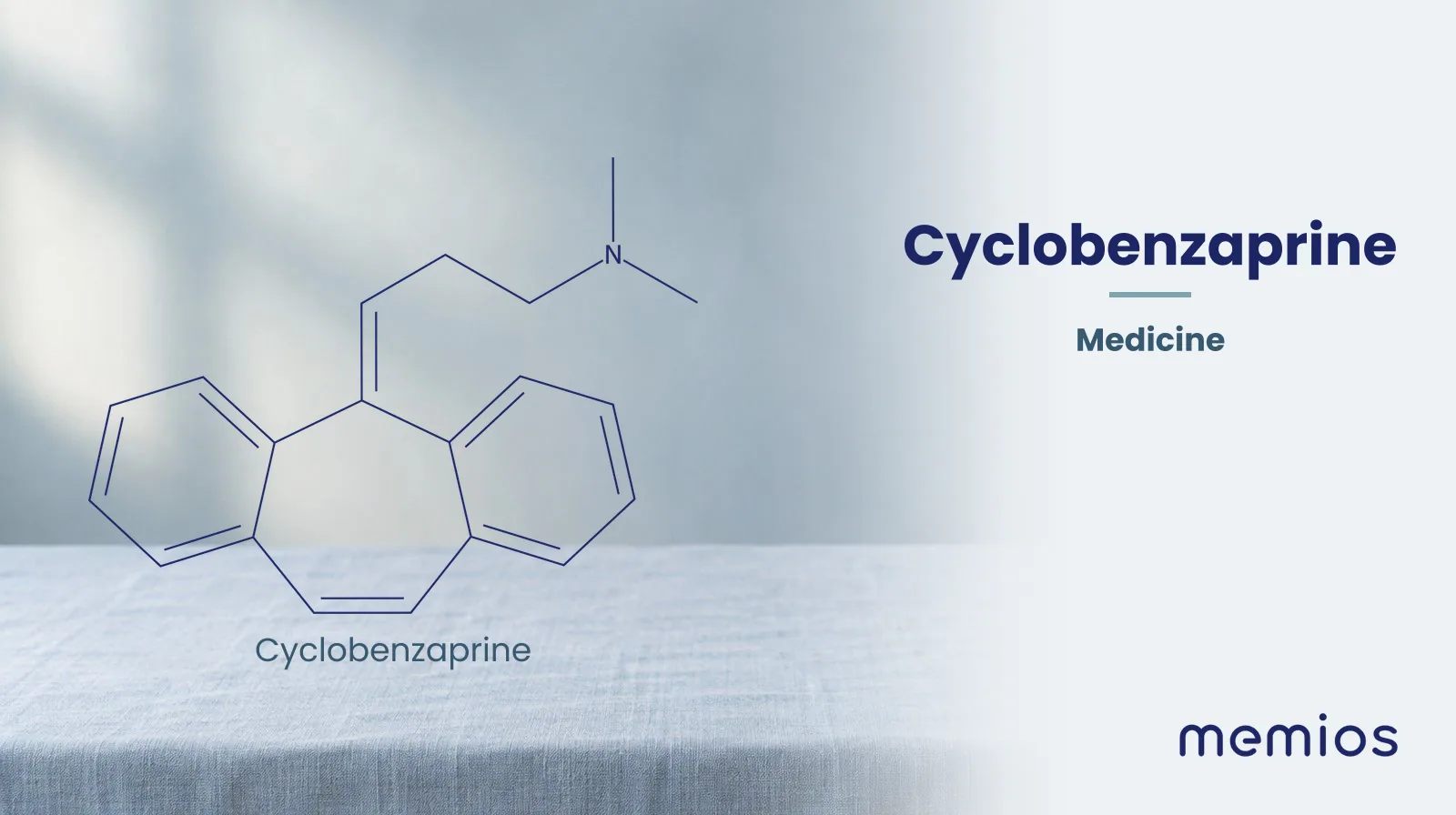
Drug class: Centrally acting skeletal muscle relaxant; a tricyclic compound structurally related to the tricyclic antidepressants
Cyclobenzaprine acts in the central nervous system, not on the muscle itself. Its label says it relieves muscle spasm arising locally in a muscle without stopping the muscle working, and that it does not help spasm caused by disease of the brain or spinal cord. Because it is chemically a tricyclic, it also blocks acetylcholine and histamine signalling, which is why sedation and dry mouth are its commonest effects. (Source 1)
What it is used for
- Pooled placebo-controlled trials show a real but modest short-term benefit for global improvement (odds ratio 4.7, on the order of three people treated for one to improve by day 10), concentrated in the first four days, with adverse effects in 53% versus 28% on placebo. The two summaries of that review we read disagree on the number needed to treat (2.7 in the DARE abstract, 3 on TheNNT) and on the number of people pooled (3,024 versus 2,440). The trials were of moderate quality and short. Evidence: limited. (Source 2)
- The evidence review we read found the randomised trials small, short and methodologically flawed, and the label itself states adequate evidence of effectiveness for more prolonged use is not available. Evidence: not-supported. (Source 3)
- A meta-analysis of five placebo-controlled trials found treated patients about three times as likely to report overall improvement (odds ratio 3.0, 95% CI 1.6 to 5.6; about 4.8 treated for 1 to improve), but no improvement in fatigue or tender points at any time point. Evidence: limited. (Source 4)
- The evidence review we read described the relevant randomised trials as small and potentially underpowered, with none showing clear evidence of benefit, and reported one trial in which cyclobenzaprine was not superior to placebo for global evaluation of muscle spasm at 14 to 18 days in 22 patients. Evidence: unknown. (Source 5)
Interactions
- Monoamine oxidase inhibitors (MAOIs) (label): Taking cyclobenzaprine with an MAOI, or within 14 days of stopping one, is contraindicated; the combination has been linked to potentially fatal serotonin syndrome. (Source 6)
- Serotonergic medicines (SSRIs, SNRIs, tricyclic antidepressants, tramadol, bupropion, meperidine, verapamil) (label): Combining cyclobenzaprine with these drugs has produced serotonin syndrome, a potentially life-threatening reaction with agitation, fever, fast heart rate, muscle twitching and diarrhoea. (Source 6)
- Alcohol, barbiturates and other CNS depressants (label): Cyclobenzaprine adds to the sedating effect of alcohol and other depressant drugs, increasing drowsiness and impairment. (Source 7)
Stopping it
- The label reports that stopping abruptly after prolonged use can rarely cause nausea, headache and malaise, and states these are not signs of addiction. There is no tapering schedule in the label. (Source 8)
- Because the label itself limits use to two or three weeks for lack of longer-term effectiveness evidence, stopping at the end of a short course is the labelled expectation rather than a deviation from it. (Source 9)
What goes wrong
The American Geriatrics Society advises avoiding skeletal muscle relaxants such as cyclobenzaprine in older adults because of anticholinergic effects, sedation and fracture risk. (Source 10)
- Official position, Moderate certainty.
- Size: expert panel recommendation, not a trial.
- Who: adults aged 65 and over.
- How long: not applicable.
- Result: recommendation: Avoid; quality of evidence moderate, strength of recommendation strong.
- Funding: professional body (American Geriatrics Society)
Muscle relaxants typically used to treat musculoskeletal complaints are poorly tolerated by older adults due to anticholinergic adverse effects, sedation, and increased risk of fractures; effectiveness at dosages tolerated by older adults is questionable.
The label warns that older people have higher blood levels and are more at risk of hallucinations, confusion and falls. (Source 11)
- Official position, Certainty not rated.
- Size: regulatory labelling.
- Who: elderly patients.
- How long: not applicable.
- Result: raised plasma concentration in the elderly; CNS events, cardiac events resulting in falls.
- Funding: manufacturer's FDA-approved labelling.
The elderly may also be more at risk for CNS adverse events such as hallucinations and confusion, cardiac events resulting in falls or other sequelae, drug-drug and drug-disease interactions.
Across the same pooled trials, people given cyclobenzaprine had more adverse effects than people given placebo, most commonly drowsiness. (Source 12)
- Meta-analysis, Low certainty.
- Size: Randomized, placebo-controlled trials of cyclobenzaprine in adults with back pain; the abstract retrieved does not state the number of trials or participants.
- Who: Adults with back pain.
- How long: Trial durations not stated in the abstract retrieved.
- Result: The abstract retrieved reports the direction only and names drowsiness as the most common adverse effect; it gives no percentages or risk ratio for adverse effects.
- Funding: not stated in the record retrieved.
Patients receiving cyclobenzaprine also experienced more adverse effects, the most common being drowsiness.
What the evidence supports
Pooled placebo-controlled trials of cyclobenzaprine in adults with back pain found people on the drug were nearly five times as likely to report symptom improvement by day 14, with slightly fewer than three treated for one extra person to improve. (Source 12)
- Meta-analysis, Low certainty.
- Size: Randomized, placebo-controlled trials of cyclobenzaprine in adults with back pain; the abstract retrieved does not state the number of trials or participants.
- Who: Adults with back pain.
- How long: Symptom improvement assessed by day 14; efficacy greatest in the first few days, declining after the first week.
- Result: Odds ratio 4.7 (95% confidence interval, 2.7-8.1) for symptom improvement by day 14; 2.7 (95% confidence interval, 2.0-4.2) needed treatment for 1 to improve; effect size 0.38 to 0.58 across all 5 outcomes.
- Funding: not stated in the record retrieved; the authors report contacting the manufacturer, Merck, Sharpe and Dohme, when searching for trials. Study quality was assessed with the Jadad method.
Patients treated with cyclobenzaprine were nearly 5 times (odds ratio, 4.7; 95% confidence interval, 2.7-8.1) as likely to report symptom improvement by day 14 as were those treated with placebo. Slightly fewer than 3 individuals (2.7; 95% confidence interval, 2.0-4.2) needed treatment for 1 to improve.
What the evidence does not support
The randomised evidence for using cyclobenzaprine long term is weak: the trials were small, short and methodologically flawed. (Source 3)
- Systematic review, Very low certainty.
- Size: 14 reports: seven systematic reviews, four RCTs reported in three papers, and four practice guidelines.
- Who: adults with fibromyalgia, back pain, neck pain or myofascial pain.
- How long: most included trials lasted only days to a few weeks.
- Result: no reliable estimate of long-term benefit could be derived.
- Funding: government health technology assessment agency (CADTH)
Included RCTs were often noted to have methodological flaws leading to potential bias, and were generally of small size and short duration.
In one small neck pain trial cyclobenzaprine was no better than placebo for global evaluation of muscle spasm. (Source 13)
- Systematic review, Very low certainty.
- Size: 22 patients in the trial described.
- Who: adults with neck pain.
- How long: 14 to 18 days.
- Result: no superiority over placebo on the global evaluation of muscle spasm.
- Funding: government health technology assessment agency (CADTH)
The second RCT found that cyclobenzaprine was not superior to placebo for the outcome of global evaluation of muscle spasm at 14 to 18 days in 22 patients.
The US label itself restricts cyclobenzaprine to two to three weeks because evidence for longer use is not available, and states it does not work for spasticity from brain or spinal cord disease or in cerebral palsy. (Source 14)
- Official position, Certainty not rated.
- Size: regulatory labelling, not a trial.
- Who: adults prescribed cyclobenzaprine.
- How long: up to 2 or 3 weeks.
- Result: no effectiveness established beyond 2 to 3 weeks; not effective for spasticity of cerebral or spinal cord origin.
- Funding: manufacturer's FDA-approved labelling.
Cyclobenzaprine hydrochloride tablets should be used only for short periods (up to 2 or 3 weeks) because adequate evidence of effectiveness for more prolonged use is not available
Where the evidence is mixed
Expressed as numbers needed to treat and harm, this summary puts it at about 1 in 3 gaining global improvement by day 10 and about 1 in 4 getting a medication adverse effect. (Source 15)
- Systematic review, Low certainty.
- Size: 14 publications, n = 2,440 as described by this appraisal.
- Who: adults with uncomplicated low back pain.
- How long: to day 10 of treatment.
- Result: NNT 3 (95% CI 2.0 to 4.5) for global improvement by day 10; adverse effects 53% versus 28% for a number needed to harm of 4.
- Funding: independent appraisal; funding of underlying trials not stated.
Limit of this finding: Two summaries of this same 2001 review report different numbers, and neither has been checked against the original paper. The DARE structured abstract says the review pooled 14 randomised trials in 3,024 people and gives 2.7 (95% CI 2.0 to 4.2) people treated for one to improve. TheNNT's summary of the same review says 14 publications in 2,440 people and a number needed to treat of 3 (95% CI 2.0 to 4.5). The two pages report the same odds ratio (4.7, 95% CI 2.7 to 8.1) and the same adverse-effect rates (53% versus 28%), so the direction of the result is not in dispute. Treat the size of the review and the exact number needed to treat as unsettled: read them as roughly three people treated for one extra person to improve, not as a precise figure.
In pooled analyses, treatment with cyclobenzaprine was more likely than placebo (odds ratio = 4.7; 95% confidence interval [CI], 2.7 to 8.1) to result in global improvement in symptoms by day 10 of treatment with a number needed to treat of 3 (95% CI, 2.0 to 4.5). Adverse effects, typically drowsiness, dry mouth, dizziness, and nausea, occurred in 53% of participants in the cyclobenzaprine group compared with 28% in the placebo group for a number needed to harm of 4.
Because adverse effects continue while the benefit is largest only in the first few days, any optimum course would be short. (Source 15)
- Systematic review, Low certainty.
- Size: as above.
- Who: adults with uncomplicated low back pain.
- How long: all recorded time points, with the largest effect in the first four days.
- Result: qualitative judgement by the appraisers.
- Funding: independent appraisal.
Limit of this finding: Two summaries of this same 2001 review report different numbers, and neither has been checked against the original paper. The DARE structured abstract says the review pooled 14 randomised trials in 3,024 people and gives 2.7 (95% CI 2.0 to 4.2) people treated for one to improve. TheNNT's summary of the same review says 14 publications in 2,440 people and a number needed to treat of 3 (95% CI 2.0 to 4.5). The two pages report the same odds ratio (4.7, 95% CI 2.7 to 8.1) and the same adverse-effect rates (53% versus 28%), so the direction of the result is not in dispute. Treat the size of the review and the exact number needed to treat as unsettled: read them as roughly three people treated for one extra person to improve, not as a precise figure.
Improvements in low back pain symptoms were present at all recorded time points, but the authors noted more of an effect size in the first four days of treatment. Because adverse effects would be present beyond the first few days, any optimum effectiveness of treatment would likely be short.
The same review's own conclusion is that the benefit over placebo is modest, comes at the price of more adverse effects, and is concentrated in the first four days, so shorter courses may be better. (Source 12)
- Meta-analysis, Low certainty.
- Size: Randomized, placebo-controlled trials of cyclobenzaprine in adults with back pain; the abstract retrieved does not state the number of trials or participants.
- Who: Adults with back pain.
- How long: Effect greatest in the first 4 days of treatment.
- Result: Authors' summary judgement; magnitude of improvement described as modest, with an effect size of 0.38 to 0.58 in all 5 outcomes.
- Funding: not stated in the record retrieved.
Cyclobenzaprine is more effective than placebo in the management of back pain; the effect is modest and comes at the price of greater adverse effects. The effect is greatest in the first 4 days of treatment, suggesting that shorter courses may be better.
In fibromyalgia, five pooled placebo-controlled trials found people on cyclobenzaprine about three times as likely to report overall improvement, with only moderate reductions in individual symptoms. (Source 16)
- Meta-analysis, Low certainty.
- Size: Five randomized, placebo-controlled trials.
- Who: People with fibromyalgia.
- How long: Not stated in the abstract retrieved; outcomes were tracked over time.
- Result: Odds ratio for global improvement 3.0 (95% confidence interval [95% CI] 1.6-5.6); pooled risk difference 0.21 (95% CI 0.09-0.34), which calculates to 4.8 (95% CI 3.0-11) individuals needing treatment for 1 patient to experience symptom improvement. The abstract also records that pain improved early on but there was no improvement in fatigue or tender points at any time.
- Funding: not stated in the record retrieved.
Cyclobenzaprine-treated patients were 3 times as likely to report overall improvement and to report moderate reductions in individual symptoms, particularly sleep.
Where the research disagrees
Whether the short-term benefit in acute back pain is clinically worth the sedation and dry mouth
- Browning and colleagues, as summarised in the DARE structured abstract, meta-analysis of 14 randomised controlled trials, n=3,024 as this DARE abstract reports it; TheNNT's summary of the same review says 14 publications and n=2,440, and the two have not been reconciled: Cyclobenzaprine was more effective than placebo in the management of back pain. However, the effect is modest and comes at the price of greater adverse effects. (Source 2)
- American Geriatrics Society Beers Criteria panel, 2023, for older adults specifically, expert consensus position with moderate quality of evidence, strong recommendation: Muscle relaxants typically used to treat musculoskeletal complaints are poorly tolerated by older adults due to anticholinergic adverse effects, sedation, and increased risk of fractures; effectiveness at dosages tolerated by older adults is questionable. (Source 10)
How much
- Reference intake: There is no reference intake for a prescription medicine. Dose is set by the prescriber. As a position, the US label (DailyMed, cyclobenzaprine hydrochloride tablets USP, read 22 September 2026) states 5 mg three times a day for most patients, which may be increased to 10 mg three times a day according to response, with less frequent dosing considered in hepatic impairment or in the elderly. (Source 9)
- Upper limit: The label sets no formal upper limit but states that use for periods longer than 2 or 3 weeks is not recommended. Separately, in its Use in the Elderly section (recorded as cyclo-label-e), it states that in the elderly cyclobenzaprine should be initiated with a 5 mg dose and titrated slowly upward. (Source 9)
- Studied: The two meta-analyses we read (back pain and fibromyalgia) did not report the per-trial cyclobenzaprine doses in the abstracts available to us; the label's stated adult range is 5 mg three times a day, increasing to 10 mg three times a day. (Source 9)
A common belief, and what the research shows
The belief: Cyclobenzaprine is a painkiller that relaxes a tight muscle directly, so it is fine to keep taking while a back problem settles.
What the research shows: It works in the nervous system, not on the muscle fibre, and its own label says "Cyclobenzaprine hydrochloride relieves skeletal muscle spasm of local origin without interfering with muscle function." It also says "Cyclobenzaprine hydrochloride tablets should be used only for short periods (up to 2 or 3 weeks) because adequate evidence of effectiveness for more prolonged use is not available", and the pooled trials found "The effect was greatest in the first 4 days of treatment, suggesting that shorter courses may be better."
Questions and answers
What is it?
Cyclobenzaprine is a prescription muscle relaxant taken by mouth, chemically related to the tricyclic antidepressants. It is licensed only as an add-on to rest and physical therapy for muscle spasm in acute, painful musculoskeletal problems. Its label states it does not help spasm caused by disease of the brain or spinal cord, nor spasticity in cerebral palsy. (Source 14)
What does it do in the body?
It acts centrally rather than on the muscle itself, easing spasm that arises locally in a muscle without stopping the muscle from working. It is ineffective when the spasm comes from central nervous system disease. Its tricyclic chemistry is why drowsiness and dry mouth are the commonest effects. (Source 1)
Is it good or bad for you?
It depends entirely on how long it is taken and for what. For short-term back pain the pooled placebo-controlled trials show a real but small benefit: people were nearly five times as likely to report improvement by day 14, yet the review itself called the size of that improvement modest, with effect sizes of 0.38 to 0.58. The same review found more adverse effects on the drug than on placebo, drowsiness being the commonest, and the benefit concentrated in the first four days. So the evidence supports a brief course for acute muscle spasm and does not support treating it as an ongoing medicine. (Source 12)
How do you get more of it?
Cyclobenzaprine is available only on prescription; there is no food, supplement or behaviour that provides it. The amount taken is decided by the prescriber. As a position, the label's stated adult range is 5 mg three times a day, which may be raised to 10 mg three times a day depending on response. (Source 9)
If it is harmful, what reduces it?
When it is causing harm the literature points to limiting exposure rather than any antidote: the label caps use at two or three weeks, starts the elderly on 5 mg, and the American Geriatrics Society advises avoiding this class in people over 65. In overdose, treatment is supportive and directed at the heart rhythm. (Source 11)
Why might someone be low in it or missing it?
Cyclobenzaprine is a prescription medicine, not something the body makes or needs, so nobody is naturally low in it. Someone will not be taking it if their prescriber has kept the course short, because the US label limits use to two or three weeks on the grounds that evidence for longer use is not available. It is also withheld outright from certain people: the label's contraindications include use with monoamine oxidase inhibitors or within 14 days of stopping them, the acute recovery phase of a heart attack, arrhythmias, heart block or conduction disturbances, congestive heart failure, and hyperthyroidism. This is the labeller's position on that label, not a trial result. (Source 17)
Which whole foods contain it or feed it?
No whole food contains cyclobenzaprine; it is a manufactured prescription medicine. The only dietary item its label addresses is alcohol, which it warns against because the two together increase sedation. There are no foods that feed or boost it. (Source 7)
What happens if you do not have it?
Nothing is depleted if a person does not take cyclobenzaprine, because it is a drug rather than a nutrient or a resident organism. What is forgone is a short-lived, small effect on acute back pain. A 2021 BMJ systematic review and meta-analysis of muscle relaxants for non-specific low back pain included 49 trials, 31 of which, sampling 6505 participants, were analysed quantitatively. Its conclusion pairs a benefit with a harm in a single sentence: non-benzodiazepine antispasmodics might give small but not clinically important reductions in pain intensity at or before two weeks, and might also increase the risk of an adverse event in acute low back pain. Both halves rest on low or very low certainty evidence, and the reviewers said considerable uncertainty remains about how well this class works and how safe it is, so neither the small benefit nor the added risk is settled. (Source 18)
How can you test for it?
There is no blood test used to monitor cyclobenzaprine treatment, and no target level. In overdose the label points to the electrocardiogram rather than a drug level: the widest limb-lead QRS duration is described as the best indicator of severity. We searched for validated urine or blood monitoring tests and for reports of cyclobenzaprine cross-reacting with tricyclic antidepressant immunoassays and could not reach a usable primary source in this run. (Source 19)
References
- DailyMed, US National Library of Medicine (manufacturer's FDA-approved label). Cyclobenzaprine Hydrochloride Tablets, USP - FDA-approved prescribing information (read 22 September 2026). Passages recorded from CLINICAL PHARMACOLOGY, INDICATIONS AND USAGE, WARNINGS (Serotonin Syndrome), PRECAUTIONS (Drug Interactions, Use in the Elderly), DRUG ABUSE AND DEPENDENCE, OVERDOSAGE and DOSAGE AND ADMINISTRATION. not dated in the text we read; accessed 2026-09-22. Read the source
- Database of Abstracts of Reviews of Effects (DARE), Centre for Reviews and Dissemination; hosted on NCBI Bookshelf. Cyclobenzaprine and back pain: a meta-analysis (DARE structured abstract of Browning R, Jackson JL, O'Malley PG, Archives of Internal Medicine). 2001. Read the source
- Canadian Agency for Drugs and Technologies in Health (CADTH) Rapid Response Report, hosted on NCBI Bookshelf. Long-term Use of Cyclobenzaprine for Pain: A Review of the Clinical Effectiveness (Summary of Evidence). not stated on the page we read. Read the source
- Database of Abstracts of Reviews of Effects (DARE), Centre for Reviews and Dissemination; hosted on NCBI Bookshelf. Treatment of fibromyalgia with cyclobenzaprine: a meta-analysis (DARE structured abstract of Tofferi JK, Jackson JL, O'Malley PG, Arthritis and Rheumatism). 2004. Read the source
- Canadian Agency for Drugs and Technologies in Health (CADTH) Rapid Response Report, hosted on NCBI Bookshelf. Long-term Use of Cyclobenzaprine for Pain: A Review of the Clinical Effectiveness (Summary of Evidence). not stated on the page we read. Read the source
- DailyMed, US National Library of Medicine (manufacturer's FDA-approved label). Cyclobenzaprine Hydrochloride Tablets, USP - FDA-approved prescribing information (read 22 September 2026). Passages recorded from CLINICAL PHARMACOLOGY, INDICATIONS AND USAGE, WARNINGS (Serotonin Syndrome), PRECAUTIONS (Drug Interactions, Use in the Elderly), DRUG ABUSE AND DEPENDENCE, OVERDOSAGE and DOSAGE AND ADMINISTRATION. not dated in the text we read; accessed 2026-09-22. Read the source
- DailyMed, US National Library of Medicine (manufacturer's FDA-approved label). Cyclobenzaprine Hydrochloride Tablets, USP - FDA-approved prescribing information (read 22 September 2026). Passages recorded from CLINICAL PHARMACOLOGY, INDICATIONS AND USAGE, WARNINGS (Serotonin Syndrome), PRECAUTIONS (Drug Interactions, Use in the Elderly), DRUG ABUSE AND DEPENDENCE, OVERDOSAGE and DOSAGE AND ADMINISTRATION. not dated in the text we read; accessed 2026-09-22. Read the source
- DailyMed, US National Library of Medicine (manufacturer's FDA-approved label). Cyclobenzaprine Hydrochloride Tablets, USP - FDA-approved prescribing information (read 22 September 2026). Passages recorded from CLINICAL PHARMACOLOGY, INDICATIONS AND USAGE, WARNINGS (Serotonin Syndrome), PRECAUTIONS (Drug Interactions, Use in the Elderly), DRUG ABUSE AND DEPENDENCE, OVERDOSAGE and DOSAGE AND ADMINISTRATION. not dated in the text we read; accessed 2026-09-22. Read the source
- DailyMed, US National Library of Medicine (manufacturer's FDA-approved label). Cyclobenzaprine Hydrochloride Tablets, USP - FDA-approved prescribing information (read 22 September 2026). Passages recorded from CLINICAL PHARMACOLOGY, INDICATIONS AND USAGE, WARNINGS (Serotonin Syndrome), PRECAUTIONS (Drug Interactions, Use in the Elderly), DRUG ABUSE AND DEPENDENCE, OVERDOSAGE and DOSAGE AND ADMINISTRATION. not dated in the text we read; accessed 2026-09-22. Read the source
- Journal of the American Geriatrics Society (American Geriatrics Society). American Geriatrics Society 2023 updated AGS Beers Criteria for potentially inappropriate medication use in older adults. 2023. DOI 10.1111/jgs.18372. Read the source
- DailyMed, US National Library of Medicine (manufacturer's FDA-approved label). Cyclobenzaprine Hydrochloride Tablets, USP - FDA-approved prescribing information (read 22 September 2026). Passages recorded from CLINICAL PHARMACOLOGY, INDICATIONS AND USAGE, WARNINGS (Serotonin Syndrome), PRECAUTIONS (Drug Interactions, Use in the Elderly), DRUG ABUSE AND DEPENDENCE, OVERDOSAGE and DOSAGE AND ADMINISTRATION. not dated in the text we read; accessed 2026-09-22. Read the source
- Archives of Internal Medicine (record retrieved from the Europe PMC REST service, EMBL-EBI). Cyclobenzaprine and back pain: a meta-analysis.. 2001. PMID 11434793, DOI 10.1001/archinte.161.13.1613. Read the source
- Canadian Agency for Drugs and Technologies in Health (CADTH) Rapid Response Report, hosted on NCBI Bookshelf. Long-term Use of Cyclobenzaprine for Pain: A Review of the Clinical Effectiveness (Summary of Evidence). not stated on the page we read. Read the source
- DailyMed, US National Library of Medicine (manufacturer's FDA-approved label). Cyclobenzaprine Hydrochloride Tablets, USP - FDA-approved prescribing information (read 22 September 2026). Passages recorded from CLINICAL PHARMACOLOGY, INDICATIONS AND USAGE, WARNINGS (Serotonin Syndrome), PRECAUTIONS (Drug Interactions, Use in the Elderly), DRUG ABUSE AND DEPENDENCE, OVERDOSAGE and DOSAGE AND ADMINISTRATION. not dated in the text we read; accessed 2026-09-22. Read the source
- TheNNT.com (independent evidence appraisal project). Cyclobenzaprine in the Treatment of Low Back Pain. not stated on the page we read. Read the source
- Arthritis and Rheumatism (record retrieved from the Europe PMC REST service, EMBL-EBI). Treatment of fibromyalgia with cyclobenzaprine: A meta-analysis.. 2004. PMID 14872449, DOI 10.1002/art.20076. Read the source
- DailyMed, US National Library of Medicine; labeler RedPharm Drug Inc.. CYCLOBENZAPRINE HYDROCHLORIDE tablet, film coated (US prescribing information). 2011. Read the source
- BMJ. Efficacy, acceptability, and safety of muscle relaxants for adults with non-specific low back pain: systematic review and meta-analysis. 2021. PMID 34233900, DOI 10.1136/bmj.n1446. Read the source
- DailyMed, US National Library of Medicine (manufacturer's FDA-approved label). Cyclobenzaprine Hydrochloride Tablets, USP - FDA-approved prescribing information (read 22 September 2026). Passages recorded from CLINICAL PHARMACOLOGY, INDICATIONS AND USAGE, WARNINGS (Serotonin Syndrome), PRECAUTIONS (Drug Interactions, Use in the Elderly), DRUG ABUSE AND DEPENDENCE, OVERDOSAGE and DOSAGE AND ADMINISTRATION. not dated in the text we read; accessed 2026-09-22. Read the source