Medications · September 30, 2026 · Memios · 26 min read
Citalopram
For acute major depression in adults the randomised evidence does show an effect over placebo, but the effect is modest and the trial base is mostly industry-sponsored and at high risk of selective reporting.
TLDR
- Boxed warning: Citalopram is not approved for use in pediatric patients.
- Well established. For acute major depression in adults the randomised evidence does show an effect over placebo, but the effect is modest and the trial base is mostly industry-sponsored and at high risk of selective reporting.
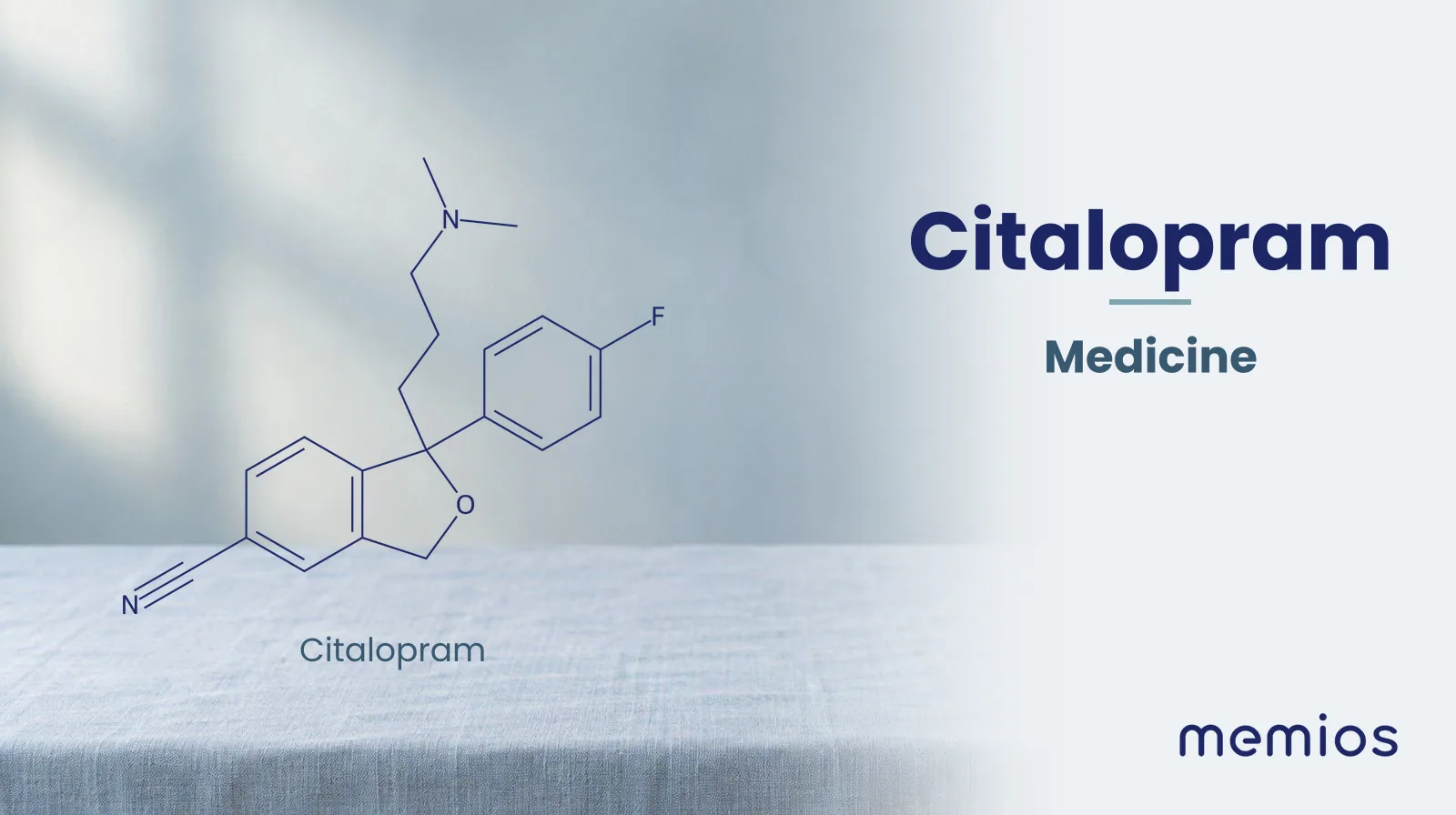
- What it is: Citalopram is a prescription-only small-molecule antidepressant, dispensed as citalopram hydrobromide tablets or oral solution. It is one of the selective serotonin reuptake inhibitors, and its US label carries a single approved indication, depression. It is a racemic mixture.
- Main use: Major depressive disorder (depression) in adults (well supported).
- Off-label uses (not on the FDA label): Agitation and aggression in Alzheimer's disease (limited evidence).
- Uses NOT supported by research: Repetitive behaviour in children and adolescents with autism spectrum disorders.
- Recommended dose: not established. There is no reference intake for a drug: the dose is set by the prescriber.
- Studied dose (a trial dose, not a recommendation): The CitAD trial in Alzheimer's disease gave 30 mg/day for up to nine weeks, above the label's 20 mg/day cap for people over 60, and measured an 18.1 ms greater QTc increase than placebo. Findings citing that trial: 1 on harm.
- Upper limit: As a position, the US citalopram label states that citalopram should not be given at doses above 40 mg/day because of dose-dependent QTc prolongation, and sets 20 mg/day as the maximum recommended dose for people over 60 years of age.
- What goes wrong: 7 findings on harm. Pooled randomised trials found SSRIs raised the risk of orgasmic dysfunction more than threefold, and the risk of reduced sexual satisfaction by about a fifth, compared with placebo.
- Interactions: 4 recorded, including St John's wort (Hypericum perforatum), Alcohol, NSAIDs, aspirin and other drugs that affect coagulation, Cimetidine or another CYP2C19 inhibitor.
- Common myth: If a standard dose of citalopram is not working, a higher dose is simply more of the same drug and carries no new kind of risk.
What it is
Citalopram is a prescription-only small-molecule antidepressant, dispensed as citalopram hydrobromide tablets or oral solution. It is one of the selective serotonin reuptake inhibitors, and its US label carries a single approved indication, depression. It is a racemic mixture; the S-enantiomer is marketed separately as escitalopram. Its labelled maximum dose is capped by cardiac conduction risk rather than by lack of extra benefit.
What the research says
For acute major depression in adults the randomised evidence does show an effect over placebo, but the effect is modest and the trial base is mostly industry-sponsored and at high risk of selective reporting. A 522-trial network meta-analysis found every one of 21 antidepressants beat placebo on response, with citalopram among the better tolerated, while rating the certainty of the evidence moderate to very low. A citalopram-specific meta-analysis of eight placebo-controlled trials found significantly higher response rates but an unclear effect on remission. Outside depression the picture is worse: in a 149-child randomised trial for repetitive behaviour in autism it was no better than placebo and caused more adverse events. Its distinctive harm is dose-dependent QT-interval prolongation, which is why the label caps the dose.
Evidence grade: Well established.
How it works
Drug class: Selective serotonin reuptake inhibitor (SSRI)
Citalopram blocks the transporter that pulls serotonin back into nerve cells in the brain, so more serotonin stays in the space between neurons. The label states this is presumed rather than proven to be how the antidepressant effect arises. (Source 1)
Boxed warning
Antidepressants increased the risk compared to placebo of suicidal thinking and behavior (suicidality) in children, adolescents, and young adults in short-term studies of major depressive disorder (MDD) and other psychiatric disorders. Anyone considering the use of citalopram tablets or any other antidepressant in a child, adolescent, or young adult must balance this risk with the clinical need. Short-term studies did not show an increase in the risk of suicidality with antidepressants compared to placebo in adults beyond age 24; there was a reduction in risk with antidepressants compared to placebo in adults aged 65 and older. Depression and certain other psychiatric disorders are themselves associated with increases in the risk of suicide. Patients of all ages who are started on antidepressant therapy should be monitored appropriately and observed closely for clinical worsening, suicidality, or unusual changes in behavior. Families and caregivers should be advised of the need for close observation and communication with the prescriber. Citalopram is not approved for use in pediatric patients. (See WARNINGS: Clinical Worsening and Suicide Risk, PRECAUTIONS: Information for Patients, and PRECAUTIONS: Pediatric Use.)
(Source 2)
What it is used for
- Across 522 randomised trials of 21 antidepressants, all drugs including citalopram beat placebo on response, and citalopram was among the more tolerable drugs in head-to-head comparisons. A citalopram-only meta-analysis of eight placebo-controlled trials gave a relative risk of response of 1.42 (95% CI 1.17 to 1.73) with substantial heterogeneity (I2=51%), and the appraisers who wrote that record up judged the trials sub-optimal in quality, mostly industry-sponsored, and the effect on full remission unclear. Evidence: established. (Source 3)
- In the placebo-controlled CitAD trial, citalopram 30 mg/day improved agitation but also lengthened the QTc interval by 18.1 ms more than placebo at three weeks. The dose used is above the 20 mg/day the label allows for people over 60, which is the age of almost everyone in the trial. Evidence: limited. (Source 4)
- A 149-child, 12-week randomised trial found identical response rates on citalopram and placebo (32.9% vs 34.2%) and more adverse events on citalopram. The investigators concluded the trial does not support this use. Evidence: not-supported. (Source 5)
Interactions
- St John's wort (Hypericum perforatum) (label): Taking St John's wort with citalopram can push serotonin activity too high and trigger serotonin syndrome, a potentially life-threatening reaction. The label names St John's wort alongside triptans, tramadol, lithium and tryptophan as serotonergic drugs that raise this risk. Limit: The label's own drug list misspells tryptophan as "trytophan". That is how the label prints it and it is quoted unchanged; it is a spelling slip in the source, not a different substance. (Source 6)
- Alcohol (label): A clinical trial did not find citalopram worsened alcohol's effects on thinking or movement, but the label still advises against drinking while taking it. (Source 7)
- NSAIDs, aspirin and other drugs that affect coagulation (label): Combining citalopram with anti-inflammatory painkillers, aspirin or other drugs that affect blood clotting increases the risk of bleeding. The label names that class of medicines; it does not name fish oil or any other supplement, and no supplement-specific study was retrieved for this entry. (Source 8)
- Cimetidine or another CYP2C19 inhibitor (label): Cimetidine and other drugs that inhibit the CYP2C19 enzyme slow citalopram's breakdown and raise its blood levels, so the label caps the dose at 20 mg/day when they are taken together. The same 20 mg/day cap applies to people who are CYP2C19 poor metabolisers. A pharmacokinetic study of omeprazole specifically could not be retrieved for this entry, so only the label's wording is carried here. (Source 9)
Stopping it
- Stopping an antidepressant commonly produces withdrawal symptoms. Pooled data across 35 studies put the incidence at 42.9% overall and 44.4% in randomised trials, usually starting within two weeks. Tapering rather than stopping abruptly was followed by a lower rate (34.5% versus 42.5%), but that difference was not statistically significant in the pooled analysis, so the pooled data do not establish that tapering reduces withdrawal. (Source 10)
- The same analysis found longer treatment was associated with more withdrawal, and that class mattered less than expected: 45.6% for SSRIs such as citalopram, 29.7% for SNRIs and 59.7% for tricyclics, with no significant difference between classes. (Source 10)
- The same analysis lists who was more likely to get withdrawal symptoms, and abrupt cessation is on that list alongside being female, being younger, early adverse effects, higher doses and longer treatment. (Source 10)
What goes wrong
In that same trial citalopram caused significantly more adverse events than placebo, including increased energy, impulsiveness, hyperactivity, diarrhoea and insomnia. (Source 5)
- Randomized trial, Moderate certainty.
- Size: 149 participants.
- Who: Children and adolescents with autism spectrum disorders.
- How long: 12 weeks.
- Result: Excess of increased energy level, impulsiveness, decreased concentration, hyperactivity, stereotypy, diarrhea, insomnia, and dry skin or pruritus on citalopram; mean maximum dose 16.5 mg/day.
- Funding: National Institutes of Health sponsored.
Limit of this finding: The trial's own definition of a "positive response" sits in a part of the abstract that is not reproduced here, so the recorded quotation gives the result without the endpoint definition. Response was rated on the Clinical Global Impressions, Improvement subscale.
Citalopram use was significantly more likely to be associated with adverse events, particularly increased energy level, impulsiveness, decreased concentration, hyperactivity, stereotypy, diarrhea, insomnia, and dry skin or pruritus.
In a randomised trial in Alzheimer's disease, citalopram 30 mg/day lengthened the QTc interval by 18.1 ms more than placebo over three weeks. (Source 4)
- Randomized trial, Moderate certainty.
- Size: 186 randomised; ECG substudy of 48 participants with baseline and week-3 QTc.
- Who: People with Alzheimer's disease and clinically significant agitation, 181 of 186 aged over 60.
- How long: 3 weeks for the ECG outcome, 9 weeks for the trial.
- Result: Difference in week 3 QTc adjusting for baseline QTc 18.1 ms (95% CI 6.1, 30.1); p = 0.004. Increases of 30 ms or more in 7 citalopram versus 1 placebo participant (p=0.046); one citalopram participant had ventricular bigeminy; no cardiovascular deaths in either group.
- Funding: National Institute on Aging and National Institute of Mental Health, R01AG031348 (independent of industry)
Limit of this finding: This paper reports the ECG results of the CitAD trial. Its conclusion also states that citalopram improved agitation, but the agitation data are in the parent trial report, not in this paper, so read the agitation claim as the authors' summary of work reported elsewhere. The QTc result itself comes from only 48 of the 186 randomised participants, who had an ECG before and at week 3.
Citalopram treatment was associated with a larger increase in QTc interval than placebo (difference in week 3 QTc adjusting for baseline QTc: 18.1 ms [95% CI: 6.1, 30.1]; p = 0.004).
In a large electronic-health-record study, higher citalopram doses were associated with longer QTc intervals, with within-person increases of about 8 to 10 ms per dose step. (Source 11)
- Survey study, Low certainty.
- Size: 38,397 adults with an ECG after an antidepressant or methadone prescription.
- Who: Adult patients of a large New England healthcare system, February 1990 to August 2011.
- How long: ECG recorded 14 to 90 days after prescription.
- Result: Dose-response association for citalopram (adjusted beta 0.10 (SE 0.04), P<0.01); within-subject mean QTc increase 7.8 (SE 3.6) ms going from 10 mg to 20 mg and 10.3 (4.0) ms from 20 mg to 40 mg.
- Funding: not stated in the abstract.
Within-subject paired observations supported the QTc prolonging effect of citalopram (10 mg to 20 mg, mean QTc increase 7.8 (SE 3.6) ms, adjusted P<0.05; and 20 mg to 40 mg, mean QTc increase 10.3 (4.0) ms, adjusted P<0.01).
Pooled randomised trials found SSRIs raised the risk of orgasmic dysfunction more than threefold, and the risk of reduced sexual satisfaction by about a fifth, compared with placebo. (Source 12)
- Meta-analysis, High certainty.
- Size: 13 randomised controlled trials met the inclusion criteria; 6 were pooled in the meta-analyses.
- Who: Adults with depression taking an SSRI versus placebo.
- How long: Trial durations as reported in the included RCTs.
- Result: Orgasmic dysfunction RR = 3.28 (95% CI 2.33 to 4.60, p < 0.00001; I² = 8%); reduced sexual satisfaction RR = 1.21 (95% CI 1.11 to 1.32, p = 0.0001, I² = 0%). The review's GRADE rating was high certainty for orgasmic dysfunction and moderate for sexual satisfaction.
- Funding: not stated in the abstract.
Limit of this finding: The published sentences carry unbalanced parentheses and a stray comma before each closing bracket (for example "I² = 8%,)"). They are quoted exactly as printed. Nothing about the numbers themselves is affected.
SSRIs were significantly associated with increased risk of orgasmic dysfunction (RR = 3.28, (95% CI of 2.33 to 4.60, p < 0.00001; I² = 8%,) and reduced sexual satisfaction (RR = 1.21, (95% CI of 1.11 to 1.32, p = 0.0001, I² = 0%,).
The US label reports that the only common adverse event occurring at 5% or more and at least twice the placebo rate in citalopram trials was ejaculation disorder in men. (Source 13)
- Official position, Certainty not rated.
- Size: Pooled placebo-controlled trials summarised in the label.
- Who: Adults in the manufacturer's controlled depression trials.
- How long: Short-term controlled trials.
- Result: Label table figures, citalopram versus placebo: nausea 21% vs 14%, dry mouth 20% vs 14%, somnolence 18% vs 10%, insomnia 15% vs 14%, increased sweating 11% vs 9%, tremor 8% vs 6%, diarrhoea 8% vs 5%, ejaculation disorder 6% vs 1%, decreased libido 2% vs under 1%.
- Funding: Manufacturer data submitted to the FDA.
The only commonly observed adverse event that occurred in citalopram patients with an incidence of 5% or greater and at least twice the incidence in placebo patients was ejaculation disorder (primarily ejaculatory delay) in male patients.
Pooled studies of antidepressant discontinuation put the incidence of withdrawal symptoms at about 43% overall and about 46% for SSRIs, with longer treatment associated with a higher rate. (Source 10)
- Meta-analysis, Low certainty.
- Size: 35 studies, including 11 randomised controlled trials.
- Who: People stopping antidepressants in RCTs, longitudinal and cross-sectional studies.
- How long: Symptoms usually appeared within 2 weeks and were generally measured for under 4 weeks.
- Result: Pooled incidence 42.9% across all studies and 44.4% across 11 RCTs; SSRIs 45.6%, SNRIs 29.7%, tricyclics 59.7% (p = 0.221); by treatment duration 6-12 weeks 35.1%, 12-24 weeks 42.7%, over 24 weeks 51.4%.
- Funding: not stated in the abstract.
Limit of this finding: The source's own wording is in tension with its own numbers. It says tapering "reduced" the incidence of withdrawal (34.5% versus 42.5%) and in the same sentence says the difference was not statistically significant (p = 0.484). Read this as: tapering was not shown to reduce withdrawal symptoms in these pooled data, not as evidence that it does. The pooled figures also mix randomised trials with online surveys.
The pooled incidence of AWS from all available studies was 42.9%, from 11 RCTs was 44.4%
The US label carries a boxed warning that antidepressants increase suicidal thinking and behaviour versus placebo in children, adolescents and young adults. (Source 2)
- Official position, Certainty not rated.
- Size: FDA pooled short-term trials referenced in the boxed warning.
- Who: Children, adolescents and young adults in short-term trials of major depressive disorder and other psychiatric disorders.
- How long: Short-term studies.
- Result: Increase in suicidality versus placebo in under-25s; no increase beyond age 24 and a reduction in those aged 65 and older, per the warning text.
- Funding: Regulatory position, FDA.
Antidepressants increased the risk compared to placebo of suicidal thinking and behavior (suicidality) in children, adolescents, and young adults in short-term studies of major depressive disorder (MDD) and other psychiatric disorders.
What the evidence supports
In the largest network meta-analysis of antidepressants, every drug studied including citalopram was more effective than placebo for acute response in adult major depression. (Source 3)
- Meta-analysis, Low certainty.
- Size: 522 trials comprising 116,477 participants.
- Who: Adults 18 and over with unipolar major depressive disorder diagnosed by standard criteria; trials with 20% or more bipolar, psychotic or treatment-resistant depression excluded.
- How long: Acute treatment (typically 8 weeks)
- Result: Odds ratios for response versus placebo ranged from 2.13 (95% CrI 1.89-2.41) for amitriptyline to 1.37 (1.16-1.63) for reboxetine; citalopram fell inside that range and was among the more tolerable drugs in head-to-head comparisons (range of ORs 0.43-0.77 for dropouts).
- Funding: National Institute for Health Research Oxford Health Biomedical Research Centre and the Japan Society for the Promotion of Science.
In terms of efficacy, all antidepressants were more effective than placebo, with ORs ranging between 2·13 (95% credible interval [CrI] 1·89–2·41) for amitriptyline and 1·37 (1·16–1·63) for reboxetine.
The Centre for Reviews and Dissemination's structured abstract of a citalopram-specific meta-analysis records significantly greater response rates and greater symptom-score reduction than placebo, with substantial heterogeneity between trials on the response outcome. (Source 14)
- Meta-analysis, Low certainty.
- Size: 8 randomised controlled trials, 2,125 participants.
- Who: Adults with major depressive disorder.
- How long: Short-term placebo-controlled trials.
- Result: Response RR 1.42, 95% CI 1.17 to 1.73, I2=51% (five trials); symptom score reduction SMD -0.27, 95% CI -0.38 to -0.16, I2=0% (five trials). The I2 of 51% on response means the trials disagreed with each other substantially on that outcome.
- Funding: Seven of the eight trials were industry sponsored.
Limit of this finding: What was read here is not the review itself but the Centre for Reviews and Dissemination's structured write-up of it, because the BMJ Open article was not reachable. The wording is CRD's rendering of the review's results, not the review authors' own sentences.
citalopram was associated with statistically significantly greater response rates (RR 1.42, 95% CI 1.17 to 1.73; I2=51%; five trials), and a significantly greater reduction in baseline depressive symptom scores (SMD -0.27, 95% CI -0.38 to -0.16; I2=0%; five trials)
What the evidence does not support
In a randomised trial in children and adolescents with autism spectrum disorders, citalopram was no better than placebo for repetitive behaviour. (Source 5)
- Randomized trial, Moderate certainty.
- Size: 149 participants (73 citalopram, 76 placebo)
- Who: Children and adolescents aged 5 to 17 (mean 9.4 years) with autistic spectrum disorder, Asperger disorder or PDD-NOS and at least moderate compulsive behaviours.
- How long: 12 weeks.
- Result: Positive response 32.9% citalopram vs 34.2% placebo (relative risk 0.96; 95% CI 0.61-1.51; P > .99); CYBOCS-PDD change -2.0 vs -1.9 points (P = .81)
- Funding: National Institutes of Health sponsored.
Limit of this finding: The trial's own definition of a "positive response" sits in a part of the abstract that is not reproduced here, so the recorded quotation gives the result without the endpoint definition. Response was rated on the Clinical Global Impressions, Improvement subscale.
There was no significant difference in the rate of positive response on the Clinical Global Impressions, Improvement subscale between the citalopram-treated group (32.9%) and the placebo group (34.2%) (relative risk, 0.96; 95% confidence interval, 0.61-1.51; P > .99).
The same pooled analysis found no statistically significant effect of SSRIs on sexual desire, and no difference from placebo in total scores on a sexual-function questionnaire. (Source 12)
- Meta-analysis, Moderate certainty.
- Size: 13 randomised controlled trials met the inclusion criteria; 6 were pooled in the meta-analyses.
- Who: Adults with depression taking an SSRI versus placebo.
- How long: Trial durations as reported in the included RCTs, searched to June 2025.
- Result: Decreased sexual desire RR = 1.40 (95% CI 0.92-2.12, p = 0.12; I² = 54%), which includes no difference; no significant difference in total CSFQ scores versus placebo. GRADE certainty moderate, on risk-of-bias grounds.
- Funding: not stated in the abstract.
Limit of this finding: The published sentences carry unbalanced parentheses and a stray comma before each closing bracket (for example "I² = 8%,)"). They are quoted exactly as printed. Nothing about the numbers themselves is affected.
A non-significant trend toward decreased sexual desire was observed (RR = 1.40, 95% CI: 0.92–2.12, p = 0.12; I² = 54%,). No significant differences were detected in total CSFQ scores compared with placebo.
Where the evidence is mixed
The same network meta-analysis rated most of its own trial base as moderate or high risk of bias and its certainty of evidence as moderate to very low. (Source 3)
- Meta-analysis, Low certainty.
- Size: 522 trials.
- Who: Adults with major depressive disorder.
- How long: Acute treatment.
- Result: 46 (9%) trials high risk of bias, 380 (73%) moderate, 96 (18%) low; certainty of evidence moderate to very low.
- Funding: National Institute for Health Research Oxford Health Biomedical Research Centre and the Japan Society for the Promotion of Science.
46 (9%) of 522 trials were rated as high risk of bias, 380 (73%) trials as moderate, and 96 (18%) as low; and the certainty of evidence was moderate to very low.
The Centre for Reviews and Dissemination, appraising that citalopram meta-analysis, judged that the sub-optimal quality of the trials and the small evidence base limit how far its results can be relied on. (Source 15)
- Meta-analysis, Very low certainty.
- Size: 8 randomised controlled trials, 2,125 participants.
- Who: Adults with major depressive disorder.
- How long: Short-term placebo-controlled trials.
- Result: Quality assessment found a high risk of selective reporting bias across all included studies; remission was reported by only two trials, one positive (RR 1.59, 95% CI 1.10 to 2.31) and one showing no difference.
- Funding: Seven trials industry sponsored.
Limit of this finding: This sentence is the appraiser's verdict on the review, not the review author's own view. The source's grammar, including "the author's results", is reproduced as printed.
Overall, the sub-optimal quality of the trials and small evidence base limit the reliability of the author's results.
Where the research disagrees
Whether the trial evidence for citalopram in depression is reliable enough to support the size of effect it is credited with
- Cipriani and colleagues, Lancet 2018 network meta-analysis, Network meta-analysis of 522 randomised trials, but the same paper rates its certainty of evidence as moderate to very low: In terms of efficacy, all antidepressants were more effective than placebo, with ORs ranging between 2·13 (95% credible interval [CrI] 1·89–2·41) for amitriptyline and 1·37 (1·16–1·63) for reboxetine. (Source 3)
- Centre for Reviews and Dissemination, appraising the citalopram-specific meta-analysis (its own commentary, not the review author's words), Critical appraisal of a meta-analysis of eight published placebo-controlled trials, seven of them industry sponsored, with a high risk of selective reporting bias: Overall, the sub-optimal quality of the trials and small evidence base limit the reliability of the author's results. (Source 15)
How much
- Reference intake: There is no reference intake for a drug: the dose is set by the prescriber. As a position, the US citalopram label recorded here (DailyMed set id c8b0a9d1..., recorded with year 2020) states that citalopram is indicated for the treatment of depression. The label's own dose ceilings are listed under the upper limit below. (Source 16)
- Upper limit: As a position, the US citalopram label states that citalopram should not be given at doses above 40 mg/day because of dose-dependent QTc prolongation, and sets 20 mg/day as the maximum recommended dose for people over 60 years of age, for people with hepatic impairment, for CYP2C19 poor metabolisers, and for people taking concomitant cimetidine or another CYP2C19 inhibitor. (Source 17)
- Studied: The CitAD trial in Alzheimer's disease gave 30 mg/day for up to nine weeks, above the label's 20 mg/day cap for people over 60, and measured an 18.1 ms greater QTc increase than placebo. (Source 4)
- Studied: The autism trial gave children a mean maximum of 16.5 mg/day (maximum 20 mg/day) of citalopram hydrobromide for 12 weeks. (Source 18)
- Studied: The eight placebo-controlled depression trials pooled in the citalopram-specific meta-analysis enrolled 2,125 adults in short-term comparisons against placebo. (Source 14)
A common belief, and what the research shows
The belief: If a standard dose of citalopram is not working, a higher dose is simply more of the same drug and carries no new kind of risk.
What the research shows: Citalopram's cardiac risk is dose-dependent, which is why the label caps it rather than leaving it open. The label states: "Citalopram causes dose-dependent QTc prolongation, an ECG abnormality that has been associated with Torsade de Pointes (TdP), ventricular tachycardia, and sudden death." Measured data match: in 38,397 patients, within-person QTc rose a mean 10.3 (4.0) ms going from 20 mg to 40 mg, and in a randomised trial at 30 mg/day in older adults with Alzheimer's disease, "Citalopram treatment was associated with a larger increase in QTc interval than placebo (difference in week 3 QTc adjusting for baseline QTc: 18.1 ms [95% CI: 6.1, 30.1]; p = 0.004)."
Questions and answers
What is it?
Citalopram is a prescription antidepressant tablet or oral solution, one of the selective serotonin reuptake inhibitors. In the United States its label lists a single approved use, depression. It is not a nutrient or a supplement and cannot be obtained from food. (Source 16)
What does it do in the body?
Citalopram blocks the reuptake of serotonin into nerve cells in the brain, leaving more serotonin available between neurons. The label itself frames this as a presumption rather than a proven chain of cause and effect for the antidepressant response. (Source 1)
Is it good or bad for you?
It depends entirely on the condition and the dose. For acute adult depression, pooled randomised trials show a real but modest advantage over placebo, and citalopram is among the better tolerated antidepressants. For repetitive behaviour in autistic children a randomised trial found no benefit and more adverse events. At higher doses it lengthens the QT interval, which is why the label caps it, and the label carries a boxed warning about suicidality in people under 25. (Source 19)
How do you get more of it?
Citalopram is prescription-only and there is no dietary or behavioural way to obtain more of it. In the trials that tested it, adults in depression studies received short-term placebo-controlled courses, the Alzheimer's agitation trial used 30 mg/day, and the autism trial used a mean maximum of 16.5 mg/day in children. The label sets caps of 40 mg/day generally and 20 mg/day for several groups; only a prescriber can set a dose. (Source 20)
If it is harmful, what reduces it?
If citalopram is causing harm, the way it is reduced is by stopping or tapering it under a prescriber's direction, and the literature says that itself carries a withdrawal risk. Pooled data across 35 studies put antidepressant withdrawal at 42.9% overall. Tapering was followed by a lower rate than abrupt stopping (34.5% versus 42.5%), but the difference was not statistically significant, so these pooled data do not show that tapering prevents withdrawal. (Source 10)
Why might someone be low in it or missing it?
Does not apply in the nutrient sense: nobody is naturally low in citalopram. What does change how much of it reaches the bloodstream is how fast the body breaks it down. The label caps the dose at 20 mg/day in CYP2C19 poor metabolisers, in people over 60, in hepatic impairment and with cimetidine, because these all raise citalopram exposure. (Source 21)
Which whole foods contain it or feed it?
No food contains citalopram; it is a synthetic prescription drug. The food-related point in the literature is what to avoid rather than what to seek: the label advises against alcohol while taking it, and names St John's wort, a plant extract sold as a supplement, among the serotonergic agents that raise the risk of serotonin syndrome. (Source 7)
What happens if you do not have it?
There is no deficiency state for a drug. What the trials describe is the counterfactual: in placebo groups of citalopram depression trials a substantial minority still responded, and across the 522-trial network meta-analysis the difference between drug and placebo, while consistent, was modest. In one randomised trial the placebo group did just as well as the drug group. (Source 5)
How can you test for it?
There is no routine blood test for citalopram levels used to guide treatment. What is measured instead is the effect the drug has on the heart's electrical recovery time, the QTc interval on an ECG, and this is measurable: randomised and observational data both show it lengthens with dose. CYP2C19 genotype is the other testable factor, because poor metabolisers are capped at 20 mg/day. (Source 4)
References
- DailyMed, US National Library of Medicine. Label: CITALOPRAM HYDROBROMIDE tablet (US prescribing information) - CLINICAL PHARMACOLOGY - Pharmacodynamics (mechanism of action). 2020. Read the source
- DailyMed, US National Library of Medicine; labeler H.J. Harkins Company, Inc.. Label: CITALOPRAM- citalopram tablet (US prescribing information, BOXED WARNING); prescribing information stamped "Revised: 07/2009", published as an SPL carrying a Medication Guide dated 11/2011. 2009. Read the source
- The Lancet. Comparative efficacy and acceptability of 21 antidepressant drugs for the acute treatment of adults with major depressive disorder: a systematic review and network meta-analysis. 2018. PMID 29477251, DOI 10.1016/S0140-6736(17)32802-7. Read the source
- PLOS ONE. Changes in QTc Interval in the Citalopram for Agitation in Alzheimer's Disease (CitAD) Randomized Trial - article abstract. 2014. PMID 24914549, DOI 10.1371/journal.pone.0098426. Read the source
- Archives of General Psychiatry (read on the JAMA Network full-text page). Lack of efficacy of citalopram in children with autism spectrum disorders and high levels of repetitive behavior - structured abstract, Results section. 2009. PMID 19487623, DOI 10.1001/archgenpsychiatry.2009.30. Read the source
- DailyMed, US National Library of Medicine. Label: CITALOPRAM HYDROBROMIDE tablet (US prescribing information) - WARNINGS - Serotonin Syndrome. 2020. Read the source
- DailyMed, US National Library of Medicine. Label: CITALOPRAM HYDROBROMIDE tablet (US prescribing information) - PRECAUTIONS - Drug Interactions (alcohol). 2020. Read the source
- DailyMed, US National Library of Medicine. Label: CITALOPRAM HYDROBROMIDE tablet (US prescribing information) - PRECAUTIONS - Abnormal Bleeding. 2020. Read the source
- DailyMed, US National Library of Medicine. Label: CITALOPRAM HYDROBROMIDE tablet (US prescribing information) - PRECAUTIONS - Drug Interactions (cimetidine and other CYP2C19 inhibitors). 2020. Read the source
- Molecular Psychiatry (Nature). Incidence and risk factors of antidepressant withdrawal symptoms: a meta-analysis and systematic review. 2024. DOI 10.1038/s41380-024-02782-4. Read the source
- BMJ. QT interval and antidepressant use: a cross sectional study of electronic health records - structured abstract, Results section. 2013. PMID 23360890, DOI 10.1136/bmj.f288. Read the source
- European Journal of Clinical Pharmacology. Sexual dysfunction associated with selective serotonin reuptake inhibitors in adults with depression: a systematic review and meta-analysis - abstract, Results section. 2026. DOI 10.1007/s00228-026-04011-z. Read the source
- DailyMed, US National Library of Medicine. Label: CITALOPRAM HYDROBROMIDE tablet (US prescribing information, adverse reactions). 2016. Read the source
- Centre for Reviews and Dissemination (Database of Abstracts of Reviews of Effects), NCBI Bookshelf - a third-party structured abstract with CRD commentary on Apler A, BMJ Open 2011;1(2):e000106; the BMJ Open article itself was not reachable. Citalopram for major depressive disorder in adults - DARE structured abstract, the "Results of the review" field as written by CRD (pooled response and symptom-score results). 2011. PMID 22021869, DOI 10.1136/bmjopen-2011-000106. Read the source
- Centre for Reviews and Dissemination (Database of Abstracts of Reviews of Effects), NCBI Bookshelf - a third-party structured abstract with CRD commentary on Apler A, BMJ Open 2011;1(2):e000106; the BMJ Open article itself was not reachable. Citalopram for major depressive disorder in adults - the CRD commentary, i.e. the Centre for Reviews and Dissemination's own appraisal of the review, not the review author's words. 2011. PMID 22021869, DOI 10.1136/bmjopen-2011-000106. Read the source
- DailyMed, US National Library of Medicine. Label: CITALOPRAM HYDROBROMIDE tablet (US prescribing information) - INDICATIONS AND USAGE. 2020. Read the source
- DailyMed, US National Library of Medicine. Label: CITALOPRAM HYDROBROMIDE tablet (US prescribing information) - WARNINGS - QT-Prolongation and Torsade de Pointes (dose ceiling). 2020. Read the source
- Archives of General Psychiatry (read on the JAMA Network full-text page). Lack of efficacy of citalopram in children with autism spectrum disorders - structured abstract, Interventions section. 2009. PMID 19487623, DOI 10.1001/archgenpsychiatry.2009.30. Read the source
- Archives of General Psychiatry (read on the JAMA Network full-text page). Lack of efficacy of citalopram in children with autism spectrum disorders - structured abstract, Conclusion section. 2009. PMID 19487623, DOI 10.1001/archgenpsychiatry.2009.30. Read the source
- DailyMed, US National Library of Medicine. Label: CITALOPRAM HYDROBROMIDE tablet (US prescribing information) - PRECAUTIONS - Geriatric Use. 2020. Read the source
- DailyMed, US National Library of Medicine. Label: CITALOPRAM HYDROBROMIDE tablet (US prescribing information) - CLINICAL PHARMACOLOGY - Population Subgroups (CYP2C19 poor metabolizers). 2020. Read the source