Medications · September 29, 2026 · Memios · 20 min read
Celecoxib
Celecoxib relieves pain and inflammation, and the size of that relief is modest and measurable.
TLDR
- Boxed warning: Gastrointestinal Bleeding, Ulceration, and Perforation.
- Well established. Celecoxib relieves pain and inflammation, and the size of that relief is modest and measurable.
- What it is: Celecoxib is a non-steroidal anti-inflammatory drug (NSAID) taken by mouth as a capsule.
- Main use: Osteoarthritis (well supported).
- Other approved uses: Rheumatoid arthritis (well supported); Acute pain after surgery (well supported).
- Off-label uses (not on the FDA label): Add-on treatment to antidepressants in major depressive disorder (limited evidence).
- Recommended dose (official position): There is no reference intake for a drug. Dosing is set by the prescriber.
- Studied dose (a trial dose, not a recommendation): PRECISION used a mean daily dose of 209 mg (SD 37) of celecoxib, against naproxen 852 mg (SD 103) and ibuprofen 2045 mg (SD 246). Findings citing that trial: 1 against.
- Upper limit: No maximum daily dose appears in the label passages we recorded.
- What goes wrong: 5 findings on harm. Compared with placebo, celecoxib caused more withdrawals from trials because of adverse effects, including gastrointestinal adverse effects.
- Interactions: 5 recorded, including Warfarin and similar anticoagulants, Fluconazole (and other CYP2C9 inhibitors), Lithium, Alcohol.
- Common myth: Celecoxib is the safe NSAID, because being COX-2 selective it does not harm the stomach.
What it is
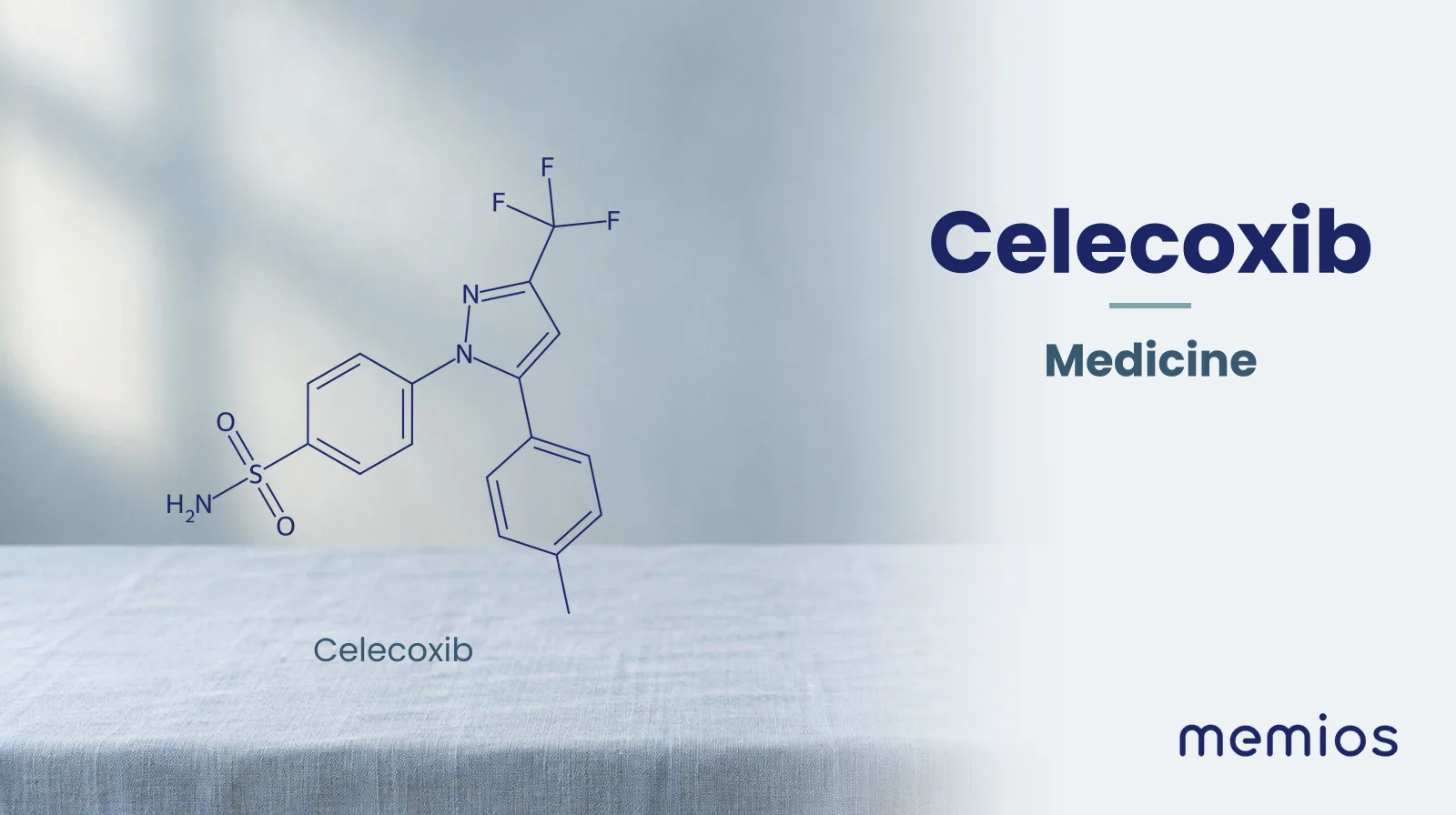
Celecoxib is a non-steroidal anti-inflammatory drug (NSAID) taken by mouth as a capsule. It differs from older NSAIDs such as ibuprofen and naproxen in being selective for the cyclooxygenase-2 (COX-2) enzyme, which is why it was developed to spare the stomach lining. It is cleared mainly by the liver enzyme CYP2C9. It carries a boxed warning for serious cardiovascular thrombotic events and serious gastrointestinal bleeding.
What the research says
Celecoxib relieves pain and inflammation, and the size of that relief is modest and measurable. In single-dose postoperative pain, 33% of people given 200 mg and 43% given 400 mg got at least half their pain relieved, against about 1 in 10 on placebo, giving numbers needed to treat of 4.2 and 2.6. In arthritis it works about as well as older NSAIDs and better than placebo, with fewer endoscopic ulcers than comparator NSAIDs. Against placebo it also causes more withdrawals for adverse effects, and in the large PRECISION cardiovascular safety trial it was non-inferior, not superior, to ibuprofen and naproxen on cardiovascular events.
Evidence grade: Well established.
How it works
Drug class: Non-steroidal anti-inflammatory drug, selective cyclooxygenase-2 (COX-2) inhibitor
Celecoxib blocks the enzyme cyclooxygenase-2, which the body uses to make prostaglandins. Prostaglandins make nerve endings more sensitive to pain and are part of the inflammation response, so blocking their production in inflamed tissue reduces pain and swelling. Because it targets COX-2 rather than COX-1, it interferes less with the prostaglandins that protect the stomach lining, which is the basis of its gastrointestinal advantage over older NSAIDs. (Source 1)
Boxed warning
WARNING: RISK OF SERIOUS CARDIOVASCULAR AND GASTROINTESTINAL EVENTS
(Source 2)
What it is used for
- Against placebo, celecoxib improved the WOMAC composite score by a mean difference of -5.67 (95% CI -7.45 to -3.89). Against another NSAID the difference was 0.42 (95% CI -1.45 to 2.30), that is, no better than the comparator. Evidence: established. (Source 3)
- Celecoxib beat placebo for ACR-20 response (RR 1.49, 95% CI 1.25 to 1.78) but was not significantly better than other NSAIDs (RR 1.04, 95% CI 0.80 to 1.36). Evidence: established. (Source 3)
- A Cochrane review of 10 trials in 1,785 participants found numbers needed to treat of 4.2 for 200 mg and 2.6 for 400 mg for at least 50% pain relief over four to six hours, with adverse events similar to placebo. Evidence: established. (Source 4)
- A meta-analysis of randomised placebo-controlled trials found add-on celecoxib reduced Hamilton Depression Rating Scale scores by a pooled 3.43 points at week 6 and raised response and remission odds (pooled OR 6.6 for each). The trials were small and short, and this is not an approved use. Evidence: limited. (Source 5)
Interactions
- Warfarin and similar anticoagulants (case reports): A study in healthy volunteers found celecoxib did not change warfarin's effect on prothrombin time, but after marketing there have been reports of serious and sometimes fatal bleeding, mostly in elderly people, alongside rising prothrombin times. (Source 6)
- Fluconazole (and other CYP2C9 inhibitors) (pharmacokinetic study): Fluconazole blocks the liver enzyme that clears celecoxib, doubling the amount of celecoxib in the blood. (Source 7)
- Lithium (pharmacokinetic study): Adding celecoxib raised steady-state lithium blood levels by about 17% in a healthy-volunteer study, so lithium levels can drift when celecoxib is started or stopped. (Source 8)
- Alcohol (cohort study (not one of the listed evidence values; see notes)): In a 26-year cohort of men, the gastrointestinal bleeding risk that goes with NSAID or aspirin use rose as alcohol intake rose. This is observational, so it shows an association rather than proving alcohol causes the extra bleeding. (Source 9)
- Low-dose aspirin (clinical trial): Celecoxib's gastrointestinal advantage over other NSAIDs was smaller in people also taking prophylactic aspirin than in those who were not, in the pooled trial data. (Source 10)
Stopping it
- No dependence or withdrawal syndrome is described for celecoxib in the sources we read. In the single-dose acute pain trials, stopping the drug because of adverse reactions happened at about the same rate as with placebo. (Source 4)
- Stopping is nonetheless common in practice for reasons other than withdrawal effects: in PRECISION, which ran for a mean of 20 months on treatment, more than two thirds of participants stopped their assigned NSAID. (Source 11)
What goes wrong
Celecoxib carries a boxed warning that NSAIDs increase the risk of fatal cardiovascular thrombotic events and of fatal gastrointestinal bleeding, ulceration and perforation. (Source 2)
- Official position, Certainty not rated.
- Size: Not applicable; regulatory position.
- Who: All users of celecoxib; elderly people and those with prior peptic ulcer disease or gastrointestinal bleeding singled out as higher risk.
- How long: The warning states risk may occur early and may increase with duration of use.
- Result: No numbers given in the warning itself; it states the events can be fatal and can occur without warning symptoms, and that celecoxib is contraindicated around coronary artery bypass graft surgery.
- Funding: not applicable.
Nonsteroidal anti-inflammatory drugs (NSAIDs) cause an increased risk of serious cardiovascular thrombotic events, including myocardial infarction, and stroke, which can be fatal.
Compared with placebo, celecoxib caused more withdrawals from trials because of adverse effects, including gastrointestinal adverse effects. (Source 12)
- Systematic review, Moderate certainty.
- Size: 5 trials, n=3,826 for the placebo comparison.
- Who: Adults with osteoarthritis or rheumatoid arthritis.
- How long: Not stated in the record.
- Result: Withdrawals for any adverse effect RR 1.49 (95% CI 1.15 to 1.92) versus placebo; withdrawals for gastrointestinal adverse effects RR 1.68 (95% CI 1.07 to 2.65) versus placebo; versus other NSAIDs the RRs were 0.86 and 0.54.
- Funding: not stated.
For withdrawals due to any adverse effects, the RR was 1.49 (95% CI: 1.15, 1.92; Q=1.08, p=0.90) for celecoxib versus placebo (5 trials, n=3,826)
Serious bleeding events, some fatal, have been reported after marketing in people taking celecoxib together with warfarin, even though a healthy-volunteer study found no change in prothrombin time. (Source 6)
- Case series, Very low certainty.
- Size: Number of post-marketing reports not stated.
- Who: Predominantly elderly people taking celecoxib concurrently with warfarin.
- How long: Not stated; the label directs monitoring particularly in the first few days.
- Result: No rate given; the label reports serious and sometimes fatal bleeding associated with increases in prothrombin time.
- Funding: not applicable.
However, in post-marketing experience, serious bleeding events, some of which were fatal, have been reported, predominantly in the elderly, in association with increases in prothrombin time in patients receiving CELEBREX concurrently with warfarin.
Alcohol appeared to increase the gastrointestinal bleeding risk associated with NSAID or aspirin use in a 26-year cohort of men. (Source 9)
- Cohort study, Low certainty.
- Size: 48,000 men; 305 episodes of major gastrointestinal bleeding.
- Who: Men aged 40 to 75 at baseline in the Health Professionals Follow-up Study.
- How long: 26 years of follow-up.
- Result: Among NSAID/aspirin users, multivariable RR for major gastrointestinal bleeding 1.37 (95% CI 0.85 to 2.19) at 1 to 14 g/day of alcohol and 1.75 (95% CI 1.07 to 2.88) at 15 g/day or more, compared with nondrinkers.
- Funding: not stated.
The risk of GIB associated with NSAIDs/aspirin use increased with greater alcohol consumption (multivariable RR 1.37; 95% CI, 0.85–2.19 for 1-14g/day of alcohol, RR 1.75; 95% CI, 1.07–2.88 for ≥ 15g/day compared to nondrinkers).
One serious adverse event, rhabdomyolysis, was judged probably related to celecoxib in the single-dose acute pain trials, although overall adverse event rates matched placebo. (Source 4)
- Systematic review, Moderate certainty.
- Size: 10 trials, 1,785 participants.
- Who: Adults with acute postoperative pain.
- How long: Single dose.
- Result: Adverse reactions and withdrawals for adverse reactions occurred at similar rates to placebo; one serious event (rhabdomyolysis) probably drug-related.
- Funding: not stated.
One serious adverse event, muscle breakdown (rhabdomyolysis), was probably related to celecoxib.
What the evidence supports
In single-dose acute postoperative pain, celecoxib gave at least 50% pain relief to a minority of people, with a number needed to treat of 4.2 at 200 mg and 2.6 at 400 mg. (Source 13)
- Systematic review, Moderate certainty.
- Size: 10 trials, 1,785 participants.
- Who: Adults with moderate or severe acute postoperative pain, often after wisdom tooth extraction.
- How long: Single dose, four to six hours of assessment, rescue medication tracked to 24 hours.
- Result: NNT 4.2 (95% CI 3.4 to 5.6) for 200 mg and 2.6 (95% CI 2.3 to 3.0) for 400 mg; 33% of people on 200 mg and 43% on 400 mg got at least 50% relief versus about 1 in 10 (1% to 11%) on placebo; NNT to prevent one person needing rescue medication 4.8 and 3.5.
- Funding: not stated.
The NNT for celecoxib 200 mg and 400 mg compared with placebo for at least 50% of maximum pain relief over four to six hours was 4.2 (95% confidence interval (CI) 3.4 to 5.6) and 2.6 (95% CI 2.3 to 3.0) respectively.
In rheumatoid arthritis, celecoxib improved the ACR-20 responder rate and joint counts compared with placebo — an outcome this review record prints as "ARC-20", its own misspelling of ACR-20. (Source 3)
- Systematic review, Moderate certainty.
- Size: 2 trials, n=1,373 for the placebo comparison.
- Who: Adults with rheumatoid arthritis.
- How long: Not stated in the record.
- Result: RR 1.49 (95% CI 1.25 to 1.78) for the responder outcome the record prints as "ARC-20" versus placebo; RR 1.39 (95% CI 1.21 to 1.61) for improvement in painful or tender joints; RR 1.34 (95% CI 1.14 to 1.56) for swollen joints.
- Funding: not stated.
Limit of this finding: The misspelling is the source's own. This review record prints the rheumatoid arthritis responder outcome as "ARC-20" in its results narrative while defining it correctly elsewhere on the same page as the American College of Rheumatology (ACR-20) responder index, so the quote is reproduced exactly as printed rather than silently corrected. Read "ARC-20" as ACR-20, meaning a 20% improvement on the American College of Rheumatology criteria. It is a spelling slip, not a different measure, and the numbers beside it are unaffected.
The RRs were 1.49 (95% CI: 1.25, 1.78; Q=0.06, p=0.81) and 1.04 (95% CI: 0.80, 1.36; Q=6.94, p=0.03) for ARC-20 improvement
Celecoxib produced fewer endoscopic ulcers and fewer serious upper gastrointestinal events than comparator non-selective NSAIDs. (Source 14)
- Systematic review, Moderate certainty.
- Size: 5 trials, n=2,742 for endoscopic ulcers; one trial, n=7,968 for serious events.
- Who: Adults with osteoarthritis or rheumatoid arthritis.
- How long: 24 weeks for the serious-event outcomes.
- Result: Endoscopic ulcers RR 0.29 (95% CI 0.21 to 0.41) versus NSAID; serious upper gastrointestinal events RR 0.55 (95% CI 0.26 to 1.14); serious events plus ulcers RR 0.61 (95% CI 0.39 to 0.96)
- Funding: not stated.
For ulcers detected by endoscopy, the RR was 1.53 (95% CI: 0.73, 3.21; Q=0.12, p=0.73) for celecoxib versus placebo (2 trials, n=933) and 0.29 (95% CI: 0.21, 0.41; Q=11.33, p=0.05) for celecoxib versus NSAID
Add-on celecoxib improved depression scores and response rates in randomised placebo-controlled trials, an off-label use resting on small short trials. (Source 5)
- Meta-analysis, Low certainty.
- Size: Randomised placebo-controlled trials pooled; participant total not stated in the record.
- Who: Patients with unipolar depressive episodes already taking antidepressants.
- How long: Four to six weeks.
- Result: Hamilton Depression Rating Scale pooled difference in means 3.3 (95% CI 1.2 to 5.3, p=0.002) at week 4 and 3.43 (95% CI 1.9 to 4.9, p<0.0001) at week 6; response pooled OR 6.6 (95% CI 2.5 to 17); remission pooled OR 6.6 (95% CI 2.7 to 15.9)
- Funding: not stated.
The add-on celecoxib group also showed higher response (pooled OR=6.6, 95%CI [2.5-17], p<0.0001) and remission rates (pooled OR=6.6, 95%CI [2.7-15.9], p<0.0001) compared with the placebo group.
What the evidence does not support
In osteoarthritis, celecoxib was no better than another NSAID on the WOMAC composite score. (Source 3)
- Systematic review, Moderate certainty.
- Size: 3 trials, n=1,853 for the NSAID comparison.
- Who: Adults with osteoarthritis.
- How long: Not stated in the record.
- Result: Mean difference 0.42 (95% CI -1.45 to 2.30) versus NSAID, where values below zero favour celecoxib; against placebo the mean difference was -5.67 (95% CI -7.45 to -3.89)
- Funding: not stated.
the MD was -5.67 (95% CI: -7.45, -3.89; Q=2.26, p=0.32) for celecoxib versus placebo (3 trials, n=1,883) and 0.42 (95% CI: -1.45, 2.30; Q=4.36, p=0.11) for celecoxib versus NSAID
In the large PRECISION trial, celecoxib was non-inferior rather than superior to ibuprofen and naproxen for major cardiovascular events, with a very high rate of treatment discontinuation. (Source 11)
- Randomized trial, Moderate certainty.
- Size: 24,081 patients randomised.
- Who: Patients with osteoarthritis or rheumatoid arthritis who needed NSAIDs and were at increased cardiovascular risk.
- How long: Mean treatment 20.3 (SD 16.0) months, mean follow-up 34.1 (SD 13.4) months.
- Result: Primary events in 188/celecoxib (2.3%), 201/naproxen (2.5%), 218/ibuprofen (2.7%); hazard ratio celecoxib vs naproxen 0.93 (95% CI 0.76 to 1.13) and vs ibuprofen 0.85 (95% CI 0.70 to 1.04); 68.8% stopped the study drug and 27.4% discontinued follow-up.
- Funding: not stated in the abstract passage recorded; the trial was sponsored by the manufacturer of celecoxib.
In the intention-to-treat analyses, a primary outcome event occurred in 188 patients in the celecoxib group (2.3%), 201 patients in the naproxen group (2.5%), and 218 patients in the ibuprofen group (2.7%)
A 2021 meta-analysis found no significant difference between celecoxib and non-selective NSAIDs or placebo for cardiovascular events other than the pooled composite, and its authors themselves flag remaining uncertainty in people on aspirin or with established cardiovascular disease. (Source 15)
- Meta-analysis, Low certainty.
- Size: 21 trials from 6,279 records screened.
- Who: Patients with rheumatoid arthritis or osteoarthritis.
- How long: Varied; search to 22 July 2021.
- Result: Pooled risk ratio for Antiplatelet Trialists Collaboration cardiovascular events 0.89 (95% CI 0.80 to 1.00) versus non-selective NSAIDs; all-cause mortality RR 0.81 (0.66 to 0.98); cardiovascular mortality RR 0.75 (0.57 to 0.99)
- Funding: not stated.
There was no significant difference between celecoxib and non-selective non-steroid anti-inflammatory drugs or placebo in the risk of other cardiovascular events.
Where the research disagrees
Whether celecoxib's cardiovascular risk is better or worse than that of older non-selective NSAIDs
- U.S. Food and Drug Administration, boxed warning on the 2018 CELEBREX label, position, class-wide regulatory warning: Nonsteroidal anti-inflammatory drugs (NSAIDs) cause an increased risk of serious cardiovascular thrombotic events, including myocardial infarction, and stroke, which can be fatal. This risk may occur early in the treatment and may increase with duration of use. (Source 2)
- Nissen and colleagues, PRECISION randomised trial (2016), rct in 24,081 patients at increased cardiovascular risk, with 68.8% study-drug discontinuation: At moderate doses, celecoxib was found to be noninferior to ibuprofen or naproxen with regard to cardiovascular safety. (Source 16)
How much
- Reference intake: There is no reference intake for a drug. Dosing is set by the prescriber. The FDA-approved label (2018 position) carries a boxed warning directing that the risk of cardiovascular and gastrointestinal harm be weighed, and in PRECISION the mean daily dose actually used was 209 mg (SD 37). (Source 11)
- Upper limit: No maximum daily dose appears in the label passages we recorded. The boxed warning is the label's stated limit on use rather than a number: it states the cardiovascular risk may increase with duration of use and that celecoxib is contraindicated around coronary artery bypass graft surgery. (Source 2)
- Studied: PRECISION used a mean daily dose of 209 mg (SD 37) of celecoxib, against naproxen 852 mg (SD 103) and ibuprofen 2045 mg (SD 246). (Source 11)
- Studied: The Cochrane acute pain review compared single doses of celecoxib 200 mg and 400 mg with placebo. (Source 13)
A common belief, and what the research shows
The belief: Celecoxib is the safe NSAID, because being COX-2 selective it does not harm the stomach.
What the research shows: Its gastrointestinal advantage is real but relative, not absolute. Against other NSAIDs, "For ulcers detected by endoscopy, the RR was 1.53 (95% CI: 0.73, 3.21; Q=0.12, p=0.73) for celecoxib versus placebo (2 trials, n=933) and 0.29 (95% CI: 0.21, 0.41; Q=11.33, p=0.05) for celecoxib versus NSAID". Against placebo it caused more gastrointestinal withdrawals, and the label still carries the class boxed warning: "NSAIDs cause an increased risk of serious gastrointestinal (GI) adverse events including bleeding, ulceration, and perforation of the stomach or intestines, which can be fatal."
Questions and answers
What is it?
Celecoxib is a prescription anti-inflammatory painkiller, one of the NSAIDs, taken as a capsule. What distinguishes it from ibuprofen or naproxen is that it blocks mainly the COX-2 form of the cyclooxygenase enzyme rather than both forms. That selectivity is the reason it was developed and the reason it is gentler on the stomach lining than older NSAIDs. (Source 1)
What does it do in the body?
It reduces the body's production of prostaglandins, chemical messengers that make nerve endings more sensitive to pain and that drive inflammation. With fewer prostaglandins in inflamed tissue, pain and swelling fall. It does not repair a joint or treat the cause of arthritis; it damps the inflammatory signalling. (Source 1)
Is it good or bad for you?
Both, and which one dominates depends on the person. The benefit is measurable: about a third to a half of people with acute postoperative pain get at least half their pain relieved, and it beats placebo in arthritis. The harm is also measurable and is carried in a boxed warning: increased risk of heart attack, stroke and serious gastrointestinal bleeding, all of which can be fatal, with elderly people and people with past ulcers at higher risk. (Source 2)
How do you get more of it?
Celecoxib is available only on prescription; there is no food or supplement source. The doses studied in acute pain were single 200 mg and 400 mg capsules, and in the long-term PRECISION trial the average daily dose actually taken was 209 mg. How much any individual should take is a decision for a prescriber, not something to read off a trial. (Source 4)
If it is harmful, what reduces it?
Celecoxib is cleared by the liver enzyme CYP2C9, so it leaves the body by metabolism rather than needing anything to remove it. That same route explains why drugs that block CYP2C9, such as fluconazole, make celecoxib levels build up: blocking the clearance route doubles the blood concentration. There is no antidote or accelerant described in the sources we read. (Source 7)
Why might someone be low in it or missing it?
This question does not apply to celecoxib. It is a manufactured drug, not something the body makes or stores, so nobody is naturally low in it or deficient in it. The only sense in which someone can be without it is not being prescribed it, or having stopped it, which in trials happened very often: in PRECISION 68.8% of participants stopped their assigned drug. (Source 11)
Which whole foods contain it or feed it?
No whole food contains celecoxib. Food and drink matter to it in the opposite direction: alcohol is the intake with documented relevance, because in a 26-year cohort of men the gastrointestinal bleeding risk associated with NSAID or aspirin use rose as alcohol intake rose. That is an observational association, not proof that alcohol causes the extra bleeding. (Source 9)
What happens if you do not have it?
Nothing happens from not having celecoxib itself; there is no deficiency state. What the trials show is only that pain relief is less likely without it: in the acute postoperative pain trials about 1 in 10 people on placebo got at least half their pain relieved, against 33% on 200 mg and 43% on 400 mg. Other painkillers achieved similar relief in the same review. (Source 4)
How can you test for it?
There is no routine blood test for celecoxib, and no test is needed to judge whether it is working; the measure is the person's pain and function. What the label does direct is monitoring of things celecoxib can disturb in other people's treatment, in particular clotting time in anyone taking warfarin, especially in the first few days after starting or changing celecoxib. (Source 6)
We searched: We looked for validated tests of celecoxib exposure or response in the Cochrane acute pain review, the BMJ systematic review record, the PRECISION trial report and the FDA-approved label sections we could retrieve; none described a clinical test for the drug itself, only monitoring of co-administered drugs and of clinical response.
References
- U.S. Food and Drug Administration (Drugs@FDA label archive). CELEBREX (celecoxib) capsules, for oral use - FDA prescribing information, section 12.1 Mechanism of Action. 2018. Read the source
- U.S. Food and Drug Administration (Drugs@FDA label archive). CELEBREX (celecoxib) capsules, for oral use - FDA prescribing information, boxed warning. 2018. Read the source
- BMJ (record in Database of Abstracts of Reviews of Effects, Centre for Reviews and Dissemination). Efficacy, tolerability, and upper gastrointestinal safety of celecoxib for treatment of osteoarthritis and rheumatoid arthritis: systematic review of randomised controlled trials. 2002. PMID 12242171. Read the source
- Cochrane Database of Systematic Reviews (Cochrane plain-language record). Single dose oral celecoxib for acute postoperative pain in adults (Cochrane Review, CD004233.pub4, published 22 October 2013). 2013. DOI 10.1002/14651858.CD004233.pub4. Read the source
- Human Psychopharmacology (record in Database of Abstracts of Reviews of Effects, Centre for Reviews and Dissemination). Celecoxib: a new augmentation strategy for depressive mood episodes. A systematic review and meta-analysis of randomized placebo-controlled trials. 2014. PMID 24911574. Read the source
- H.J. Harkins Company, Inc. relabeler copy of the Pfizer CELEBREX label, hosted on DailyMed (U.S. National Library of Medicine). CELEBREX (celecoxib) capsule - full prescribing information, section 7.1 Warfarin (H.J. Harkins Company, Inc. relabeler label, Revised: 9/2011). 2011. Read the source
- H.J. Harkins Company, Inc. relabeler copy of the Pfizer CELEBREX label, hosted on DailyMed (U.S. National Library of Medicine). CELEBREX (celecoxib) capsule - full prescribing information, section 7.5 Fluconazole (H.J. Harkins Company, Inc. relabeler label, Revised: 9/2011). 2011. Read the source
- H.J. Harkins Company, Inc. relabeler copy of the Pfizer CELEBREX label, hosted on DailyMed (U.S. National Library of Medicine). CELEBREX (celecoxib) capsule - full prescribing information, section 7.2 Lithium (H.J. Harkins Company, Inc. relabeler label, Revised: 9/2011). 2011. Read the source
- PLOS ONE. A Prospective Study of Alcohol Consumption and Smoking and the Risk of Major Gastrointestinal Bleeding in Men. 2016. DOI 10.1371/journal.pone.0165278. Read the source
- BMJ (record in Database of Abstracts of Reviews of Effects, Centre for Reviews and Dissemination). Efficacy, tolerability, and upper gastrointestinal safety of celecoxib for treatment of osteoarthritis and rheumatoid arthritis: systematic review of randomised controlled trials. 2002. PMID 12242171. Read the source
- New England Journal of Medicine. Cardiovascular Safety of Celecoxib, Naproxen, or Ibuprofen for Arthritis. 2016. PMID 27959716, DOI 10.1056/NEJMoa1611593. Read the source
- BMJ (record in Database of Abstracts of Reviews of Effects, Centre for Reviews and Dissemination). Efficacy, tolerability, and upper gastrointestinal safety of celecoxib for treatment of osteoarthritis and rheumatoid arthritis: systematic review of randomised controlled trials. 2002. PMID 12242171. Read the source
- Cochrane Database of Systematic Reviews (Cochrane plain-language record). Single dose oral celecoxib for acute postoperative pain in adults (Cochrane Review, CD004233.pub4, published 22 October 2013). 2013. DOI 10.1002/14651858.CD004233.pub4. Read the source
- BMJ (record in Database of Abstracts of Reviews of Effects, Centre for Reviews and Dissemination). Efficacy, tolerability, and upper gastrointestinal safety of celecoxib for treatment of osteoarthritis and rheumatoid arthritis: systematic review of randomised controlled trials. 2002. PMID 12242171. Read the source
- PLOS ONE. Cardiovascular safety of celecoxib in rheumatoid arthritis and osteoarthritis patients: A systematic review and meta-analysis. 2021. DOI 10.1371/journal.pone.0261239. Read the source
- New England Journal of Medicine. Cardiovascular Safety of Celecoxib, Naproxen, or Ibuprofen for Arthritis. 2016. PMID 27959716, DOI 10.1056/NEJMoa1611593. Read the source