Supplements · September 30, 2026 · Memios · 15 min read
Cascara sagrada
Cascara is taken to force a bowel movement, and the plants that carry these anthraquinones are put into supplements for bowel function. The state of the evidence is the important part: in this search we could not reach or verify a single controlled human trial of cascara on its own, so its laxative effect rests on tradition.
TLDR
- Not enough research to say. Cascara is taken to force a bowel movement, and the plants that carry these anthraquinones are put into supplements for bowel function. The state of the evidence is the important part: in this search we could not reach or verify a single controlled human trial of cascara on its own.
- What it is: Cascara sagrada is the dried bark of Rhamnus purshiana DC., a North American shrub, used as a stimulant laxative.
- Main use, supported: A validated in-vitro micronucleus assay of a Rhamnus purshiana (cascara) bark extract measured its hydroxyanthracene content, confirming that the bark extract carries aloe-emodin, emodin and rhein. (low certainty)
- Claim NOT supported by research: In the same in-vitro assay, the Rhamnus purshiana bark extract did not increase micronucleus formation in human lymphocytes at concentrations up to 2000 microgram/mL. (low certainty)
- Another claim NOT supported: A prospective case-control study at Erlangen found no statistically significant association between anthranoid laxative use, or melanosis coli, and colorectal adenoma or carcinoma. (low certainty)
- Recommended dose: not established. No dietary reference intake, RDA or AI exists for cascara. It is a botanical laxative preparation rather than a nutrient; the plant group it belongs to is described as being added to food supplements to affect bowel function, not to meet a nutritional requirement.
- Studied dose (a trial dose, not a recommendation): We could not verify any controlled human trial of cascara and therefore cannot report a dose that a trial actually gave people. Findings citing that trial: 1 for, 1 against.
- Upper limit: No tolerable upper intake level has been set for cascara as such.
- What goes wrong: 1 finding on harm. A laboratory survey of 24 commercial food supplements and herbal infusions bought in Belgium found that more than half of those samples exceeded the maximum tolerated levels suggested for aloe-emodin and emodin, the anthraquinones that cascara bark contains.
- Common myth: Cascara is a gentle, natural laxative that has been proven to work and is safe to keep taking, and long-term use will pigment and then cancer the bowel.
What it is
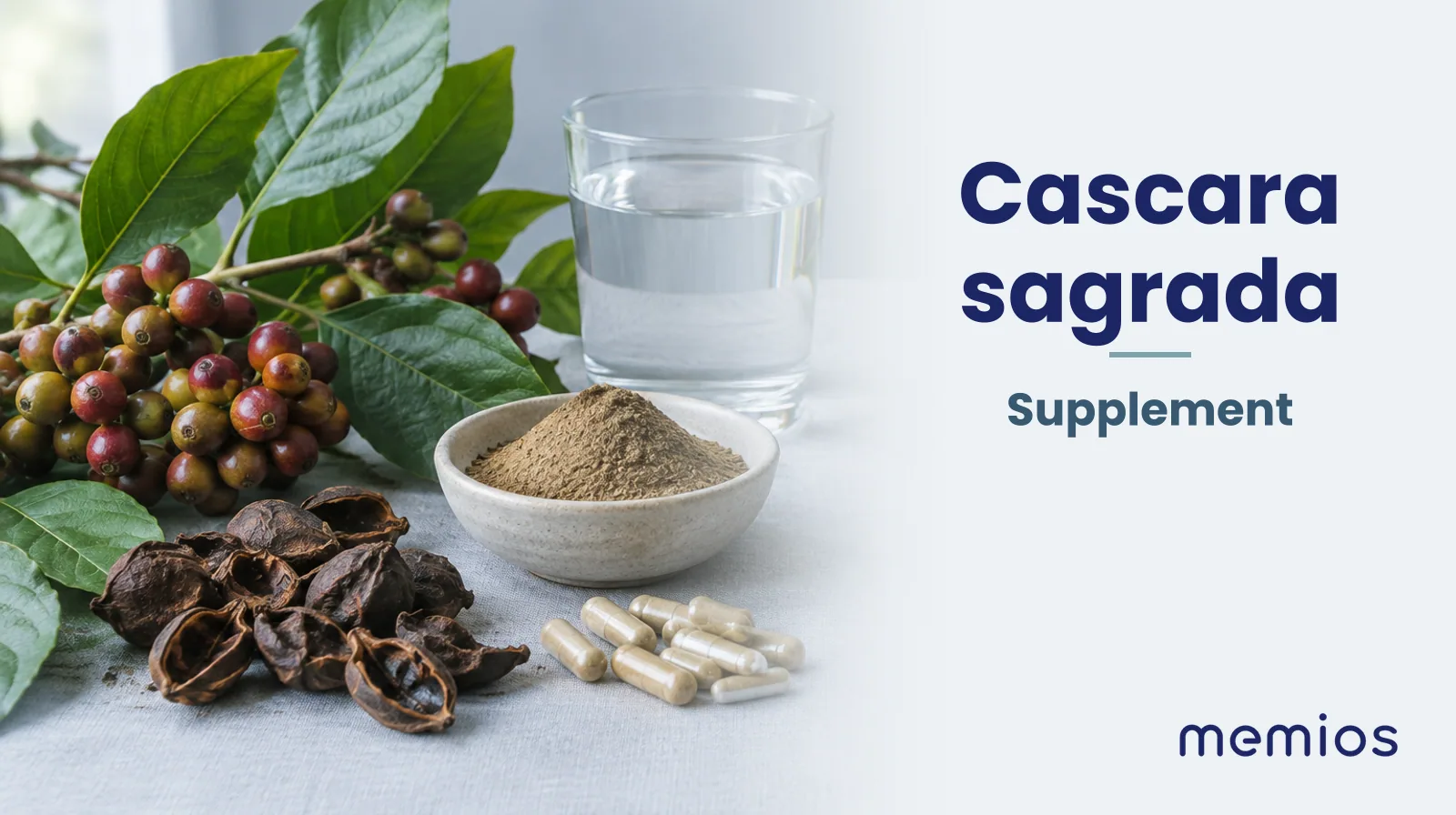
Cascara sagrada is the dried bark of Rhamnus purshiana DC., a North American shrub, used as a stimulant laxative. It is one of a group of plants whose active constituents are hydroxyanthracene derivatives; analysis of cascara bark extract found aloe-emodin at 0.06% to 0.23% and emodin and rhein at 0.07% to 0.16%. The same family of substances occurs in aloe, rhubarb root, frangula bark and senna leaf. Since the FDA's 2002 final rule, cascara sagrada ingredients have not been permitted in US over-the-counter laxative drugs pending a final monograph, though the bark is still sold in food supplements and herbal infusions.
What the research says
Cascara is taken to force a bowel movement, and the plants that carry these anthraquinones are put into supplements for bowel function. The state of the evidence is the important part: in this search we could not reach or verify a single controlled human trial of cascara on its own, so its laxative effect rests on tradition, pharmacology and clinical experience rather than on trial data we could read and quote. The best-known fear about it, that long-term anthranoid laxative use causes bowel cancer, was not borne out in a 554-person case-control study, and a cascara bark extract was not genotoxic in a validated in-vitro micronucleus assay. What is documented is on the product side: in one Belgian market survey of 24 hydroxyanthracene-containing food supplements and herbal infusions, more than half of those samples exceeded the maximum tolerated levels suggested for aloe-emodin and emodin.
Evidence grade: Not enough research to say.
What goes wrong
A laboratory survey of 24 commercial food supplements and herbal infusions bought in Belgium found that more than half of those samples exceeded the maximum tolerated levels suggested for aloe-emodin and emodin, the anthraquinones that cascara bark contains. (Source 1)
- Survey study, Low certainty.
- Size: 24 commercial food supplement and herbal infusion samples.
- Who: Retail products sourced in Belgium, not people.
- How long: Single market survey; not applicable.
- Result: More than half of the 24 products exceeded the maximum tolerated levels suggested for aloe-emodin and emodin; the authors report the 1 ppm level was exceeded in 14 of 24 samples (58%) for emodin and 12 samples (50%) for aloe-emodin.
- Funding: not stated.
Limit of this finding: Two things limit how far this can be read. The denominator is small, mixed and local: 24 commercial samples of food supplements and herbal infusions sourced in Belgium, so "more than half of the products" means 14 of 24 samples for emodin and 12 of 24 for aloe-emodin in one country's retail sample, not a majority of supplements on the market generally; the paper does not say how many of the 24 were supplements and how many were infusions. Second, the same abstract states the method's own limits: recovery fell outside the acceptable 80% to 120% range for physcion, within-laboratory reproducibility ran as high as 16.3%, and expanded measurement uncertainty was below 50% for all the compounds measured, so individual readings near the 1 ppm threshold carry real uncertainty.
The results indicated that although the industry put a great effort into minimizing the amount of aloin and danthron present in food supplements, more than half of the products still exceeded the maximum tolerated levels suggested for aloe-emodin and emodin.
What the evidence supports
A validated in-vitro micronucleus assay of a Rhamnus purshiana (cascara) bark extract measured its hydroxyanthracene content, confirming that the bark extract carries aloe-emodin, emodin and rhein. (Source 2)
- Lab study in cells, Low certainty.
- Size: Four botanical extracts (Rheum palmatum, Rhamnus purshiana, Rhamnus frangula, Cassia senna) assayed in cultured human lymphocytes.
- Who: Not a human study; plant extracts assayed in cultured human peripheral lymphocytes.
- How long: In-vitro assay; not applicable.
- Result: Aloe-emodin 0.06%-0.23% of extract; emodin and rhein 0.07%-0.16% of extract, across the four extracts tested.
- Funding: not stated.
The hydroxyanthracene content varied between 0.06% and 0.23% for aloe-emodin, and between 0.07% and 0.16% for emodin and rhein.
What the evidence does not support
In the same in-vitro assay, the Rhamnus purshiana bark extract did not increase micronucleus formation in human lymphocytes at concentrations up to 2000 microgram/mL, so it did not support the hypothesis that cascara extract is genotoxic in this test system. (Source 2)
- Lab study in cells, Low certainty.
- Size: Rhamnus purshiana extract tested from 0 to 2000 microgram/mL alongside three other botanical extracts.
- Who: Cultured human peripheral blood lymphocytes, not people.
- How long: In-vitro assay; not applicable.
- Result: No cytotoxicity detected at any concentration and no increase in micronuclei for any extract tested.
- Funding: not stated.
Micronucleus analyses showed a lack of genotoxicity for all the extracts tested.
A prospective case-control study at Erlangen found no statistically significant association between anthranoid laxative use, or melanosis coli, and colorectal adenoma or carcinoma. (Source 3)
- Case-control study, Low certainty.
- Size: 554 people: 202 with colorectal carcinoma, 114 with adenomatous polyps, 238 colonoscopy controls without neoplasia.
- Who: Patients referred for total colonoscopy at a single German university hospital.
- How long: Lifetime anthranoid exposure assessed by standardised interview at a single time point.
- Result: Unadjusted odds ratio 1.0 (95% CI 0.5-1.9) for adenomas and 1.0 (95% CI 0.6-1.8) for carcinomas; adjusted for age, sex and blood in stools, 0.84 (95% CI 0.4-1.7) for adenomas and 0.93 (95% CI 0.5-1.7) for carcinomas.
- Funding: not stated.
Neither anthranoid laxative use, even in the long term, nor macroscopic or marked microscopic melanosis coli were associated with any significant risk for the development of colorectal adenoma or carcinoma.
In a 2002 final rule the US Food and Drug Administration determined that cascara sagrada ingredients should be deemed not generally recognised as safe and effective for over-the-counter laxative use before a final monograph is established, a determination it reached on the absence of submitted carcinogenicity data rather than on trial evidence of harm. (Source 4)
- Official position, Certainty not rated.
- Size: Not applicable; regulatory determination.
- Who: US over-the-counter drug market.
- How long: Final rule published 9 May 2002, effective 5 November 2002.
- Result: Aloe and cascara sagrada stimulant laxative ingredients reclassified as nonmonograph and required to be removed from OTC laxative products, a status the rule itself frames as applying before a final monograph is established for OTC laxative drug products.
- Funding: independent (government regulator)
Limit of this finding: This is a regulatory determination, not a study result. The FDA acted because the carcinogenicity studies it had asked for were never submitted, so the rule records missing data rather than demonstrated harm. The sentence is also expressly limited to the period "before a final monograph is established for OTC laxative drug products", so it is a step in an unfinished rulemaking, not a settled permanent finding that cascara is unsafe. Its practical effect was that these ingredients could no longer be sold in US over-the-counter laxative drugs. It is not a finding that cascara has been shown to cause cancer.
the agency has determined that the stimulant laxative ingredients aloe (including aloe extract and aloe flower extract) and cascara sagrada (including casanthranol, cascara fluidextract aromatic, cascara sagrada bark, cascara sagrada extract, and cascara sagrada fluidextract) should be deemed not generally recognized as safe and effective for OTC use before a final monograph is established for OTC laxative drug products
Where the evidence is mixed
In two-year feed bioassays of pure emodin, one of the anthraquinones measured in cascara bark, the National Toxicology Program reported equivocal evidence of carcinogenic activity in female rats and in male mice and no evidence in male rats or female mice. (Source 5)
- Animal study, Certainty not rated.
- Size: F344/N rats and B6C3F1 mice, standard NTP two-year feed bioassay groups.
- Who: Rats and mice fed emodin in the diet; not people, and emodin alone rather than whole cascara bark.
- How long: 2 years.
- Result: Male rats fed 280, 830 or 2,500 ppm and female mice 312, 625 or 1,250 ppm; the report's study description gives male mice 0, 160, 312 or 625 ppm and female mice 0, 312, 625 or 1,250 ppm emodin in the diet for 105 weeks. The equivocal findings were a marginal increase in Zymbal's gland carcinoma in female rats and a low incidence of uncommon renal tubule neoplasms in male mice.
- Funding: independent (US government toxicology programme)
Limit of this finding: The conclusions paragraph quoted here names exposure concentrations only for the two groups with no evidence of carcinogenic activity (male rats, female mice) and omits them for male mice, the group carrying the equivocal renal tubule finding; the report's own study description gives those male mice 0, 160, 312 or 625 ppm emodin in the diet. The conclusions also cover cancer only. The report separately records non-cancer kidney effects in both species, including increased incidences of renal tubule hyaline droplets and pigmentation in rats, renal tubule pigmentation in mice of both sexes and increased nephropathy in female mice, and decreased incidences of mononuclear cell leukaemia in rats exposed to 2,500 ppm. "No evidence of carcinogenic activity" therefore does not mean no effect was seen.
There was equivocal evidence of carcinogenic activity of emodin in female F344/N rats based on a marginal increase in the incidence of Zymbal's gland carcinoma.
Where the research disagrees
Whether the hydroxyanthracenes in cascara and related laxative barks are genotoxic and carcinogenic
- US Food and Drug Administration (final rule, 9 May 2002), Regulatory determination made because requested carcinogenicity studies were never submitted, not because a trial showed harm; expressly framed as applying before a final monograph is established for OTC laxative drug products: "the agency has determined that the stimulant laxative ingredients aloe (including aloe extract and aloe flower extract) and cascara sagrada (including casanthranol, cascara fluidextract aromatic, cascara sagrada bark, cascara sagrada extract, and cascara sagrada fluidextract) should be deemed not generally recognized as safe and effective for OTC use before a final monograph is established for OTC laxative drug products" (Source 4)
- National Toxicology Program (TR-493, emodin feed studies), Two-year rodent feed bioassay of the isolated constituent emodin: "There was equivocal evidence of carcinogenic activity of emodin in female F344/N rats based on a marginal increase in the incidence of Zymbal's gland carcinoma." (Source 5)
- Melzi, Galli and Marinovich (Separations, 2024), Validated in-vitro micronucleus assay of whole bark extracts including Rhamnus purshiana, in human lymphocytes: "Micronucleus analyses showed a lack of genotoxicity for all the extracts tested." (Source 2)
- Nusko and colleagues (Gut, 2000), Prospective case-control study of 554 colonoscopy patients: "Neither anthranoid laxative use, even in the long term, nor macroscopic or marked microscopic melanosis coli were associated with any significant risk for the development of colorectal adenoma or carcinoma." (Source 3)
How much
- Reference intake: No dietary reference intake, RDA or AI exists for cascara. It is a botanical laxative preparation rather than a nutrient; the plant group it belongs to is described as being added to food supplements to affect bowel function, not to meet a nutritional requirement. (Source 1)
- Upper limit: No tolerable upper intake level has been set for cascara as such. For its constituent hydroxyanthracenes, the European Commission has prohibited aloin, aloe-emodin, emodin and danthron in food, and analysts work to maximum tolerated levels suggested for aloe-emodin and emodin (reported by Malysheva and colleagues in 2024 as a 1 ppm threshold in products). In the US, the FDA final rule of 9 May 2002 removed cascara sagrada ingredients from over-the-counter laxative products altogether. (Source 1)
- Studied: We could not verify any controlled human trial of cascara and therefore cannot report a dose that a trial actually gave people. The only quantities we can report are laboratory ones: a Rhamnus purshiana bark extract was tested in cultured human lymphocytes at concentrations from 0 to 2000 microgram/mL. (Source 2)
- Studied: In the two-year animal bioassay of the cascara constituent emodin, rats were fed 280, 830 or 2,500 ppm and mice 312, 625 or 1,250 ppm in the diet. These are animal feed concentrations, not human doses. (Source 5)
A common belief, and what the research shows
The belief: Cascara is a gentle, natural laxative that has been proven to work and is safe to keep taking, and long-term use will pigment and then cancer the bowel.
What the research shows: Both halves are wrong in opposite directions. On efficacy, there is no controlled human trial of cascara alone that we could verify, and in 2002 the US regulator determined that cascara sagrada ingredients "should be deemed not generally recognized as safe and effective for OTC use before a final monograph is established for OTC laxative drug products" - a ruling about carcinogenicity data that were never submitted, so 'proven to work' is not supported and 'proven dangerous' is not what the rule says either. On cancer, the specific fear has not held up in the human data we could read: in 554 colonoscopy patients, "Neither anthranoid laxative use, even in the long term, nor macroscopic or marked microscopic melanosis coli were associated with any significant risk for the development of colorectal adenoma or carcinoma." The documented problem is different and duller: product content. In a survey of 24 supplements and herbal infusions bought in Belgium, "more than half of the products still exceeded the maximum tolerated levels suggested for aloe-emodin and emodin."
Questions and answers
What is it?
Cascara sagrada is the dried bark of Rhamnus purshiana, a shrub native to the Pacific Northwest of North America. Like rhubarb root, frangula bark and senna, it belongs to a group of plants that contain hydroxyanthracene derivatives. When a cascara bark extract was analysed for a 2024 laboratory study, aloe-emodin made up between 0.06% and 0.23% of the extract and emodin and rhein between 0.07% and 0.16%. (Source 2)
What does it do in the body?
Cascara is sold as a stimulant laxative, and analytical chemists describe this plant group as being put into food supplements for bowel function. We could not verify any controlled human trial of cascara on its own that measured stool frequency or any other bowel outcome, so what it does in people is described from tradition and pharmacology rather than from trials we could read. (Source 1)
Is it good or bad for you?
There is no verified controlled trial showing that cascara works, and in 2002 the US regulator determined that cascara sagrada ingredients should be deemed not generally recognised as safe and effective for over-the-counter use before a final monograph is established, because the carcinogenicity data it had asked for were never submitted. That was a decision about missing data and an unfinished rulemaking, not a demonstration of harm. Against it, the main cancer worry has not been borne out: a case-control study of 554 colonoscopy patients found no association between anthranoid laxative use and colorectal adenoma or carcinoma. So the honest position is unresolved rather than clearly good or clearly bad. (Source 4)
How do you get more of it?
Since 2002 cascara cannot be sold as a US over-the-counter laxative drug, but cascara bark still reaches people as a food supplement and as a herbal infusion. A Belgian market survey analysed 24 such commercial food supplements and herbal infusions containing hydroxyanthracene derivatives. This is a description of how products are sold, not a suggestion to take them. (Source 1)
If it is harmful, what reduces it?
Cascara is not something the body stores or accumulates; exposure ends when the product is stopped. At the population level, exposure has been reduced by regulation: the US regulator required cascara sagrada ingredients to come out of over-the-counter laxative products, and the European Commission has prohibited several of the hydroxyanthracenes these plants contain. (Source 1)
Why might someone be low in it or missing it?
This question does not apply. Cascara is a plant preparation swallowed on purpose, not a nutrient or a resident organism, so nobody is deficient in it and there is no state of being low in it. People simply have it in the body when they have recently taken a product made from the bark of Rhamnus purshiana or a related hydroxyanthracene-containing plant. (Source 1)
Which whole foods contain it or feed it?
No ordinary whole food contains cascara. The closely related hydroxyanthracene derivatives occur in other plants used medicinally or as supplements, including Aloe species, Rheum (rhubarb) species, other Rhamnus species such as frangula, and Cassia senna. Garden rhubarb root belongs to that group, but the stalks people eat are not a source of cascara itself. (Source 1)
What happens if you do not have it?
Nothing happens. Cascara has no role in normal human physiology and there is no deficiency state; it is a plant preparation taken to provoke a bowel movement, not a nutrient the body requires. A person who never takes it lacks nothing. (Source 1)
How can you test for it?
There is no blood or stool test that tells an individual their cascara status. Two related things can be measured. Laboratories can quantify hydroxyanthracene derivatives in a product by validated liquid chromatography-tandem mass spectrometry, and long-term anthranoid use can leave melanosis coli, a pigmentation of the colon lining that is seen at colonoscopy and confirmed by histopathology. (Source 3)
References
- Toxins (MDPI). Determination of 16 Hydroxyanthracene Derivatives in Food Supplements Using LC-MS/MS: Method Development and Application. 2024. DOI 10.3390/toxins16120505. Read the source
- Separations (MDPI). Risk Characterization of Botanical Extracts Containing Hydroxyanthracenes as Determined by a Validated Micronucleus In Vitro Assay. 2024. DOI 10.3390/separations11020047. Read the source
- Gut (BMJ). Anthranoid laxative use is not a risk factor for colorectal neoplasia: results of a prospective case control study. 2000. PMID 10764708. Read the source
- US Food and Drug Administration, Federal Register vol. 67 no. 90. Status of Certain Additional Over-the-Counter Drug Category II and III Active Ingredients (Final Rule). 2002. PMID 12001972. Read the source
- National Toxicology Program, US Department of Health and Human Services. NTP Technical Report on the Toxicology and Carcinogenesis Studies of Emodin (CAS No. 518-82-1) in F344/N Rats and B6C3F1 Mice (Feed Studies), TR-493. 2001. PMID 12563347. Read the source