Medications · September 29, 2026 · Memios · 12 min read
Carvedilol
Well established. It slows the heart and relaxes blood vessels by blocking adrenaline's effects.
TLDR
- Well established. It slows the heart and relaxes blood vessels by blocking adrenaline's effects.
- What it is: Carvedilol is a prescription beta-blocker sold as Coreg tablets and Coreg CR capsules.
- Main use: Chronic heart failure with reduced ejection fraction (well supported).
- Other approved uses: Left ventricular dysfunction after myocardial infarction (well supported); Hypertension (limited evidence).
- Off-label uses (not on the FDA label): Compensated cirrhosis with clinically significant portal hypertension (preventing decompensation) (limited evidence).
- Recommended dose (official position): Dosing is set by the prescriber. The US Coreg label (revised 10/2023) is a regulator position: the heart failure maximum is 50 mg twice daily, and for hypertension the total daily dose should not exceed 50 mg.
- Studied dose (a trial dose, not a recommendation): The trial abstracts we read (US Carvedilol programme, COPERNICUS, CAPRICORN) did not state target doses. Findings citing that trial: 1 for.
- Upper limit: Label maximum (position, 10/2023): 50 mg twice daily in heart failure; 50 mg total daily dose in hypertension.
- What goes wrong: 4 findings on harm. Across beta-blocker trials after heart attack, heart failure and hypertension, beta-blockers slightly raised reported fatigue: about 18 extra cases per 1,000 patients per year.
- Interactions: 3 recorded, including Food, CYP2D6 inhibitors (for example fluoxetine, paroxetine, quinidine), Digoxin.
- Common myth: Beta-blockers like carvedilol commonly cause depression.
What it is
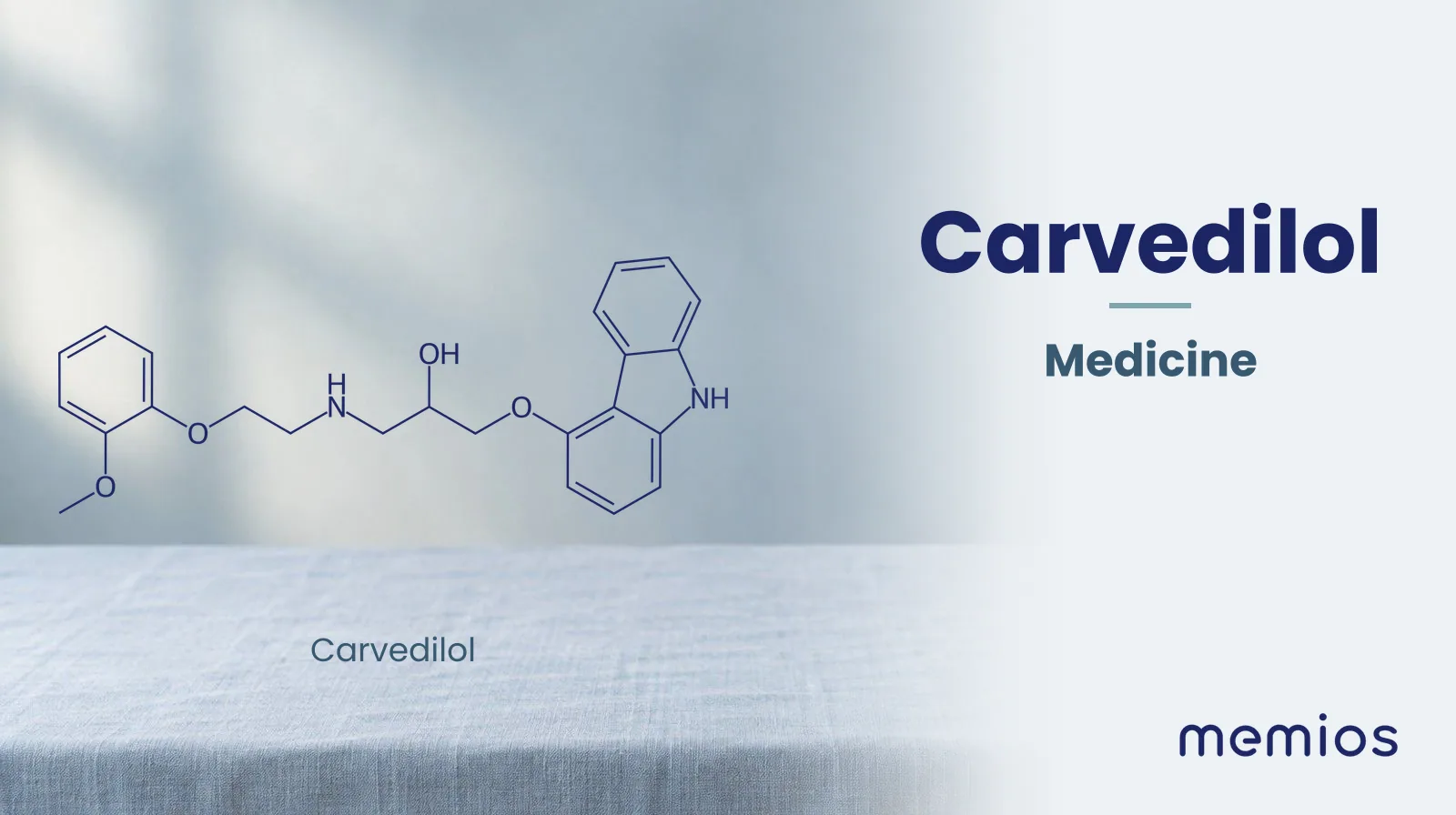
Carvedilol is a prescription beta-blocker sold as Coreg tablets and Coreg CR capsules. Unusually for a beta-blocker, it also blocks alpha-1 receptors. The US label (revised 10/2023) lists it for chronic heart failure, weakened heart function after a heart attack, and high blood pressure.
What the research says
It slows the heart and relaxes blood vessels by blocking adrenaline's effects. In heart failure with reduced pumping, large placebo-controlled trials found fewer deaths: in COPERNICUS, 35% fewer deaths in severe heart failure. After a heart attack with a weakened heart, it did not reduce the trial's main combined endpoint, but all-cause deaths fell from 15% to 12%. As a first choice for blood pressure, beta-blockers as a class look inferior to other drug types. Stopping suddenly can worsen angina.
Evidence grade: Well established.
How it works
Drug class: Non-selective beta-blocker with alpha-1 blocking activity
Carvedilol blocks beta-adrenergic receptors (slowing the heart and reducing its workload) and alpha-1 receptors (widening blood vessels). (Source 1)
What it is used for
- In the US Carvedilol programme, deaths fell from 7.8% to 3.2%. In COPERNICUS (severe heart failure), there were 130 deaths versus 190 on placebo, a 35% relative reduction. Evidence: established. (Source 2)
- In CAPRICORN, the primary endpoint (death or cardiovascular hospital admission) did not differ. All-cause deaths were lower (12% vs 15%, an absolute difference of about 3 percentage points). Evidence: established. (Source 3)
- Carvedilol-specific outcome trials in hypertension were not found in this run. For beta-blockers as a class, a Cochrane review found no effect on mortality versus placebo and higher stroke risk than calcium channel blockers and RAS inhibitors, on evidence the reviewers judged mostly at high risk of bias. Evidence: limited. (Source 4)
- An individual-patient meta-analysis of 4 RCTs (352 patients) found lower risk of decompensation (SHR 0.506) and death (SHR 0.417) with carvedilol. Evidence: limited. (Source 5)
Interactions
- Food (label): The label says to take it with food, to slow absorption and lower the chance of dizziness on standing. (Source 1)
- CYP2D6 inhibitors (for example fluoxetine, paroxetine, quinidine) (label): The label says this combination has not been studied, but such drugs would be expected to raise blood levels of one form of carvedilol (the R(+) enantiomer). (Source 1)
- Digoxin (label): Digoxin levels rise by about 15% when the two are taken together. (Source 1)
Stopping it
- People with coronary artery disease should not stop suddenly. Abrupt beta-blocker withdrawal has been followed by severe angina, heart attack and ventricular arrhythmias. (Source 1)
What goes wrong
Across beta-blocker trials after heart attack, heart failure and hypertension, beta-blockers slightly raised reported fatigue: about 18 extra cases per 1,000 patients per year. This is class data, not carvedilol-specific. (Source 6)
- Meta-analysis, Certainty not rated.
- Size: 42,409 participants in 15 trials.
- Who: Patients in beta-blocker RCTs.
- How long: annualised.
- Result: 18 extra reports of fatigue per 1,000 patients per year (95% CI 5 to 30), i.e. one extra report for every 57 patients treated for a year.
- Funding: not stated in text read.
Beta-blockers were associated with a small significant annual increase in risk of reported fatigue (18 per 1,000 patients, 95% CI: 5, 30), equivalent to one additional report of fatigue for every 57 patients treated per year with beta-blockers.
The same meta-analysis found a small rise in reported sexual dysfunction: about 5 extra reports per 1,000 patients per year, which works out at one extra report for every 199 people treated for a year. This is class data, not carvedilol-specific. (Source 7)
- Meta-analysis, Certainty not rated.
- Size: More than 35,000 subjects in 15 trials.
- Who: Patients in beta-blocker RCTs.
- How long: annualised.
- Result: 5 extra reports of sexual dysfunction per 1,000 patients per year (95% CI 2 to 8), i.e. one extra report for every 199 patients treated for a year.
- Funding: not stated in text read.
beta-Blockers were also associated with a small, significant annual increase in risk of reported sexual dysfunction (5 per 1000 patients; 95% CI, 2-8), equivalent to one additional report for every 199 patients treated per year.
Beta-blockers may hide the early warning signs of low blood sugar and increase the risk of severe hypoglycaemia (label position). (Source 1)
- Official position, Certainty not rated.
- Size: not applicable.
- Who: People with diabetes or at risk of hypoglycaemia.
- How long: not applicable.
- Result: No rate given.
- Funding: label.
Beta-blockers may prevent early warning signs of hypoglycemia, such as tachycardia, and increase the risk for severe or prolonged hypoglycemia at any time during treatment.
The label lists dizziness, fatigue, low blood pressure, diarrhoea, high blood sugar, weakness, slow heart rate and weight gain as the most common adverse events in heart failure and post-heart-attack patients. (Source 1)
- Official position, Certainty not rated.
- Size: label trial pool.
- Who: Heart failure and post-MI LV dysfunction.
- How long: not applicable.
- Result: Listed as most common; exact percentages not captured in the text we read.
- Funding: industry label.
Dizziness, fatigue, hypotension, diarrhea, hyperglycemia, asthenia, bradycardia, weight increase.
What the evidence supports
In chronic heart failure, carvedilol added to standard therapy cut deaths, and the trial was stopped early for benefit. (Source 2)
- Randomized trial, High certainty.
- Size: 1,094 patients (696 carvedilol, 398 placebo)
- Who: Chronic heart failure with ejection fraction 0.35 or less, on digoxin, diuretics and ACE inhibitor.
- How long: 6 months (12 months for mild heart failure)
- Result: Mortality 7.8% placebo vs 3.2% carvedilol; 65% relative risk reduction (95% CI 39 to 80%; P < 0.001); absolute difference 4.6 percentage points.
- Funding: not stated in abstract.
The overall mortality rate was 7.8 percent in the placebo group and 3.2 percent in the carvedilol group; the reduction in risk attributable to carvedilol was 65 percent (95 percent confidence interval, 39 to 80 percent; P < 0.001).
In severe heart failure (COPERNICUS), carvedilol reduced deaths by 35% and fewer patients withdrew for adverse effects than on placebo. (Source 8)
- Randomized trial, High certainty.
- Size: 2,289 patients.
- Who: Severe chronic heart failure, ejection fraction below 25%.
- How long: mean 10.4 months.
- Result: 190 vs 130 deaths; 35% risk reduction (95% CI 19 to 48%); death or hospitalization 507 vs 425.
- Funding: not stated in text read.
There were 190 deaths in the placebo group and 130 deaths in the carvedilol group. This difference reflected a 35 percent decrease in the risk of death with carvedilol
In CAPRICORN, all-cause mortality alone was lower with carvedilol, 12% versus 15%. (Source 3)
- Randomized trial, Moderate certainty.
- Size: about 1,959 patients.
- Who: Post-myocardial infarction with left-ventricular dysfunction.
- How long: mean follow-up about 1.3 years.
- Result: 116 [12%] vs 151 [15%], HR 0.77 (0.60-0.98), p=0.03; absolute difference about 3 percentage points.
- Funding: not stated in text read.
all-cause mortality alone was lower in the carvedilol group than in the placebo group (116 [12%] vs 151 [15%], 0·77 [0·60—0·98], p=0·03).
Off-label in compensated cirrhosis with portal hypertension, an individual-patient meta-analysis found carvedilol lowered the risk of decompensation and death. (Source 5)
- Meta-analysis, Certainty not rated.
- Size: 352 patients in 4 RCTs.
- Who: Compensated cirrhosis with clinically significant portal hypertension, no prior bleeding.
- How long: long-term.
- Result: Decompensation SHR 0.506 (95% CI 0.289-0.887); death SHR 0.417 (95% CI 0.194-0.896)
- Funding: not stated in text read.
The risk of death was also lower with carvedilol (SHR = 0.417; 95% CI: 0.194–0.896; p = 0.025; I2 = 0.0%, Q-statistic-p = 0.989).
What the evidence does not support
After a heart attack with a weakened heart (CAPRICORN), carvedilol did not reduce the trial's primary endpoint. (Source 3)
- Randomized trial, High certainty.
- Size: about 1,959 patients (340 and 367 events)
- Who: Post-myocardial infarction with left-ventricular dysfunction.
- How long: mean follow-up about 1.3 years.
- Result: Primary endpoint 35% vs 37%, HR 0.92 (95% CI 0.80-1.07)
- Funding: not stated in text read.
there was no difference between the carvedilol and placebo groups in the number of patients with the primary endpoint (340 [35%] vs 367 [37%], hazard ratio 0·92 [95% CI 0·80—1·07]).
For high blood pressure, beta-blockers as a class did not reduce mortality compared with placebo (Cochrane, mostly older beta-blockers, not carvedilol-specific). (Source 4)
- Systematic review, Moderate certainty.
- Size: 23,613 participants in 4 studies.
- Who: Adults with hypertension.
- How long: trial durations.
- Result: RR 0.99 (95% CI 0.88 to 1.11)
- Funding: not stated in text read.
Beta blockers had no significant effect on mortality when compared with placebo (four studies, N = 23,613; relative risk [RR] = 0.99; 95% confidence interval [CI], 0.88 to 1.11; moderate certainty evidence).
For high blood pressure, beta-blockers as a class were worse than calcium channel blockers and RAS inhibitors for preventing stroke (class evidence, mostly older beta-blockers rather than carvedilol). (Source 4)
- Systematic review, Moderate certainty.
- Size: 44,167 participants in three studies (vs calcium channel blockers); 9,951 in two studies (vs RAS inhibitors)
- Who: Adults with hypertension.
- How long: trial durations not stated in the text we read.
- Result: Stroke RR 1.24 (95% CI 1.11 to 1.40), NNH 180 versus calcium channel blockers; RR 1.30 (95% CI 1.11 to 1.53), NNH 65 versus RAS inhibitors.
- Funding: not stated in the text we read.
Beta blockers were found to be inferior for stroke reduction when compared with calcium channel blockers (three studies, N = 44,167; RR = 1.24; 95% CI, 1.11 to 1.40; moderate certainty evidence; number needed to harm [NNH] = 180) and RAS inhibitors (two studies, N = 9,951; RR = 1.30; 95% CI, 1.11 to 1.53; moderate certainty evidence; NNH = 65)
How much
- Reference intake: Dosing is set by the prescriber. The US Coreg label (revised 10/2023) is a regulator position: the heart failure maximum is 50 mg twice daily, and for hypertension the total daily dose should not exceed 50 mg. (Source 1)
- Upper limit: Label maximum (position, 10/2023): 50 mg twice daily in heart failure; 50 mg total daily dose in hypertension. (Source 1)
- Studied: The trial abstracts we read (US Carvedilol programme, COPERNICUS, CAPRICORN) did not state target doses. The US programme gave carvedilol on top of digoxin, diuretics and an ACE inhibitor. (Source 2)
A common belief, and what the research shows
The belief: Beta-blockers like carvedilol commonly cause depression.
What the research shows: A meta-analysis of 15 trials in 42,409 people found no significant rise in reported depressive symptoms (6 per 1,000 patients, 95% CI -7 to 19), but it did find 'a small significant annual increase in risk of reported fatigue'. These are class data, not carvedilol-specific.
Questions and answers
What is it?
Carvedilol is a prescription beta-blocker (Coreg). It also blocks alpha-1 receptors, which widens blood vessels. (Source 1)
What does it do in the body?
By blocking adrenaline's effects on the heart and blood vessels, it slows the heart and lowers its workload. In heart failure trials this translated into fewer deaths and hospital stays. (Source 2)
Is it good or bad for you?
It depends on the condition. In heart failure with reduced pumping it saves lives in large trials. After a heart attack its main combined endpoint was not met, though deaths fell. For blood pressure alone, beta-blockers as a class appear inferior to other drug types. Side effects include fatigue, dizziness and sexual dysfunction. (Source 4)
How do you get more of it?
Carvedilol is available only on prescription, and the prescriber sets the dose. The label advises taking it with food. (Source 1)
If it is harmful, what reduces it?
It should not be stopped suddenly, especially with coronary artery disease, because abrupt withdrawal has been followed by worse angina and heart attacks. Any change is made with the prescriber. (Source 1)
Why might someone be low in it or missing it?
Does not apply. Carvedilol is a medicine, not a body substance or nutrient, so no one is naturally low in it. The sources we read describe no deficiency state. (Source 1)
We searched: Coreg label (DailyMed 10/2023), US Carvedilol 1996, COPERNICUS 2001, CAPRICORN 2001
Which whole foods contain it or feed it?
Does not apply. No food contains carvedilol. The only food point in the label is that it should be taken with food. (Source 1)
What happens if you do not have it?
In heart failure trials, people given placebo instead of carvedilol died more often: 7.8% versus 3.2% over about 6 months in the US programme. (Source 2)
How can you test for it?
The sources we read describe no blood test for carvedilol levels in routine care. Its effect is judged clinically, for example by heart rate and blood pressure, which the label warns can drop. (Source 1)
We searched: Coreg label (DailyMed 10/2023) and heart failure trial abstracts; no carvedilol level test described
References
- DailyMed, US National Library of Medicine (FDA label). COREG (carvedilol) tablets, prescribing information (Waylis Therapeutics). Revised 10/2023. 2023. Read the source
- New England Journal of Medicine. The effect of carvedilol on morbidity and mortality in patients with chronic heart failure. U.S. Carvedilol Heart Failure Study Group. 1996. PMID 8614419, DOI 10.1056/NEJM199605233342101. Read the source
- Lancet. Effect of carvedilol on outcome after myocardial infarction in patients with left-ventricular dysfunction: the CAPRICORN randomised trial. 2001. PMID 11356434, DOI 10.1016/S0140-6736(00)04560-8. Read the source
- American Family Physician. Beta Blockers Compared with Other Drug Options for the Treatment of Hypertension (Cochrane for Clinicians summary of Wiysonge CS et al., Cochrane 2017, CD002003.pub5). Choi E, Pak G, Burket J. 2018. Read the source
- Journal of Hepatology, abstract as reproduced by Falk Foundation. Carvedilol reduces the risk of decompensation and mortality in patients with compensated cirrhosis in a competing-risk meta-analysis (Villanueva C et al., J Hepatol 2022;77(4):1014-25). 2022. PMID 35661713. Read the source
- Centre for Reviews and Dissemination, University of York (DARE). Beta-blocker therapy and symptoms of depression, fatigue, and sexual dysfunction (Ko DT et al., JAMA 2002;288:351-357), DARE structured abstract. 2002. PMID 12117400. Read the source
- JAMA. Beta-blocker therapy and symptoms of depression, fatigue, and sexual dysfunction (Ko DT, Hebert PR, Coffey CS, Sedrakyan A, Curtis JP, Krumholz HM). 2002. PMID 12117400, DOI 10.1001/jama.288.3.351. Read the source
- New England Journal of Medicine. Effect of carvedilol on survival in severe chronic heart failure (COPERNICUS). 2001. PMID 11386263, DOI 10.1056/NEJM200105313442201. Read the source