Supplements · September 30, 2026 · Memios · 16 min read
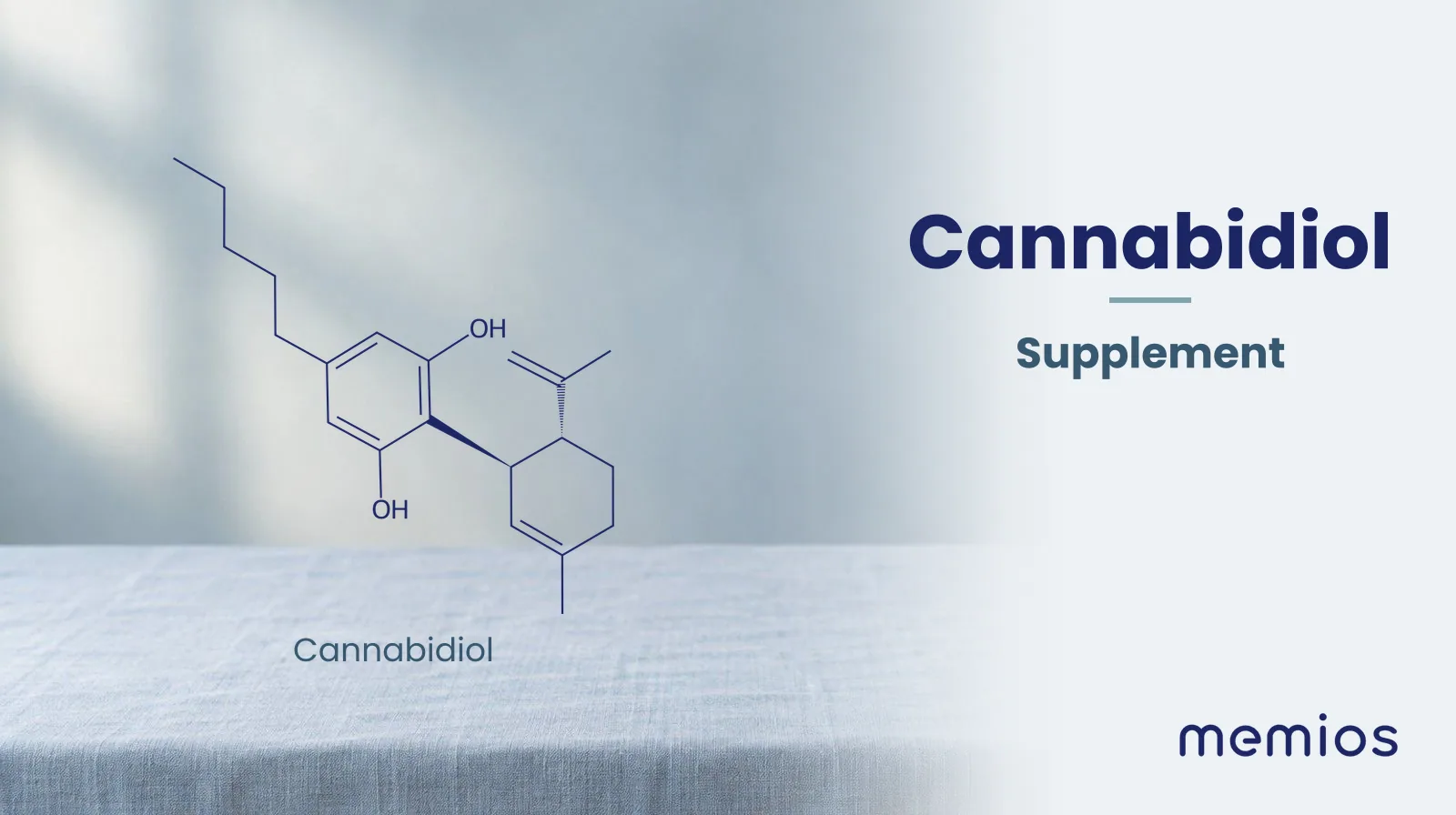
Cannabidiol
The evidence is strong and narrow: purified pharmaceutical cannabidiol reduces seizure frequency in two rare epilepsy syndromes in placebo-controlled trials.
TLDR
- Limited evidence. The evidence is strong and narrow: purified pharmaceutical cannabidiol reduces seizure frequency in two rare epilepsy syndromes in placebo-controlled trials.
- What it is: Cannabidiol is one of the non-intoxicating cannabinoid molecules found in Cannabis sativa, sold both as a prescription medicine and, far more widely, as unregulated oils, e-liquids and 'hemp extract' supplements.
- Main use, supported: Purified pharmaceutical cannabidiol reduced drop-seizure frequency versus placebo in randomised trials in Lennox-Gastaut syndrome. (moderate certainty)
- Other use, supported: Purified pharmaceutical cannabidiol reduced convulsive-seizure frequency versus placebo in a single randomised trial in Dravet syndrome. (moderate certainty)
- Claim NOT supported by research: A 2025 systematic review and meta-analysis in adults with drug-resistant epilepsy found a seizure reduction with adjunctive cannabidiol that did not reach statistical significance. (moderate certainty)
- Another claim NOT supported: A corrigendum issued by the authors in November 2025 withdrew this meta-analysis's original finding that adjunctive cannabidiol was efficacious in adults with drug-resistant epilepsy. (moderate certainty)
- Recommended dose: not established. No reference intake exists. Cannabidiol is not a nutrient; in a consumer update dated 5 March 2020 the US FDA states that its safety data are limited, and it does not set an intake.
- Studied dose (a trial dose, not a recommendation): Registration trials gave purified cannabidiol oral solution at 10 mg/kg/day and 20 mg/kg/day to children and adults with Lennox-Gastaut or Dravet syndrome. Findings citing that trial: 2 for, 2 on harm.
- Upper limit: No tolerable upper intake level or acceptable daily intake has been set by the bodies reviewed here.
- What goes wrong: 7 findings on harm. Cannabidiol use raised the odds of liver enzyme elevation and of drug-induced liver injury compared with placebo.
- Common myth: CBD is a gentle plant extract that cannot hurt you and does not interact with medicines.
What it is
Cannabidiol is one of the non-intoxicating cannabinoid molecules found in Cannabis sativa, sold both as a prescription medicine and, far more widely, as unregulated oils, e-liquids and 'hemp extract' supplements. A highly purified pharmaceutical form is approved in the United States for two rare childhood epilepsies. Independent laboratory testing repeatedly finds that the CBD content of retail products does not match the label, and that traces of THC can be present.
What the research says
The evidence is strong and narrow: purified pharmaceutical cannabidiol reduces seizure frequency in two rare epilepsy syndromes in placebo-controlled trials. For the uses most people buy CBD for - anxiety, mood, sleep, general wellbeing - the pooled trial evidence is scarce and of very low quality, and a 2025 meta-analysis in adults with drug-resistant epilepsy found a seizure reduction that did not reach statistical significance - that paper first reported the result as statistically significant and a corrigendum published in November 2025 withdrew the claim. Against that, cannabidiol carries a well-quantified signal for liver enzyme elevation and drug interactions.
Evidence grade: Limited evidence.
What goes wrong
Cannabidiol use raised the odds of liver enzyme elevation and of drug-induced liver injury compared with placebo. (Source 1)
- Meta-analysis, Moderate certainty.
- Size: 12 placebo-controlled trials, n=1229 for the comparison; 28 trials, n=1533 for pooled proportions.
- Who: participants in clinical trials of daily cannabidiol with serial liver enzyme measures.
- How long: trial length varied; elevations typically early in treatment.
- Result: liver enzyme elevation OR 5.85 (95% CI 3.84-8.92, p < 0.001); DILI OR 4.82 (95% CI 2.46-9.45, p < 0.001); pooled proportion of liver enzyme elevation 0.074 (95% CI 0.0448-0.1212) and DILI 0.0296 (95% CI 0.0136-0.0631)
- Funding: not stated in the abstract.
Cannabidiol use was associated with an increased probability of liver enzyme elevation
High doses and concurrent antiepileptic drugs were the identified risk factors for cannabidiol liver injury, and no cases occurred in adults below 300 mg/day. (Source 1)
- Meta-analysis, Moderate certainty.
- Size: 28 trials, n=1533.
- Who: clinical trial participants taking daily cannabidiol.
- How long: varied.
- Result: no cases in adults at doses under 300 mg/day; no severe DILI reported; risk concentrated at 1000 mg/day or more, or 20 mg/kg/day or more.
- Funding: not stated in the abstract.
High-dose CBD (≥1000 mg/day or ≥20 mg/kg/day) and concomitant antiepileptic drug use were identified as risk factors. No cases were reported in adults using cannabidiol doses <300 mg/day.
In epilepsy trials, cannabidiol raised the rate of adverse events, serious adverse events, and withdrawals. (Source 2)
- Meta-analysis, Low certainty.
- Size: nine randomised clinical trials.
- Who: patients with epilepsy.
- How long: varied across trials.
- Result: any-grade AEs 9.7% CBD versus 4.0% control; RR for any grade 1.12 (95% CI 1.02-1.23); severe grade 3.39 (1.42-8.09); serious AEs RR 2.67 (1.83-3.88); discontinuation RR 3.95 (1.86-8.37); dose reduction RR 9.87 (5.34-14.40)
- Funding: not stated in the abstract.
Because most of the included studies had some risk of bias (3 raised some concerns and 3 were at high risk of bias), these findings should be interpreted with some caution.
Cannabidiol raises blood levels of the active metabolite of clobazam roughly threefold, a pharmacokinetic interaction described in the approved product label. (Source 3)
- Blood level study, Moderate certainty.
- Size: not stated in the label section quoted.
- Who: patients and healthy volunteers taking clobazam with cannabidiol.
- How long: single and repeated dosing.
- Result: 3-fold increase in plasma concentrations of N-desmethylclobazam.
- Funding: manufacturer data submitted to FDA.
Coadministration of EPIDIOLEX produces a 3-fold increase in plasma concentrations of N-desmethylclobazam, the active metabolite of clobazam (a substrate of CYP2C19).
Dose-related liver transaminase elevations occurred in a substantial minority of patients in the controlled trials of prescription cannabidiol. (Source 3)
- Randomized trial, Moderate certainty.
- Size: pooled controlled trials supporting the approval.
- Who: patients aged 2 years and older with LGS or Dravet syndrome.
- How long: controlled treatment periods, with some cases up to 18 months.
- Result: ALT above 3x ULN in 13% of cannabidiol-treated patients versus 1% on placebo; fewer than 1% had ALT or AST above 20x ULN.
- Funding: manufacturer-sponsored.
the incidence of ALT elevations above 3 times the upper limit of normal (ULN) was 13% in EPIDIOLEX-treated patients compared with 1% in patients on placebo
Commercial CBD oils and e-liquids were found to contain more or less cannabidiol than their labels declared, and possible THC. (Source 4)
- Survey study, Low certainty.
- Size: 5 commercial oils and 3 e-liquids.
- Who: retail CBD products sold in Costa Rica.
- How long: single analytical survey.
- Result: over- and underlabeling observed; tentative presence of delta-9-THC; the authors describe the result as mirroring international trends.
- Funding: not stated.
Notably, some commercial samples showed CBD over- and underlabeling, and tentative presence of Δ⁹-THC.
The US Food and Drug Administration stated, in a consumer update whose content is current as of 5 March 2020, that CBD can cause liver injury and can alter how other medicines work. (Source 5)
- Official position, Certainty not rated.
- Size: not applicable.
- Who: consumers of CBD products.
- How long: not applicable.
- Result: no quantitative estimate given in the consumer update.
- Funding: government agency.
Limit of this finding: This is an agency position with a date on it, not a study. The page carries the date 5 March 2020 and has not been revised since, so it reflects what the FDA judged from the data available then. It gives no figures for how often liver injury happens or at what dose, and it should not be read as a measurement of risk or as FDA's necessarily current wording.
We are concerned about potential liver injury associated with CBD use that could go undetected if not monitored by a healthcare provider.
What the evidence supports
Purified pharmaceutical cannabidiol reduced drop-seizure frequency versus placebo in randomised trials in Lennox-Gastaut syndrome. (Source 3)
- Randomized trial, Moderate certainty.
- Size: 171 patients (Study 1) and 225 patients (Study 2)
- Who: patients aged 2 to 55 years with Lennox-Gastaut syndrome.
- How long: 14-week treatment period as described in the label.
- Result: Study 1: median reduction in drop seizure frequency -44% on 20 mg/kg/day versus -22% on placebo (p=0.01). Study 2: -37% (10 mg/kg/day) and -42% (20 mg/kg/day) versus -17% placebo (both p<0.01), as tabulated in the label.
- Funding: manufacturer-sponsored registration trials (GW Pharmaceuticals)
The effectiveness of EPIDIOLEX for the treatment of seizures associated with LGS was established in
Purified pharmaceutical cannabidiol reduced convulsive-seizure frequency versus placebo in a single randomised trial in Dravet syndrome. (Source 3)
- Randomized trial, Moderate certainty.
- Size: 120 patients (61 cannabidiol, 59 placebo)
- Who: patients aged 2 to 18 years with Dravet syndrome.
- How long: 14-week treatment period as described in the label.
- Result: median reduction in convulsive seizure frequency -39% on 20 mg/kg/day versus -13% on placebo (p=0.01), as tabulated in the label.
- Funding: manufacturer-sponsored registration trial.
The effectiveness of EPIDIOLEX for the treatment of seizures associated with DS was demonstrated in
What the evidence does not support
A 2025 systematic review and meta-analysis in adults with drug-resistant epilepsy found a seizure reduction with adjunctive cannabidiol that did not reach statistical significance; the paper originally reported the result as statistically significant and a 2025 corrigendum withdrew that claim. (Source 6)
- Meta-analysis, Moderate certainty.
- Size: 16 studies, 668 participants.
- Who: adults with drug-resistant epilepsy.
- How long: not stated in the abstract.
- Result: Corrected pooled result: SMD −1.50, 95% CI (−3.47, 0.47). The confidence interval crosses zero and the authors state the reduction did not reach statistical significance. The original publication reported the same point estimate as statistically significant at p < 0.01; that significance claim was withdrawn by corrigendum.
- Funding: not stated.
Limit of this finding: The published record for this result changed after publication. As first published in January 2025 the paper reported the pooled seizure reduction as statistically significant, with a p value below 0.01, and concluded that cannabidiol was efficacious as an add-on treatment. In November 2025 the journal published a corrigendum (DOI 10.1177/17562864251400528) that withdrew both of those statements. The corrected result is a pooled standardised mean difference of −1.50 with a 95% confidence interval running from −3.47 to 0.47. Because that interval crosses zero, the pooled data are compatible with a benefit, with no effect and with a worsening, and the authors now state that the result did not reach statistical significance. A reader should not take this meta-analysis as evidence that cannabidiol reduces seizures in adults with drug-resistant epilepsy.
There was a reduction in seizures in the group receiving CBD therapy compared to the placebo group [SMD: −1.50, 95% CI (−3.47, 0.47)], though this did not reach statistical significance.
A corrigendum issued by the authors in November 2025 withdrew this meta-analysis's original finding that adjunctive cannabidiol was efficacious in adults with drug-resistant epilepsy, replacing it with a statement that the pooled result did not reach statistical significance. (Source 7)
- Meta-analysis, Moderate certainty.
- Size: 16 studies, 668 participants.
- Who: adults with drug-resistant epilepsy.
- How long: not stated.
- Result: The conclusion was changed from cannabidiol being efficacious as an adjunctive therapy to cannabidiol possibly reducing seizures, with the pooled result stated not to reach statistical significance. The pooled estimate itself is unchanged: SMD −1.50, 95% CI (−3.47, 0.47).
- Funding: not stated.
Limit of this finding: The published record for this result changed after publication. As first published in January 2025 the paper reported the pooled seizure reduction as statistically significant, with a p value below 0.01, and concluded that cannabidiol was efficacious as an add-on treatment. In November 2025 the journal published a corrigendum (DOI 10.1177/17562864251400528) that withdrew both of those statements. The corrected result is a pooled standardised mean difference of −1.50 with a 95% confidence interval running from −3.47 to 0.47. Because that interval crosses zero, the pooled data are compatible with a benefit, with no effect and with a worsening, and the authors now state that the result did not reach statistical significance. A reader should not take this meta-analysis as evidence that cannabidiol reduces seizures in adults with drug-resistant epilepsy.
Our review has shown that CBD may reduce seizures as an adjunctive therapy in adult patients with DRE, though pooled results did not reach statistical significance.
A large GRADE-assessed systematic review found scarce evidence that cannabinoids, including CBD, improve any of the mental disorders examined. (Source 8)
- Systematic review, Very low certainty.
- Size: 83 studies, of which 40 randomised controlled trials, n=3067.
- Who: adults treated for depression, anxiety, ADHD, Tourette syndrome, PTSD or psychosis.
- How long: varied across trials.
- Result: the only signal was pharmaceutical THC (with or without CBD) for anxiety among people with other medical conditions, SMD -0.25 (95% CI -0.49 to -0.01), seven studies, n=252, graded very low certainty.
- Funding: Therapeutic Goods Administration Australia; Commonwealth Department of Health Australia; Australian NHMRC; US National Institutes of Health.
There is scarce evidence to suggest that cannabinoids improve depressive disorders and symptoms, anxiety disorders, attention-deficit hyperactivity disorder, Tourette syndrome, post-traumatic stress disorder, or psychosis.
The same review concluded there is not enough evidence to guide use of cannabinoids for mental disorders. (Source 8)
- Systematic review, Very low certainty.
- Size: 40 randomised controlled trials, n=3067.
- Who: adults with mental disorders.
- How long: varied.
- Result: no significant effect on remission or symptom change for the other disorders examined.
- Funding: government and NIH funded.
There remains insufficient evidence to provide guidance on the use of cannabinoids for treating mental disorders within a regulatory framework.
Where the research disagrees
Whether cannabidiol helps anxiety and related mental-health symptoms
- Black and colleagues, Lancet Psychiatry systematic review with GRADE, systematic review and meta-analysis of 40 RCTs, n=3067: There is scarce evidence to suggest that cannabinoids improve depressive disorders and symptoms, anxiety disorders, attention-deficit hyperactivity disorder, Tourette syndrome, post-traumatic stress disorder, or psychosis. (Source 8)
- US FDA consumer update, content current as of 5 March 2020, agency position, content current as of 5 March 2020: The FDA has seen only limited data about CBD safety and these data point to real risks that need to be considered before taking CBD for any reason. (Source 5)
How much
- Reference intake: No reference intake exists. Cannabidiol is not a nutrient; in a consumer update dated 5 March 2020 the US FDA states that its safety data are limited, and it does not set an intake. (Source 5)
- Upper limit: No tolerable upper intake level or acceptable daily intake has been set by the bodies reviewed here. In its consumer update dated 5 March 2020 the FDA states it does not know what level of intake triggers the known risks. (Source 5)
- Studied: Registration trials gave purified cannabidiol oral solution at 10 mg/kg/day and 20 mg/kg/day to children and adults with Lennox-Gastaut or Dravet syndrome. (Source 3)
- Studied: A meta-analysis of liver safety reported that no liver-injury cases occurred in adults taking under 300 mg/day, with risk concentrated at 1000 mg/day or more, or 20 mg/kg/day or more. (Source 1)
A common belief, and what the research shows
The belief: CBD is a gentle plant extract that cannot hurt you and does not interact with medicines.
What the research shows: Pooled trial data show a clear liver signal and a clear interaction signal. The hepatotoxicity meta-analysis reports that "Cannabidiol use was associated with an increased probability of liver enzyme elevation", and the approved label records that "Coadministration of EPIDIOLEX produces a 3-fold increase in plasma concentrations of N-desmethylclobazam, the active metabolite of clobazam (a substrate of CYP2C19)." Products are also frequently mislabelled.
Questions and answers
What is it?
Cannabidiol is a cannabinoid extracted from Cannabis sativa (including low-THC hemp varieties). It is sold both as a prescription oral solution and, far more commonly, as retail oils, capsules and e-liquids. Laboratory surveys of these retail products find the amount in the bottle often differs from the amount on the label. (Source 4)
What does it do in the body?
In the body cannabidiol acts on several targets and is metabolised by liver enzymes, which is why it changes the levels of some other drugs. Clinically, the effect that has been demonstrated in placebo-controlled trials is a reduction in seizures in two rare epilepsy syndromes. For most other advertised effects the trial evidence is scarce. (Source 3)
Is it good or bad for you?
It depends on dose, formulation and who is taking it. As a prescription medicine for two rare epilepsies it has proven benefit with monitored risks. As an over-the-counter supplement, pooled evidence for mental-health uses is scarce, and the liver risk rises steeply with dose. A meta-analysis found no liver-injury cases in adults below 300 mg/day but a clear signal at high doses and alongside antiepileptic drugs. (Source 1)
How do you get more of it?
Cannabidiol is not obtained from an ordinary diet. It reaches people either as a prescription purified oral solution or as retail hemp-derived oils and e-liquids. Because retail products are not consistently accurate, the dose a person actually receives from a supplement is uncertain. (Source 4)
If it is harmful, what reduces it?
Where cannabidiol is causing harm, the documented mitigation is dose and monitoring rather than any agent that removes it. The liver-safety meta-analysis found the injury signal concentrated at high doses and in people also taking antiepileptic drugs, and found no cases in adults taking less than 300 mg a day. FDA's position is that liver injury can go undetected without monitoring. (Source 1)
Why might someone be low in it or missing it?
Does not apply. Cannabidiol is not an essential nutrient or a substance the body makes, so nobody is deficient in it. Where it is present in a person it is because they took a cannabis-derived product or a prescribed medicine. (Source 3)
Which whole foods contain it or feed it?
No ordinary whole food supplies cannabidiol. It comes from the cannabis plant, and commercial products are hemp-derived extracts rather than foods. Analytical surveys of these hemp-based products describe mislabelling as a documented problem. (Source 4)
What happens if you do not have it?
Nothing. There is no deficiency state for cannabidiol. The only setting in which absence matters is a patient for whom prescription cannabidiol is an approved seizure treatment and who stops it. (Source 3)
How can you test for it?
There is no clinical test for a person's cannabidiol status, because there is no deficiency to detect. What can be tested is the product: validated chromatographic methods can measure how much cannabidiol a bottle actually contains and screen for THC. Liver enzymes are the monitoring test used in the trials, not a test of cannabidiol itself. (Source 4)
We searched: Searched for validated human biomarkers or status tests for cannabidiol alongside the hepatotoxicity and product-quality literature; found product-assay methods and liver-enzyme monitoring, not a status test.
References
- Journal of Internal Medicine. Cannabidiol-associated hepatotoxicity: A systematic review and meta-analysis. 2023. PMID 36912195, DOI 10.1111/joim.13627. Read the source
- JAMA Network Open. Adverse Events of Cannabidiol Use in Patients With Epilepsy: A Systematic Review and Meta-analysis. 2023. PMID 37079302, DOI 10.1001/jamanetworkopen.2023.9126. Read the source
- US Food and Drug Administration. EPIDIOLEX (cannabidiol) oral solution, CX - Highlights of Prescribing Information. 2018. Read the source
- Journal of Cannabis Research. Not what it seems: analytical validation and label accuracy of commercial CBD oils using HPTLC. 2026. DOI 10.1186/s42238-026-00419-7. Read the source
- US Food and Drug Administration (Consumer Update; content current as of 5 March 2020). What You Need to Know (And What We're Working to Find Out) About Products Containing Cannabis or Cannabis-derived Compounds, Including CBD — FDA Consumer Update, content current as of 5 March 2020. 2020. Read the source
- Therapeutic Advances in Neurological Disorders. The use of cannabidiol as adjunctive therapy in adult patients with drug-resistant epilepsy: a systematic review and meta-analysis. 2025. PMID 39882324, DOI 10.1177/17562864251313914. Read the source
- Therapeutic Advances in Neurological Disorders. Corrigendum to “The use of cannabidiol as adjunctive therapy in adult patients with drug-resistant epilepsy: a systematic review and meta-analysis”. 2025. PMID 41311475, DOI 10.1177/17562864251400528. Read the source
- The Lancet Psychiatry. Cannabinoids for the treatment of mental disorders and symptoms of mental disorders: a systematic review and meta-analysis. 2019. PMID 31672337, DOI 10.1016/S2215-0366(19)30401-8. Read the source