Supplements · September 29, 2026 · Memios · 22 min read
Caffeine
The evidence is strongest for the things caffeine does acutely: it raises alertness, and added to a standard painkiller it gives a small extra amount of pain relief with high-certainty evidence from Cochrane.
TLDR
- Well established. The evidence is strongest for the things caffeine does acutely: it raises alertness, and added to a standard painkiller it gives a small extra amount of pain relief with high-certainty evidence from Cochrane.
- What it is: Caffeine is a methylxanthine alkaloid found in coffee, tea, cocoa, guarana and added to energy drinks, soft drinks, pre-workout powders and some analgesics.
- Main use, supported: Adding at least 100 mg of caffeine to a standard dose of a common painkiller produced a small but real increase in the proportion of people getting good pain relief, with high-certainty evidence. (high certainty)
- Other use, supported: A systematic review updating Health Canada's assessment concluded that up to 400 mg of caffeine a day in healthy adults was not linked to overt adverse cardiovascular, behavioural, reproductive, acute or bone effects. (moderate certainty)
- Claim NOT supported by research: In a randomised crossover trial in which adults were assigned day by day to drink or avoid caffeinated coffee, coffee did not produce significantly more premature atrial contractions, the trial's primary outcome. (moderate certainty)
- Another claim NOT supported: Neonatal caffeine therapy, which had improved outcomes at 18 months, no longer showed a significant benefit for survival without disability when the same randomised cohort was assessed at five years. (moderate certainty)
- Recommended dose: not established. No recommended dietary allowance or adequate intake exists for caffeine, because it is a stimulant rather than an essential nutrient.
- Studied dose (a trial dose, not a recommendation): Cochrane's analgesic trials added at least 100 mg of caffeine to a standard dose of a common painkiller. Findings citing that trial: 1 for.
- Upper limit: No formal tolerable upper intake level has been set.
- What goes wrong: 8 findings on harm. In the same randomised crossover trial, caffeinated coffee was associated with about half again as many premature ventricular contractions and with fewer minutes of sleep: 397 minutes a night on coffee days against 432 minutes on caffeine-avoidance days.
- Common myth: Coffee and caffeine are bad for the heart, and moderate drinkers are storing up trouble.
What it is
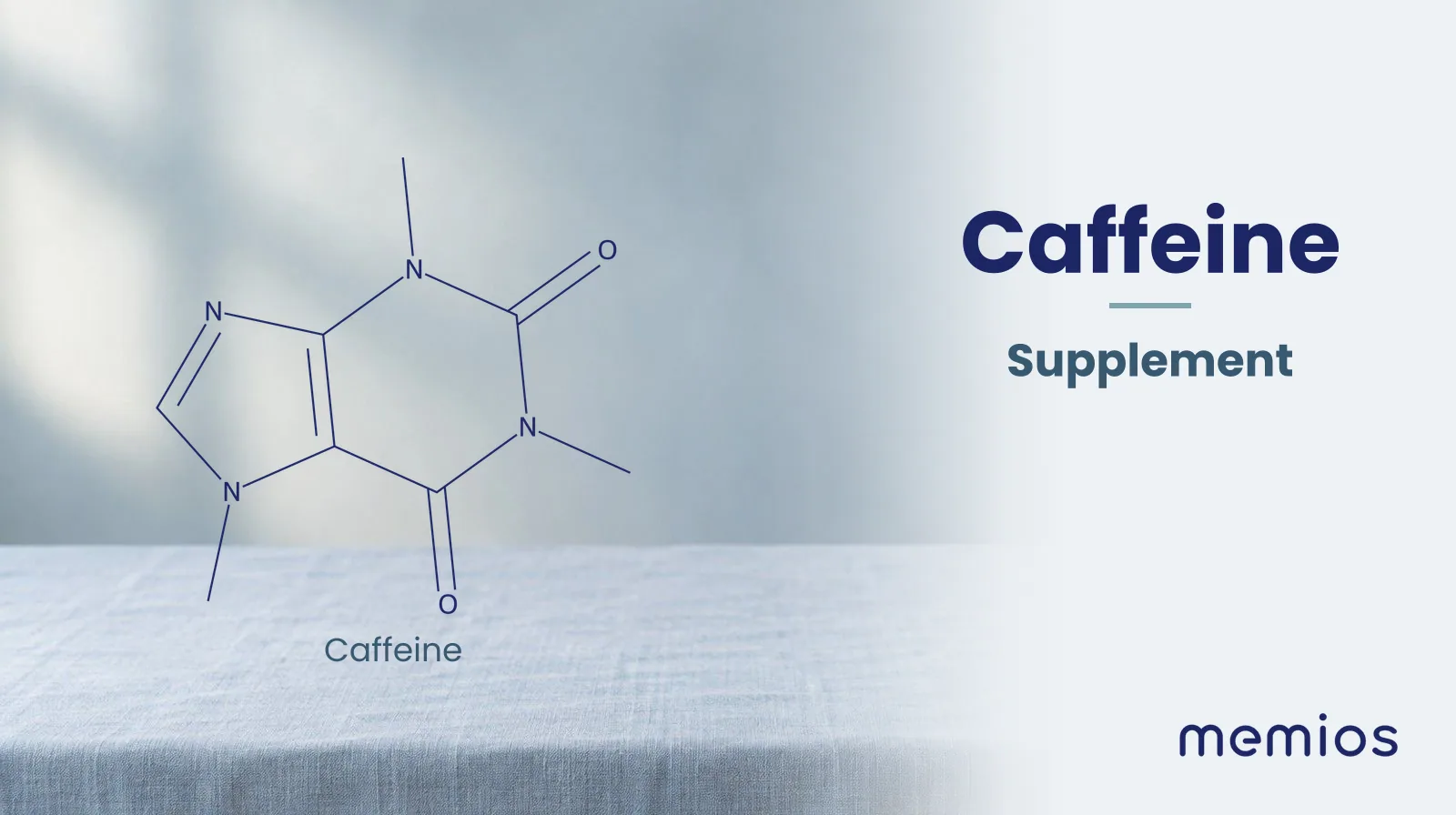
Caffeine is a methylxanthine alkaloid found in coffee, tea, cocoa, guarana and added to energy drinks, soft drinks, pre-workout powders and some analgesics. It is the most widely used psychoactive substance in food, and it is a stimulant rather than a nutrient - there is no dietary requirement for it. Once swallowed it is almost entirely broken down in the liver by the enzyme CYP1A2, mainly into paraxanthine, with smaller amounts of theobromine and theophylline. How fast a person clears it varies widely between individuals.
What the research says
The evidence is strongest for the things caffeine does acutely: it raises alertness, and added to a standard painkiller it gives a small extra amount of pain relief with high-certainty evidence from Cochrane. The large body of work on coffee and long-term disease is observational; an umbrella review of 201 meta-analyses found more benefit than harm across many outcomes, but rated about a quarter of the outcomes low and three quarters very low certainty by GRADE, and explicitly said randomised trials are needed before calling any of it causal. The harms are better characterised than for most supplement ingredients: dose-dependent sleep disruption, panic attacks in people with panic disorder at high doses, more premature ventricular contractions in a randomised crossover trial, a withdrawal syndrome on stopping, associations with pregnancy loss and low birth weight, serious interactions with clozapine and other CYP1A2 substrates, and deaths from concentrated caffeine powders and tablets.
Evidence grade: Well established.
What goes wrong
In the same randomised crossover trial, caffeinated coffee was associated with about half again as many premature ventricular contractions and with fewer minutes of sleep: 397 minutes a night on coffee days against 432 minutes on caffeine-avoidance days. (Source 1)
- Randomized trial, Moderate certainty.
- Size: 100 participants.
- Who: ambulatory adults, mean age 39.
- How long: two weeks of day-by-day randomised assignment.
- Result: 154 versus 102 daily premature ventricular contractions, rate ratio 1.51 (95% CI 1.18 to 1.94); 397 minutes of nightly sleep on caffeinated-coffee days versus 432 minutes on caffeine-avoidance days, a difference of about 36 minutes LESS sleep on coffee days (the abstract prints the mean difference unsigned, as 36; 95% CI, 25 to 47); 10,646 versus 9665 daily steps; serum glucose 95 versus 96 mg per decilitre.
- Funding: not stated in the abstract we read.
Limit of this finding: The published abstract prints the sleep result inconsistently. It gives the two averages, 397 minutes on caffeinated-coffee days and 432 minutes on caffeine-avoidance days, which means coffee days had about 36 minutes LESS sleep - but it then writes the difference without a minus sign, as “mean difference, 36”, while the glucose difference on the same line is printed with a minus sign. Read on its own, the unsigned 36 looks like extra sleep, which is the opposite of what the trial found. Take the direction from the two averages, not from the unsigned number, and do not read “36” here as a gain in sleep.
The consumption of caffeinated coffee as compared with no caffeine consumption was associated with 154 and 102 daily premature ventricular contractions, respectively (rate ratio, 1.51; 95% CI, 1.18 to 1.94); 10,646 and 9665 daily steps (mean difference, 1058; 95% CI, 441 to 1675); 397 and 432 minutes of nightly sleep (mean difference, 36; 95% CI, 25 to 47); and serum glucose levels of 95 mg per deciliter and 96 mg per deciliter (mean difference, -0.41; 95% CI, -5.42 to 4.60).
In pooled placebo-controlled challenge studies, high single doses of caffeine triggered panic attacks in about half of patients with panic disorder and in almost no healthy controls. (Source 2)
- Meta-analysis, Moderate certainty.
- Size: 237 patients across 9 studies for panic attacks; 128 patients versus 115 healthy controls in six comparative studies.
- Who: adults with diagnosed panic disorder and healthy controls.
- How long: single acute caffeine challenge.
- Result: 51.1% of patients had a panic attack after caffeine and none after placebo; patients 53.9% versus healthy controls 1.7%, log risk ratio 3.47 (95% CI 2.06 to 4.87); subjective anxiety Hedges' g = 1.02 (95% CI 0.09 to 1.96). Doses tested were restricted to 400-750 mg, so no dose-response could be analysed.
- Funding: not stated in the abstract we read.
The 9 studies investigating panic attacks included 237 patients, of which 51.1% had a panic attack following caffeine, but none after placebo.
The umbrella review found that, unlike most other harm signals, the pregnancy associations were not explained away by adjusting for smoking: higher coffee intake was associated with low birth weight, preterm birth and pregnancy loss. (Source 3)
- Review of reviews, Very low certainty.
- Size: meta-analyses of observational studies within the umbrella review.
- Who: pregnant women in observational cohorts.
- How long: varies by included meta-analysis.
- Result: Low birth weight odds ratio 1.31 (95% CI 1.03 to 1.67); preterm birth first trimester 1.22 (1.00 to 1.49) and second trimester 1.12 (1.02 to 1.22); pregnancy loss 1.46 (1.06 to 1.99). These are associations from observational data, not demonstrated causes.
- Funding: independent (BMJ-published academic umbrella review)
Harmful associations were largely nullified by adequate adjustment for smoking, except in pregnancy, where high versus low/no consumption was associated with low birth weight (odds ratio 1.31, 95% confidence interval 1.03 to 1.67), preterm birth in the first (1.22, 1.00 to 1.49) and second (1.12, 1.02 to 1.22) trimester, and pregnancy loss (1.46, 1.06 to 1.99).
A young woman died after taking about 60 caffeine tablets bought online, with a measured blood caffeine concentration of 177 micrograms per millilitre. (Source 4)
- Case report, Certainty not rated.
- Size: 1 patient.
- Who: a 25-year-old woman, intentional overdose.
- How long: hours from ingestion to death.
- Result: Estimated 12 g ingested (60 tablets of 200 mg); blood caffeine 177 micrograms/mL by HPLC; hypotension 90/60 mmHg, sinus tachycardia 150 beats/min, convulsions progressing to coma, ventricular tachycardia, exotoxic shock and toxic cardiomyopathy; death despite intensive care.
- Funding: not stated.
A 25-year-old woman ingested an estimated 60 tablets containing 200 mg of caffeine each, purchased online.
Case reports describe cardiac arrest in temporal proximity to heavy energy drink consumption in a young man with pre-existing premature ventricular complexes. (Source 5)
- Case report, Certainty not rated.
- Size: 1 patient.
- Who: a 27-year-old man with a history of premature ventricular complexes.
- How long: single episode.
- Result: Ventricular fibrillation and cardiopulmonary arrest following energy drink consumption, with successful resuscitation; the authors note the causal link is not established.
- Funding: not stated.
this case report, we discuss the effects of energy drinks on a 27-year-old male with a history of premature ventricular complexes (PVCs) resulting in cardiopulmonary arrest.
Caffeine inhibits CYP1A2 and can raise clozapine blood levels; a man stable on clozapine for five years developed life-threatening toxicity and multiorgan failure after starting energy drinks. (Source 6)
- Case report, Certainty not rated.
- Size: 1 patient.
- Who: a 34-year-old man with chronic schizophrenia stable on 400 mg clozapine for 5 years.
- How long: caffeine added over about 3 weeks.
- Result: Estimated 600 mg caffeine/day from four cans of an energy drink; maximum recorded clozapine level 1796 ng/mL; reduced consciousness, severe metabolic acidosis, acute respiratory failure and acute renal failure attributed to interstitial nephritis, requiring intensive care.
- Funding: not stated.
The total daily dose of caffeine was estimated as 600 mg/day (four cans of Red Bull).
Stopping caffeine produces a well-characterised withdrawal syndrome; headache occurred in half of participants in experimental studies and appeared after abstinence from doses as low as 100 mg a day. (Source 7)
- Expert review, not systematic, Moderate certainty.
- Size: 57 experimental and 9 survey studies met inclusion criteria.
- Who: habitual caffeine consumers in experimental abstinence studies.
- How long: onset 12-24 hours, duration 2-9 days.
- Result: Headache incidence 50%; clinically significant distress or functional impairment 13%; onset 12-24 h after abstinence, peak 20-51 h, duration 2-9 days; symptoms produced by abstinence from doses as low as 100 mg/day.
- Funding: not stated in the abstract we read.
In experimental studies, the incidence of headache was 50% and the incidence of clinically significant distress or functional impairment was 13%.
In the section of its consumer page headed “Pure and Highly Concentrated Caffeine Products”, the US Food and Drug Administration estimates that toxic effects such as seizures can follow rapid consumption of around 1,200 mg of caffeine - less than half a teaspoon of pure caffeine powder - and states that such products can have serious health consequences, including death. (Source 8)
- Official position, Certainty not rated.
- Size: not applicable - regulatory position.
- Who: general adult population, United States; the passage concerns pure and highly concentrated caffeine products.
- How long: position as published; page dated 28 August 2024.
- Result: Toxic effects including seizures estimated at around 1,200 mg of caffeine consumed rapidly, which the agency equates to less than half a teaspoon of pure caffeine. The figure appears in the section about pure and highly concentrated caffeine powders and similar products, not about brewed coffee; the same page separately cites 400 mg a day as an amount not generally associated with negative effects for most adults.
- Funding: not applicable - government agency.
The FDA estimates toxic effects, like seizures, can be observed with rapid consumption of around 1,200 milligrams of caffeine, or less than 1/2 teaspoon of pure caffeine.
What the evidence supports
Adding at least 100 mg of caffeine to a standard dose of a common painkiller produced a small but real increase in the proportion of people getting good pain relief, with high-certainty evidence. (Source 9)
- Systematic review, High certainty.
- Size: 4262 participants in the caffeine analyses; this update identified no new studies with available results, and the earlier version of the review included 20 studies with 7238 participants.
- Who: adults with acute pain, mostly postoperative dental pain, postpartum pain and headache.
- How long: single-dose studies over four to six hours.
- Result: About 5% to 10% more participants achieved at least 50% of maximum pain relief over four to six hours, giving a number needed to treat of about 14.
- Funding: not stated in the Cochrane plain-language record we read.
About 5% to 10% more participants achieve a good level of pain relief (at least 50% of the maximum over four to six hours) with the addition of caffeine, giving a NNT of about 14 (high quality evidence).
An umbrella review of meta-analyses found coffee drinking was more often associated with benefit than harm, but the authors rated the underlying evidence low or very low certainty and said trials are needed before treating the associations as causal. (Source 10)
- Review of reviews, Very low certainty.
- Size: 201 meta-analyses of observational research covering 67 unique health outcomes, plus 17 meta-analyses of interventional research covering nine outcomes.
- Who: general adult populations in observational cohorts.
- How long: varies by included meta-analysis.
- Result: Largest relative risk reduction at three to four cups a day versus none: all cause mortality relative risk 0.83 (95% CI 0.83 to 0.88); cardiovascular mortality 0.81 (0.72 to 0.90); cardiovascular disease 0.85 (0.80 to 0.90); high versus low consumption and incident cancer 0.82 (0.74 to 0.89)
- Funding: independent (BMJ-published academic umbrella review)
In terms of quality of evidence for each outcome, about 25% were rated as being of 'low' and 75% as 'very low' quality with the GRADE classification.
A systematic review updating Health Canada's assessment concluded that up to 400 mg of caffeine a day in healthy adults was not linked to overt adverse cardiovascular, behavioural, reproductive, acute or bone effects. (Source 11)
- Systematic review, Moderate certainty.
- Size: 381 studies met the inclusion criteria in the published review.
- Who: healthy adults, pregnant women, adolescents and children.
- How long: studies published 2001 to June 2015.
- Result: Intake levels described as generally not associated with adverse effects: 400 mg/day for healthy adults, 300 mg/day for healthy pregnant women, 2.5 mg/kg body weight/day for children and adolescents.
- Funding: industry-linked: conducted by ToxStrategies with support from the North American Branch of the International Life Sciences Institute, as reported by the publisher.
evidence generally supports that consumption of up to 400 mg caffeine/day in healthy adults is not associated with overt, adverse cardiovascular effects
The same EFSA assessment states that single doses of caffeine up to 200 mg from all sources do not raise safety concerns for the general healthy adult population. (Source 12)
- Official position, Certainty not rated.
- Size: not applicable - regulatory position.
- Who: general healthy adult population in the European Union.
- How long: position adopted 2015.
- Funding: not applicable - government agency.
Single doses of caffeine up to 200mg – about 3mg per kilogram of body weight (mg/kg bw) from all sources do not raise safety concerns for the general healthy adult population.
What the evidence does not support
In a randomised crossover trial in which adults were assigned day by day to drink or avoid caffeinated coffee, coffee did not produce significantly more premature atrial contractions, the trial's primary outcome. (Source 13)
- Randomized trial, Moderate certainty.
- Size: 100 participants.
- Who: ambulatory adults, mean age 39, 51% women.
- How long: two weeks of day-by-day randomised assignment.
- Result: 58 daily premature atrial contractions on caffeinated-coffee days versus 53 on caffeine-avoidance days; rate ratio 1.09 (95% CI 0.98 to 1.20), P = 0.10.
- Funding: not stated in the abstract we read.
The consumption of caffeinated coffee was associated with 58 daily premature atrial contractions as compared with 53 daily events on days when caffeine was avoided (rate ratio, 1.09; 95% confidence interval [CI], 0.98 to 1.20; P = 0.10).
Neonatal caffeine therapy, which had improved outcomes at 18 months, no longer showed a significant benefit for survival without disability when the same randomised cohort was assessed at five years. (Source 14)
- Randomized trial, Moderate certainty.
- Size: 1,640 children assessed (833 assigned caffeine, 807 assigned placebo)
- Who: children with very low birth weight who had been treated for apnoea of prematurity.
- How long: follow-up to age 5 years.
- Result: Death or disability 21.1% with caffeine versus 24.8% with placebo; odds ratio adjusted for centre 0.82 (95% CI 0.65 to 1.03), p = 0.09; cognitive impairment 4.9% versus 5.1%, odds ratio 0.97 (95% CI 0.61 to 1.55), p = 0.89.
- Funding: not stated in the abstract we read.
The combined outcome of death or disability was not significantly different for the 833 children assigned to caffeine from that for the 807 children assigned to placebo (21.1% vs 24.8%; odds ratio adjusted for center, 0.82; 95% CI, 0.65-1.03; P = .09).
Where the evidence is mixed
The European Food Safety Authority's 2015 position is that habitual caffeine intakes up to 400 mg a day do not raise safety concerns for healthy adults other than pregnant women, and that single doses as low as 100 mg may affect sleep duration and patterns when taken close to bedtime. (Source 15)
- Official position, Certainty not rated.
- Size: not applicable - regulatory position.
- Who: general healthy population in the European Union, including pregnant women and children.
- How long: position adopted 2015.
- Result: Single doses of 100 mg (about 1.4 mg/kg bw) may affect sleep duration and patterns in some adults, particularly close to bedtime; habitual intake up to 400 mg/day (about 5.7 mg/kg bw per day) does not raise safety concerns for healthy adults in the general population, except pregnant women.
- Funding: not applicable - government agency.
Intakes up to 400mg per day (about 5.7mg/kg bw per day) consumed throughout the day do not raise safety concerns for healthy adults in the general population, except pregnant women.
Where the research disagrees
How much caffeine is acceptable during pregnancy
- EFSA (2015), position based on a review of the reproductive and developmental literature: Caffeine intakes from all sources up to 200mg per day consumed throughout the day do not raise safety concerns for the foetus. (Source 16)
- Wikoff and colleagues, Food and Chemical Toxicology (2017), systematic review of studies published 2001 to June 2015: Evidence also supports consumption of up to 300 mg caffeine/day in healthy pregnant women as an intake that is generally not associated with adverse reproductive and developmental effects. (Source 11)
- Poole and colleagues, BMJ umbrella review (2017), umbrella review of meta-analyses of observational data, graded low to very low certainty: Importantly, outside of pregnancy, existing evidence suggests that coffee could be tested as an intervention without significant risk of causing harm. (Source 17)
Whether coffee's apparent long-term benefits can be treated as real effects
- Poole and colleagues, BMJ (2017), umbrella review of 201 meta-analyses of observational research: Coffee consumption was more often associated with benefit than harm for a range of health outcomes across exposures including high versus low, any versus none, and one extra cup a day. (Source 18)
- The same authors on the strength of that evidence, GRADE appraisal within the same umbrella review: Even the meta-analyses of randomised controlled trials were graded as low quality of evidence because of risk of bias, inconsistency, or imprecision. (Source 10)
How much
- Reference intake: No recommended dietary allowance or adequate intake exists for caffeine, because it is a stimulant rather than an essential nutrient. Bodies express guidance as intakes that do not raise safety concerns rather than as requirements: EFSA (2015) describes single doses up to 200 mg and habitual intakes up to 400 mg a day as not raising safety concerns for healthy adults. (Source 12)
- Upper limit: No formal tolerable upper intake level has been set. EFSA (2015) treats 400 mg a day for healthy adults, 200 mg a day in pregnancy and 3 mg/kg body weight a day for children and adolescents as the levels of no safety concern; the FDA (page updated 2024) cites 400 mg a day for most adults and estimates toxic effects such as seizures at around 1,200 mg taken rapidly. (Source 15)
- Studied: Cochrane's analgesic trials added at least 100 mg of caffeine to a standard dose of a common painkiller. (Source 9)
- Studied: The placebo-controlled panic-disorder challenge studies used single doses restricted to a range of 400 to 750 mg, most often 480 mg. (Source 2)
- Studied: Caffeine withdrawal studies produced symptoms on abstinence from habitual intakes as low as 100 mg a day. (Source 7)
A common belief, and what the research shows
The belief: Coffee and caffeine are bad for the heart, and moderate drinkers are storing up trouble.
What the research shows: The picture is split by outcome. An umbrella review of 201 meta-analyses reported that "Coffee consumption seems generally safe within usual levels of intake" with the largest risk reductions at three to four cups a day - while grading that evidence low to very low certainty. A randomised crossover trial found coffee did not significantly increase the atrial ectopic beats it set out to measure, but the same trial found it did increase ventricular ectopic beats: "The consumption of caffeinated coffee as compared with no caffeine consumption was associated with 154 and 102 daily premature ventricular contractions, respectively (rate ratio, 1.51; 95% CI, 1.18 to 1.94)". The clear cardiac dangers sit at the extremes and in interactions - concentrated powders and tablets, and drugs such as clozapine.
Questions and answers
What is it?
Caffeine is a methylxanthine stimulant that occurs naturally in coffee, tea and cocoa and is added to energy drinks and some medicines. It is not a nutrient and the body has no requirement for it. In the liver it is converted almost entirely by the enzyme CYP1A2 into paraxanthine, with smaller amounts of theobromine and theophylline. (Source 19)
What does it do in the body?
Caffeine blocks adenosine signalling, which is why it increases alertness and delays sleep. Added to a standard painkiller it produces a small extra amount of pain relief, which Cochrane graded as high-certainty evidence. It is also used as a medicine in newborn intensive care for apnoea of prematurity. (Source 20)
Is it good or bad for you?
Both, depending on amount, timing and the person. Regulators treat up to about 400 mg a day as not raising safety concerns for healthy adults, but the same review sets a lower figure in pregnancy, notes that 100 mg close to bedtime can disturb sleep, and applies a weight-based limit to children. High single doses trigger panic attacks in people with panic disorder, and concentrated powders and tablets have killed people. (Source 15)
How do you get more of it?
Caffeine comes from coffee, tea, cocoa, energy drinks, soft drinks and caffeine tablets or powders. The FDA notes that the same amount affects people differently, because sensitivity and clearance vary widely between individuals. This is a description of what has been studied and sold, not advice about what to take. (Source 21)
If it is harmful, what reduces it?
Caffeine is cleared by the liver, so levels fall once intake stops - but stopping abruptly causes a recognised withdrawal syndrome. In experimental studies headache affected half of participants, symptoms started 12 to 24 hours after abstinence, peaked at 20 to 51 hours and lasted two to nine days, and appeared even after habitual intakes as low as 100 mg a day. (Source 7)
Why might someone be low in it or missing it?
There is no deficiency state for caffeine, so being low in it simply means consuming little or none. Blood levels also differ between people who consume the same amount, because sensitivity and the speed of elimination vary widely - much of that variation sits in the CYP1A2 enzyme that breaks caffeine down. (Source 21)
Which whole foods contain it or feed it?
Coffee, tea, cocoa and chocolate contain caffeine naturally; energy drinks and many soft drinks and pre-workout powders have it added. There is no whole food that is required to obtain it, because caffeine is not an essential nutrient. (Source 19)
What happens if you do not have it?
Nothing is lost by not having caffeine, because there is no requirement for it. What happens is withdrawal in people who were already regular consumers: headache, fatigue, reduced alertness and concentration, low mood and irritability were the symptom categories that met the review's validity criteria. (Source 7)
How can you test for it?
Caffeine and its metabolites can be measured in blood, saliva or urine. In research and clinical pharmacology a measured caffeine dose is used as a probe: the pattern of caffeine and paraxanthine in the sample is used to phenotype CYP1A2 activity and to test liver function. (The paper prints the abbreviation for N-acetyltransferase 2 as “NA2”, which is a slip for the usual NAT2.) Blood caffeine is also measured in poisoning cases, where the fatal case above recorded 177 micrograms per millilitre by HPLC. (Source 22)
References
- New England Journal of Medicine. Acute Effects of Coffee Consumption on Health among Ambulatory Adults (CRAVE randomised trial) (abstract Results, secondary outcomes). 2023. PMID 36947466, DOI 10.1056/NEJMoa2204737. Read the source
- General Hospital Psychiatry. Effects of caffeine on anxiety and panic attacks in patients with panic disorder: A systematic review and meta-analysis (abstract Results section). 2022. PMID 34871964, DOI 10.1016/j.genhosppsych.2021.11.005. Read the source
- BMJ. Coffee consumption and health: umbrella review of meta-analyses of multiple health outcomes (abstract passages on pregnancy and fracture). 2017. PMID 29167102, DOI 10.1136/bmj.j5024. Read the source
- Journal of Xenobiotics. Acute Intoxication with Caffeine-Containing Tablets: A Case Report with a Fatal Outcome. 2026. DOI 10.3390/jox16020056. Read the source
- Journal of Medical Cases. Energy Drink Induced Ventricular Fibrillation and Cardiac Arrest: A Successful Outcome. 2015. Read the source
- BMC Psychiatry. Caffeine-clozapine interaction associated with severe toxicity and multiorgan system failure: a case report (Case presentation section of the abstract). 2021. DOI 10.1186/s12888-021-03199-x. Read the source
- Psychopharmacology. A critical review of caffeine withdrawal: empirical validation of symptoms and signs, incidence, severity, and associated features. 2004. PMID 15448977, DOI 10.1007/s00213-004-2000-x. Read the source
- U.S. Food and Drug Administration. Spilling the Beans: How Much Caffeine is Too Much? (section headed “Pure and Highly Concentrated Caffeine Products”). 2024. Read the source
- Cochrane Database of Systematic Reviews. Caffeine as an analgesic adjuvant for acute pain in adults (Cochrane plain-language record, Main results section). 2014. PMID 25502052, DOI 10.1002/14651858.CD009281.pub3. Read the source
- BMJ. Coffee consumption and health: umbrella review of meta-analyses of multiple health outcomes (Results, subsection “AMSTAR and GRADE classification of included studies”). 2017. PMID 29167102, DOI 10.1136/bmj.j5024. Read the source
- Food and Chemical Toxicology. Systematic review of the potential adverse effects of caffeine consumption in healthy adults, pregnant women, adolescents, and children. 2017. PMID 28438661, DOI 10.1016/j.fct.2017.04.002. Read the source
- European Food Safety Authority. EFSA explains risk assessment: Caffeine (statement on single doses for the general healthy adult population). 2015. Read the source
- New England Journal of Medicine. Acute Effects of Coffee Consumption on Health among Ambulatory Adults (CRAVE randomised trial) (abstract Results, premature atrial contractions). 2023. PMID 36947466, DOI 10.1056/NEJMoa2204737. Read the source
- JAMA. Survival without disability to age 5 years after neonatal caffeine therapy for apnea of prematurity. 2012. PMID 22253394, DOI 10.1001/jama.2011.2024. Read the source
- European Food Safety Authority. EFSA explains risk assessment: Caffeine (subsection on adults). 2015. Read the source
- European Food Safety Authority. EFSA explains risk assessment: Caffeine (subsection on pregnant and lactating women). 2015. Read the source
- BMJ. Coffee consumption and health: umbrella review of meta-analyses of multiple health outcomes (abstract conclusions). 2017. PMID 29167102, DOI 10.1136/bmj.j5024. Read the source
- BMJ. Coffee consumption and health: umbrella review of meta-analyses of multiple health outcomes. 2017. PMID 29167102, DOI 10.1136/bmj.j5024. Read the source
- Frontiers in Pharmacology. Pharmacokinetics of Caffeine: A Systematic Analysis of Reported Data for Application in Metabolic Phenotyping and Liver Function Testing (abstract). 2022. DOI 10.3389/fphar.2021.752826. Read the source
- Cochrane Database of Systematic Reviews. Caffeine as an analgesic adjuvant for acute pain in adults (Cochrane plain-language record, Authors' conclusions section). 2014. PMID 25502052, DOI 10.1002/14651858.CD009281.pub3. Read the source
- U.S. Food and Drug Administration. Spilling the Beans: How Much Caffeine is Too Much? (opening section on how much caffeine is too much). 2024. Read the source
- Frontiers in Pharmacology. Pharmacokinetics of Caffeine: A Systematic Analysis of Reported Data for Application in Metabolic Phenotyping and Liver Function Testing (Introduction, first paragraph on the applications of caffeine). 2022. DOI 10.3389/fphar.2021.752826. Read the source