Supplements · September 29, 2026 · Memios · 18 min read
Butterbur
Disputed. The evidence is narrow and contested.
TLDR
- Disputed. The evidence is narrow and contested.
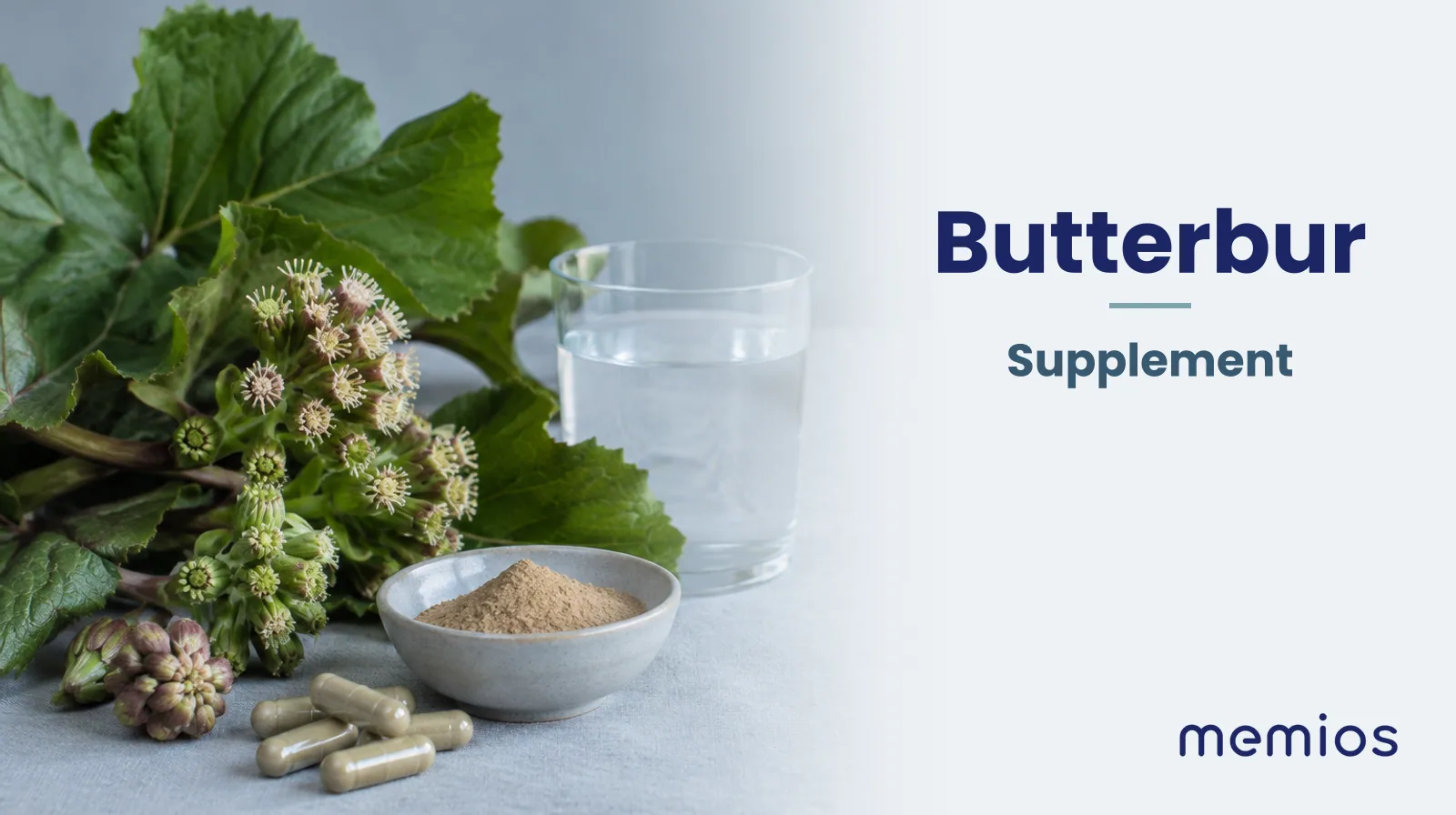
- What it is: Butterbur is a herbal preparation made from the rhizomes, roots, stems or leaves of Petasites hybridus, a perennial marsh plant native to Europe.
- Main use, supported: A systematic review of two randomised trials found moderate evidence that a proprietary Petasites root extract at 150 mg a day reduced migraine attack frequency. (moderate certainty)
- Claim NOT supported by research: In allergic rhinitis, butterbur failed to beat comparators in three of six trials, including one placebo comparison and two head-to-head comparisons with non-sedating antihistamines. (low certainty)
- Recommended dose: not established. No reference intake exists: butterbur is a herbal product, not a nutrient, and LiverTox records that its long-term efficacy and safety are not established and that it is not specifically approved for migraine or allergic rhinitis in the United States.
- Studied dose (a trial dose, not a recommendation): LiverTox describes typical oral dosing of 100 to 150 mg per day in 2 to 3 divided doses. Findings citing that trial: 1 on harm.
- Upper limit: No tolerable upper intake level was located for butterbur itself.
- What goes wrong: 5 findings on harm. The pyrrolizidine alkaloids in the raw plant are described as capable of causing sinusoidal obstruction syndrome in humans as well as animals, which is why oral products must be processed to remove them.
- Common myth: A butterbur product labelled PA-free carries no liver risk.
What it is
Butterbur is a herbal preparation made from the rhizomes, roots, stems or leaves of Petasites hybridus, a perennial marsh plant native to Europe. Its characteristic constituents are sesquiterpene esters (petasin-type compounds) alongside volatile oils, flavonoids and tannins. The raw plant also contains pyrrolizidine alkaloids, liver-toxic molecules that oral products must be processed to remove. Most clinical work has used one proprietary root extract, Petadolex, at 100 to 150 mg per day.
What the research says
The evidence is narrow and contested. Two good-quality randomised trials of one proprietary root extract found fewer migraine attacks on 150 mg a day over three to four months, and a systematic review called this only moderate evidence from two relatively small studies. For allergic rhinitis, some placebo trials were positive but others, including comparisons against antihistamines, found no difference. Set against this, cases of serious liver injury were reported after European approval, products were withdrawn in Switzerland, Germany and the UK, and the American Academy of Neurology dropped its recommendation in 2015.
Evidence grade: Disputed.
What goes wrong
After European approval of a commercial butterbur product, ten liver-injury cases were reported to the sponsor; the NIH LiverTox review judged eight of them reasonably convincing and two led to urgent liver transplantation. (Source 1)
- Case series, Low certainty.
- Size: 10 reported cases.
- Who: people taking a commercial butterbur migraine product.
- How long: onset usually within 2 to 12 weeks of starting the product.
- Result: 8 of 10 cases judged reasonably convincing, hepatocellular injury with moderate-to-severe jaundice; two urgent liver transplants; others recovered usually within 2 to 12 weeks.
- Funding: independent (NIDDK LiverTox)
Two cases resulted in urgent liver transplants, while the others apparently recovered, usually within 2 to 12 weeks.
Some marketed butterbur preparations were found on testing to contain detectable pyrrolizidine alkaloids and were withdrawn. (Source 1)
- Expert review, not systematic, Low certainty.
- Size: not stated.
- Who: marketed butterbur products in Europe.
- How long: not applicable.
- Result: Detectable pyrrolizidine alkaloid content in some preparations; product withdrawals followed.
- Funding: independent (NIDDK LiverTox)
Testing suggested that some preparations contained detectable amounts of pyrrolizidine alkaloids and some of the products were withdrawn.
The pyrrolizidine alkaloids in the raw plant are described as capable of causing sinusoidal obstruction syndrome in humans as well as animals, which is why oral products must be processed to remove them. (Source 2)
- Expert review, not systematic, Moderate certainty.
- Size: not applicable.
- Who: not applicable.
- How long: not applicable.
- Result: Senecionine and integerrimine identified in leaves and stems; oral products must be specially processed.
- Funding: independent (NIDDK LiverTox)
Extracts from butterbur leaves and stems can contain pyrrolizidine alkaloids (senecionine, integerrimine), which are toxic molecules capable of causing sinusoidal obstruction syndrome in animals as well as humans.
Position: NCCIH states that only products processed to remove pyrrolizidine alkaloids should be considered, and that rare liver injury has still occurred with products labelled PA-free. (Source 3)
- Official position, Certainty not rated.
- Size: not applicable.
- Who: US public.
- How long: studies cited cover use by mouth for up to 16 weeks.
- Result: PA-free products described as seeming safe for up to 16 weeks, with rare liver injury reported even in products reported to be PA-free.
- Funding: independent (US government agency)
However, there have been rare cases of liver injury associated with products that were reported to be PA-free.
A review of spontaneous adverse-event reports for the proprietary butterbur root extract Petadolex describes nine users who developed severe herb-induced liver injury, with two of them requiring a liver transplant. (Source 4)
- Case series, Low certainty.
- Size: nine patients with severe herb-induced liver injury among the spontaneously reported cases reviewed.
- Who: people taking the proprietary Petasites hybridus root extract Petadolex, reported doses 50 to 225 mg per day.
- How long: reported treatment durations of 4 to 730 days; average time to onset of severe injury 103 days.
- Result: ALT 3 to 153 times and AST 2 to 104 times the upper limit of normal in the severe cases; liver values settled after the product was stopped, but two patients required liver transplantation.
- Funding: Mechanistic safety studies reported in the paper were funded by the manufacturer of Petadolex, Weber & Weber GmbH & Co. KG; one author served as a paid scientific advisor to that company (stated in the paper's own funding and conflict-of-interest section)
nine developed severe HILI (average time-to-onset 103 days, ALT-range 3–153; AST 2–104-fold ULN). HILI cases resolved after medication withdrawal though two patients required liver transplantation.
What the evidence supports
A systematic review of two randomised trials found moderate evidence that a proprietary Petasites root extract at 150 mg a day reduced migraine attack frequency. (Source 5)
- Systematic review, Moderate certainty.
- Size: 293 patients across 2 trials (60 and 233 patients)
- Who: adults with migraine.
- How long: 3-4 months.
- Result: The extract at higher dose (150 mg) showed a greater decreased frequency of migraine attacks and a greater number of responders (improvement>50%) than the 100 mg dose and placebo; data were not pooled because of heterogeneity.
- Funding: not stated.
Moderate evidence of effectiveness is, thus, available for a higher than the recommended dose of the proprietary Petasites root extract Petadolex in the prophylaxis of migraine.
What the evidence does not support
In allergic rhinitis, butterbur failed to beat comparators in three of six trials, including one placebo comparison and two head-to-head comparisons with non-sedating antihistamines. (Source 6)
- Systematic review, Low certainty.
- Size: six Petasites trials within a review of 16 trials and 1,561 participants.
- Who: people with allergic rhinitis.
- How long: not stated in the review record.
- Result: Two studies comparing P. hybridus with a non-sedating antihistamine and one comparing it with placebo found no significant differences between treatments for any outcomes; median Jadad score across the review was 4 (range 2 to 4)
- Funding: not stated.
Two studies that compared P. hybridus with non-sedating antihistamine and one that comparing it with placebo found no significant differences between treatments for any outcomes.
Where the evidence is mixed
In the larger of the two migraine trials the 150 mg dose beat placebo but the 100 mg dose did not, so the benefit was dose-dependent and not seen at the lower dose. (Source 7)
- Systematic review, Moderate certainty.
- Size: two trials, n=60 and n=233.
- Who: adults with migraine.
- How long: 3-4 months.
- Result: One trial (n=60) showed a significant reduction in migraine attacks for 100mg; the other (n=233) showed a statistically significant effect for 150mg but not for 100mg.
- Funding: not stated.
Limit of this finding: A caution about this record rather than about the doses: the same DARE record labels the two trials quality in two different ways, "rated as high quality (with scores of 10 and 11)" in its Results of the review section and "Both studies were of good quality." in its commentary. The dose findings quoted here are unaffected, but no single quality grade should be read off this record.
The other trial (n=233) reported a statistically significant effect for the 150mg dose for decreased frequency of migraine attacks but not the 100mg dose.
The independent quality appraisal of that systematic review warned against drawing firm conclusions from only two small trials and flagged possible publication bias, and labelled the two trials quality inconsistently in its own two sections. (Source 8)
- Systematic review, Low certainty.
- Size: 2 trials, 293 patients.
- Who: adults with migraine.
- How long: 3-4 months.
- Result: The CRD commentary says "Both studies were of good quality." while the Results of the review section of the same record says the two trials were "rated as high quality (with scores of 10 and 11)"; no unpublished studies were sought, and the whole evidence base is two small trials of one product.
- Funding: independent (Centre for Reviews and Dissemination, University of York)
Limit of this finding: The source contradicts itself about how good the two trials were. In its CRD commentary the record says "Both studies were of good quality." In its Results of the review section the same record says the two trials were "rated as high quality (with scores of 10 and 11)". Both wordings are quoted here from the sections they appear in, because the record never reconciles them. A reader should conclude that the appraisers scored both trials well on their checklist, and should not read either "good" or "high" as a settled grade of the evidence; neither label changes the appraisers own warning that two small trials of a single product are too little to draw firm conclusions from.
Overall, it would be unwise to draw too many conclusions regarding the suitability of the intervention for the prophylaxis of migraine from the two relatively small studies included in the review.
The reviewers of the allergic rhinitis literature judged the positive butterbur results to need replication by investigators without a financial interest. (Source 9)
- Systematic review, Low certainty.
- Size: six Petasites trials.
- Who: people with seasonal allergic rhinitis.
- How long: not stated.
- Result: Evidence described as encouraging but requiring financially independent replication and larger, more rigorous trials.
- Funding: not stated for the primary trials; the review record notes the need for financially independent replication.
There was encouraging evidence for Petasites hybridus as a treatment for seasonal allergic rhinitis, but financially independent replication of the results was needed.
Position: NCCIH records that the American Academy of Neurology recommended butterbur for migraine prevention in 2012 and stopped recommending it in 2015 over safety concerns. (Source 10)
- Official position, Certainty not rated.
- Size: not applicable.
- Who: US public and clinicians.
- How long: not applicable.
- Result: Recommendation made 2012, withdrawn 2015; NCCIH page last updated November 2024.
- Funding: independent (US government agency)
In 2012, the American Academy of Neurology recommended butterbur for preventing migraines. However, the Academy stopped recommending it in 2015 because of serious concerns about its safety.
In the same set of reports, formal causality assessment rated only three of the liver cases as likely related to the butterbur extract, and 22 patients had also been taking medicines known to injure the liver. (Source 4)
- Case series, Low certainty.
- Size: 48 causality-assessed spontaneous reports (3 likely, 13 possible, 8 unlikely, 24 unclassifiable or unclassified)
- Who: people who reported hepatobiliary events while taking the proprietary butterbur extract.
- How long: not stated for the causality set.
- Result: 3 likely, 13 possible, 8 unlikely, 24 unclassifiable/unclassified; 22 patients reported hepatotoxic co-medications.
- Funding: Mechanistic safety studies in the paper were manufacturer-funded (Weber & Weber GmbH & Co. KG); one author was a paid advisor to the company.
Causality assessment rated 3 cases likely, 13 possible, 8 unlikely and 24 as unclassifiable/unclassified. Note, 22 patients reported hepatotoxic co-medications especially during periods of pain.
The paper reporting those liver-injury cases discloses that its mechanistic safety studies were paid for by the manufacturer of Petadolex and that one of its two authors was a paid scientific advisor to that company. (Source 11)
- Case series, Certainty not rated.
- Size: not applicable; a funding and conflict-of-interest disclosure.
- Who: not applicable.
- How long: the manufacturer-funded studies were carried out in 2008 to 2010.
- Result: no outcome is measured; the disclosure states the sponsor had no role in the design, execution, interpretation or writing of the study.
- Funding: industry-funded in part: Weber & Weber GmbH & Co. KG, the manufacturer of Petadolex.
J.B. served as a scientific advisor to Weber & Weber and received a consultancy fee. The sponsor had no role in the design, execution, interpretation or writing of the study.
Where the research disagrees
Whether the proprietary butterbur extract itself caused the reported serious liver injuries
- NIH LiverTox (NIDDK), narrative review of reported cases: A single publication summarizing clinical features of 10 cases reported to the sponsor has suggested that the liver injury was not related to the butterbur product, but 8 of the 10 cases were reasonably convincing and described a consistent clinical phenotype of fatigue, nausea and jaundice usually arising within 2 to 12 weeks of starting the product (Source 1)
- Authors of the 2019 pharmacovigilance and toxicology analysis of Petadolex, case series with formal causality assessment plus animal and hepatocyte experiments: Causality assessment rated 3 cases likely, 13 possible, 8 unlikely and 24 as unclassifiable/unclassified. Note, 22 patients reported hepatotoxic co-medications especially during periods of pain. (Source 12)
- Competing-interests statement printed in that same 2019 paper, declared competing interests, not a finding: Several mechanistic safety studies were performed at the Fraunhofer Institute of Toxicology and Experimental Medicine, Germany and were funded by the manufacturer of Petadolex, Weber & Weber GmbH & Co. KG, Germany in 2008–2010. J.B. served as a scientific advisor to Weber & Weber and received a consultancy fee. (Source 13)
How much
- Reference intake: No reference intake exists: butterbur is a herbal product, not a nutrient, and LiverTox records that its long-term efficacy and safety are not established and that it is not specifically approved for migraine or allergic rhinitis in the United States. (Source 2)
- Upper limit: No tolerable upper intake level was located for butterbur itself. LiverTox states that oral butterbur products must be specially processed to remove any traces of pyrrolizidine alkaloids. (Source 2)
- Studied: LiverTox describes typical oral dosing of 100 to 150 mg per day in 2 to 3 divided doses. (Source 2)
- Studied: The two migraine trials gave the proprietary root extract at 100 mg or 150 mg per day for 3 to 4 months. (Source 5)
- Studied: Reported liver-injury cases spanned doses of 50 to 225 mg per day and treatment durations of 4 to 730 days. (Source 12)
A common belief, and what the research shows
The belief: A butterbur product labelled PA-free carries no liver risk.
What the research shows: NCCIH records the opposite. PA-free products have looked reasonably safe in trials of up to 16 weeks - "Several studies, including studies of children and adolescents, have reported that PA-free butterbur products seem to be safe when taken by mouth for up to 16 weeks." - but the same page adds "However, there have been rare cases of liver injury associated with products that were reported to be PA-free." LiverTox records that laboratory testing found the alkaloids in marketed products: "Testing suggested that some preparations contained detectable amounts of pyrrolizidine alkaloids and some of the products were withdrawn."
Questions and answers
What is it?
Butterbur is a herbal preparation from Petasites hybridus, a perennial marsh plant of Europe. Products are made from the rhizomes and stems, and sometimes the leaves. Its named constituents include sesquiterpene alcohol esters, volatile oils, flavonoids and tannins. (Source 2)
What does it do in the body?
In the body, the best-documented effect is on migraine attack frequency, and only for one proprietary root extract. A systematic review of two trials found that 150 mg a day reduced attack frequency and produced more responders than 100 mg a day or placebo over three to four months. The review did not pool the data because the results were heterogeneous. (Source 5)
Is it good or bad for you?
It depends entirely on the preparation. The raw plant contains pyrrolizidine alkaloids that NCCIH says can damage the liver and lungs and may cause cancer, so only products processed to remove them are considered at all. Even then, liver injury has been reported rarely in products described as PA-free, and the American Academy of Neurology withdrew its recommendation in 2015. (Source 3)
How do you get more of it?
Butterbur is taken as a processed oral extract rather than obtained from the diet. LiverTox describes typical oral dosing of 100 to 150 mg a day in two or three divided doses, and the migraine trials used a single proprietary root extract at 100 mg or 150 mg a day. This is a description of what has been studied and sold, not a recommendation. (Source 2)
If it is harmful, what reduces it?
Butterbur is not something the body makes or stores, so reducing it means stopping the product rather than clearing a substance. In the published review of liver-injury reports linked to the proprietary butterbur extract Petadolex, the liver abnormalities resolved after the medication was withdrawn. That review also records that two of the affected patients still needed a liver transplant, so stopping did not undo the injury in every case. No other method of reducing butterbur exposure is described in that report. (Source 4)
Why might someone be low in it or missing it?
Nobody is deficient in butterbur. It is a traditional herbal remedy rather than a nutrient the body needs, so there is no low level to correct. The only reason a person would not have it is that they are not taking a butterbur product. (Source 2)
Which whole foods contain it or feed it?
No whole food supplies butterbur in a form used in trials. The plant is not a food crop; its large leaves were historically used to wrap butter, which is where the name comes from, and the leaves and stems can carry liver-toxic pyrrolizidine alkaloids, which is why oral products must be specially processed. (Source 2)
What happens if you do not have it?
Nothing happens from an absence of butterbur, because there is no deficiency state. What someone forgoes is a possible reduction in migraine attack frequency, which a systematic review rated as moderate evidence from two small trials of one product, and which the same review said needed confirmation before it could be recommended. (Source 5)
How can you test for it?
No validated test of a person's butterbur status exists in the literature we searched; there is nothing to measure because it is not a body constituent. What has been tested is the product: laboratory testing of marketed preparations found detectable pyrrolizidine alkaloids in some of them, and those products were withdrawn. (Source 1)
We searched: LiverTox butterbur chapter, NCCIH butterbur page, the Phytomedicine systematic review and its DARE appraisal, and the 2019 Journal of Clinical Medicine pharmacovigilance analysis; none describes a clinical test of butterbur status in a person, only analytical testing of products for pyrrolizidine alkaloid content.
References
- National Institute of Diabetes and Digestive and Kidney Diseases (NCBI Bookshelf). Butterbur - LiverTox: Clinical and Research Information on Drug-Induced Liver Injury (Hepatotoxicity section). 2020. PMID 31643329. Read the source
- National Institute of Diabetes and Digestive and Kidney Diseases (NCBI Bookshelf). Butterbur - LiverTox: Clinical and Research Information on Drug-Induced Liver Injury. 2020. PMID 31643329. Read the source
- National Center for Complementary and Integrative Health. Butterbur - What do we know about safety? (NCCIH). 2024. Read the source
- Journal of Clinical Medicine (MDPI). Hepatobiliary Events in Migraine Therapy with Herbs—The Case of Petadolex, A Petasites Hybridus Extract. 2019. PMID 31083451, DOI 10.3390/jcm8050652. Read the source
- Phytomedicine. Effectiveness of Petasites hybridus preparations in the prophylaxis of migraine: a systematic review. 2006. PMID 16987643, DOI 10.1016/j.phymed.2006.02.008. Read the source
- Centre for Reviews and Dissemination, University of York (NCBI Bookshelf). Herbal medicines for the treatment of allergic rhinitis: a systematic review - Database of Abstracts of Reviews of Effects (DARE), Results of the review. 2007. Read the source
- Centre for Reviews and Dissemination, University of York (NCBI Bookshelf). Effectiveness of Petasites hybridus preparations in the prophylaxis of migraine: a systematic review - Database of Abstracts of Reviews of Effects (DARE), Results of the review. 2006. Read the source
- Centre for Reviews and Dissemination, University of York (NCBI Bookshelf). Effectiveness of Petasites hybridus preparations in the prophylaxis of migraine: a systematic review - Database of Abstracts of Reviews of Effects (DARE), CRD commentary. 2006. Read the source
- Centre for Reviews and Dissemination, University of York (NCBI Bookshelf). Herbal medicines for the treatment of allergic rhinitis: a systematic review - Database of Abstracts of Reviews of Effects (DARE), Authors' conclusions. 2007. Read the source
- National Center for Complementary and Integrative Health. Butterbur - What have we learned? (NCCIH). 2024. Read the source
- Journal of Clinical Medicine (MDPI). Hepatobiliary Events in Migraine Therapy with Herbs—The Case of Petadolex, A Petasites Hybridus Extract (funding and conflict of interest statement). 2019. PMID 31083451, DOI 10.3390/jcm8050652. Read the source
- Journal of Clinical Medicine. Hepatobiliary Events in Migraine Therapy with Herbs-The Case of Petadolex, A Petasites Hybridus Extract. 2019. PMID 31083414, DOI 10.3390/jcm8050652. Read the source
- Journal of Clinical Medicine. Hepatobiliary Events in Migraine Therapy with Herbs-The Case of Petadolex, A Petasites Hybridus Extract - Conflicts of Interest statement. 2019. PMID 31083414, DOI 10.3390/jcm8050652. Read the source