Medications · September 29, 2026 · Memios · 19 min read
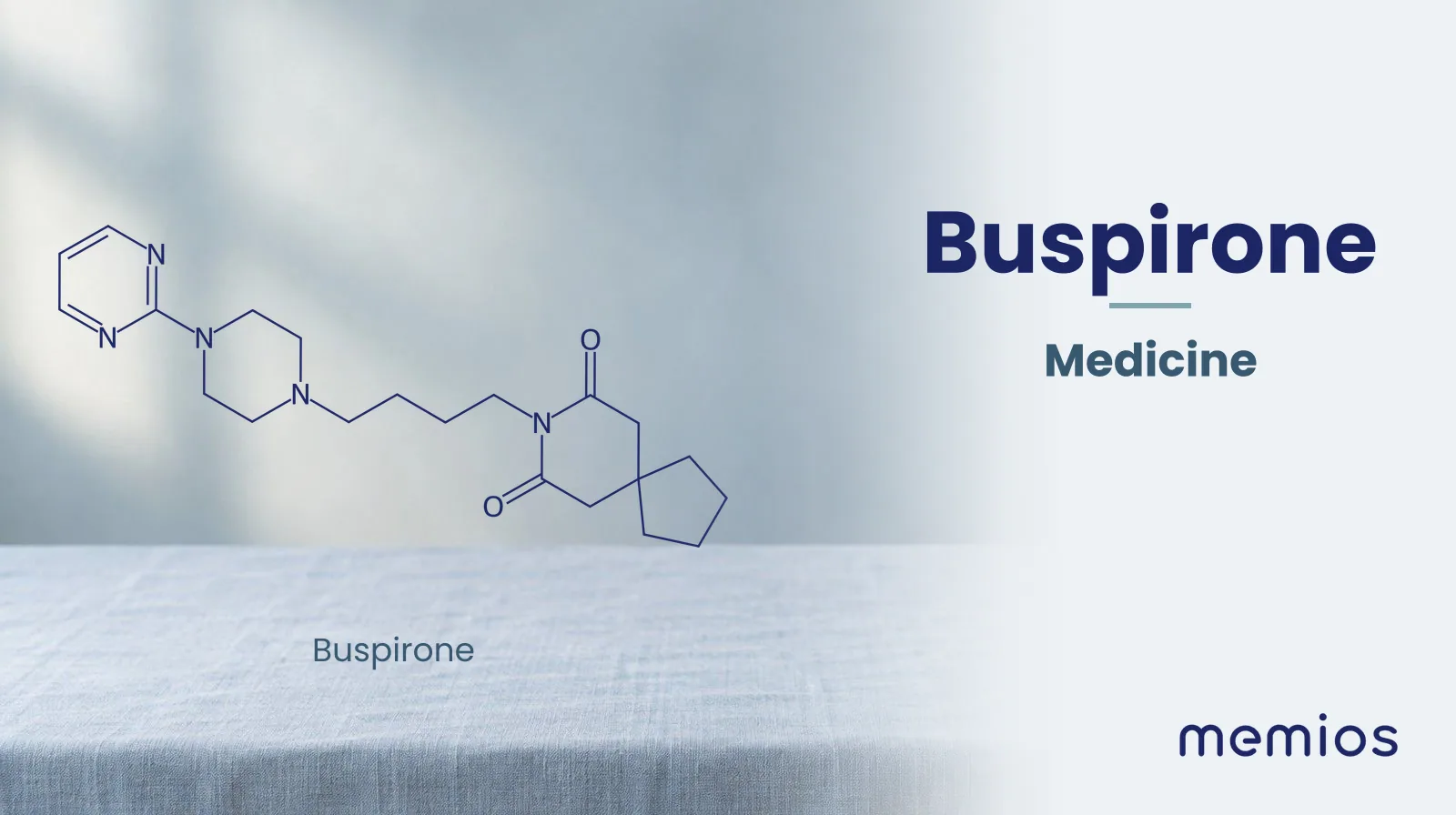
Buspirone
A Cochrane review of 36 trials in 5,908 people found azapirones including buspirone better than placebo for generalised anxiety disorder, with a number needed to treat of 4.4 on the Clinical Global Impression scale.
TLDR
- Limited evidence. A Cochrane review of 36 trials in 5,908 people found azapirones including buspirone better than placebo for generalised anxiety disorder, with a number needed to treat of 4.4 on the Clinical Global Impression scale, but probably less effective than benzodiazepines and less acceptable to patients.
- What it is: Buspirone is an azapirone anxiolytic, chemically and pharmacologically unrelated to the benzodiazepines.
- Main use: Generalised anxiety disorder / short-term relief of anxiety (limited evidence).
- Off-label uses (not on the FDA label): Augmenting an SSRI in depression that has not responded (disputed).
- Uses NOT supported by research: Panic disorder; Restricted and repetitive behaviour in young children with autism spectrum disorder.
- Recommended dose: not established. There is no reference intake for a drug: the dose is set by the prescriber. As a position, the US prescribing information for BuSpar states that the recommended initial dose is 15 mg daily (7.5 mg twice daily).
- Studied dose (a trial dose, not a recommendation): The autism trial gave children aged 2-6 either placebo or 2.5 mg or 5.0 mg of buspirone twice daily for 24 weeks. No finding here cites that trial.
- Upper limit: Position, not a reference upper limit: the same label states that the maximum daily dosage should not exceed 60 mg per day.
- What goes wrong: 5 findings on harm. In an unrefereed preprint reanalysis of STAR*D using the original protocol's definitions, buspirone augmentation was followed by substantially more treatment-emergent suicidal ideation than bupropion augmentation.
- Interactions: 6 recorded, including Grapefruit juice, Itraconazole and other strong CYP3A4 inhibitors (including erythromycin, nefazodone), Rifampin and other CYP3A4 inducers, Monoamine oxidase inhibitors.
- Common myth: Buspirone is a weaker, safer version of a benzodiazepine that works the same way.
What it is
Buspirone is an azapirone anxiolytic, chemically and pharmacologically unrelated to the benzodiazepines. Its label states plainly that "The mechanism of action of buspirone is unknown", while also reporting that it has high affinity for serotonin receptors, moderate affinity for brain D2-dopamine receptors, and no significant affinity for benzodiazepine receptors. It is a prescription-only tablet, is not a controlled substance, and carries no boxed warning.
What the research says
A Cochrane review of 36 trials in 5,908 people found azapirones including buspirone better than placebo for generalised anxiety disorder, with a number needed to treat of 4.4 on the Clinical Global Impression scale, but probably less effective than benzodiazepines and less acceptable to patients. For panic disorder, a separate Cochrane review of 3 trials found no usable efficacy data and moderate-quality evidence that people dropped out more often on azapirones than placebo. Its main practical advantage is that it does not appear to produce dependence, tolerance or a withdrawal syndrome. Its main limitation is that long-term effectiveness beyond 3 to 4 weeks has not been demonstrated in controlled trials, and its blood levels are extraordinarily sensitive to CYP3A4 - grapefruit juice raised its exposure 9.2-fold.
Evidence grade: Limited evidence.
How it works
Drug class: Azapirone anxiolytic; serotonin 5-HT1A receptor partial agonist (non-benzodiazepine)
Buspirone acts on serotonin signalling in the brain rather than on the GABA system that benzodiazepines use, which is why it does not sedate, relax muscles or cause dependence in the way they do. Its label says the mechanism of action is unknown, but reports high affinity for serotonin receptors, moderate affinity for brain dopamine D2 receptors, and no significant affinity for benzodiazepine receptors. It works slowly, over weeks rather than on a single dose. (Source 1)
What it is used for
- A Cochrane review of 36 trials in 5,908 participants found azapirones including buspirone superior to placebo, with a number needed to treat of 4.4 on the Clinical Global Impression scale. The same review said azapirones may be less effective than benzodiazepines, were less acceptable than benzodiazepines, and that longer-term studies are still needed. The label itself concedes that effectiveness beyond 3 to 4 weeks has not been demonstrated in controlled trials. Evidence: limited. (Source 2)
- A Cochrane review of 3 trials in 170 participants found no study provided usable data on the primary efficacy outcome, and moderate-quality evidence that azapirones were less acceptable than placebo (dropout risk ratio 2.13, 95% CI 1.11 to 4.07). Evidence: not-supported. (Source 3)
- In an unrefereed medRxiv preprint reanalysing STAR*D level 3 against the original protocol, buspirone augmentation of citalopram produced a 25.8% remission rate, lower than originally reported, essentially the same as bupropion-SR (25.0%), but with significantly more treatment-emergent suicidal ideation (13.9% vs 3.6%). Sustained remission through 12 months across both arms was 4.9-12.5%. The reanalysis has not been peer reviewed. Evidence: disputed. (Source 4)
- A 166-child randomised trial found no difference in the primary outcome, the ADOS Composite Total Score, between placebo and either buspirone dose at 24 weeks. A secondary restricted-and-repetitive-behaviour score showed a time-by-treatment effect favouring the 2.5 mg group, which is a secondary finding after a negative primary. Evidence: not-supported. (Source 5)
Interactions
- Grapefruit juice (pharmacokinetic study): Grapefruit juice blocks the CYP3A4 enzyme in the gut wall that normally destroys most of a buspirone dose before it reaches the blood. In healthy volunteers, two days of double-strength grapefruit juice raised buspirone blood levels 4.3-fold at peak and 9.2-fold over the whole exposure - effectively turning one tablet into several. (Source 6)
- Itraconazole and other strong CYP3A4 inhibitors (including erythromycin, nefazodone) (pharmacokinetic study): These drugs block the same enzyme as grapefruit and raise buspirone exposure enormously - 19-fold for itraconazole, 6-fold for erythromycin and up to 50-fold for nefazodone in healthy-volunteer studies. (Source 6)
- Rifampin and other CYP3A4 inducers (pharmacokinetic study): Rifampin speeds up the enzyme that destroys buspirone, cutting its blood levels by about 90% and its pharmacodynamic effects with them. St John's wort is a well-known CYP3A4 inducer of the same kind, but we could not retrieve a buspirone-specific source for it in this run. (Source 6)
- Monoamine oxidase inhibitors (case reports): The label states that giving BuSpar to a patient taking an MAOI may pose a hazard, cites reports of elevated blood pressure when BuSpar was added to a regimen including an MAOI, and on that basis recommends that the two not be used together. (Source 7)
- Alcohol (label): The label's advice is to avoid drinking alcohol while taking buspirone. Its reason for that advice is prudence rather than a measured interaction: formal studies did not find that buspirone added to alcohol's impairment of motor and mental performance, but the label still says it is prudent to avoid using the two together. Separately, in a drug-preference study in moderate drinkers, buspirone - unlike diazepam - was not chosen over placebo and did not increase liking. (Source 7)
- Serotonergic medicines generally (case reports): Serotonin syndrome was among the most frequently reported buspirone adverse events in an analysis of 1,744 spontaneous reports, and drug interaction was itself one of the top reported terms. Spontaneous reports have no denominator and cannot establish a rate. (Source 8)
Stopping it
- The label states buspirone is not a controlled substance and that human and animal studies have shown no potential for abuse or diversion and no evidence of tolerance or physical or psychological dependence. This is the manufacturer's position, recorded as such. (Source 1)
- An independent review of animal and clinical studies reached the same conclusion: buspirone appears to lack abuse liability and does not lead to dependence or withdrawal symptoms. This was a narrative review with no stated search method, so it summarises rather than systematically tests the question. (Source 9)
- Against that, a 2026 analysis of 1,744 spontaneous adverse event reports flagged drug abuse (n=43) and intentional overdose (n=30) among the signals, and its authors said prolonged buspirone use carries safety hazards worth attention. Spontaneous reports cannot establish a rate and are prone to reporting bias. (Source 8)
- On how long to continue, the label concedes that effectiveness beyond 3 to 4 weeks has not been demonstrated in controlled trials, and the Cochrane reviewers said longer-term studies are still needed - so there is no trial evidence base for either continuing indefinitely or for a particular tapering schedule. (Source 1)
What goes wrong
In an unrefereed preprint reanalysis of STAR*D using the original protocol's definitions, buspirone augmentation was followed by substantially more treatment-emergent suicidal ideation than bupropion augmentation. (Source 4)
- Randomized trial, Moderate certainty.
- Size: Patient-level data from STAR*D level 3; the reanalysis excluded 124 inappropriately included patients (21.9% of enrolled subjects)
- Who: Adults with major depression whose citalopram had not worked.
- How long: Acute augmentation phase plus 12-month follow-up.
- Result: Treatment-emergent suicidal ideation 13.9% with buspirone vs 3.6% with bupropion SR; remission 25.8% (buspirone) vs 25.0% (bupropion SR), both lower than originally published; sustained 12-month remission 4.9-12.5%.
- Funding: independent reanalysis (RIAT) of a publicly funded trial.
Limit of this finding: This comes from an unrefereed preprint posted on medRxiv, not from a peer-reviewed journal article. It has not been through independent review, and its numbers and methods could change or be disputed. It is a reanalysis of an existing trial's patient-level data rather than a new trial. Treat it as a serious but provisional challenge to the originally published STAR*D results, not as a settled finding.
TESI rates were significantly higher for buspirone (13.9%) than bupropion SR (3.6%) augmentation.
A pharmacovigilance analysis of spontaneous reports flagged dizziness, anxiety, drug interaction, serotonin syndrome and tremor as the most-reported buspirone adverse events, and its authors read the reports as indicating a potential risk of abuse during therapeutic use. (Source 8)
- Survey study, Very low certainty.
- Size: 1,744 buspirone-related adverse event reports.
- Who: Spontaneous reports submitted to the FDA Adverse Event Reporting System.
- How long: Not applicable - disproportionality analysis without a denominator.
- Result: Most reported events: dizziness (n=141), anxiety (n=133), drug interaction (n=86), serotonin syndrome (n=83), tremor (n=71); drug abuse (n=43) and intentional overdose (n=30) also signalled.
- Funding: not stated.
Limit of this finding: This is a disproportionality analysis of voluntary reports, not a study of how often anything happens. There is no denominator, so no rate can be worked out, and a signal cannot show that buspirone caused the event. The abuse signal rests on 43 reports out of 1,744 and the authors describe it as a risk 'during therapeutic use' - it is not a finding of recreational abuse, and the FDA label for the same drug states that human and animal studies have shown no potential for abuse or diversion. Read this as a question raised for further study, not as an established harm.
These findings indicated a potential risk of abuse with buspirone exposure during therapeutic use.
The label's own controlled-trial table shows dizziness, nausea, headache and nervousness more often on buspirone than placebo. (Source 1)
- Official position, Certainty not rated.
- Size: 4-week controlled trials comparing BuSpar with placebo; denominator not given in the extract.
- Who: Patients with anxiety in the registration trials.
- How long: 4 weeks.
- Result: Dizziness 12% vs 3%, nausea 8% vs 5%, headache 6% vs 3%, nervousness 5% vs 1%, lightheadedness 3% vs under 1%.
- Funding: manufacturer (label)
The table that follows enumerates adverse events that occurred at a frequency of 1% or more among BuSpar (buspirone hydrochloride) patients who participated in 4-week, controlled trials comparing BuSpar with placebo.
Grapefruit juice raised buspirone blood exposure more than nine-fold in healthy volunteers. (Source 6)
- Blood level study, Moderate certainty.
- Size: Healthy volunteers; number not stated in the label's summary of the study.
- Who: Healthy volunteers given buspirone 10 mg as a single dose.
- How long: Grapefruit juice 200 mL double-strength three times daily for 2 days.
- Result: 4.3-fold increase in Cmax; 9.2-fold increase in AUC.
- Funding: not stated.
In a study in healthy volunteers, coadministration of buspirone (10 mg as a single dose) with grapefruit juice (200 mL double-strength t.i.d. for 2 days) increased plasma buspirone concentrations (4.3-fold increase in Cmax; 9.2-fold increase in AUC).
CYP3A4-inhibiting medicines raise buspirone levels dramatically and rifampin almost abolishes them. (Source 6)
- Blood level study, Moderate certainty.
- Size: Separate healthy-volunteer studies summarised in the label.
- Who: Healthy volunteers.
- How long: 2 to 5 days of the interacting drug.
- Result: Erythromycin: 5-fold Cmax, 6-fold AUC. Itraconazole: 13-fold Cmax, 19-fold AUC. Nefazodone: up to 20-fold Cmax, up to 50-fold AUC. Rifampin: 83.7% decrease in Cmax, 89.6% decrease in AUC.
- Funding: manufacturer-sponsored studies reported in the label.
In a study in healthy volunteers, coadministration of buspirone (10 mg as a single dose) with itraconazole (200 mg/day for 4 days) increased plasma buspirone concentrations (13-fold increase in Cmax and 19-fold increase in AUC).
What the evidence supports
Azapirones including buspirone were better than placebo for generalised anxiety disorder, with a number needed to treat of about 4. (Source 2)
- Systematic review, Low certainty.
- Size: 36 trials, 5,908 participants.
- Who: Adults with generalised anxiety disorder.
- How long: Mostly short-term trials; the reviewers called for longer-term studies.
- Result: Number needed to treat 4.4 on the Clinical Global Impression scale.
- Funding: not stated.
The calculated number needed to treat for azapirones using the Clinical Global Impression scale was 4.4
Buspirone did not act as a reinforcer in a drug-preference study in moderate drinkers, while diazepam did. (Source 10)
- Randomized trial, Low certainty.
- Size: 55 moderate drinkers (30 given diazepam 4 mg, 25 given buspirone 5 mg)
- Who: Moderate drinkers without a substance use disorder diagnosis.
- How long: Seven-session choice procedure.
- Result: 70% chose diazepam over placebo on at least two of three choice sessions; only 24% chose buspirone over placebo on at least two sessions. Both increased sedation; only diazepam increased liking and impaired performance.
- Funding: not stated.
only 24% of subjects chose buspirone over placebo on at least two sessions
A review of animal and clinical studies concluded buspirone lacks abuse liability and does not produce dependence or a withdrawal syndrome. (Source 9)
- Expert review, not systematic, Low certainty.
- Size: Not stated - an expert review with no described search method.
- Who: Animal and clinical study populations.
- How long: Not stated.
- Result: No numerical effect estimates reported; a qualitative conclusion.
- Funding: not stated (published in a journal supplement of the era, which typically carried manufacturer sponsorship - a reviewer should check)
to lack abuse liability and does not lead to drug dependence or withdrawal
What the evidence does not support
For panic disorder, azapirones produced no usable efficacy data and more dropouts than placebo. (Source 3)
- Systematic review, Moderate certainty.
- Size: 3 studies, 170 participants.
- Who: Adults with panic disorder.
- How long: Not stated in the summary.
- Result: Dropouts for any reason RR 2.13 (95% CI 1.11 to 4.07); no study provided usable information on response.
- Funding: not stated.
No study provided enough usable information on our primary efficacy outcome (response).
Buspirone's long-term effectiveness has not been demonstrated in controlled trials. (Source 1)
- Official position, Certainty not rated.
- Size: Not applicable.
- Who: Patients prescribed buspirone for anxiety.
- How long: Beyond 3 to 4 weeks.
- Result: No demonstrated effect beyond 3 to 4 weeks in controlled trials, per the label; the Cochrane reviewers made the same point independently.
- Funding: manufacturer (label)
The effectiveness of BuSpar in long-term use, that is, for more than 3 to 4 weeks, has not been demonstrated in controlled trials.
In a 166-child randomised trial in autism, buspirone failed on its pre-specified primary outcome over 24 weeks; the only improvement was on a secondary repetitive-behaviour score and only at the lower of the two doses. (Source 11)
- Randomized trial, Moderate certainty.
- Size: Children 2-6 years of age with ASD (N = 166) were randomized.
- Who: Children aged 2 to 6 years with autism spectrum disorder.
- How long: 24 weeks.
- Result: Primary outcome, ADOS Composite Total Score: no difference between the 3 treatment groups (P = .400). Secondary ADOS Restricted and Repetitive Behavior score: time-by-treatment effect P = .006, with significant improvement in the 2.5 mg group (P = .003) and no change in placebo or the 5.0 mg group. Adverse events did not differ significantly among treatment groups.
- Funding: Independent public funding: the Europe PMC record lists NINDS NIH HHS grant 5U01 NS61264; trial registration ClinicalTrials.gov NCT00873509.
There was no difference in the ADOS Composite Total Score between baseline and 24 weeks among the 3 treatment groups (P = .400); however, the ADOS Restricted and Repetitive Behavior score showed a time-by-treatment effect (P = .006); the 2.5-mg buspirone group showed significant improvement (P = .003), whereas placebo and 5.0-mg buspirone groups showed no change.
Where the evidence is mixed
The same review concluded azapirones may be less effective than benzodiazepines and could not establish superiority over antidepressants. (Source 2)
- Systematic review, Low certainty.
- Size: 36 trials, 5,908 participants.
- Who: Adults with generalised anxiety disorder.
- How long: Short-term.
- Result: Fewer participants stopped taking benzodiazepines than azapirones; no conclusion possible versus antidepressants.
- Funding: not stated.
Azapirones may be less effective than benzodiazepines and we were unable to conclude if azapirones were superior to antidepressants
Where the research disagrees
Whether buspirone has any abuse potential
- BuSpar prescribing information (2010) and a 1987 review, manufacturer position supported by a narrative review of animal and clinical studies, plus a randomised drug-preference study: In human and animal studies, buspirone has shown no potential for abuse or diversion and there is no evidence that it causes tolerance, or either physical or psychological dependence. (Source 1)
- Pharmacovigilance analysis of FAERS reports (2026), disproportionality analysis of 1,744 spontaneous adverse event reports, no denominator, reporting bias: These findings indicated a potential risk of abuse with buspirone exposure during therapeutic use. (Source 8)
How much
- Reference intake: There is no reference intake for a drug: the dose is set by the prescriber. As a position, the US prescribing information for BuSpar states that the recommended initial dose is 15 mg daily (7.5 mg twice daily). (Source 1)
- Upper limit: Position, not a reference upper limit: the same label states that the maximum daily dosage should not exceed 60 mg per day. (Source 1)
- Studied: The autism trial gave children aged 2-6 either placebo or 2.5 mg or 5.0 mg of buspirone twice daily for 24 weeks. (Source 5)
- Studied: The drug-preference study gave moderate drinkers single 5 mg capsules of buspirone (compared with 4 mg diazepam). (Source 10)
- Studied: The interaction studies reported in the label used single 10 mg or 30 mg doses of buspirone in healthy volunteers. (Source 1)
A common belief, and what the research shows
The belief: Buspirone is a weaker, safer version of a benzodiazepine that works the same way.
What the research shows: It does not act on benzodiazepine receptors at all: the label states "Buspirone has no significant affinity for benzodiazepine receptors and does not affect" that system, and "Buspirone has moderate affinity for brain D2-dopamine receptors." The Cochrane reviewers found that "Azapirones may be less effective than benzodiazepines and we were unable to conclude if azapirones were superior to antidepressants", and that they "do not appear as acceptable as benzodiazepines". The genuine difference is dependence: in a preference study "only 24% of subjects chose buspirone over placebo on at least two sessions", against 70% for diazepam.
Questions and answers
What is it?
Buspirone is a prescription anxiolytic tablet of the azapirone class. It is chemically unrelated to benzodiazepines and is not a controlled substance. It acts mainly on serotonin signalling, with some dopamine D2 affinity and none at benzodiazepine receptors. (Source 1)
What does it do in the body?
It reduces anxiety gradually rather than on a single dose, and does so without sedating, relaxing muscles or producing the dependence that benzodiazepines can. The manufacturer is candid that the precise mechanism has not been established. (Source 1)
Is it good or bad for you?
It depends on the condition. For generalised anxiety disorder it beat placebo across 36 trials, with about one in four people benefiting who would not have on placebo. For panic disorder there was no usable efficacy evidence and more dropouts than placebo. As an add-on in depression it carried significantly more treatment-emergent suicidal ideation than the comparator. (Source 2)
How do you get more of it?
This does not apply the way it would to a nutrient: buspirone exists in the body only when the tablet is taken. The label's starting dose is 15 mg a day in two divided doses, and it describes raising the dose by 5 mg per day at intervals of 2 to 3 days if needed, up to a stated maximum of 60 mg a day. One thing that raises blood levels unintentionally is grapefruit juice, which increased exposure 9.2-fold in healthy volunteers - that is an interaction to avoid, not a way to get more. (Source 1)
If it is harmful, what reduces it?
Stopping the tablet removes it, and unlike benzodiazepines there is no recognised withdrawal syndrome to manage: a review of animal and clinical studies concluded it does not lead to dependence or withdrawal. Rifampin, a strong enzyme inducer, clears it from the blood so effectively that levels drop by about 90%. (Source 9)
Why might someone be low in it or missing it?
Nobody is naturally low in buspirone. People end up with too little of it in the blood for a different reason: enzyme-inducing drugs. Rifampin cut peak levels by 83.7% and total exposure by 89.6% in healthy volunteers, along with the drug's measurable effects. (Source 6)
Which whole foods contain it or feed it?
No whole food contains buspirone. One food matters a great deal in the other direction: grapefruit juice blocks the enzyme that breaks buspirone down, and two days of double-strength juice raised blood levels 4.3-fold at peak and 9.2-fold overall in healthy volunteers. (Source 6)
What happens if you do not have it?
Nothing is lost physiologically. What the trials show is a lost treatment effect: in generalised anxiety disorder about one extra person in every four or five treated improved on an azapirone who would not have on placebo. For panic disorder, going without loses nothing the trials could measure. (Source 2)
How can you test for it?
There is no routine blood test for buspirone in ordinary care. Blood concentrations are measured only in pharmacokinetic studies, which is how the grapefruit, itraconazole, erythromycin, nefazodone and rifampin interactions were quantified as fold-changes in Cmax and AUC. In practice response is judged clinically, for instance on the Clinical Global Impression scale used in the trials. (Source 6)
References
- US Food and Drug Administration (Drugs@FDA), label revised November 2010. BuSpar (buspirone HCl, USP) tablets - Prescribing Information (indications, dosage, clinical pharmacology, adverse reactions, drug abuse and dependence sections). 2010. Read the source
- Cochrane Database of Systematic Reviews. Azapirones for generalized anxiety disorder (GAD). 2006. PMID 16856115, DOI 10.1002/14651858.CD006115. Read the source
- Cochrane Database of Systematic Reviews. Azapirones versus placebo for panic disorder in adults. 2014. PMID 25268297, DOI 10.1002/14651858.CD010828.pub2. Read the source
- medRxiv preprint server - not peer reviewed. Restoring STAR*D: A RIAT Reanalysis of Medication Augmentation Therapy After Failed SSRI Treatment Using Patient-Level Data with Fidelity to the Original Research Protocol [unrefereed medRxiv preprint, posted 30 October 2025]. 2025. DOI 10.1101/2025.10.27.25338365. Read the source
- The Journal of Pediatrics. Efficacy of Low-Dose Buspirone for Restricted and Repetitive Behavior in Young Children with Autism Spectrum Disorder: A Randomized Trial. 2016. PMID 26746121. Read the source
- US Food and Drug Administration (Drugs@FDA), label revised November 2010. BuSpar (buspirone HCl, USP) tablets - Prescribing Information (PRECAUTIONS: Drug Interactions - healthy-volunteer pharmacokinetic studies). 2010. Read the source
- US Food and Drug Administration (Drugs@FDA), label revised November 2010. BuSpar (buspirone HCl, USP) tablets - Prescribing Information (WARNINGS: monoamine oxidase inhibitors; PRECAUTIONS: information for patients, alcohol). 2010. Read the source
- Journal of Affective Disorders. Adverse events related to buspirone: a real-world pharmacovigilance study using the FAERS database. 2026. DOI 10.1016/j.jad.2026.121240. Read the source
- The American Journal of Medicine. Assessing the potential for buspirone dependence or abuse and effects of its withdrawal. 1987. PMID 3296749, DOI 10.1016/0002-9343(87)90199-9. Read the source
- Psychopharmacology. Preference for diazepam, but not buspirone, in moderate drinkers. 1996. PMID 8741938, DOI 10.1007/BF02246172. Read the source
- The Journal of Pediatrics (record retrieved from the Europe PMC REST service, EMBL-EBI). Efficacy of Low-Dose Buspirone for Restricted and Repetitive Behavior in Young Children with Autism Spectrum Disorder: A Randomized Trial.. 2016. PMID 26746121, DOI 10.1016/j.jpeds.2015.11.033. Read the source