Medications · September 30, 2026 · Memios · 15 min read
Budesonide; Formoterol
The evidence supports real reductions in asthma and COPD flare-ups (exacerbations) when budesonide/formoterol is used as directed.
TLDR
- Well established. The evidence supports real reductions in asthma and COPD flare-ups (exacerbations) when budesonide/formoterol is used as directed, and large safety trials required by regulators did not find a significant increase in serious asthma-related hospitalization, intubation.
- What it is: Budesonide/formoterol is a combination medicine delivered by inhaler, sold as Symbicort.
- Main use: Asthma maintenance treatment (including as maintenance-and-reliever therapy, 'SMART') (well supported).
- Other approved uses: COPD maintenance treatment and exacerbation reduction (well supported).
- Recommended dose (official position): Dosing (strength and number of inhalations) is set by the prescriber based on asthma or COPD severity and age.
- Studied dose (a trial dose, not a recommendation): SMART regimen trials: budesonide-formoterol dry powder inhaler used as both scheduled maintenance and as-needed reliever, up to a maximum of 10 inhalations daily. Findings citing that trial: 1 for.
- Upper limit: The label sets a maximum recommended number of inhalations per day by strength and indication; SMART/as-needed-reliever trials capped budesonide-formoterol reliever use at a stated daily maximum.
- What goes wrong: 1 finding on harm. Grapefruit juice roughly doubles the bioavailability of budesonide taken by mouth, via inhibition of intestinal CYP3A4 first-pass metabolism.
- Interactions: 6 recorded, including Strong CYP3A4 inhibitors (ketoconazole, ritonavir, atazanavir, clarithromycin, and similar drugs), Grapefruit (grapefruit juice), Non-potassium-sparing diuretics (loop or thiazide diuretics), MAO inhibitors and tricyclic antidepressants.
- Common myth: Many people believe long-acting beta-agonists (LABAs) like formoterol are inherently dangerous and increase the risk of dying from asthma, based on the older boxed warning.
What it is
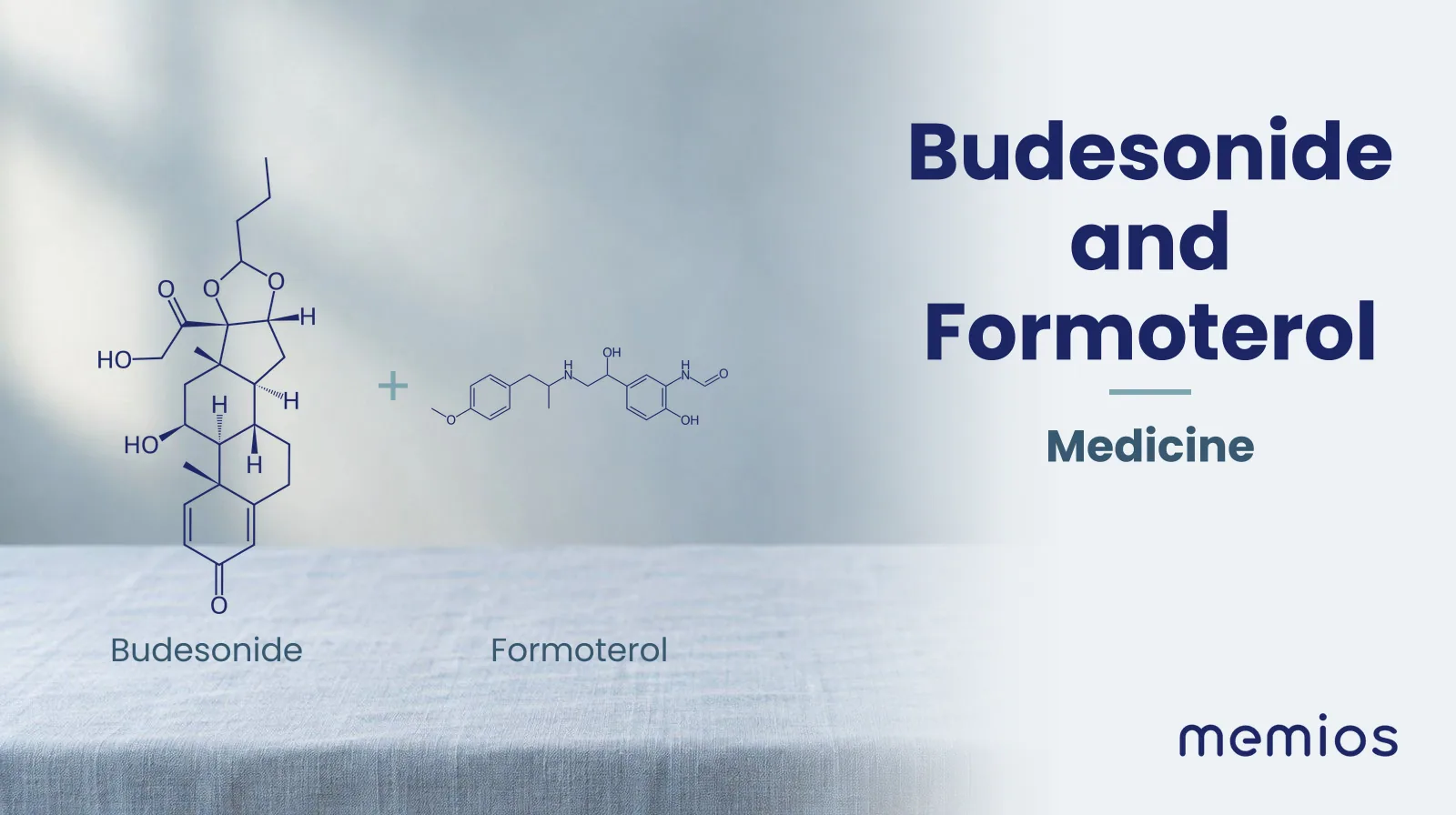
Budesonide/formoterol is a combination medicine delivered by inhaler, sold as Symbicort. Budesonide is a synthetic corticosteroid; formoterol fumarate is a synthetic long-acting beta2-agonist bronchodilator. The two are combined in one inhaler so a person with asthma or COPD gets an anti-inflammatory steroid and an airway-opening bronchodilator in the same puff.
What the research says
The evidence supports real reductions in asthma and COPD flare-ups (exacerbations) when budesonide/formoterol is used as directed, and large safety trials required by regulators did not find a significant increase in serious asthma-related hospitalization, intubation, or death when formoterol was combined with budesonide compared with budesonide alone. It is not a rescue-only quick fix and it does not cure asthma or COPD; inhaled corticosteroids can also cause local and, less often, systemic side effects, and long-acting beta-agonists carry class warnings that have been intensely studied.
Evidence grade: Well established.
How it works
Drug class: Combination inhaler: an inhaled corticosteroid (budesonide) plus a long-acting beta2-adrenergic agonist, LABA (formoterol fumarate)
Budesonide is a corticosteroid that, once inhaled into the lungs, damps down the inflammation (swelling, mucus, immune cell activity) that narrows airways in asthma and COPD; it has strong anti-inflammatory (glucocorticoid) activity and only weak mineralocorticoid (salt/water-retaining) activity. Formoterol is a long-acting beta2-agonist that relaxes the smooth muscle around the airways, opening them, and unlike older long-acting agonists it starts working quickly as well as lasting long. Combining them treats both the underlying inflammation and the muscle tightening that cause asthma and COPD symptoms. (Source 1)
What it is used for
- A meta-analysis of 16 randomized controlled trials (about 22,748 patients), most using budesonide/formoterol as both maintenance and as-needed reliever, found this SMART approach reduced acute asthma exacerbations compared with conventional fixed-dose therapy, with numbers needed to treat in the range of about 9 to 37 depending on the comparator regimen and dose. Evidence: established. (Source 2)
- The approved COPD indication rests on placebo- and active-controlled trials in COPD patients (one pivotal program enrolled 771 adults) lasting 6-12 months; independent journal sources describing the exacerbation-rate results could not be retrieved in this session (blocked by publisher access controls), so this use is reported here from the label's own description of its pivotal trials rather than from an independently verified effect size, which is a gap a reviewer should close. Evidence: established. (Source 3)
Interactions
- Strong CYP3A4 inhibitors (ketoconazole, ritonavir, atazanavir, clarithromycin, and similar drugs) (label): These drugs can raise budesonide blood levels by blocking the enzyme that normally breaks it down, increasing the risk of corticosteroid side effects; the label advises caution when co-administering long-term ketoconazole or other strong CYP3A4 inhibitors. (Source 4)
- Grapefruit (grapefruit juice) (pharmacokinetic study): In a small pharmacokinetic study of oral budesonide (not the inhaled product), regular grapefruit juice intake roughly doubled budesonide's bioavailability by inhibiting intestinal CYP3A4, the same pathway flagged for drug-drug interactions on the inhaled label; whether this magnitude applies to the much lower systemic exposure from inhaled budesonide/formoterol was not directly studied in the sources reached here. (Source 5)
- Non-potassium-sparing diuretics (loop or thiazide diuretics) (label): Beta-agonists like formoterol can worsen the ECG changes and low potassium (hypokalemia) that these diuretics can cause; the label advises caution with co-administration. (Source 6)
- MAO inhibitors and tricyclic antidepressants (label): These drug classes can potentiate formoterol's effect on the cardiovascular (vascular) system, increasing cardiovascular risk; the label advises caution or avoidance around the time these are used. (Source 7)
- Beta-blockers (including beta-blocker eye drops) (label): Beta-blockers can blunt or block formoterol's airway-opening effect and, conversely, formoterol may reduce a beta-blocker's own effect; the label flags both directions of interaction. (Source 8)
- Alcohol, and specific supplements this app tracks (St John's wort, calcium, iron, magnesium, potassium, vitamin K, fish oil, turmeric, red yeast rice) (theoretical): This research did not find published pharmacokinetic studies or case reports documenting a specific interaction between inhaled budesonide/formoterol and alcohol or these named supplements; this is reported as an absence of evidence found in the searches conducted, not as proof that no interaction exists (formoterol's beta-agonist and potassium-lowering effects mean caution with potassium-affecting supplements or diuretic-like substances is theoretically reasonable, but no direct study was located). (Source 9)
Stopping it
- Step-down evidence here is for the inhaled-corticosteroid class in asthma generally, not for budesonide/formoterol as a fixed combination. In one randomised trial reported inside a systematic review, replacing the inhaled corticosteroid with a leukotriene receptor antagonist alone raised treatment failure over 16 weeks (20.2% continuing the inhaled corticosteroid versus 30.3% after substitution, hazard ratio 1.6, 95% confidence interval 1.1-2.6). The rebound rate after stopping budesonide/formoterol specifically was not found in the sources reached. (Source 10)
- A separate and different comparison in the same review looked at adding a leukotriene receptor antagonist rather than placebo while the inhaled corticosteroid dose was being reduced, and found a modestly decreased risk ratio favouring the leukotriene receptor antagonist (0.57, 95% CI 0.36-0.90, I2 = 0%) across three studies. That is a different clinical scenario from substituting one controller for another, so the two results should not be read together. (Source 11)
What goes wrong
Grapefruit juice roughly doubles the bioavailability of budesonide taken by mouth, via inhibition of intestinal CYP3A4 first-pass metabolism. (Source 5)
- Blood level study, Low certainty.
- Size: 8 healthy men.
- Who: Healthy adult male volunteers (oral budesonide, not inhaled)
- How long: Single open, randomised, crossover study with four treatment periods.
- Result: Mean increase in bioavailability about 94% (95% CI 68-126%) with regular grapefruit juice intake.
- Funding: not stated.
The mean increase was 94% (95% confidence limits: 68–126).
What the evidence supports
Using budesonide/formoterol as both daily controller and as-needed reliever (the SMART regimen) reduces acute asthma exacerbations compared with conventional therapy. (Source 2)
- Systematic review, Moderate certainty.
- Size: 16 randomized controlled trials, N = 22,748 patients.
- Who: Patients 12 years or older with persistent asthma (one trial in children 4-11 was inconclusive)
- How long: Varied by trial (SMART regimens typically studied over several months to a year)
- Result: Reduced risk of acute exacerbations; NNT = 12.3 (95% CI 8.7-22.2) vs same-dose ICS, and NNT = 9.1 (95% CI 6.8-13.9) vs higher-dose ICS alone.
- Funding: not stated in this secondary source.
SMART is associated with a reduced risk of acute asthma exacerbations in patients 12 years or older.
Budesonide-formoterol used as a reliever reduces exacerbations requiring oral corticosteroids compared with a short-acting beta-agonist (terbutaline). (Source 12)
- Systematic review, Certainty not rated.
- Size: 3 trials, 5905 participants.
- Who: Adults and children with asthma.
- How long: Not specified in this summary.
- Result: Odds ratio 0.54 (95% CI 0.44 to 0.65) for exacerbations requiring oral corticosteroids vs terbutaline.
- Funding: not stated in this secondary source.
reduction in exacerbations requiring oral corticosteroids compared to terbutaline, odds ratio 0.54 (95% CI 0.44 to 0.65)
In the FDA-mandated safety trials, adding formoterol to budesonide did not significantly increase the risk of serious asthma-related hospitalization, intubation, or death compared with budesonide alone, leading the FDA to remove the boxed warning for this and other fixed-dose ICS/LABA combinations. (Source 13)
- Randomized trial, Moderate certainty.
- Size: Four trials analyzed by FDA in total across ICS/LABA products, 41,297 patients combined.
- Who: Patients with asthma prescribed an ICS/LABA fixed-dose combination vs ICS alone.
- How long: Not specified in this secondary source.
- Result: No statistically significant increase in serious asthma-related events (hospitalization, intubation, death) with budesonide/formoterol vs budesonide alone.
- Funding: Sponsor-conducted trials required by FDA post-marketing requirement (AstraZeneca and other manufacturers)
The results did not show a significant increase in risk of a serious asthma-related event (hospitalization, intubations and death) with ICS/LABA fixed-dose combination compared with ICS alone.
What the evidence does not support
In a randomised trial reported in a systematic review of asthma step-down, replacing an inhaled corticosteroid with a leukotriene receptor antagonist alone led to more treatment failures than continuing the inhaled corticosteroid. (Source 10)
- Systematic review, Certainty not rated.
- Size: One randomised trial reported within the review; the review does not give a pooled estimate for this comparison.
- Who: Patients with stable asthma on an inhaled corticosteroid.
- How long: 16 weeks.
- Result: Treatment failure 20.2% continuing the inhaled corticosteroid vs 30.3% after substituting a leukotriene receptor antagonist (hazard ratio 1.6; 95% confidence interval, 1.1-2.6) over 16 weeks.
- Funding: not stated in this secondary source.
Limit of this finding: This is evidence about the inhaled-corticosteroid class in asthma generally. It did not test budesonide/formoterol itself, and the comparison was substituting a different controller, not simply stopping treatment.
The treatment failure rates were 20.2% in the continue ICS group and 30.3% in the LTRA group (hazard ratio 1.6; 95% confidence interval, 1.1–2.6) over the 16-week study period.
Where the evidence is mixed
Budesonide/formoterol was studied in placebo- and active-controlled COPD trials lasting 6-12 months, but was associated with more non-pneumonia lung infections (mostly bronchitis) than placebo. (Source 3)
- Randomized trial, Certainty not rated.
- Size: 771 adult COPD patients (one pivotal exacerbation-study population cited)
- Who: Adults 40 years and older with COPD.
- How long: 6 and 12 months.
- Result: Non-pneumonia lung infections (mostly bronchitis): 7.9% with budesonide/formoterol 160/4.5 vs 5.1% with placebo.
- Funding: Manufacturer-sponsored (label-reported pivotal trials)
Lung infections other than pneumonia (mostly bronchitis) occurred in a greater percentage of subjects treated with SYMBICORT 160/4.5 compared with placebo (7.9% vs. 5.1%, respectively).
How much
- Reference intake: Dosing (strength and number of inhalations) is set by the prescriber based on asthma or COPD severity and age. The FDA label carried on DailyMed, revision date 24 July 2019, states the approved dosing regimens; that is the manufacturer's and regulator's position on this date, not evidence of an effect. (Source 14)
- Upper limit: The label sets a maximum recommended number of inhalations per day by strength and indication; SMART/as-needed-reliever trials capped budesonide-formoterol reliever use at a stated daily maximum. This is the label's and trial protocols' position, not a target for a member to self-select. (Source 2)
- Studied: SMART regimen trials: budesonide-formoterol dry powder inhaler used as both scheduled maintenance and as-needed reliever, up to a maximum of 10 inhalations daily. (Source 2)
- Studied: COPD pivotal trials: SYMBICORT 160/4.5, two inhalations twice daily, over 6-12 months. (Source 3)
A common belief, and what the research shows
The belief: Many people believe long-acting beta-agonists (LABAs) like formoterol are inherently dangerous and increase the risk of dying from asthma, based on the older boxed warning.
What the research shows: The original LABA boxed warning was based on earlier trials of a LABA used without a steroid; large FDA-mandated trials of fixed-dose ICS/LABA combinations (including budesonide/formoterol) analyzed over 41,000 patients and found no significant increase in serious asthma-related hospitalization, intubation, or death compared with the inhaled corticosteroid alone, leading FDA to remove the boxed warning for these combination products in December 2017.
Questions and answers
What is it?
Budesonide/formoterol (brand name Symbicort) is a prescription inhaler that combines two medicines: budesonide, an inhaled corticosteroid, and formoterol, a long-acting beta2-agonist bronchodilator. It is a maintenance treatment for asthma in people 6 years and older, used when asthma is not adequately controlled on a controller medicine alone or when treatment with both components is warranted. It is not a rescue inhaler for sudden breathing trouble. (Source 14)
What does it do in the body?
The budesonide component reduces airway inflammation over time, while the formoterol component relaxes the muscle around the airways so they open up; together they are meant to keep airways calmer day to day and reduce flare-ups. Large safety trials found that adding formoterol to budesonide did not significantly raise the risk of serious asthma events compared with budesonide alone. (Source 13)
Is it good or bad for you?
For people with persistent asthma or COPD who need more than a rescue inhaler, the trial evidence supports real benefit in reducing exacerbations. It is not free of downsides: inhaled corticosteroids can cause local effects like hoarseness, and rarely systemic effects like reduced growth velocity in children or adrenal insufficiency during steroid transitions, and the combination was linked to more non-pneumonia lung infections than placebo in COPD trials (7.9% vs 5.1%). (Source 3)
How do you get more of it?
This does not apply the way it would to a nutrient: budesonide/formoterol is a prescription inhaler, obtained only via a prescriber's decision about asthma or COPD control, not something to seek out or increase on one's own. Trials studied specific fixed regimens, such as using it as both daily controller and as-needed reliever up to a stated maximum number of inhalations per day. (Source 2)
If it is harmful, what reduces it?
For side effects tied to the corticosteroid component, evidence on the ICS class suggests effects like growth-velocity reduction and adrenal suppression relate to dose and duration and can improve if the dose is reduced or the medicine stopped under medical supervision, though stopping is linked to a higher chance of the underlying disease flaring, so it is a trade-off rather than a simple fix. (Source 15)
Why might someone be low in it or missing it?
This question does not apply in the nutrient sense; nobody is naturally deficient in budesonide or formoterol. The relevant question is why someone would be prescribed it, which is uncontrolled asthma or COPD symptoms despite simpler treatment, per its approved indications. (Source 14)
We searched: Searched the label and trial literature for a deficiency framing; none exists for this synthetic drug combination.
Which whole foods contain it or feed it?
No whole food supplies budesonide or formoterol; both are synthetic pharmaceuticals. One food interaction is documented for the budesonide component specifically: grapefruit juice roughly doubled the bioavailability of oral budesonide capsules in a small pharmacokinetic study, though that study used oral (not inhaled) budesonide. (Source 5)
What happens if you do not have it?
For asthma, the evidence reached here is about the inhaled-corticosteroid class rather than this product. In one randomised trial reported inside a systematic review of step-down strategies, people who swapped their inhaled corticosteroid for a leukotriene receptor antagonist had more treatment failures over 16 weeks than those who stayed on the inhaled corticosteroid (30.3% versus 20.2%). For COPD, the approved indication rests on the manufacturer's trials of airflow obstruction and exacerbations rather than on an independently verified effect size here. (Source 10)
How can you test for it?
There is no blood test for budesonide or formoterol levels used in routine care; monitoring instead relies on lung function tests (spirometry, peak flow) and symptom control to judge whether the medicine is working, and on watching for steroid-related effects (such as growth tracking in children) as clinically indicated. This research did not find a validated drug-level test relevant to a member. (Source 14)
We searched: Searched the label and clinical literature for drug-level monitoring; none is standard for this inhaled combination.
References
- DailyMed (NIH/NLM) / AstraZeneca Pharmaceuticals LP label, revision date 24 July 2019. SYMBICORT label - section 12.1 Mechanism of Action. 2019. Read the source
- American Family Physician (AAFP), summarizing a systematic review/meta-analysis of SMART trials. Single Maintenance and Reliever Therapy More Effective Than Inhaled Corticosteroids and Beta Agonists for Asthma. 2018. Read the source
- Drugs.com (reproducing AstraZeneca full prescribing information, Section 14). SYMBICORT prescribing information - Clinical Studies (COPD). 2019. Read the source
- DailyMed (NIH/NLM) / AstraZeneca Pharmaceuticals LP label, revision date 24 July 2019. SYMBICORT label - section 7.1 Inhibitors of Cytochrome P450 3A4. 2019. Read the source
- Die Pharmazie (via IMR Press). Grapefruit juice interaction with oral budesonide: equal effect on immediate-release and delayed-release formulations. 2009. Read the source
- DailyMed (NIH/NLM) / AstraZeneca Pharmaceuticals LP label, revision date 24 July 2019. SYMBICORT label - section 7.4 Diuretics. 2019. Read the source
- DailyMed (NIH/NLM) / AstraZeneca Pharmaceuticals LP label, revision date 24 July 2019. SYMBICORT label - section 7.2 Monoamine Oxidase Inhibitors and Tricyclic Antidepressants. 2019. Read the source
- DailyMed (NIH/NLM) / AstraZeneca Pharmaceuticals LP label, revision date 24 July 2019. SYMBICORT label - section 7.3 Beta-Adrenergic Receptor Blocking Agents. 2019. Read the source
- DailyMed (NIH/NLM) / AstraZeneca Pharmaceuticals LP label, revision date 24 July 2019. SYMBICORT label - section 5.18 Hypokalemia and Hyperglycemia. 2019. Read the source
- PMC (systematic review). Stepping down inhaled corticosteroids in stable asthma (systematic review) - section 'Substitution of LTRA for ICS as Step-Down Strategy'. 2015. Read the source
- PMC (systematic review). Stepping down inhaled corticosteroids in stable asthma (systematic review) - section 'Use of LTRA or Placebo During ICS Dose Reduction'. 2015. Read the source
- Cochrane Database of Systematic Reviews. Formoterol and budesonide for relief of asthma symptoms in adults and children (Cochrane review summary). 2013. Read the source
- BioSpace (AstraZeneca press release coverage), reporting FDA review of AUSTRI/VESTRI and related trials. US FDA Updates SYMBICORT Label With LABA Safety Class Revisions and Removes Boxed WARNING for Serious Asthma-Related Outcomes. 2017. Read the source
- DailyMed (NIH/NLM) / AstraZeneca Pharmaceuticals LP label, revision date 24 July 2019. SYMBICORT (budesonide and formoterol fumarate dihydrate) inhalation aerosol - section 1.1 Treatment of Asthma. 2019. Read the source
- DailyMed (NIH/NLM) / AstraZeneca Pharmaceuticals LP label, revision date 24 July 2019. SYMBICORT label - section 5.14 Effect on Growth. 2019. Read the source