Supplements · September 29, 2026 · Memios · 19 min read
Bitter melon
Disputed. Bitter melon is taken chiefly for blood sugar, and the pooled evidence is split.
TLDR
- Disputed. Bitter melon is taken chiefly for blood sugar, and the pooled evidence is split.
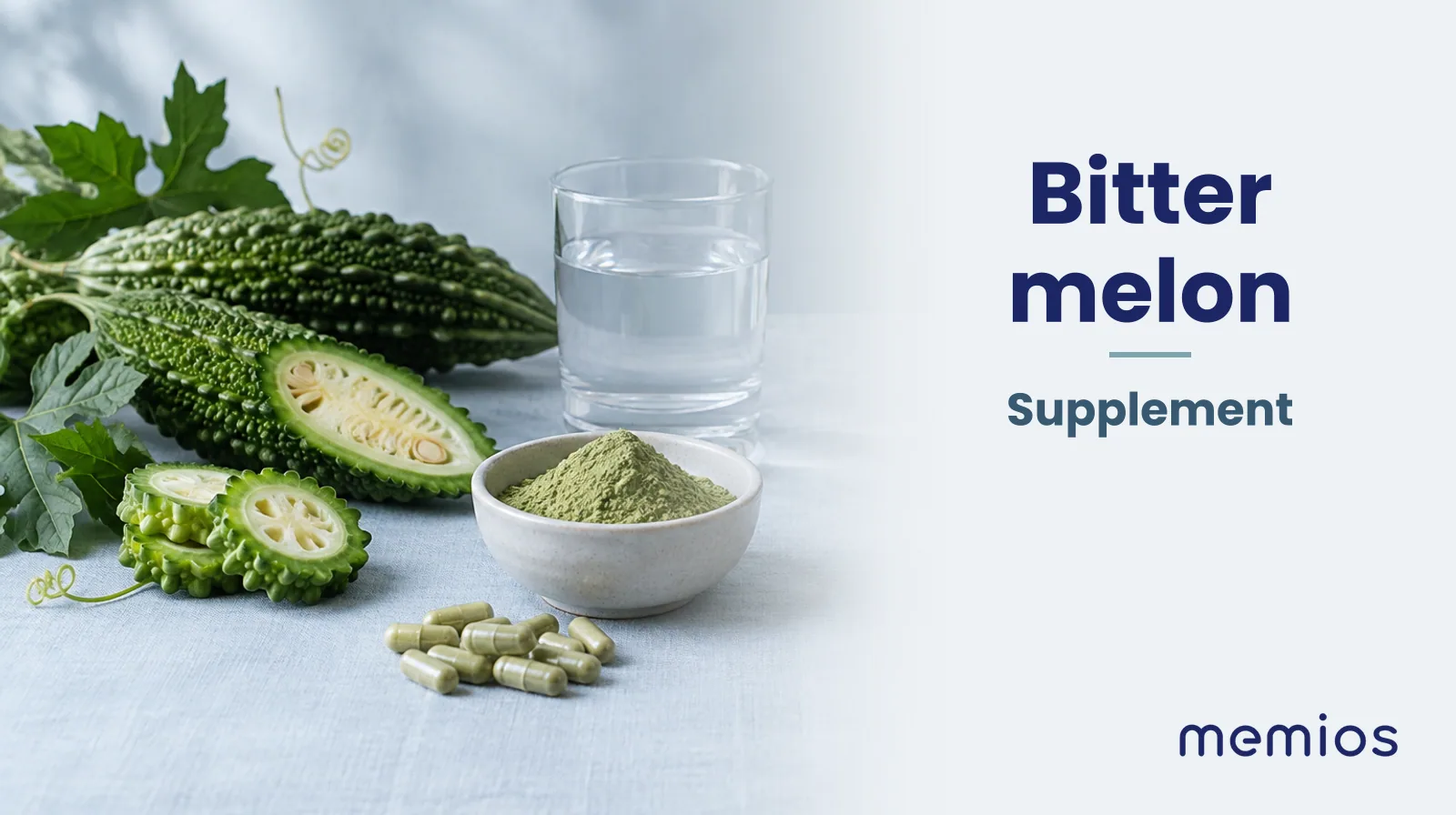
- What it is: Bitter melon is the fruit of Momordica charantia, a climbing vine in the gourd family Cucurbitaceae, grown across tropical and subtropical regions where the unripe fruit is eaten as a vegetable.
- Main use, supported: A GRADE-assessed meta-analysis of eight randomised trials in type 2 diabetes found significant reductions in fasting glucose, postprandial glucose, HbA1c and total cholesterol with Momordica charantia.
- Claim NOT supported by research: A 2023 systematic review and meta-analysis of nine trials found no significant effect of bitter melon over placebo on fasting glucose, HbA1c, lipids, body weight, BMI or blood pressure. (low certainty)
- Another claim NOT supported: The 2023 meta-analysis stated that its analyses were underpowered and the included trials too short to detect long-term metabolic effects, which is why its title says the metabolic effect cannot be determined. (low certainty)
- Recommended dose: not established. No recommended dietary allowance or adequate intake exists for bitter melon. It is a vegetable and traditional medicine, not an essential nutrient, so no body has set a reference intake and there is no deficiency state.
- Studied dose (a trial dose, not a recommendation): The four-week multicentre trial randomised patients to bitter melon 500 mg/day, 1000 mg/day or 2000 mg/day, or metformin 1000 mg/day. Findings citing that trial: 1 against, 1 mixed.
- Upper limit: We found no tolerable upper intake level or acceptable daily intake set for bitter melon by any body we could reach.
- What goes wrong: 5 findings on harm. A systematic review of harms across 17 randomised trials, published as a medRxiv preprint that has not been peer reviewed, found no evidence of harm in humans below 6 g a day of bitter melon products.
- Common myth: Bitter melon is a natural alternative to diabetes medication.
What it is
Bitter melon is the fruit of Momordica charantia, a climbing vine in the gourd family Cucurbitaceae, grown across tropical and subtropical regions where the unripe fruit is eaten as a vegetable. Beyond cooking, it has a long tradition of medicinal use, including for diabetes. Proposed active constituents include charantin, a mixture of two sterol glucosides, the insulin-like polypeptide p-insulin, and cucurbitane-type triterpenoids, but which of them accounts for any clinical effect has not been established.
What the research says
Bitter melon is taken chiefly for blood sugar, and the pooled evidence is split. A 2024 GRADE-assessed meta-analysis of eight trials in type 2 diabetes reported significant falls in fasting glucose, post-meal glucose, HbA1c and total cholesterol, while a 2023 meta-analysis of nine trials found no significant effect on any of fasting glucose, HbA1c, lipids, weight or blood pressure and said its analyses were underpowered and too short. The best comparative trial found a modest effect at 2000 mg a day only, and less than metformin 1000 mg a day. A systematic review of harms - available only as a medRxiv preprint that has not been peer reviewed - found no evidence of harm below 6 g a day of solid preparations, but the serious case reports involve liquid forms, including two young children who fell into hypoglycaemic coma after drinking tea made from the leaves.
Evidence grade: Disputed.
What goes wrong
A systematic review of harms across 17 randomised trials, published as a medRxiv preprint that has not been peer reviewed, found no evidence of harm in humans below 6 g a day of bitter melon products, but noted that the case reports of serious harm involved liquid forms. (Source 1)
- Systematic review, Very low certainty.
- Size: 17 trials met the inclusion criteria.
- Who: adults taking Momordica charantia derived products in randomised controlled trials.
- How long: trials searched to December 2020.
- Result: incidence rate ratios for any adverse event ranged from 0.30 (95% CI 0.12 to 0.75) to 13.00 (95% CI 0.73 to 230.76)
- Funding: not stated; preprint, not peer reviewed.
Limit of this finding: This review exists only as a medRxiv preprint: it has not been peer reviewed or published in a journal, so its methods and numbers have had no independent editorial check. Treat "no evidence of harm" as no harm detected in short trials rather than as a demonstration of safety.
Under a daily dosage of 6g of MC-derived products no evidence was seen of harms in humans. In case reports that showed serious harm, MC was used in a liquid form.
The same harms review, a medRxiv preprint that has not been peer reviewed, reported wide and imprecise incidence rate ratios for adverse events across trials, with one study's upper confidence limit above 230. (Source 1)
- Systematic review, Very low certainty.
- Size: 17 randomised controlled trials.
- Who: adults taking Momordica charantia derived products.
- How long: trials searched to December 2020.
- Result: IRR range 0.30 (95% CI 0.12 to 0.75) to 13.00 (95% CI 0.73 to 230.76)
- Funding: not stated; preprint, not peer reviewed.
Limit of this finding: The source is a medRxiv preprint that has not been peer reviewed. The intervals it reports are so wide that they show mainly that the trials were too small to measure adverse-event rates, not that any particular rate is real.
Seventeen trials met the inclusion criteria. The IRR was calculated for each study ranging from 0.30 (95% CI = 0.12 to 0.75) to 13.00 (95% CI = 0.73 to 230.76) of any adverse events.
A published case report, as summarised in a medRxiv preprint systematic review of harms that has not been peer reviewed, describes two young children falling into hypoglycaemic coma after drinking tea made from bitter melon leaves. (Source 2)
- Case report, Very low certainty.
- Size: 2 children.
- Who: two young children given tea made from Momordica charantia leaves.
- How long: acute, after drinking the tea.
- Result: hypoglycaemic coma, described by the review as a potentially fatal reaction.
- Funding: not stated.
Limit of this finding: The case is quoted as the harms review reports it, and that review is a medRxiv preprint that has not been peer reviewed; the original 1988 case report was not obtained. The review does not give the children's ages, so no age should be stated.
There is a report of a potentially fatal reaction in two young children. They fell into hypoglycaemic coma after drinking tea of MC leaves
A further case, as summarised in the same medRxiv preprint harms review that has not been peer reviewed, describes a 42-year-old G6PD-deficient man presenting with fatigue, dark urine, fever, chills, vomiting and black stools after drinking bitter melon tea. (Source 3)
- Case report, Very low certainty.
- Size: 1 patient.
- Who: 42-year-old man with glucose-6-phosphate dehydrogenase deficiency taking Chinese bitter melon tea for hyperlipidaemia.
- How long: symptoms after 11 days of use prior to hospitalisation.
- Result: presentation consistent with haemolysis; the review notes G6PD deficiency means some drugs, foods and chemicals can trigger haemolysis.
- Funding: not stated.
Limit of this finding: The case is quoted as the harms review reports it, and that review is a medRxiv preprint that has not been peer reviewed; the original 2018 case report was not obtained.
A 42-year-old man admitted to the Emergency Department had complaints of fatigue, intermittent dark urine for 1 week, fever, chills, vomiting and loose black stools for 1 day.
In alloxan-induced diabetic mice, combining bitter gourd juice with metformin produced no significant additional glucose lowering, and twice-daily dosing was associated with hypoglycaemia and deaths; this is animal evidence, not a human finding. (Source 4)
- Animal study, Very low certainty.
- Size: groups of alloxan-induced diabetic mice.
- Who: diabetic mice, not humans.
- How long: 21 days of treatment.
- Result: no significant difference in blood glucose between groups versus negative control (p>0.05); twice-daily combination reported to induce hypoglycaemia and mouse deaths.
- Funding: not stated.
The use of bitter gourd once daily together with metformin is a better choice, while twice daily might induce hypoglycemia and mice death.
What the evidence supports
A GRADE-assessed meta-analysis of eight randomised trials in type 2 diabetes found significant reductions in fasting glucose, postprandial glucose, HbA1c and total cholesterol with Momordica charantia. (Source 5)
- Meta-analysis, Certainty not rated.
- Size: 8 trials, 423 patients with type 2 diabetes.
- Who: adults with type 2 diabetes mellitus.
- How long: not stated in the abstract.
- Result: FBG WMD -0.85 mmol/L (95%CI -1.44, -0.26; p = 0.005; I2 = 73.4%); PPG WMD -2.28 mmol/L (95%CI -3.35, -1.21; I2 = 66.9%); HbA1c WMD -0.38% (95%CI -0.53, -0.23; I2 = 37.6%); total cholesterol WMD -0.38 mmol/L (95%CI -0.70, -0.07; p = 0.017)
- Funding: not stated.
glycosylated hemoglobin A1c (HbA1c) (WMD: −0.38 %; 95%CI: −0.53, −0.23; p = 0.000; I2 = 37.6 %)
What the evidence does not support
The same meta-analysis found no significant effect on triglycerides, HDL or LDL cholesterol and called for higher-quality trials. (Source 5)
- Meta-analysis, Certainty not rated.
- Size: 8 trials, 423 patients with type 2 diabetes.
- Who: adults with type 2 diabetes mellitus.
- How long: not stated in the abstract.
- Result: no significant differences for triglyceride, HDL or LDL.
- Funding: not stated.
However, no significant differences were observed in terms of triglyceride (TG), high-density lipoprotein (HDL), and low-density lipoprotein (LDL).
A 2023 systematic review and meta-analysis of nine trials found no significant effect of bitter melon over placebo on fasting glucose, HbA1c, lipids, body weight, BMI or blood pressure. (Source 6)
- Meta-analysis, Low certainty.
- Size: 9 studies, 414 patients.
- Who: adults in randomised controlled trials of bitter melon for metabolic syndrome parameters.
- How long: 4 to 16 weeks.
- Result: fasting glucose MD -0.03 (95% CI -0.38 to 0.31; I2 = 34%); HbA1c MD -0.12 (95% CI -0.35 to 0.11; I2 = 56%); systolic BP MD 1.01 (95% CI -1.07 to 3.09); BMI MD -0.42 (95% CI -0.99 to 0.14; I2 = 95%)
- Funding: not stated.
Limit of this finding: One set of numbers in this paper is duplicated: its total cholesterol result (MD = -0.04; 95% CI -0.17 to 0.09; I2 = 66%) is printed with exactly the same estimate, interval and heterogeneity as the HDL result just before it, which is far more likely to be a copy-and-paste slip in the paper than a real coincidence. The claim above does not rest on that figure, and the total cholesterol number should not be relied on; the fasting glucose, HbA1c and liver and kidney marker results are unaffected.
no significant effect could be observed for bitter melon treatment over placebo on fasting blood glucose level (MD = -0.03; 95% CI: -0.38 to 0.31; I2 = 34%), HbA1c level (MD = -0.12; 95% CI: -0.35 to 0.11; I2 = 56%)
The 2023 meta-analysis stated that its analyses were underpowered and the included trials too short to detect long-term metabolic effects, which is why its title says the metabolic effect cannot be determined. (Source 6)
- Meta-analysis, Low certainty.
- Size: 9 studies, 414 patients.
- Who: adults in randomised controlled trials of bitter melon.
- How long: 4 to 16 weeks.
- Result: power described as overall low; follow-up too short.
- Funding: not stated.
Limit of this finding: One set of numbers in this paper is duplicated: its total cholesterol result (MD = -0.04; 95% CI -0.17 to 0.09; I2 = 66%) is printed with exactly the same estimate, interval and heterogeneity as the HDL result just before it, which is far more likely to be a copy-and-paste slip in the paper than a real coincidence. The claim above does not rest on that figure, and the total cholesterol number should not be relied on; the fasting glucose, HbA1c and liver and kidney marker results are unaffected.
However, the power was overall low and the meta-analyzed studies were also too short to reliably detect long-term metabolic effects.
The same trial concluded bitter melon's hypoglycaemic effect was less than that of metformin 1000 mg/day. (Source 7)
- Randomized trial, Low certainty.
- Size: 4 randomised groups in a multicentre trial.
- Who: patients with newly diagnosed type 2 diabetes.
- How long: 4 weeks.
- Result: modest hypoglycaemic effect at 2000 mg/day only, inferior to metformin 1000 mg/day.
- Funding: not stated.
However, the hypoglycemic effect of bitter melon was less than metformin 1000 mg/day.
NCCIH's position, last updated November 2023, is that research on herbal supplements for diabetes, bitter melon among them, has been limited in number, size and quality and has not proven any of them effective. (Source 8)
- Official position, Certainty not rated.
- Size: not applicable - agency summary.
- Who: people with diabetes considering herbal supplements.
- How long: not applicable.
- Result: no effectiveness established.
- Funding: US government agency.
research has been limited in the number, size, and quality of studies and hasn't proven that any of these herbal supplements are effective
Where the evidence is mixed
In a four-week randomised double-blind active-control trial, bitter melon at 500 and 1000 mg/day did not significantly lower fructosamine, and the 2000 mg/day effect was smaller than metformin 1000 mg/day. (Source 7)
- Randomized trial, Low certainty.
- Size: 4 randomised groups in a multicentre trial.
- Who: patients with newly diagnosed type 2 diabetes.
- How long: 4 weeks.
- Result: fructosamine change: metformin -16.8 (95% CI -31.2, -2.4 micromol/L); bitter melon 2000 mg/day -10.2 (95% CI -19.1, -1.3); 1000 mg/day -10.3 (95% CI -22.7, 2.2); 500 mg/day -3.5 (95% CI -11.7, 4.6)
- Funding: not stated.
Bitter melon 500 and 1000 mg/day did not significantly decrease fructosamine levels (−3.5; 95% CI −11.7, 4.6 and −10.3; 95% CI −22.7, 2.2 μmol/L, respectively).
In the 2023 meta-analysis, bitter melon did not change ALT, AST or creatinine compared with placebo, which the authors read as supporting its safety over the short trial durations studied. (Source 6)
- Meta-analysis, Low certainty.
- Size: 9 studies, 414 patients.
- Who: adults in randomised controlled trials of bitter melon.
- How long: 4 to 16 weeks.
- Result: no notable change in ALT, AST or creatinine versus placebo.
- Funding: not stated.
Limit of this finding: One set of numbers in this paper is duplicated: its total cholesterol result (MD = -0.04; 95% CI -0.17 to 0.09; I2 = 66%) is printed with exactly the same estimate, interval and heterogeneity as the HDL result just before it, which is far more likely to be a copy-and-paste slip in the paper than a real coincidence. The claim above does not rest on that figure, and the total cholesterol number should not be relied on; the fasting glucose, HbA1c and liver and kidney marker results are unaffected.
Momordica treatment was not associated with a notable change in ALT, AST, and creatinine levels compared to the placebo, which supports the safety of this plant.
The compounds responsible for bitter melon's reported antidiabetic effects have not been adequately identified, and much of the supporting work is in vitro or in animals. (Source 9)
- Expert review, not systematic, Certainty not rated.
- Size: not applicable - mini review of isolated compounds and quality control methods.
- Who: in vitro systems, animal models and bitter gourd preparations.
- How long: not applicable.
- Result: no human effect estimate; charantin and p-insulin concentrations or bioavailability said to be too low to explain observed effects.
- Funding: not stated.
Its antidiabetic properties and its beneficial effects on blood glucose and lipid concentrations have been reported in numerous in vitro and in vivo studies, but the compounds responsible for the observed effects have not yet been adequately described.
Where the research disagrees
Whether bitter melon lowers blood glucose and HbA1c in type 2 diabetes
- Authors of the 2024 GRADE-assessed meta-analysis in Heliyon, meta-analysis of 8 RCTs, 423 patients, with Hartung-Knapp adjustment: glycosylated hemoglobin A1c (HbA1c) (WMD: −0.38 %; 95%CI: −0.53, −0.23; p = 0.000; I2 = 37.6 %) (Source 5)
- Authors of the 2023 meta-analysis in Frontiers in Nutrition, meta-analysis of 9 RCTs, 414 patients, change-score analysis: no significant effect could be observed for bitter melon treatment over placebo on fasting blood glucose level (MD = -0.03; 95% CI: -0.38 to 0.31; I2 = 34%), HbA1c level (MD = -0.12; 95% CI: -0.35 to 0.11; I2 = 56%) (Source 6)
How safe bitter melon preparations are
- Authors of the systematic review of possible harms, systematic review of harms across 17 RCTs, plus published case reports; a medRxiv preprint that has not been peer reviewed: Under a daily dosage of 6g of MC-derived products no evidence was seen of harms in humans. In case reports that showed serious harm, MC was used in a liquid form. (Source 1)
- Authors of the case report of paediatric hypoglycaemic coma cited in that review, case report of two children, as summarised in a medRxiv preprint that has not been peer reviewed: There is a report of a potentially fatal reaction in two young children. They fell into hypoglycaemic coma after drinking tea of MC leaves (Source 2)
How much
- Reference intake: No recommended dietary allowance or adequate intake exists for bitter melon. It is a vegetable and traditional medicine, not an essential nutrient, so no body has set a reference intake and there is no deficiency state. (Source 9)
- Upper limit: We found no tolerable upper intake level or acceptable daily intake set for bitter melon by any body we could reach. The nearest quantified safety threshold in the literature is the harms systematic review's observation that below a daily dose of 6 g of Momordica charantia derived products no evidence of harm in humans was seen; that review is a medRxiv preprint and has not been peer reviewed, and it is not a limit set by any authority. (Source 1)
- Studied: The four-week multicentre trial randomised patients to bitter melon 500 mg/day, 1000 mg/day or 2000 mg/day, or metformin 1000 mg/day. (Source 7)
- Studied: The 2023 meta-analysis pooled nine randomised trials totalling 414 patients with 4 to 16 weeks of follow-up. (Source 6)
A common belief, and what the research shows
The belief: Bitter melon is a natural alternative to diabetes medication.
What the research shows: The one trial that compared them head to head found the opposite: "However, the hypoglycemic effect of bitter melon was less than metformin 1000 mg/day.", and in that trial "Bitter melon 500 and 1000 mg/day did not significantly decrease fructosamine levels (−3.5; 95% CI −11.7, 4.6 and −10.3; 95% CI −22.7, 2.2 μmol/L, respectively)." Whether it works at all is contested: one 2024 meta-analysis found a significant HbA1c reduction, while a 2023 meta-analysis reported that "no significant effect could be observed for bitter melon treatment over placebo on fasting blood glucose level (MD = -0.03; 95% CI: -0.38 to 0.31; I2 = 34%), HbA1c level (MD = -0.12; 95% CI: -0.35 to 0.11; I2 = 56%)" and that "However, the power was overall low and the meta-analyzed studies were also too short to reliably detect long-term metabolic effects." The systematic review of harms is a medRxiv preprint that has not been peer reviewed. The serious harms on record are hypoglycaemic, which is exactly the hazard of treating it as a free add-on to glucose-lowering drugs.
Questions and answers
What is it?
Bitter melon is the fruit of Momordica charantia, a gourd-family vine grown widely in tropical and subtropical regions, where the unripe fruit is eaten as a vegetable. It is intensely bitter. Supplements are made from the fruit, seeds or leaves, as powders, extracts or juices. (Source 9)
What does it do in the body?
Its best-studied claimed action is lowering blood glucose. A GRADE-assessed meta-analysis of eight trials in type 2 diabetes reported reductions in fasting and post-meal glucose, HbA1c and total cholesterol, but a separate meta-analysis of nine trials found no significant effect at all. Which compounds would be responsible has not been established. (Source 5)
Is it good or bad for you?
As a vegetable it is food, and across randomised trials solid preparations below about 6 g a day showed no evidence of harm, although that finding comes from a systematic review that exists only as a medRxiv preprint and has not been peer reviewed. The serious reported injuries involve liquid forms, especially teas and juices, and the mechanism is the same one people take it for: dropping blood glucose. Children and people who are G6PD-deficient appear in the worst case reports. (Source 1)
How do you get more of it?
Eating the unripe fruit as a vegetable is the traditional route; supplements supply concentrated fruit extract. The trial that tested doses head to head against metformin used 500, 1000 or 2000 mg a day of bitter melon for four weeks. Those are the amounts studied, not a recommendation. (Source 7)
If it is harmful, what reduces it?
Nothing in the literature describes removing bitter melon from the body; the harm literature is about avoidance and form. Serious cases clustered in liquid preparations rather than standardised solid products, and the review that reports this - a medRxiv preprint that has not been peer reviewed - links safety to production under strict quality standards. Stopping intake is what the case reports describe. (Source 1)
Why might someone be low in it or missing it?
This does not apply as a deficiency. Bitter melon is a vegetable and a traditional medicine, not a nutrient the body needs, so no one is short of it in a medical sense. Low intake simply reflects cuisine and availability. (Source 9)
Which whole foods contain it or feed it?
The whole food is the fruit itself, eaten unripe as a vegetable in South and East Asian, African and Caribbean cooking, often sliced and stir-fried, stuffed or curried. Young leaves and shoots are also eaten and are the part used for the teas that appear in the serious case reports. (Source 9)
What happens if you do not have it?
Nothing is known to happen: there is no deficiency state and no demonstrated loss. The stronger way to put it is that one meta-analysis of nine trials with 414 patients could not detect any metabolic effect of taking it, so the consequence of not taking it is, on that evidence, unmeasurable. (Source 6)
How can you test for it?
There is no test for bitter melon status; nothing in the literature we searched measures it in the body. What trials do measure is effects and safety markers, namely glucose, HbA1c, liver enzymes ALT and AST, and creatinine, and in the pooled trials those liver and kidney markers did not change. Those are outcome tests, not tests for the plant. (Source 6)
We searched: Searched for Momordica charantia biomarkers, charantin or momordicoside measurement in blood or urine, and checked the 2024 GRADE-assessed meta-analysis, the 2023 Frontiers meta-analysis, the harms systematic review and the 2022 quality-control mini review; none describes a validated human test for bitter melon status or intake.
References
- medRxiv preprint (not peer reviewed). Possible harms of Momordica charantia L. in humans; a systematic review. 2022. DOI 10.1101/2022.10.22.22281390. Read the source
- medRxiv preprint (not peer reviewed). Possible harms of Momordica charantia L. in humans; a systematic review - case report of hypoglycaemic coma in two children. 2022. DOI 10.1101/2022.10.22.22281390. Read the source
- medRxiv preprint (not peer reviewed). Possible harms of Momordica charantia L. in humans; a systematic review - case report in a G6PD-deficient man. 2022. DOI 10.1101/2022.10.22.22281390. Read the source
- Molecular and Cellular Biomedical Sciences. Drug-Herb Interaction between Metformin and Momordica charantia in Diabetic Mice. 2019. DOI 10.21705/mcbs.v3i2.47. Read the source
- Heliyon. Effects of Momordica charantia L. supplementation on glycemic control and lipid profile in type 2 diabetes mellitus patients: A systematic review and meta-analysis of randomized controlled trials. 2024. Read the source
- Frontiers in Nutrition. The metabolic effect of Momordica charantia cannot be determined based on the available clinical evidence: a systematic review and meta-analysis of randomized clinical trials. 2024. DOI 10.3389/fnut.2023.1200801. Read the source
- Journal of Ethnopharmacology. Hypoglycemic effect of bitter melon compared with metformin in newly diagnosed type 2 diabetes patients. 2011. PMID 21211558. Read the source
- National Center for Complementary and Integrative Health (NCCIH), NIH. Diabetes and Dietary Supplements: What You Need To Know. 2023. Read the source
- Frontiers in Pharmacology. Momordica charantia L.-Diabetes-Related Bioactivities, Quality Control, and Safety Considerations. 2022. DOI 10.3389/fphar.2022.904643. Read the source