Supplements · September 29, 2026 · Memios · 16 min read
Berberine
Limited evidence. The trial literature is real but thin and mostly low quality.
TLDR
- Limited evidence. The trial literature is real but thin and mostly low quality.
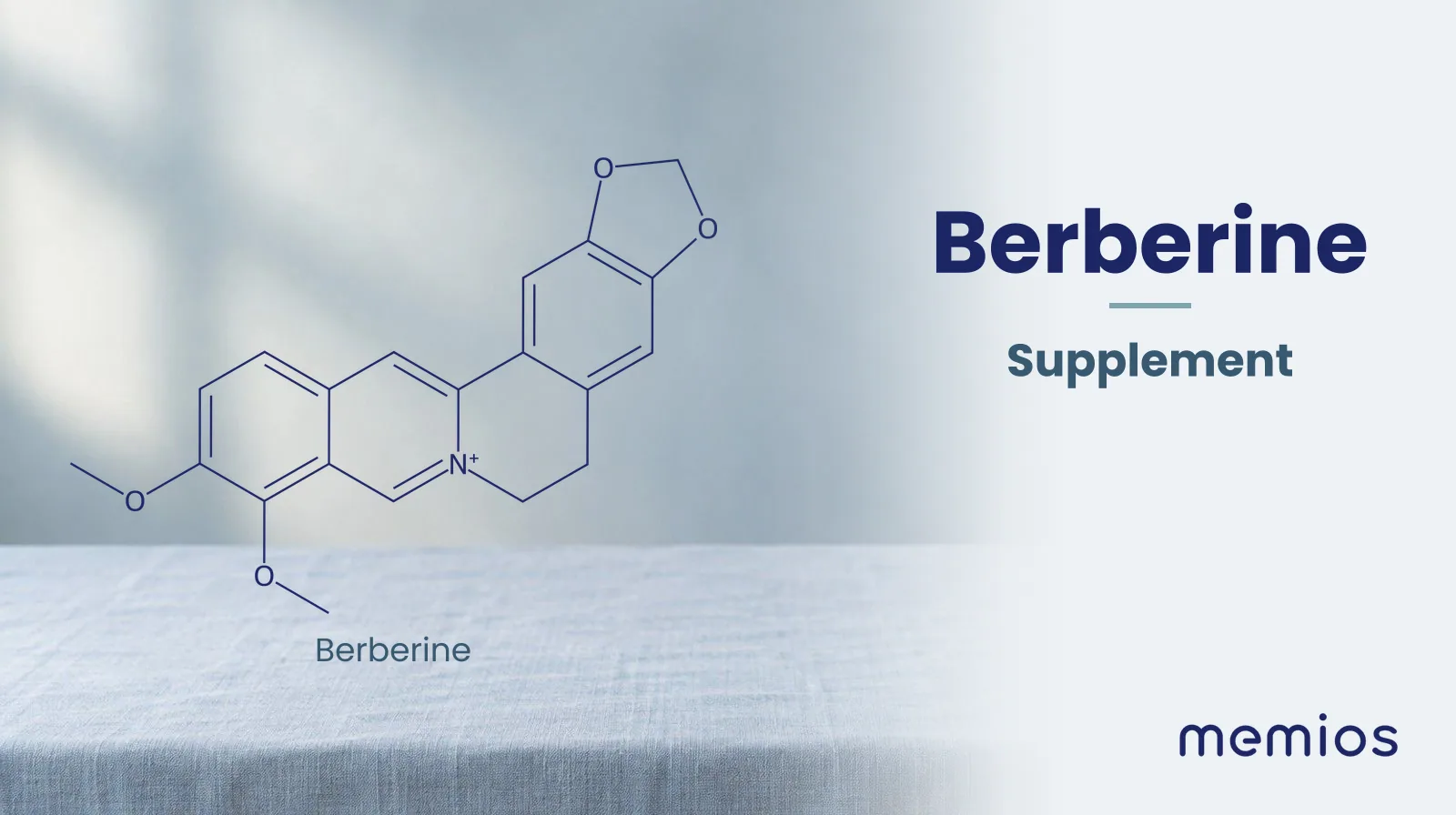
- What it is: Berberine is a plant alkaloid rather than a nutrient: an overview of systematic reviews describes it as "an isoquinoline alkaloid isolated from Chinese herb coptis chinensis and other berberis plants".
- Main use, supported: A meta-analysis of 37 randomised trials found berberine lowered HbA1c by about 0.63 percentage points and fasting glucose by about 0.82 mmol/L in type 2 diabetes. (low certainty)
- Claim NOT supported by research: A dose-response meta-analysis found berberine produced no significant change in body weight, despite small reductions in BMI and waist circumference. (low certainty)
- Recommended dose: not established. No reference intake (RDA or AI) exists for berberine, because it is a plant alkaloid rather than an essential nutrient. NCCIH describes it as "a substance found in a variety of plants, including goldenseal, barberry, Oregon grape, and others."
- Studied dose (a trial dose, not a recommendation): Berberine 0.5 g three times daily for 3 months, against metformin 0.5 g three times daily, in 36 adults with newly diagnosed type 2 diabetes (study A) Findings citing that trial: 1 mixed, 1 on harm.
- Upper limit: No tolerable upper intake level or acceptable daily intake has been set by EFSA, the US Institute of Medicine or NIH for berberine.
- What goes wrong: 4 findings on harm. In a two-week crossover study in healthy men, berberine reduced the activity of three cytochrome P450 enzymes, increasing midazolam exposure by about 40%.
- Common myth: Berberine is "nature's Ozempic" — a natural equivalent of a GLP-1 weight-loss drug.
What it is
Berberine is a plant alkaloid rather than a nutrient: an overview of systematic reviews describes it as "an isoquinoline alkaloid isolated from Chinese herb coptis chinensis and other berberis plants". The US National Center for Complementary and Integrative Health states that it is "a substance found in a variety of plants, including goldenseal, barberry, Oregon grape, and others." Supplements typically supply berberine hydrochloride; trials have used 300 mg to 500 mg taken two or three times a day.
What the research says
The trial literature is real but thin and mostly low quality. Pooled randomised data do show glucose lowering in type 2 diabetes of roughly the size seen with a modest drug dose, but the largest overview of this literature rated 45 of 54 systematic reviews as critically low quality on AMSTAR-2, and most trials are small, short and run in China. For weight specifically — the "natural Ozempic" claim — the pooled evidence is weaker than for glucose: one dose-response meta-analysis found a small BMI reduction but no significant change in body weight at all. Berberine also measurably inhibits several drug-metabolising enzymes in humans, which is a practical safety problem rather than a theoretical one.
Evidence grade: Limited evidence.
What goes wrong
In a two-week crossover study in healthy men, berberine reduced the activity of three cytochrome P450 enzymes, increasing midazolam exposure by about 40%. (Source 1)
- Randomized trial, Moderate certainty.
- Size: healthy male subjects in a two-phase randomised crossover study (number not stated in abstract)
- Who: healthy male volunteers.
- How long: 2 weeks of berberine 300 mg three times daily per phase.
- Result: urinary dextromethorphan/dextrorphan increased ninefold (P < 0.01); losartan/E-3174 ratio doubled (P < 0.01); midazolam Cmax +38% (P < 0.05), AUC0–∞ +40% (P < 0.01), AUC0–12 +37% (P < 0.05); midazolam oral clearance decreased 27% (P < 0.05)
- Funding: not stated.
Limit of this finding: The published abstract of this study reports midazolam's time to peak concentration and half-life in a way that looks swapped: it gives about 3 hours for the time to peak and under 1 hour for the half-life, whereas midazolam normally peaks within about an hour and has a half-life of around 3 hours. Those two sets of numbers should not be relied on or repeated until checked against the paper's full data tables. The main findings, that berberine raised midazolam exposure (peak level up 38%, total exposure up about 40%) and cut its clearance by 27%, are not affected.
Repeated administration of berberine (300 mg, t.i.d., p.o.) decreased CYP2D6, 2C9, and CYP3A4 activities. Drug-drug interactions should be considered when berberine is administered.
In renal transplant recipients, adding berberine to cyclosporin A raised cyclosporin blood levels and drug exposure. (Source 2)
- Blood level study, Moderate certainty.
- Size: 52 renal-transplant recipients on berberine plus cyclosporin versus 52 on cyclosporin alone; plus a 6-patient pharmacokinetic substudy.
- Who: renal transplant recipients taking cyclosporin A.
- How long: 3 months (clinical arm); 12 days (pharmacokinetic substudy)
- Result: final CsA trough concentrations and concentration/dose ratios 29.3% and 27.8% higher than in berberine-free patients (P<0.05); mean CsA AUC increased 34.5% (P<0.05); CL/F decreased 40.4% (P<0.05)
- Funding: not stated.
Nevertheless, the final blood concentrations and the ratios of concentration/dose of CsA in BBR-treated patients were still 29.3% and 27.8%, respectively, higher than those in BBR-free patients (P<0.05).
In an early pilot trial, 20 patients taking berberine had transient gastrointestinal side effects; the paper's accompanying percentage does not match any group size it reports. (Source 3)
- Randomized trial, Low certainty.
- Size: 36 adults randomised in study A; 48 adults in the single-arm study B (the denominator for the side-effect figures is not stated)
- Who: adults with newly diagnosed or poorly controlled type 2 diabetes in China.
- How long: 3 months (13 weeks)
- Result: 20 patients had transient gastrointestinal adverse effects (the paper gives this as 34.5%, a figure that does not match any stated group size); some patients needed a dose reduction from 0.5 g t.i.d. to 0.3 g t.i.d.
- Funding: not stated.
Limit of this finding: The paper reports '20 (34.5%) patients' with gastrointestinal side effects, but 20 is 34.5% of 58, and 58 matches none of the group sizes the paper gives (36 in study A, 48 in study B, 84 in total). The count of 20 is what the paper states; the percentage cannot be checked against a stated denominator, so it should not be read as the share of all participants or of all berberine takers. The trial was also small and short, and study A compared berberine with metformin rather than placebo.
During the trial, 20 (34.5%) patients suffered from transient gastrointestinal adverse effects.
NCCIH warns that berberine exposure has been linked to bilirubin build-up in infants and that it interacts with cyclosporine. (Source 4)
- Official position, Certainty not rated.
- Size: not applicable.
- Who: infants, pregnant and breastfeeding people, and people taking medicines.
- How long: not applicable.
- Result: no numbers given; qualitative safety statement.
- Funding: US government agency (NCCIH)
Exposure to berberine has been linked to a harmful buildup of bilirubin in infants, which can cause brain damage.
What the evidence supports
A meta-analysis of 37 randomised trials found berberine lowered HbA1c by about 0.63 percentage points and fasting glucose by about 0.82 mmol/L in type 2 diabetes. (Source 5)
- Meta-analysis, Low certainty.
- Size: 3,048 patients across 37 randomised controlled trials.
- Who: adults with type 2 diabetes mellitus.
- How long: trials published up to November 2021; individual trial durations varied.
- Result: FPG WMD = -0.82 mmol/L, 95% CI (-0.95, -0.70); HbA1c WMD = -0.63%, 95% CI (-0.72, -0.53); 2hPBG WMD = -1.16 mmol/L, 95% CI (-1.36, -0.96)
- Funding: not stated.
Limit of this finding: This paper's summary contains an internal contradiction about side effects. It says berberine 'did not significantly increase' total adverse events, but the figures it gives (risk ratio 0.73, 95% confidence interval 0.55 to 0.97, p = 0.03) describe a statistically significant decrease in adverse events, not merely no difference. A reader should not conclude that berberine reduces side effects, because the result may reflect how side effects were recorded in the small, mostly Chinese trials pooled here, and should not conclude that side effects were shown to be the same as control either. The safe reading is only that these trials did not find more side effects with berberine. The glucose-lowering figures quoted above are not affected by this inconsistency.
Thirty-seven studies involving 3,048 patients were included in the meta-analysis. The results showed that berberine could reduce FPG (WMD = -0.82 mmol/L, 95% CI (-0.95, -0.70)), HbA1c (WMD = -0.63%, 95% CI (-0.72, -0.53)), and 2hPBG (WMD = -1.16 mmol/L, 95% CI (-1.36, -0.96)), with all results being statistically significant.
What the evidence does not support
A dose-response meta-analysis found berberine produced no significant change in body weight, despite small reductions in BMI and waist circumference. (Source 6)
- Meta-analysis, Low certainty.
- Size: 10 clinical trials.
- Who: human subjects in trials of berberine supplementation; populations varied.
- How long: databases searched to February 2019; trial durations varied.
- Result: Body weight WMD: -0.11 kg, 95% CI: -0.99 to 0.76, p = 0.79; BMI WMD: -0.29 kg/m2, 95% CI: -0.51 to -0.08, p = 0.006; waist circumference WMD: -2.75 cm, 95% CI: -4.88 to -0.62, p = 0.01.
- Funding: not stated.
However, berberine supplementation yielded no significant decline in body weight (BW) (WMD: −0.11 kg, 95% CI: −0.99 to 0.76, p = 0.79).
Where the evidence is mixed
The largest overview of systematic reviews of berberine rated almost all of the underlying reviews as very low methodological quality and most outcomes as low-quality evidence. (Source 7)
- Review of reviews, Very low certainty.
- Size: 54 systematic reviews covering 70 health outcomes across 9 diseases.
- Who: people with chronic diseases including type 2 diabetes, cardiovascular disease, PCOS, NAFLD, schizophrenia, metabolic syndrome, obesity and dyslipidaemia.
- How long: databases searched from inception to 11 April 2024.
- Result: 1 review high quality, 8 low, 45 very low on AMSTAR-2; on GRADE 8 outcomes high, 22 moderate, 110 low quality; berberine improved 92.59% (25/27) of type 2 diabetes outcomes but only 57.14% (4/7) of obesity outcomes.
- Funding: not stated.
Only one SR was rated as high quality while eight SRs were rated as low quality and forty-five SRs as very low quality according to AMSTAR-2.
The same overview reports berberine improved most diabetes outcomes but only about half of obesity outcomes, and cautions about the quality of the reviews it pooled. (Source 7)
- Review of reviews, Low certainty.
- Size: 54 systematic reviews, 70 outcomes.
- Who: people with chronic diseases.
- How long: reviews published up to April 2024.
- Result: 92.59% (25/27) type 2 diabetes outcomes improved; 57.14% (4/7) obesity outcomes improved; high overlap of primary studies (CCA > 15%) in obesity, PCOS, NAFLD and schizophrenia reviews.
- Funding: not stated.
Berberine has improved most outcomes of these diseases: 78% (25/32) cardiovascular disease outcomes, 92.59% (25/27) type 2 diabetes mellitus outcomes
The overview's own authors qualify their positive conclusion by pointing to the poor quality of the reviews behind it. (Source 8)
- Review of reviews, Very low certainty.
- Size: 54 systematic reviews.
- Who: people with chronic diseases.
- How long: not applicable.
- Result: no pooled effect reported in the conclusion; a narrative caution.
- Funding: not stated.
However, caution is needed considering the shortcomings in the quality of the relevant system reviews included.
The same pilot trial was very small and compared berberine against metformin rather than placebo. (Source 3)
- Randomized trial, Very low certainty.
- Size: 36 adults in study A.
- Who: adults with newly diagnosed type 2 diabetes.
- How long: 3 months.
- Result: HbA1c fell from 9.5% ± 0.5% to 7.5% ± 0.4%, P<0.01; FBG from 10.6 ± 0.9 mmol/L to 6.9 ± 0.5 mmol/L, P<0.01.
- Funding: not stated.
Limit of this finding: The paper reports '20 (34.5%) patients' with gastrointestinal side effects, but 20 is 34.5% of 58, and 58 matches none of the group sizes the paper gives (36 in study A, 48 in study B, 84 in total). The count of 20 is what the paper states; the percentage cannot be checked against a stated denominator, so it should not be read as the share of all participants or of all berberine takers. The trial was also small and short, and study A compared berberine with metformin rather than placebo.
In study A, 36 adults with newly diagnosed type 2 diabetes were randomly assigned to treatment with berberine or metformin (0.5 g t.i.d.) in a 3-month trial.
What official bodies say
NCCIH says the weight-loss review it cites was built largely on high-risk-of-bias studies with inconsistent results. (Source 9)
- Official position, Certainty not rated.
- Size: a 2022 review of 18 studies of body weight and 23 of BMI.
- Who: adults, mostly with diabetes or fatty liver disease, mostly in Asian countries.
- How long: effects on weight seen mainly with more than 8 weeks of use.
- Result: no pooled figures given on the page; effects seen mainly at doses above 1 gram per day.
- Funding: US government agency (National Center for Complementary and Integrative Health), page current as of the date fetched.
Many of the studies included in this review had a high risk of bias, and the outcomes of individual studies were inconsistent.
Where the research disagrees
Whether the berberine literature is strong enough to support the claims made for it
- Authors of the 2025 overview of 54 systematic reviews, umbrella review of systematic reviews: "Current evidence suggests that berberine has beneficial effects on a range of health outcomes for people with chronic diseases." (Source 8)
- US National Center for Complementary and Integrative Health, government position statement summarising a 2022 review: "Therefore, additional, high-quality research would be needed to allow definite conclusions to be reached about whether berberine reduces weight and BMI." (Source 9)
How much
- Reference intake: No reference intake (RDA or AI) exists for berberine, because it is a plant alkaloid rather than an essential nutrient. NCCIH describes it as "a substance found in a variety of plants, including goldenseal, barberry, Oregon grape, and others." (Source 10)
- Upper limit: No tolerable upper intake level or acceptable daily intake has been set by EFSA, the US Institute of Medicine or NIH for berberine. NCCIH instead gives a qualitative warning: "Therefore, berberine is likely to be unsafe for infants and may also be unsafe for use during pregnancy or while breastfeeding because of possible effects on the fetus or infant." (Source 4)
- Studied: Berberine 0.5 g three times daily for 3 months, against metformin 0.5 g three times daily, in 36 adults with newly diagnosed type 2 diabetes (study A) (Source 3)
- Studied: Berberine 300 mg three times daily by mouth for 2 weeks in healthy men in the cytochrome P450 probe study (Source 1)
- Studied: Berberine 0.2 g three times daily for 3 months alongside cyclosporin A in renal transplant recipients (Source 11)
- Studied: NCCIH notes weight effects were "seen primarily in people who took berberine in doses of more than 1 gram per day and for more than 8 weeks." (Source 9)
A common belief, and what the research shows
The belief: Berberine is "nature's Ozempic" — a natural equivalent of a GLP-1 weight-loss drug.
What the research shows: The pooled randomised evidence does not show weight loss. The dose-response meta-analysis of 10 trials reported that "berberine supplementation yielded no significant decline in body weight (BW) (WMD: −0.11 kg, 95% CI: −0.99 to 0.76, p = 0.79)." It found a BMI change of −0.29 kg/m2 — a fraction of a BMI point. NCCIH adds that "Many of the studies included in this review had a high risk of bias, and the outcomes of individual studies were inconsistent." The glucose-lowering signal is better supported than the weight signal, but the overview of this whole literature found that "Only one SR was rated as high quality while eight SRs were rated as low quality and forty-five SRs as very low quality according to AMSTAR-2."
Questions and answers
What is it?
Berberine is a plant alkaloid found in several medicinal plants, including goldenseal, barberry and Oregon grape. It is sold as a supplement, often as berberine hydrochloride. It is not a nutrient. (Source 12)
What does it do in the body?
Laboratory and animal studies suggest berberine activates AMPK, a cellular energy sensor involved in how fat and sugar are handled. Very little is absorbed from the gut: bioavailability is under 1%, with much broken down by the liver's CYP2D6 and CYP1A2 enzymes. That makes drug interactions plausible. These mechanisms have not been shown directly in people. (Source 13)
Is it good or bad for you?
In type 2 diabetes, a 2022 meta-analysis of 37 randomised trials (3,048 patients) found that berberine lowered fasting glucose by 0.82 mmol/L and HbA1c by 0.63 percentage points. The authors rated most trials as moderate quality because allocation concealment and blinding were poorly reported. Harms are covered under getRidOf. (Source 14)
How do you get more of it?
Berberine is taken as a supplement or in herbal products. One small 12-week pilot trial in 34 adults with prediabetes gave 500 mg three times a day. That trial was funded by the investigators' university. (Source 15)
If it is harmful, what reduces it?
Berberine is not made by the body, so this is about harm from taking it. NCCIH reports stomach and bowel side effects and an interaction with the transplant drug cyclosporine. It also reports a link to a harmful build-up of bilirubin in infants. LiverTox says berberine has not been linked to clinically apparent liver injury. (Source 16)
Why might someone be low in it or missing it?
Does not apply. Berberine is a plant compound, not something the body makes or needs, so no one is deficient in it. (Source 13)
Which whole foods contain it or feed it?
Berberine is not a meaningful part of ordinary foods. It comes from medicinal plants such as goldenseal, barberry and Oregon grape, taken as herbal preparations or supplements. (Source 16)
What happens if you do not have it?
Does not apply. Berberine is not an essential nutrient, and no deficiency state is described in the literature searched. (Source 13)
We searched: WebSearch for berberine reviews, the NCCIH berberine page, LiverTox berberine entry and a 2025 review in European Journal of Medical Research; none describes berberine as essential or any deficiency state.
How can you test for it?
No clinical test for berberine 'status' exists, and none is needed. Research labs can measure berberine in blood plasma with liquid chromatography-mass spectrometry, down to 0.020 ng/mL. This is used in pharmacokinetic studies, not for diagnosis. (Source 17)
References
- European Journal of Clinical Pharmacology. Repeated administration of berberine inhibits cytochromes P450 in humans. 2012. PMID 21870106, DOI 10.1007/s00228-011-1108-2. Read the source
- European Journal of Clinical Pharmacology. Effects of berberine on the blood concentration of cyclosporin A in renal transplanted recipients: clinical and pharmacokinetic study. 2005. PMID 16133554, DOI 10.1007/s00228-005-0952-3. Read the source
- Metabolism: Clinical and Experimental. Efficacy of berberine in patients with type 2 diabetes mellitus. 2008. PMID 18442638, DOI 10.1016/j.metabol.2008.01.013. Read the source
- National Center for Complementary and Integrative Health (NIH). Berberine and Weight Loss: What You Need To Know. 2023. Read the source
- Frontiers in Pharmacology. Glucose-lowering effect of berberine on type 2 diabetes: A systematic review and meta-analysis. 2022. PMID 36467075, DOI 10.3389/fphar.2022.1015045. Read the source
- Complementary Therapies in Clinical Practice. The effect of berberine supplementation on obesity indices: A dose-response meta-analysis and systematic review of randomized controlled trials. 2020. PMID 32379652, DOI 10.1016/j.ctcp.2020.101113. Read the source
- BMC Complementary Medicine and Therapies. Berberine and health outcomes: an overview of systematic reviews. 2025. DOI 10.1186/s12906-025-04872-4. Read the source
- BMC Complementary Medicine and Therapies. Berberine and health outcomes: an overview of systematic reviews. 2025. DOI 10.1186/s12906-025-04872-4. Read the source
- National Center for Complementary and Integrative Health (NIH). Berberine and Weight Loss: What You Need To Know. 2023. Read the source
- National Center for Complementary and Integrative Health (NIH). Berberine and Weight Loss: What You Need To Know. 2023. Read the source
- European Journal of Clinical Pharmacology. Effects of berberine on the blood concentration of cyclosporin A in renal transplanted recipients: clinical and pharmacokinetic study. 2005. PMID 16133554, DOI 10.1007/s00228-005-0952-3. Read the source
- National Institute of Diabetes and Digestive and Kidney Diseases (NCBI Bookshelf). Berberine - LiverTox: Clinical and Research Information on Drug-Induced Liver Injury. 2020. Read the source
- European Journal of Medical Research. Berberine as a multi-target therapeutic agent for obesity: from pharmacological mechanisms to clinical evidence. 2025. DOI 10.1186/s40001-025-02738-6. Read the source
- Frontiers in Pharmacology. Glucose-lowering effect of berberine on type 2 diabetes: A systematic review and meta-analysis. 2022. DOI 10.3389/fphar.2022.1015045. Read the source
- BMC Endocrine Disorders. Efficacy and safety of HIMABERB® Berberine on glycemic control in patients with prediabetes: double-blind, placebo-controlled, and randomized pilot trial. 2023. DOI 10.1186/s12902-023-01442-y. Read the source
- National Center for Complementary and Integrative Health (NCCIH). Berberine and Weight Loss: What You Need To Know. 2023. Read the source
- Journal of Pharmaceutical and Biomedical Analysis. Determination of berberine in human plasma by liquid chromatography–electrospray ionization–mass spectrometry. 2007. PMID 17531424, DOI 10.1016/j.jpba.2007.03.022. Read the source