Supplements · September 30, 2026 · Memios · 9 min read
Banaba
Limited evidence. Banaba is sold for blood sugar and metabolic syndrome.
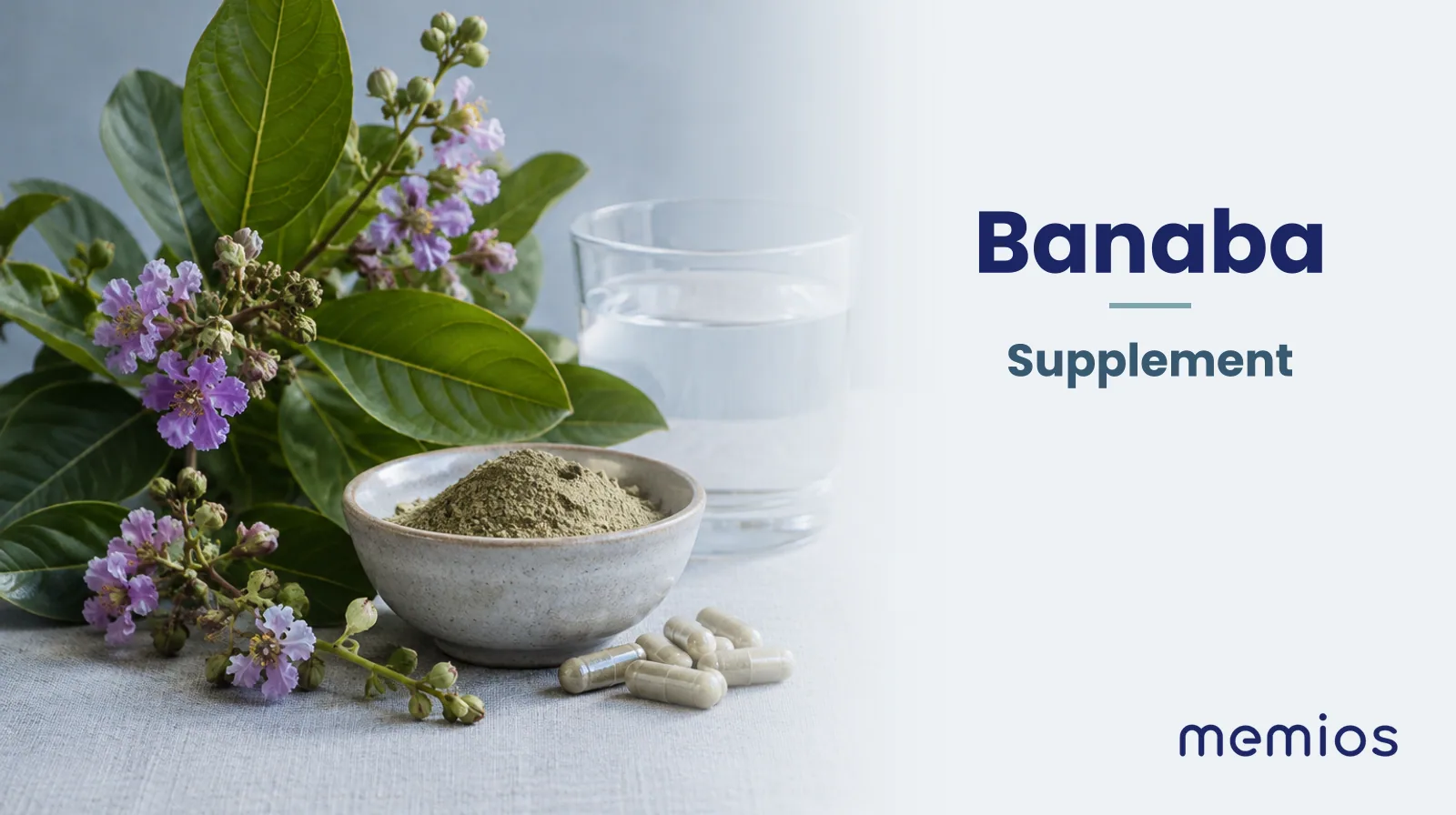
TLDR
- Limited evidence. Banaba is sold for blood sugar and metabolic syndrome.
- What it is: Banaba is a tropical tree whose leaves have been used in folk medicine to treat diabetes, with the first published research on it appearing in 1940.
- Main use, supported: A 12-week randomised, double-blind, placebo-controlled trial in 24 people with metabolic syndrome reported significant before-and-after falls in systolic blood pressure, fasting glucose, triglycerides. (low certainty)
- Other use, supported: A 2011 review reports that purified corosolic acid has been described as lowering blood sugar within an hour in human subjects, and attributes banaba's hypoglycaemic effects to corosolic acid and ellagitannins. (very low certainty)
- Claim NOT supported by research: That trial's headline results are within-group before-and-after changes in twelve people, and a change of similar kind appeared in the placebo group, so it does not establish an effect of banaba over placebo. (very low certainty)
- Recommended dose: not established. No reference intake exists. Banaba is a botanical used in folk medicine, not an essential nutrient, and no body has set a recommended intake for it.
- Studied dose (a trial dose, not a recommendation): 500 mg of banaba twice a day, before breakfast and dinner, for 12 weeks, in adults with metabolic syndrome. Findings citing that trial: 1 for, 1 against.
- Upper limit: No tolerable upper intake level or acceptable daily intake has been set by any body we could reach.
- What goes wrong: 1 finding on harm. A 2026 human liver organ-on-a-chip study found that Lagerstroemia speciosa leaf extracts reduced liver cell viability at medium-to-high concentrations and impaired albumin production even at low concentrations.
- Common myth: Banaba, or its active corosolic acid, is a proven natural alternative to diabetes medication.
What it is
Banaba is a tropical tree whose leaves have been used in folk medicine to treat diabetes, with the first published research on it appearing in 1940. Supplements are made from water-soluble leaf extracts, from extracts standardised to the triterpene corosolic acid, or from purified corosolic acid and ellagitannins. Research extracts have been prepared from both fresh and shed leaves.
What the research says
Banaba is sold for blood sugar and metabolic syndrome. The human evidence is thin: there is no meta-analysis with certainty ratings that we could find, the most cited review of the field was retracted by its journal, and the main recent randomised trial had only 24 people and reported its results as before-and-after changes within each arm rather than as differences between banaba and placebo. A 2026 laboratory study using a human liver organ-on-a-chip found reduced cell viability and impaired albumin production with Lagerstroemia speciosa leaf extract, which is a preclinical signal and not a human finding, but it sits awkwardly against older review claims that no adverse effects had been reported.
Evidence grade: Limited evidence.
What goes wrong
A 2026 human liver organ-on-a-chip study found that Lagerstroemia speciosa leaf extracts reduced liver cell viability at medium-to-high concentrations and impaired albumin production even at low concentrations, and the authors concluded liver function should be monitored in clinical studies of these extracts. (Source 1)
- Lab study in cells, Very low certainty.
- Size: not applicable - HepG2 cells in an organ-on-a-chip system and 2D cultures.
- Who: human hepatocyte-derived (HepG2) cells, not people.
- How long: 24 hours, and a separate 7-day exposure.
- Result: significant viability reductions at medium-to-high concentrations; albumin production impaired by L. speciosa fresh-leaf extract even at low concentrations; 7-day exposure further reduced viability and albumin production.
- Funding: not stated in the abstract.
This OOC study revealed the potential hepatotoxicity of Lagerstroemia extracts, suggesting that functional assessments of the liver may be required during clinical studies involving these extracts.
What the evidence supports
A 2011 review reports that purified corosolic acid has been described as lowering blood sugar within an hour in human subjects, and attributes banaba's hypoglycaemic effects to corosolic acid and ellagitannins. (Source 2)
- Expert review, not systematic, Very low certainty.
- Size: not stated - narrative summary of animal, human and in vitro studies.
- Who: mixed: animal models, human subjects and in vitro systems.
- How long: acute effects described within 60 minutes.
- Result: no pooled estimate; the review reports a fall in blood sugar within 60 min after pure corosolic acid.
- Funding: not stated in the abstract; a reviewer should check author affiliations, as this review's authors have supplement-industry connections.
Pure corosolic acid has been reported to decrease blood sugar levels within 60 min in human subjects.
A 12-week randomised, double-blind, placebo-controlled trial in 24 people with metabolic syndrome reported significant before-and-after falls in systolic blood pressure, fasting glucose, triglycerides, VLDL and insulin area under the curve in the banaba arm. (Source 3)
- Randomized trial, Low certainty.
- Size: 24 patients (12 banaba, 12 placebo)
- Who: patients meeting International Diabetes Federation criteria for metabolic syndrome.
- How long: 12 weeks.
- Result: SBP 121.5 +/- 12.9 to 116.3 +/- 9.8 mmHg (P = .050); FPG 5.9 +/- 0.4 to 5.7 +/- 0.4 mmol/L (P = .034); TG 2.3 +/- 0.4 to 1.7 +/- 0.5 mmol/L (P = .021); VLDL 0.5 +/- 0.1 to 0.3 +/- 0.1 mmol/L (P = .021); AUC insulin 50,675 +/- 14,309 to 37,983 +/- 19,298 (P = .017); 8 of 12 (67%) had remission of metabolic syndrome.
- Funding: not stated in the abstract.
After Banaba administration, there were significant decreases in systolic blood pressure (SBP) (121.5 ± 12.9 vs. 116.3 ± 9.8 mmHg, P = .050), FPG (5.9 ± 0.4 vs. 5.7 ± 0.4 mmol/L, P = .034), triglycerides (TG) (2.3 ± 0.4 vs. 1.7 ± 0.5 mmol/L, P = .021)
What the evidence does not support
That trial's headline results are within-group before-and-after changes in twelve people, and a change of similar kind appeared in the placebo group, so it does not establish an effect of banaba over placebo. (Source 3)
- Randomized trial, Very low certainty.
- Size: 24 patients (12 per arm)
- Who: patients with metabolic syndrome.
- How long: 12 weeks.
- Result: placebo group showed a downward trend toward significance in the Stumvoll insulin sensitivity index (910.3 +/- 514.1 vs 651.0 +/- 405.2, P = .062); no between-group comparison is reported in the abstract.
- Funding: not stated in the abstract.
In the placebo group, there was a downward trend toward statistical significance in the Stumvoll index (910.3 ± 514.1 vs. 651.0 ± 405.2, P = .062).
Where the research disagrees
Whether banaba has any demonstrated toxicity
- Stohs, Miller and Kaats, Phytotherapy Research 2011, narrative review of animal, human and in vitro studies published to 2011: No adverse effects have been observed or reported in animal studies or controlled human clinical trials. (Source 2)
- Thirapanmethee and colleagues, Scientific Reports 2026, in vitro human liver organ-on-a-chip with HepG2 cells, 24-hour and 7-day exposures: This OOC study revealed the potential hepatotoxicity of Lagerstroemia extracts, suggesting that functional assessments of the liver may be required during clinical studies involving these extracts. (Source 1)
How much
- Reference intake: No reference intake exists. Banaba is a botanical used in folk medicine, not an essential nutrient, and no body has set a recommended intake for it. (Source 2)
- Upper limit: No tolerable upper intake level or acceptable daily intake has been set by any body we could reach. A 2011 review stated that no adverse effects had been observed or reported in animal studies or controlled human trials, but a 2026 liver organ-on-a-chip study reported a hepatotoxicity signal, so no safe ceiling has been established. (Source 2)
- Studied: 500 mg of banaba twice a day, before breakfast and dinner, for 12 weeks, in adults with metabolic syndrome. (Source 3)
A common belief, and what the research shows
The belief: Banaba, or its active corosolic acid, is a proven natural alternative to diabetes medication.
What the research shows: The claim traces back largely to review articles rather than to large trials. The 2011 review does report that "Pure corosolic acid has been reported to decrease blood sugar levels within 60 min in human subjects." - but that is a narrative summary, not a pooled analysis. The most cited review making this case, Miura and colleagues' 2012 paper in Evidence-Based Complementary and Alternative Medicine, was retracted by the journal in 2013. The main recent randomised trial enrolled just 24 people and reported before-and-after changes within arms, noting that "In the placebo group, there was a downward trend toward statistical significance in the Stumvoll index (910.3 ± 514.1 vs. 651.0 ± 405.2, P = .062)."
Questions and answers
What is it?
Banaba is a tropical tree, Lagerstroemia speciosa, whose leaves are brewed or extracted for use as a herbal remedy. Its leaves have been used for many years in folk medicine to treat diabetes, and research on it dates back to 1940. The constituents credited with its effects are the triterpene corosolic acid and a group of polyphenols called ellagitannins. (Source 2)
What does it do in the body?
Laboratory and animal work suggests several ways banaba might affect glucose: increasing glucose uptake into cells, slowing the breakdown of sucrose and starch, and reducing glucose production in the liver. Reviews attribute the blood-sugar effect to corosolic acid and ellagitannins. These are proposed mechanisms, and the human evidence for a clinically useful effect remains small. (Source 2)
Is it good or bad for you?
The honest answer is that it is not established either way. The largest recent randomised trial had 24 participants and reported within-arm changes, with two-thirds of the banaba group no longer meeting metabolic syndrome criteria after 12 weeks. Against that, a 2026 laboratory study found a liver-toxicity signal for leaf extract in human liver cells, so the authors called for liver monitoring in future trials. (Source 3)
How do you get more of it?
Banaba is not part of an ordinary Western diet and is not made by the body. It is taken as a leaf tea or as a capsule of leaf extract, sometimes standardised to corosolic acid. In the main randomised trial participants took 500 mg twice a day before breakfast and dinner for 12 weeks. (Source 3)
If it is harmful, what reduces it?
Exposure ends when the supplement is stopped; banaba is not stored or produced by the body. Because a 2026 organ-on-a-chip study found reduced liver cell viability and impaired albumin production with leaf extract, its authors suggested that liver function be assessed during clinical studies of these extracts. (Source 1)
Why might someone be low in it or missing it?
This does not apply. Banaba is not a nutrient, so nobody is deficient in it and there is no biological reason to be low in it. A person has none in their body unless they take a banaba preparation, which the literature describes as a folk medicine rather than a dietary need. (Source 2)
Which whole foods contain it or feed it?
The leaf is the source. Research extracts have been prepared from fresh banaba leaves and from shed leaves, and traditionally the leaves are brewed as a tea. No common food contains corosolic acid in the amounts used in trials. (Source 1)
What happens if you do not have it?
Nothing happens. There is no banaba deficiency and no condition caused by not taking it. Reviews put it no higher than that its constituents may be beneficial for metabolic syndrome symptoms, which is a possible benefit rather than a requirement. (Source 2)
How can you test for it?
No validated test for banaba or corosolic acid exposure in a person exists in the literature we searched. What trials measured was the metabolic effect - fasting glucose and insulin sampled repeatedly after a glucose load - which reflects glucose handling, not whether banaba is present. (Source 3)
We searched: Searched PubMed, Crossref and journal pages for corosolic acid biomarker, pharmacokinetic and assay studies in humans and for any validated Lagerstroemia speciosa exposure test; found only outcome measurements in trials.
References
- Scientific Reports. Toxicological evaluation of Lagerstroemia speciosa (L.) Martyn and Lagerstroemia tomentosa C.Presl extracts using a liver organ-on-a-chip system. 2026. PMID 42062337, DOI 10.1038/s41598-026-44626-x. Read the source
- Phytotherapy Research. A Review of the Efficacy and Safety of Banaba (Lagerstroemia speciosa L.) and Corosolic Acid. 2011. PMID 22095937, DOI 10.1002/ptr.3664. Read the source
- Journal of Medicinal Food. Effect of Banaba (Lagerstroemia speciosa) on Metabolic Syndrome, Insulin Sensitivity, and Insulin Secretion. 2022. PMID 34726501, DOI 10.1089/jmf.2021.0039. Read the source