Supplements · September 29, 2026 · Memios · 14 min read
Astaxanthin
Claims run to antioxidant, anti-inflammatory, skin, eye and sports-performance effects; the trial evidence is thin and mixed.
TLDR
- Limited evidence. Claims run to antioxidant, anti-inflammatory, skin, eye and sports-performance effects; the trial evidence is thin and mixed.
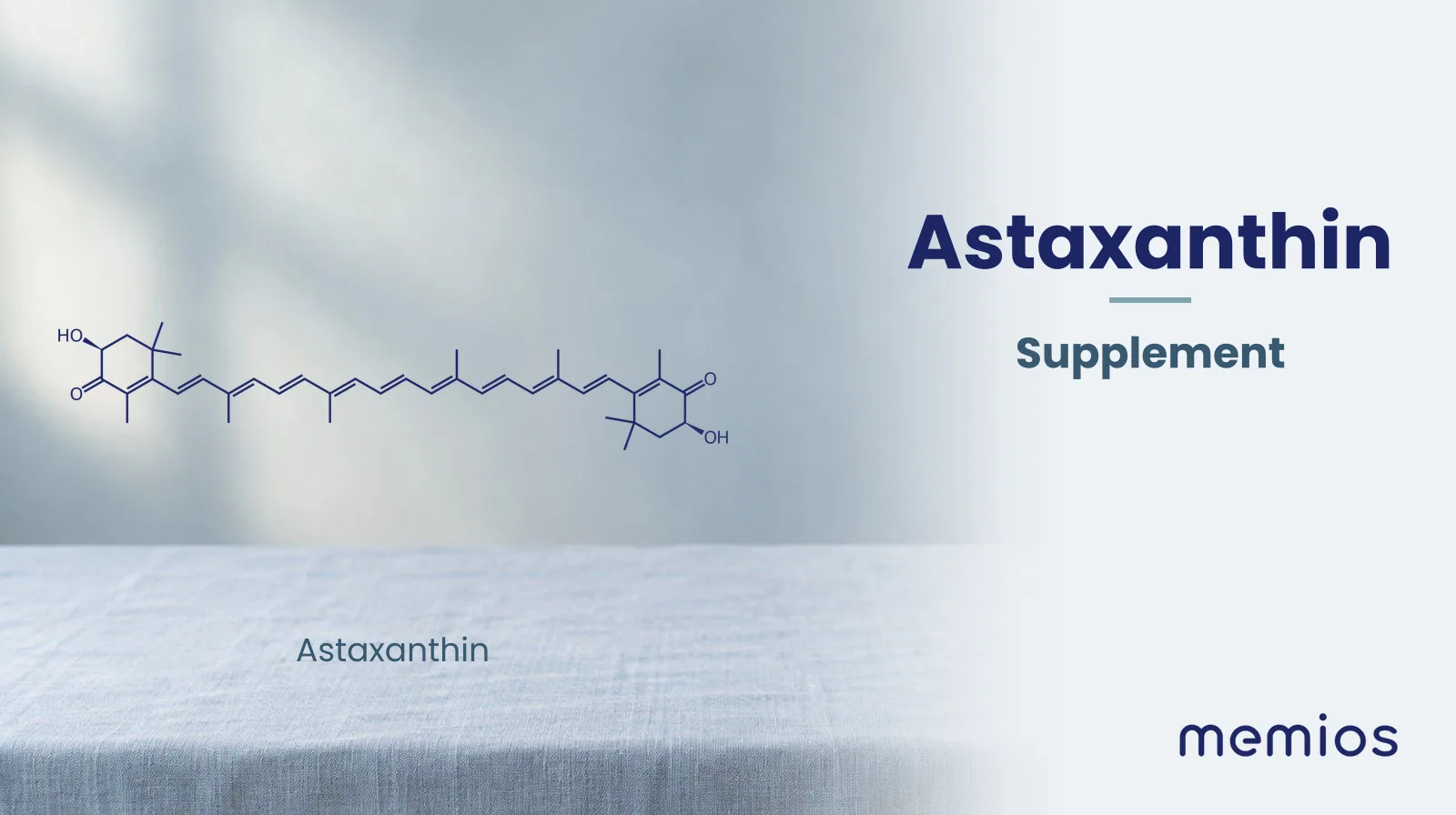
- What it is: Astaxanthin is a red-orange xanthophyll carotenoid.
- Main use, supported: A 2026 systematic review and meta-analysis of 24 randomised trials found astaxanthin reduced post-exercise creatine kinase, rated moderate certainty by the reviewers. (moderate certainty)
- Other use, supported: A 2022 meta-analysis of 12 randomised trials found astaxanthin lowered blood malondialdehyde, a marker of lipid oxidation. (low certainty)
- Claim NOT supported by research: The same meta-analysis found no improvement in any measure of exercise performance, and no significant effect on malondialdehyde or interleukin-6. (low certainty)
- Another claim NOT supported: The same meta-analysis found no significant effect on C-reactive protein or tumour necrosis factor alpha. (low certainty)
- Recommended dose: not established. No recommended dietary allowance or adequate intake exists for astaxanthin. It is treated as a novel food and a feed additive rather than a nutrient, and background dietary exposure comes from fish and crustaceans.
- Studied dose (a trial dose, not a recommendation): The lipid meta-analysis pooled randomised studies using 6 to 20 mg a day. Findings citing that trial: 1 for, 1 against.
- Upper limit: EFSA (2020) applies an Acceptable Daily Intake of 0.2 mg astaxanthin per kilogram of body weight - about 14 mg a day for a 70 kg adult - and judged 8 mg a day from supplements plus background diet safe for adults while exceeding the ADI for children and...
- What goes wrong: 4 findings on harm. A published case report describes a woman stable on warfarin whose INR rose from 1.4 to 10.38 with bruising one day after astaxanthin was added, assessed as a probable adverse drug reaction.
- Common myth: Astaxanthin is the strongest antioxidant there is, and it makes you perform better and recover faster.
What it is
Astaxanthin is a red-orange xanthophyll carotenoid. The commercial natural form is extracted from the green microalga Haematococcus pluvialis, which accumulates it in large amounts; most of the astaxanthin on the world market, however, is chemically synthesised and used in fish feed. It is the pigment that makes salmon, trout, shrimp and krill pink. In the EU it is regulated as a novel food when used in supplements.
What the research says
Claims run to antioxidant, anti-inflammatory, skin, eye and sports-performance effects; the trial evidence is thin and mixed. Meta-analyses of randomised trials report lower creatine kinase after exercise and lower malondialdehyde (a marker of lipid oxidation), but no improvement in VO2max, time-trial performance or power output, and no consistent change in C-reactive protein or TNF-alpha. For blood lipids, pooled trials show higher HDL cholesterol and lower triglycerides but no change in LDL or total cholesterol. Almost all of this is short-term biomarker work rather than trials of outcomes people can feel.
Evidence grade: Limited evidence.
What goes wrong
A published case report describes a woman stable on warfarin whose INR rose from 1.4 to 10.38 with bruising one day after astaxanthin was added, assessed as a probable adverse drug reaction. (Source 1)
- Case report, Very low certainty.
- Size: 1 patient.
- Who: A 69-year-old Thai woman with previous ischaemic stroke, taking warfarin, atenolol, digoxin, aspirin, omeprazole and simvastatin.
- How long: onset within 1 day; INR fell to 1.43 two days after withdrawal and vitamin K.
- Result: INR 1.4 to 10.38; ecchymosis of the groin and thigh, enlarging over a day; causality assessed as probable.
- Funding: not stated.
International normalized ratio (INR) values increased from 1.4 to 10.38. Warfarin and astaxanthin were withheld and vitamin K was given.
In cultured primary human hepatocytes astaxanthin induced CYP3A4 and CYP2B6, the enzymes that clear a large share of prescription drugs - a mechanism for drug interactions, shown in cells rather than in patients. (Source 2)
- Lab study in cells, Very low certainty.
- Size: primary cultures of human hepatocytes.
- Who: Human liver cells in culture.
- How long: not applicable.
- Result: Significant induction of CYP3A4 and CYP2B6; no induction of CYP1A or CYP2C family enzymes.
- Funding: not stated; the work was carried out in an industrial and academic toxicology setting.
In cultured hepatocytes, astaxanthin was a significant inducer of the major cytochrome P450 enzyme, CYP3A4 as well as of CYP2B6, but not of other CYPs, including those from CYP1A and CYP2C families.
EFSA concluded that 8 mg a day in supplements plus dietary astaxanthin is safe for adults but exceeds the Acceptable Daily Intake for children and, by a large margin, for infants. (Source 3)
- Official position, Certainty not rated.
- Size: EU population exposure modelling.
- Who: Adults, adolescents, children aged 10 to under 14, and infants aged 4 to 6 months.
- How long: lifetime intake.
- Result: ADI 0.2 mg astaxanthin per kg body weight; ADI exceeded by 28% in children aged 10 to under 14 and by up to 524% in infants aged 4 to 6 months.
- Funding: public body (EFSA)
the NDA Panel concludes that (i) such combined exposure to astaxanthin is safe for adults, (ii) 14 to < 18 years old adolescents reach the ADI, and (iii) the ADI is exceeded by 28% in children aged 10 to < 14 years and up to 524% in infants aged 4–6 months.
EFSA's position, dated 2020, is that the Acceptable Daily Intake for astaxanthin is 0.2 mg per kilogram of body weight, replacing the earlier figure of 0.034 mg/kg. (Source 3)
- Official position, Certainty not rated.
- Size: not applicable.
- Who: General population.
- How long: lifetime intake.
- Result: ADI raised from 0.034 mg/kg bw (2014) to 0.2 mg/kg bw (2019 FEEDAP opinion, applied in the 2020 NDA opinion)
- Funding: public body (EFSA)
In that assessment, the FEEDAP Panel derived a new ADI of 0.2 mg astaxanthin/kg bw which replaced the ADI of 0.034 mg/kg bw established in 2014.
What the evidence supports
A 2026 systematic review and meta-analysis of 24 randomised trials found astaxanthin reduced post-exercise creatine kinase, rated moderate certainty by the reviewers. (Source 4)
- Meta-analysis, Moderate certainty.
- Size: 24 randomised controlled trials.
- Who: Healthy participants and athletes.
- How long: varied; searched from inception to January 2026.
- Result: Creatine kinase SMD -0.45 (95% CI -0.83 to -0.07); lactate dehydrogenase SMD -0.93 (95% CI -1.39 to -0.48) with substantial heterogeneity.
- Funding: not stated in the material we could read.
Twenty-four RCTs were included. Astaxanthin significantly reduced creatine kinase levels
A 2022 meta-analysis of 12 randomised trials found astaxanthin lowered blood malondialdehyde, a marker of lipid oxidation. (Source 5)
- Meta-analysis, Low certainty.
- Size: 12 randomised controlled trials, 380 participants.
- Who: Mixed adult populations, including people with type 2 diabetes and overweight adults.
- How long: at least 1 week of supplementation per trial.
- Result: Malondialdehyde SMD -0.95 (95% CI -1.67 to -0.23; P = .01); in type 2 diabetes SMD -0.64 (95% CI -1.26 to -0.01; P < .05); interleukin-6 in type 2 diabetes WMD -0.70 pg/mL (95% CI -1.29 to -0.11; P = .02)
- Funding: not stated in the abstract.
Compared with placebo, astaxanthin significantly reduced blood malondialdehyde concentration (standardized mean difference [SMD]: -0.95; 95% CI, -1.67 to -0.23; P = .01).
A 2025 meta-analysis of eight randomised studies at 6 to 20 mg a day found higher HDL cholesterol and lower triglycerides. (Source 6)
- Meta-analysis, Low certainty.
- Size: 8 studies contributing 11 results.
- Who: Adults in randomised controlled studies of astaxanthin.
- How long: not stated in the abstract.
- Result: HDL-C standardised effect 0.4200 (95% CI 0.1081 to 0.7319); triglycerides -0.3058 (95% CI -0.5138 to -0.0978)
- Funding: not stated in the abstract.
The meta-analysis concludes positive effects of astaxanthin (6–20 mg/d) on HDL-C (0.4200; 95% CI: 0.1081 to 0.7319) and triglyceride (−0.3058; 95% CI: −0.5138 to −0.0978) levels.
A small human study found astaxanthin metabolites in the plasma of volunteers after a single 100 mg oral dose, confirming that oral astaxanthin is absorbed and metabolised in people. (Source 2)
- Blood level study, Very low certainty.
- Size: 2 volunteers.
- Who: Human volunteers.
- How long: single dose, blood taken 24 hours later.
- Result: Four radiolabelled metabolites identified in plasma 24 hours after 100 mg orally.
- Funding: not stated.
The same four metabolites were identified in human plasma from two volunteers who had orally taken 100 mg astaxanthin 24 h before blood collection.
What the evidence does not support
The same meta-analysis found no improvement in any measure of exercise performance, and no significant effect on malondialdehyde or interleukin-6. (Source 4)
- Meta-analysis, Low certainty.
- Size: 24 randomised controlled trials.
- Who: Healthy participants and athletes.
- How long: varied.
- Result: No significant effect on VO2max, time-trial performance or maximal workload/power output; no significant effect on malondialdehyde or interleukin-6.
- Funding: not stated in the material we could read.
No significant effects were observed for malondialdehyde or interleukin-6. Astaxanthin did not significantly improve VO2max, time-trial performance, or maximal workload/power output.
The same meta-analysis found no significant effect on C-reactive protein or tumour necrosis factor alpha. (Source 5)
- Meta-analysis, Low certainty.
- Size: 12 randomised controlled trials, 380 participants.
- Who: Mixed adult populations.
- How long: at least 1 week per trial.
- Result: Effects on C-reactive protein and TNF-alpha not statistically significant.
- Funding: not stated in the abstract.
The effects of astaxanthin on blood C-reactive protein and tumor necrosis factor-α concentrations were not significant.
The same meta-analysis found no significant effect on LDL cholesterol or total cholesterol. (Source 6)
- Meta-analysis, Low certainty.
- Size: 8 studies contributing 11 results.
- Who: Adults in randomised controlled studies.
- How long: not stated in the abstract.
- Result: LDL-C -0.0725 (95% CI -0.3070 to 0.1620); total cholesterol -0.0448 (95% CI -0.3369 to 0.2473)
- Funding: not stated in the abstract.
Unfortunately, astaxanthin (6–20 mg/d) does not appear to significantly influence LDL-C (−0.0725; 95% CI: −0.3070 to 0.1620) and total cholesterol (−0.0448; 95% CI: −0.3369 to 0.2473) levels.
Where the evidence is mixed
A very small randomised trial reported longer time to exhaustion on a cycling test with astaxanthin, a result the larger meta-analysis does not support. (Source 7)
- Randomized trial, Very low certainty.
- Size: 10 physically active male adults.
- Who: Young physically active men, mean age 22.5 years.
- How long: 4 days of supplementation.
- Result: Time to exhaustion 85.41 ± 4.42 minutes with astaxanthin vs 72.11 ± 2.24 minutes with placebo (P < 0.001, partial eta squared 0.71); creatine kinase and lactate dehydrogenase reduced (P < 0.05), with a time-by-treatment interaction for creatine kinase of P = 0.039, partial eta squared 0.217; malondialdehyde, a marker of lipid peroxidation, substantially inhibited (P < 0.05); no response of TNF-alpha or C-reactive protein; substrate utilisation similar in both trials.
- Funding: not stated in the material we could read.
Limit of this finding: This trial did report an oxidative-stress result in its own favour (less malondialdehyde during and after exercise), so it is not a null result on that outcome. It is still ten men supplemented for four days, and the larger meta-analysis of 24 trials in this write-up found no improvement in exercise performance, so the performance result should not be read as settled.
Short-term AST supplementation significantly enhanced exercise performance, as we found longer TTE in the AST trial (85.41 ± 4.42 min) than in the placebo trial (72.11 ± 2.24 min).
Where the research disagrees
Whether astaxanthin improves exercise performance
- Authors of a single randomised trial (BMC Sports Science, Medicine and Rehabilitation, 2025), randomised controlled trial in 10 men, 4 days of supplementation: "Short-term AST supplementation significantly enhanced exercise performance, as we found longer TTE in the AST trial (85.41 ± 4.42 min) than in the placebo trial (72.11 ± 2.24 min)." (Source 7)
- Authors of a 2026 systematic review and meta-analysis (Nutrients), meta-analysis of 24 randomised controlled trials with GRADE ratings: "Astaxanthin did not significantly improve VO2max, time-trial performance, or maximal workload/power output." (Source 4)
Whether astaxanthin lowers malondialdehyde, the most-cited oxidative stress marker
- Nutrition Research meta-analysis (2022), meta-analysis of 12 randomised trials, 380 participants: "Compared with placebo, astaxanthin significantly reduced blood malondialdehyde concentration (standardized mean difference [SMD]: -0.95; 95% CI, -1.67 to -0.23; P = .01)." (Source 5)
- Nutrients meta-analysis (2026), meta-analysis of 24 randomised trials in exercise settings, rated very low certainty for this outcome: "No significant effects were observed for malondialdehyde or interleukin-6." (Source 4)
How much
- Reference intake: No recommended dietary allowance or adequate intake exists for astaxanthin. It is treated as a novel food and a feed additive rather than a nutrient, and background dietary exposure comes from fish and crustaceans. Quote: "By taking into account an updated exposure assessment for astaxanthin from the background diet (fish and crustaceans) in combination with 8 mg from food supplements". (Source 3)
- Upper limit: EFSA (2020) applies an Acceptable Daily Intake of 0.2 mg astaxanthin per kilogram of body weight - about 14 mg a day for a 70 kg adult - and judged 8 mg a day from supplements plus background diet safe for adults while exceeding the ADI for children and infants. There is no US Tolerable Upper Intake Level. (Source 3)
- Studied: The lipid meta-analysis pooled randomised studies using 6 to 20 mg a day. (Source 6)
- Studied: A randomised cycling trial gave 28 mg a day for 4 days to ten physically active men. (Source 7)
- Studied: A metabolism study gave volunteers a single oral dose of 100 mg. (Source 2)
A common belief, and what the research shows
The belief: Astaxanthin is the strongest antioxidant there is, and it makes you perform better and recover faster.
What the research shows: Pooled randomised evidence supports a recovery-marker effect, not a performance effect: "Twenty-four RCTs were included. Astaxanthin significantly reduced creatine kinase levels", but "Astaxanthin did not significantly improve VO2max, time-trial performance, or maximal workload/power output." Even the antioxidant claim is inconsistent - one meta-analysis found lower malondialdehyde while a larger and more recent one found "No significant effects were observed for malondialdehyde or interleukin-6." The reviewers themselves say "Further well-powered trials with standardized dosing, duration, exercise protocols, and outcome assessments are needed."
Questions and answers
What is it?
Astaxanthin is a red-orange xanthophyll carotenoid. The natural supplement form comes from the green microalga Haematococcus pluvialis, the richest known natural source; most astaxanthin produced worldwide is synthetic and goes into fish feed. It is the pigment responsible for the pink colour of salmon, trout and shrimp. (Source 8)
What does it do in the body?
It is a lipid-soluble antioxidant and anti-inflammatory compound in laboratory work. In people, pooled randomised trials show reduced markers of muscle damage after exercise and, in some analyses, lower lipid-oxidation markers, but the effects on performance and on inflammation markers such as CRP and TNF-alpha are not significant. The reviewers describe its effects as uncertain. (Source 4)
Is it good or bad for you?
It depends on dose and on who is taking it. EFSA judged 8 mg a day from supplements, on top of a normal diet, safe for adults, but the same exposure exceeds the Acceptable Daily Intake for children and greatly exceeds it for infants. There is also a published case of a serious bleeding episode when astaxanthin was added to warfarin. (Source 3)
How do you get more of it?
Dietary astaxanthin comes from fish and crustaceans - salmon, trout, shrimp, krill. Supplements use algal oleoresin or synthetic astaxanthin; EFSA's assessment was built around 8 mg a day from supplements, and trials pooled in the lipid meta-analysis used 6 to 20 mg a day. One small performance trial used 28 mg a day for four days. (Source 6)
If it is harmful, what reduces it?
There is no described way to remove astaxanthin other than stopping intake; it is cleared by normal metabolism, and metabolites appear in plasma within a day of a dose. Where a limit matters, EFSA's figure is 0.2 mg per kilogram of body weight a day, and it applied that to conclude the intake was safe for adults but not for children. (Source 3)
Why might someone be low in it or missing it?
Astaxanthin is not an essential nutrient and there is no defined requirement, so nobody is 'deficient' in the medical sense. Intake is simply low in people who eat little salmon, trout, shrimp or krill, because those are the background dietary sources EFSA modelled. (Source 3)
Which whole foods contain it or feed it?
Fish and crustaceans: salmon, trout, shrimp and krill carry astaxanthin, which is what gives their flesh its pink colour. The microalga Haematococcus pluvialis is the richest natural source and is what supplement astaxanthin is extracted from. (Source 8)
What happens if you do not have it?
No deficiency state is described for astaxanthin in the literature we searched, and no trial has tested what happens to people who take none. What the trials show is the other direction: adding it changes some biomarkers and leaves performance measures unchanged. (Source 4)
How can you test for it?
Astaxanthin and its metabolites can be measured in blood plasma in research settings - a study identified four metabolites in volunteers' plasma 24 hours after a 100 mg dose. We found no validated clinical test with a reference range or a defined 'low' value, so there is nothing a member could be tested against. (Source 2)
References
- Journal of Cardiology Cases. Interaction between warfarin and astaxanthin: A case report. 2019. DOI 10.1016/j.jccase.2019.01.002. Read the source
- Archives of Toxicology. Metabolism and CYP-inducer properties of astaxanthin in man and primary human hepatocytes. 2002. PMID 11876499, DOI 10.1007/s00204-001-0287-5. Read the source
- European Food Safety Authority (EFSA), Panel on Nutrition, Novel Foods and Food Allergens (NDA). Safety of astaxanthin for its use as a novel food in food supplements. 2020. PMID 32874213, DOI 10.2903/j.efsa.2020.5993. Read the source
- Nutrients. The Effects of Astaxanthin Supplementation on Exercise Recovery Biomarkers and Exercise Performance: A Systematic Review and Meta-Analysis. 2026. PMID 42197030, DOI 10.3390/nu18101570. Read the source
- Nutrition Research. Astaxanthin supplementation mildly reduced oxidative stress and inflammation biomarkers: a systematic review and meta-analysis of randomized controlled trials. 2022. PMID 35091276, DOI 10.1016/j.nutres.2021.09.005. Read the source
- Pharmaceuticals. Assessing the Effects of Moderate to High Dosage of Astaxanthin Supplementation on Lipid Profile Parameters-A Systematic Review and Meta-Analysis of Randomized Controlled Studies. 2025. DOI 10.3390/ph18081097. Read the source
- BMC Sports Science, Medicine and Rehabilitation. Effect of astaxanthin supplementation on cycling performance, muscle damage biomarkers and oxidative stress in young adults: a randomized controlled trial. 2025. PMID 40615903, DOI 10.1186/s13102-025-01221-3. Read the source
- Marine Drugs. Astaxanthin and other Nutrients from Haematococcus pluvialis-Multifunctional Applications. 2020. DOI 10.3390/md18090459. Read the source