Medications · September 30, 2026 · Memios · 22 min read
Aripiprazole
Well established. Aripiprazole reduces psychotic and manic symptoms and adds modestly to antidepressants.
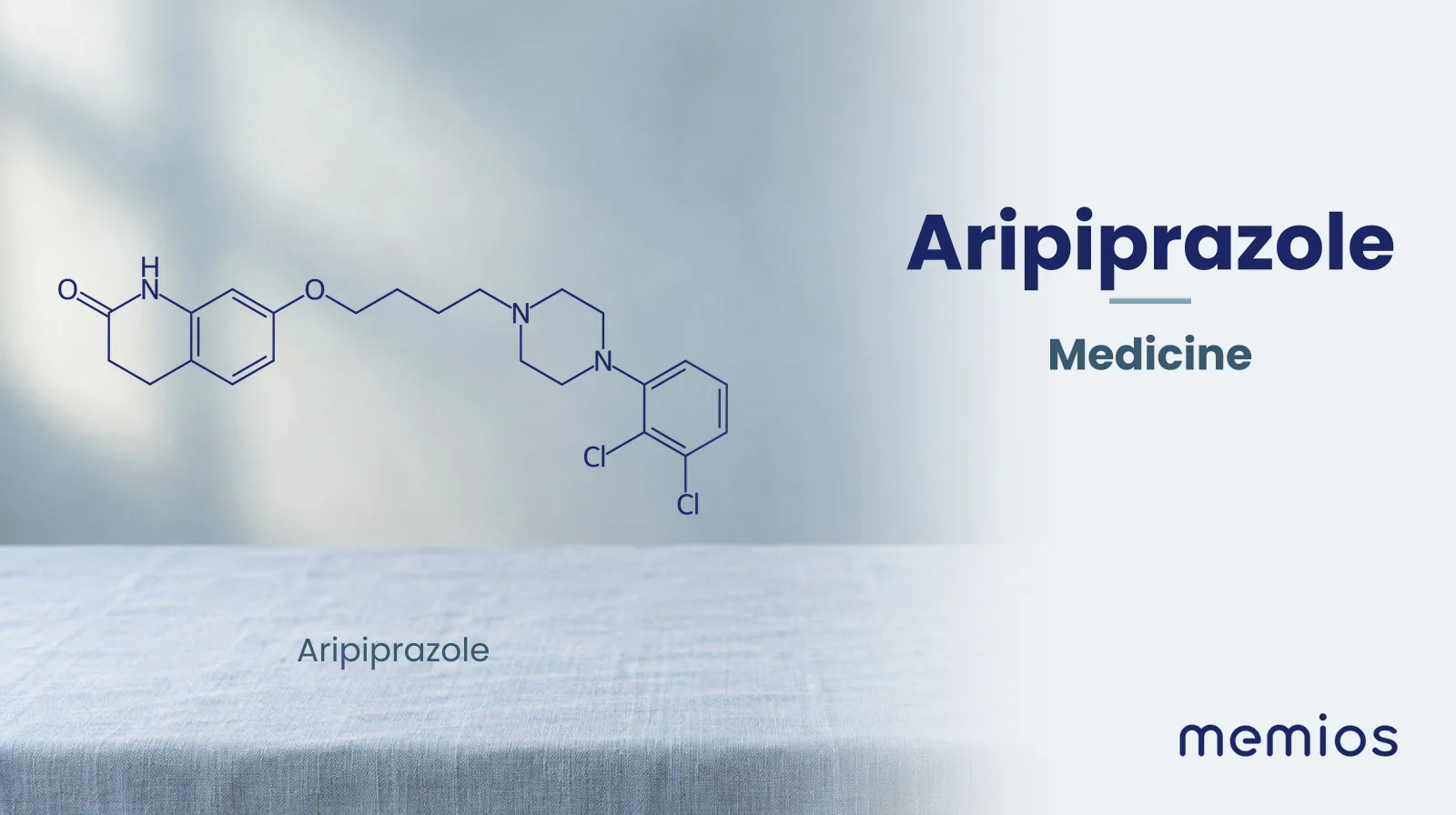
TLDR
- Boxed warning: Antidepressants increased the risk of suicidal thoughts and behavior in children, adolescents, and young adults in short-term studies.
- Well established. Aripiprazole reduces psychotic and manic symptoms and adds modestly to antidepressants.
- What it is: Aripiprazole is a prescription antipsychotic medicine, sometimes called a third-generation antipsychotic because it acts as a partial agonist rather than a pure blocker at dopamine D2 receptors.
- Main use: Schizophrenia (well supported).
- Other approved uses: Acute manic or mixed episodes of bipolar I disorder (well supported); Adjunctive treatment of major depressive disorder (limited evidence); Irritability associated with autistic disorder (limited evidence) and 1 more.
- Recommended dose (official position): There is no reference intake for aripiprazole; it is a prescription medicine and the dose is set by the prescriber for the specific condition. The US label used here (aripiprazole tablets, NorthStar Rx LLC, revision 5/2023, and the ABILIFY label.
- Studied dose (a trial dose, not a recommendation): The acute mania trial randomised 272 hospitalised patients to aripiprazole 30 mg/day, reducible to 15 mg/day for tolerability; 85% maintained 30 mg/day. Findings citing that trial: 1 for.
- Upper limit: The ABILIFY label (revision 8/2014) states maximum recommended daily doses of 30 mg/day for schizophrenia, bipolar mania and agitation, and 15 mg/day for adjunctive treatment of major depressive disorder and for irritability associated with autistic disorder.
- What goes wrong: 5 findings on harm. Movement disorder side effects were more common with aripiprazole than placebo in every autism trial.
- Interactions: 2 recorded, including St John's wort (Hypericum perforatum), Clonidine and other blood-pressure-lowering drugs.
- Common myth: Aripiprazole is the clean antipsychotic: no weight gain, so no real downside.
What it is
Aripiprazole is a prescription antipsychotic medicine, sometimes called a third-generation antipsychotic because it acts as a partial agonist rather than a pure blocker at dopamine D2 receptors. It is taken as tablets, an oral solution, or a long-acting injection. Its US approvals cover schizophrenia, manic and mixed episodes of bipolar I disorder and their maintenance, add-on treatment of major depressive disorder, irritability associated with autistic disorder, and Tourette's disorder. It carries a boxed warning and, since 2016, a labelled warning about compulsive gambling and other urges.
What the research says
Aripiprazole reduces psychotic and manic symptoms and adds modestly to antidepressants, and it is unusual among antipsychotics in causing little weight gain. A Cochrane review found it reduced relapse against placebo in schizophrenia (risk ratio 0.59 short term) but was unable to extract usable data on death, functioning or satisfaction from nine trials in 2,585 people. In acute mania, 53% responded versus 32% on placebo. As an add-on in depression the pooled odds ratio for remission was 2.01 with a number needed to treat of nine, and no meaningful gain in quality of life. In autistic children it improved irritability and hyperactivity over 8 weeks, but the one discontinuation study found relapse rates no different from placebo. Its characteristic harms are akathisia, an inner restlessness reported by 9% in schizophrenia trials against 6% on placebo and 18% against 5% in bipolar trials, and compulsive gambling and other urges.
Evidence grade: Well established.
How it works
Drug class: Atypical antipsychotic; dopamine D2 partial agonist (third-generation antipsychotic)
The label states that the mechanism of action of aripiprazole in schizophrenia is unclear, but that its effects could be mediated through a combination of partial agonist activity at dopamine D2 and serotonin 5-HT1A receptors and antagonist activity at 5-HT2A receptors. Partial agonism means it turns dopamine signalling down where dopamine is excessive and props it up where it is low, which is the usual explanation for why it causes less prolactin rise and less weight gain than most antipsychotics but more restlessness (akathisia). The same dopamine partial agonism is the leading hypothesis for the compulsive gambling and other urges now described in its label. (Source 1)
Boxed warning
WARNING: INCREASED MORTALITY IN ELDERLY PATIENTS WITH DEMENTIA-RELATED PSYCHOSIS; AND SUICIDAL THOUGHTS AND BEHAVIORS WITH ANTIDEPRESSANT DRUGS Elderly patients with dementia-related psychosis treated with antipsychotic drugs are at an increased risk of death. Aripiprazole tablets are not approved for the treatment of patients with dementia-related psychosis [see Warnings and Precautions (5.1)]. Antidepressants increased the risk of suicidal thoughts and behavior in children, adolescents, and young adults in short-term studies. These studies did not show an increase in the risk of suicidal thoughts and behavior with antidepressant use in patients over age 24 years; there was a reduction in risk with antidepressant use in patients aged 65 years and older [see Warnings and Precautions (5.3)]. In patients of all ages who are started on antidepressant therapy, monitor closely for worsening, and for emergence of suicidal thoughts and behaviors. Advise families and caregivers of the need for close observation and communication with the prescriber [see Warnings and Precautions (5.3)].
(Source 1)
What it is used for
- A Cochrane review of nine trials in 2,585 people found aripiprazole reduced relapse compared with placebo (risk ratio 0.59 short term, 0.66 medium term, both from a single 310-person trial) and had fewer people leaving the study. The review's central criticism is how little the trials reported: no usable data on death, functioning, behaviour, satisfaction or cognition could be extracted. Evidence: established. (Source 2)
- In a 3-week double-blind trial of 272 hospitalised patients, 53% of those on aripiprazole responded versus 32% on placebo, with no significant difference from placebo in body weight change and no prolactin rise or QTc prolongation. Discontinuation for adverse events was similar (8.8% versus 7.5%). Evidence: established. (Source 3)
- A meta-analysis of 14 short-term placebo-controlled trials found aripiprazole improved remission (odds ratio 2.01, number needed to treat nine) and response (odds ratio 2.07, number needed to treat seven), but add-on antipsychotics as a class produced no benefit or a very small benefit on functioning and quality of life, and aripiprazole was the drug specifically linked to akathisia. Evidence: limited. (Source 4)
- A Cochrane review of three trials found short-term (8-week) benefit for irritability, hyperactivity and stereotypy in children and adolescents, rated moderate-quality evidence, with weight gain, sedation, drooling and tremor more common than placebo. The single long-term discontinuation study found relapse rates did not differ between continuing aripiprazole and placebo. Evidence: limited. (Source 5)
- This is an approved indication on the US label, but this research batch did not retrieve the Tourette's trials, so no effect size is stated here. The approval is recorded as a regulatory position dated 5/2023. Evidence: unknown. (Source 1)
Interactions
- St John's wort (Hypericum perforatum) (theoretical): St John's wort is a potent inducer of the liver enzyme CYP3A4, and aripiprazole is broken down by CYP3A4: the aripiprazole label requires the dose to be roughly doubled when a strong CYP3A4 inducer such as carbamazepine or rifampin is added. A strong herbal inducer would be expected to lower aripiprazole levels the same way. This is inference from the shared enzyme pathway, quoted here from the quetiapine label which names St John's wort explicitly as a potent CYP3A4 inducer; we did not find a pharmacokinetic study of St John's wort with aripiprazole. (Source 6)
- Clonidine and other blood-pressure-lowering drugs (label): Taking an antipsychotic such as aripiprazole alongside clonidine can bring on or worsen problems with standing up, including orthostatic hypotension, dizziness and fatigue. This is documented from the clonidine side of the pair. (Source 7)
Stopping it
- For antipsychotics as a class, a 2021 Schizophrenia Bulletin paper argues that stopping can itself contribute to relapse, through adaptations including dopamine receptor hypersensitivity that persist for months or years after the drug is gone, and proposes hyperbolic tapering over months to years in progressively smaller steps, with final doses possibly as small as one fortieth of a therapeutic dose. The authors state the proposal has not yet been tested in randomised trials. (Source 8)
- In autism, the one randomised discontinuation study found that stopping aripiprazole after irritability had stabilised did not produce a significantly higher relapse rate than continuing it (35% versus 52%, hazard ratio 0.57, 95% CI 0.28 to 1.12). The Cochrane authors take this as a reason to re-evaluate continued use rather than to assume it must be continued. (Source 5)
- The label notes that in some cases, though not all, the compulsive urges reported with aripiprazole stopped when the dose was reduced or the medication was discontinued, and it advises considering dose reduction or stopping if such urges develop. (Source 9)
What goes wrong
Movement disorder side effects were more common with aripiprazole than placebo in every autism trial. (Source 10)
- Systematic review, Moderate certainty.
- Size: 316 children and adolescents across the 8-week trials.
- Who: Children and adolescents with autism spectrum disorder.
- How long: 8 weeks.
- Result: Sedation risk ratio 4.28 (95% CI 1.58 to 11.60); tremor risk ratio 10.26 (95% CI 1.37 to 76.63); mean weight gain 1.13 kg more than placebo (95% CI 0.71 to 1.54), all moderate-quality evidence.
- Funding: independent (Cochrane review)
Rates of movement disorder side effects such as tremor, muscle rigidity and involuntary movement were higher in children/adolescents taking aripiprazole in all trials.
Akathisia, an inner restlessness, occurred in 9% of aripiprazole-treated patients versus 6% on placebo in schizophrenia trials and 18% versus 5% in bipolar I trials. (Source 11)
- Meta-analysis, Low certainty.
- Size: Pooled safety data from short- and long-term aripiprazole trials (exact totals not given in the abstract)
- Who: Patients with schizophrenia, schizoaffective disorder or bipolar I disorder.
- How long: Short- and long-term trials pooled; akathisia occurred early in treatment.
- Result: Schizophrenia and schizoaffective disorder: 9% aripiprazole versus 6% placebo (3 percentage points absolute, about 33 treated for one extra case); bipolar I: 18% versus 5% (13 percentage points, about 8 treated for one extra case). Discontinuation for akathisia was low (0.3% versus 0% in schizophrenia; 2.3% versus 0% in bipolar).
- Funding: industry-linked: this is a post hoc analysis of pooled manufacturer trial data, and several authors are affiliated with the manufacturer.
akathisia in 9% of aripiprazole- and 6% of placebo-treated patients; 12.5% of aripiprazole- versus 24% of haloperidol-treated patients
The label warns that patients can develop intense, uncontrollable urges, particularly to gamble, while taking aripiprazole. (Source 9)
- Official position, Certainty not rated.
- Size: Post-marketing case reports; no rate given.
- Who: People taking aripiprazole.
- How long: Onset reported from days to years.
- Result: No incidence figure is given in the label. Urges reported include gambling, sexual urges, shopping, eating or binge eating. In some but not all cases urges stopped when the dose was reduced or the drug stopped.
- Funding: Not applicable (regulatory position, label revision 5/2023)
Post-marketing case reports suggest that patients can experience intense urges, particularly for gambling, and the inability to control these urges while taking aripiprazole.
In the FDA's adverse event database, aripiprazole accounted for 94% of impulse control disorder reports linked to dopamine partial agonists, three quarters of them gambling. (Source 12)
- Case series, Very low certainty.
- Size: 2,708 reports of impulse control disorders linked to third-generation antipsychotics, of which 2,545 named aripiprazole.
- Who: Spontaneous reports in the FDA Adverse Event Reporting System up to December 2020.
- How long: Time to onset varied between days and years.
- Result: Aripiprazole 2,545 of 2,708 reports (94%); gambling 2,018 reports (75%); positive dechallenge (symptoms stopping when the drug stopped) in 20% of cases. Spontaneous reports cannot give a rate or prove cause, and reporting is affected by the 2016 FDA warning itself.
- Funding: not stated (academic pharmacovigilance group)
A total of 2708 reports of TGA-related ICDs were found, primarily recording aripiprazole (2545 reports, 94%) among the drugs, and gambling (2018 reports, 75%) among the events.
The US label carries a boxed warning that antipsychotics increase the risk of death in elderly people with dementia-related psychosis. (Source 1)
- Official position, Certainty not rated.
- Size: Not stated in this label's boxed warning.
- Who: Elderly patients with dementia-related psychosis.
- How long: Not stated.
- Result: The warning states an increased risk of death without giving numbers in this version of the label; aripiprazole is not approved for this population.
- Funding: Not applicable (regulatory position, label revision 5/2023)
Elderly patients with dementia-related psychosis treated with antipsychotic drugs are at an increased risk of death. Aripiprazole tablets are not approved for the treatment of patients with dementia-related psychosis
What the evidence supports
Aripiprazole significantly reduced relapse compared with placebo in schizophrenia. (Source 2)
- Systematic review, Low certainty.
- Size: 2,585 participants across 9 randomised controlled trials; relapse data from 1 trial of 310 people.
- Who: People with schizophrenia.
- How long: Short and medium term; attrition very large in all studies over four weeks.
- Result: Relapse RR 0.59 (CI 0.45 to 0.77) short term and RR 0.66 (CI 0.53 to 0.81) medium term; fewer left the aripiprazole group than placebo (RR 0.73, CI 0.60 to 0.87)
- Funding: not stated.
Compared with placebo, aripiprazole significantly decreased relapse in both the short (n = 310, 1 RCT, RR 0.59 CI 0.45 to 0.77) and medium term (n = 310, 1 RCT, RR 0.66 CI 0.53 to 0.81).
In acute mania, 53% of patients responded to aripiprazole versus 32% on placebo over three weeks. (Source 3)
- Randomized trial, Moderate certainty.
- Size: 272 hospitalised patients.
- Who: Hospitalised patients with bipolar I disorder in an acute manic or mixed episode.
- How long: 3 weeks.
- Result: Response (50% fall in Young Mania Rating Scale) 53% versus 32%, an absolute difference of 21 percentage points (about 5 people treated for one extra responder); discontinuation for adverse events 8.8% versus 7.5%; no significant difference in body weight change.
- Funding: not stated in the abstract we read; the author list is largely employees of the manufacturer.
A significantly higher response rate was observed in aripiprazole-treated patients (53% vs. 32% at endpoint).
As an add-on in treatment-resistant depression, aripiprazole improved remission with an odds ratio of 2.01 and a number needed to treat of nine. (Source 4)
- Meta-analysis, Moderate certainty.
- Size: 14 short-term trials of four drugs.
- Who: Adults with major depressive disorder not responding to antidepressant monotherapy.
- How long: 4 to 12 weeks.
- Result: Remission odds ratio 2.01 (95% CI 1.48-2.73), number needed to treat nine; response odds ratio 2.07 (95% CI 1.58-2.72), number needed to treat seven.
- Funding: independent (academic review using manufacturers' registries and FDA New Drug Applications)
All four drugs had statistically significant effects on remission, as follows: aripiprazole (odds ratio [OR], 2.01; 95% CI, 1.48–2.73), OFC (OR, 1.42; 95% CI, 1.01–2.0), quetiapine (OR, 1.79; 95% CI, 1.33–2.42), and risperidone (OR, 2.37; 95% CI, 1.31–4.30). The number needed to treat (NNT) was 19 for OFC and nine for each other drug.
In autistic children and adolescents, aripiprazole was effective short term for irritability, hyperactivity and repetitive behaviours. (Source 5)
- Systematic review, Moderate certainty.
- Size: 316 children and adolescents across two 8-week trials.
- Who: Children and adolescents with autism spectrum disorder (diagnosed by DSM-IV criteria)
- How long: 8 weeks.
- Result: Aberrant Behavior Checklist irritability subscale mean difference -6.17 points (95% CI -9.07 to -3.26), hyperactivity -7.93 (95% CI -10.98 to -4.88), stereotypy -2.66 (95% CI -3.55 to -1.77), all moderate-quality evidence. No improvement in lethargy or withdrawal.
- Funding: independent (Cochrane review); the underlying trials were manufacturer-sponsored.
Evidence from two RCTs suggests that aripiprazole can be effective as a short-term medication intervention for some behavioural aspects of ASD in children/adolescents.
What the evidence does not support
Despite 2,585 participants across nine trials, the Cochrane review could extract no usable data on death, functioning, behaviour, engagement, satisfaction, economic outcomes or cognition. (Source 2)
- Systematic review, Low certainty.
- Size: 2,585 participants across 9 randomised controlled trials.
- Who: People with schizophrenia.
- How long: Trials mostly four weeks or less with high attrition.
- Result: No extractable data for the outcomes that matter most to patients; insomnia (about 23%) and headache (about 15%) were common in both groups with no significant difference.
- Funding: not stated.
Despite the fact that 2585 people participated in nine randomised aripiprazole studies, we were unable to extract any usable data on death, service outcomes, general functioning, behaviour, engagement with services, satisfaction with treatment; economic outcomes or cognitive functioning.
Add-on antipsychotics including aripiprazole produced no benefit or a very small benefit on functioning and quality of life, and aripiprazole was the drug linked to akathisia. (Source 13)
- Meta-analysis, Moderate certainty.
- Size: 14 short-term trials.
- Who: Adults with treatment-resistant major depressive disorder.
- How long: 4 to 12 weeks.
- Result: Functioning and quality of life: no benefit or a very small benefit; clinician-rated severity Hedges' g 0.26 to 0.48 across drugs.
- Funding: independent.
On measures of functioning and quality of life, these medications produced either no benefit or a very small benefit, except for risperidone, which had a small-to-moderate effect on quality of life (g = 0.49). Treatment was linked to several adverse events, including akathisia (aripiprazole), sedation (quetiapine, OFC, and aripiprazole), abnormal metabolic laboratory results (quetiapine and OFC), and weight gain (all four drugs, especially OFC).
In the one long-term discontinuation study in autism, relapse rates did not differ between children continuing aripiprazole and those switched to placebo. (Source 5)
- Systematic review, Low certainty.
- Size: One placebo discontinuation study within the review.
- Who: Children and adolescents with autism spectrum disorder whose irritability had stabilised.
- How long: Long-term discontinuation design.
- Result: Relapse 35% on aripiprazole versus 52% on placebo, hazard ratio 0.57 (95% CI 0.28 to 1.12), not statistically significant, low-quality evidence.
- Funding: independent (Cochrane review)
One long-term, placebo discontinuation study found that relapse rates did not differ between children/adolescents randomised to continue aripiprazole versus children/adolescents randomised to receive placebo, suggesting that re-evaluation of aripiprazole use after a period of stabilisation in irritability symptoms is warranted.
Where the evidence is mixed
Unlike most antipsychotics, aripiprazole produced negligible weight change with prolonged exposure, but switching to it did not produce weight loss and weight gain was more pronounced in people who had never taken an antipsychotic. (Source 14)
- Meta-analysis, Moderate certainty.
- Size: 307 articles met inclusion criteria.
- Who: Patients in clinical trials of antipsychotics, stratified by duration of use.
- How long: Stratified: up to 6 weeks, 6-16 weeks, 16-38 weeks, over 38 weeks.
- Result: Aripiprazole among the exceptions with negligible weight change after prolonged exposure; switching to aripiprazole did not produce weight loss; in antipsychotic-naive patients weight gain was much more pronounced for all antipsychotics.
- Funding: not stated.
Contrary to expectations, switch of AP did not result in weight loss for amisulpride, aripiprazole or ziprasidone. In AP-naive patients, weight gain was much more pronounced for all AP.
Where the research disagrees
How much weight the trial evidence for aripiprazole in schizophrenia can bear
- The Cochrane review's conclusion, Systematic review of 9 randomised trials in 2,585 people: Aripiprazole may be effective for the treatment of schizophrenia. Aripiprazole has a lower risk of raised prolactin and prolongation of the QTc interval. (Source 15)
- The same review on what the trials failed to measure, The same systematic review, on outcome reporting and attrition: Despite the fact that 2585 people participated in nine randomised aripiprazole studies, we were unable to extract any usable data on death, service outcomes, general functioning, behaviour, engagement with services, satisfaction with treatment; economic outcomes or cognitive functioning. (Source 2)
How much
- Reference intake: There is no reference intake for aripiprazole; it is a prescription medicine and the dose is set by the prescriber for the specific condition. The US label used here (aripiprazole tablets, NorthStar Rx LLC, revision 5/2023, and the ABILIFY label, revision 8/2014) sets a different range for each indication. Recorded as a regulatory position with its date. (Source 1)
- Upper limit: The ABILIFY label (revision 8/2014) states maximum recommended daily doses of 30 mg/day for schizophrenia, bipolar mania and agitation, and 15 mg/day for adjunctive treatment of major depressive disorder and for irritability associated with autistic disorder. This is a regulatory position with its date, not advice. (Source 1)
- Studied: The acute mania trial randomised 272 hospitalised patients to aripiprazole 30 mg/day, reducible to 15 mg/day for tolerability; 85% maintained 30 mg/day. (Source 3)
- Studied: The Cochrane autism review pooled two 8-week trials totalling 316 children and adolescents. (Source 10)
- Studied: The add-on depression meta-analysis pooled short-term trials of 4 to 12 weeks' duration. (Source 4)
A common belief, and what the research shows
The belief: Aripiprazole is the clean antipsychotic: no weight gain, so no real downside.
What the research shows: Its metabolic profile genuinely is better than most: a meta-analysis of 307 articles found that with prolonged exposure aripiprazole produced "negligible weight change". But that is not the same as no downside, and the same review warns "In AP-naive patients, weight gain was much more pronounced for all AP." Its own characteristic harms are different: akathisia, reported in "akathisia in 9% of aripiprazole- and 6% of placebo-treated patients" in schizophrenia trials and 18% versus 5% in bipolar trials, and compulsive urges, for which the label states "Post-marketing case reports suggest that patients can experience intense urges, particularly for gambling, and the inability to control these urges while taking aripiprazole."
Questions and answers
What is it?
Aripiprazole is a prescription antipsychotic medicine, available as tablets, an oral solution and a long-acting injection. It is used for schizophrenia, for manic and mixed episodes of bipolar I disorder, as an add-on in major depression, for irritability in autistic disorder and for Tourette's disorder. It differs from older antipsychotics in acting as a partial agonist at dopamine receptors rather than simply blocking them. (Source 1)
What does it do in the body?
It modulates dopamine and serotonin signalling, damping psychotic and manic symptoms and adding to the effect of antidepressants. A Cochrane review concluded it may be effective for schizophrenia and that it raises prolactin and prolongs the QTc interval less than comparators. In acute mania 53% of patients responded against 32% on placebo. (Source 15)
Is it good or bad for you?
Both, depending on the condition and the person. The benefits in schizophrenia, mania, add-on depression and autistic irritability are measurable in placebo-controlled trials. Against that sit akathisia (9% versus 6% on placebo in schizophrenia trials, 18% versus 5% in bipolar trials), movement side effects in children, and compulsive gambling and other urges that the label warns can harm the patient and others if not recognised. (Source 9)
How do you get more of it?
Aripiprazole is prescription-only and no food or supplement provides it. The dose is set by a prescriber: the label caps it at 30 mg a day for schizophrenia and mania and 15 mg a day for add-on depression and autistic irritability. In the acute mania trial, patients were given 30 mg a day, reducible to 15 mg for tolerability. (Source 3)
If it is harmful, what reduces it?
If the problem is compulsive urges, the label says these stopped in some but not all cases when the dose was reduced or the drug stopped. More generally, stopping an antipsychotic is a medical decision: a 2021 paper argues for reducing over months or years in progressively smaller steps, because adaptations to the drug can persist long after it is gone. (Source 9)
Why might someone be low in it or missing it?
Blood levels can fall well below what the prescriber intended if something is speeding up its breakdown. Aripiprazole is cleared by the liver enzymes CYP3A4 and CYP2D6, and strong CYP3A4 inducers such as carbamazepine, rifampin or St John's wort push levels down. Genetic differences in CYP2D6 work the other way, raising levels in poor metabolisers. (Source 6)
Which whole foods contain it or feed it?
None. Aripiprazole is a manufactured medicine, not a nutrient, so no whole food contains it or feeds it. The question does not apply in the way it does to a vitamin or a gut organism; the only dietary items that matter are ones that change how the liver clears the drug. (Source 6)
What happens if you do not have it?
For someone with schizophrenia, coming off it raises relapse risk: in the Cochrane review, relapse was lower on aripiprazole than placebo (risk ratio 0.59 short term). In autistic children whose irritability had settled, the picture is different: the one discontinuation study found relapse rates no different between continuing and stopping, which the Cochrane authors read as a reason to re-examine long-term use. (Source 5)
How can you test for it?
There is no routine blood test that tells you whether an aripiprazole dose is right. What is monitored is effect and harm: symptom rating scales in trials, and clinically the presence of akathisia, weight, glucose and lipids, and direct questioning about gambling and other urges, which the label says prescribers should ask about specifically because patients may not recognise the behaviour as abnormal. (Source 9)
References
- DailyMed, US National Library of Medicine (labeler: NorthStar Rx LLC). ARIPIPRAZOLE- aripiprazole tablet - boxed warning. 2023. Read the source
- Cochrane Database of Systematic Reviews 2011 (The Cochrane Collaboration; Belgamwar RB, El-Sayeh HG). Aripiprazole versus placebo for schizophrenia (Cochrane Review) - Main results. 2011. DOI 10.1002/14651858.CD006622.pub2. Read the source
- Journal of Psychopharmacology. Aripiprazole in the treatment of acute manic or mixed episodes in patients with bipolar I disorder: a 3-week placebo-controlled study. 2006. DOI 10.1177/0269881106059693. Read the source
- PLOS Medicine. Adjunctive Atypical Antipsychotic Treatment for Major Depressive Disorder: A Meta-Analysis of Depression, Quality of Life, and Safety Outcomes - remission results. 2013. DOI 10.1371/journal.pmed.1001403. Read the source
- Cochrane Database of Systematic Reviews. Aripiprazole for autism spectrum disorders (ASD) (Cochrane Review) - Authors' conclusions. 2016. PMID 27344135, DOI 10.1002/14651858.CD009043.pub3. Read the source
- DailyMed, US National Library of Medicine (labeler: Camber Pharmaceuticals, Inc.). QUETIAPINE FUMARATE tablet, film coated - CYP3A4 inhibitors and inducers dose adjustment. 2024. Read the source
- DailyMed, US National Library of Medicine. Clonidine Hydrochloride Tablets, USP - DRUG INTERACTIONS. 2022. Read the source
- Schizophrenia Bulletin. A Method for Tapering Antipsychotic Treatment That May Minimize the Risk of Relapse. 2021. DOI 10.1093/schbul/sbab017. Read the source
- DailyMed, US National Library of Medicine (labeler: NorthStar Rx LLC). ARIPIPRAZOLE- aripiprazole tablet - Pathological Gambling and Other Compulsive Behaviors. 2023. Read the source
- Cochrane Database of Systematic Reviews. Aripiprazole for autism spectrum disorders (ASD) (Cochrane Review) - Key results. 2016. PMID 27344135, DOI 10.1002/14651858.CD009043.pub3. Read the source
- Journal of Psychopharmacology. Evaluation of akathisia in patients with schizophrenia, schizoaffective disorder, or bipolar I disorder: a post hoc analysis of pooled data from short- and long-term aripiprazole trials. 2010. DOI 10.1177/0269881109348157. Read the source
- International Journal of Neuropsychopharmacology. Impulse Control Disorders by Dopamine Partial Agonists: A Pharmacovigilance-Pharmacodynamic Assessment Through the FDA Adverse Event Reporting System. 2022. DOI 10.1093/ijnp/pyac031. Read the source
- PLOS Medicine. Adjunctive Atypical Antipsychotic Treatment for Major Depressive Disorder: A Meta-Analysis of Depression, Quality of Life, and Safety Outcomes - severity, quality of life and adverse events. 2013. DOI 10.1371/journal.pmed.1001403. Read the source
- PLOS ONE. Almost All Antipsychotics Result in Weight Gain: A Meta-Analysis. 2014. DOI 10.1371/journal.pone.0094112. Read the source
- Cochrane Database of Systematic Reviews 2011 (The Cochrane Collaboration; Belgamwar RB, El-Sayeh HG). Aripiprazole versus placebo for schizophrenia (Cochrane Review) - Authors' conclusions. 2011. DOI 10.1002/14651858.CD006622.pub2. Read the source