Medications · September 30, 2026 · Memios · 13 min read
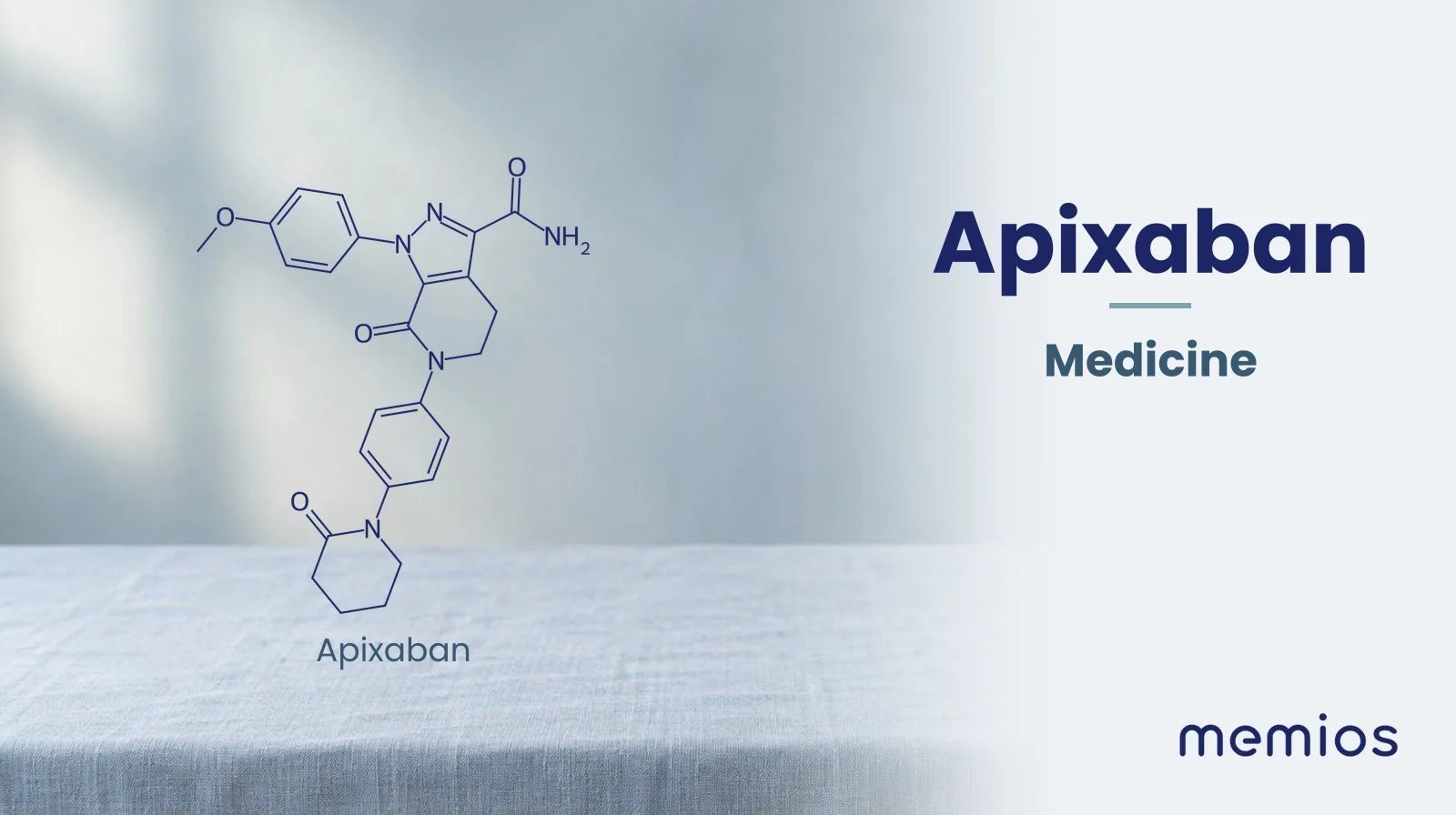
Apixaban
Large randomised trials show apixaban lowers stroke and systemic embolism in atrial fibrillation compared with warfarin (ARISTOTLE) and aspirin (AVERROES).
TLDR
- Boxed warning: These hematomas may result in long-term or permanent paralysis.
- Well established. Large randomised trials show apixaban lowers stroke and systemic embolism in atrial fibrillation compared with warfarin (ARISTOTLE) and aspirin (AVERROES), and treats venous clots as well as standard therapy with less major bleeding (AMPLIFY).
- What it is: Apixaban is a prescription tablet anticoagulant (blood thinner).
- Main use: Reducing stroke and systemic embolism in nonvalvular atrial fibrillation (well supported).
- Other approved uses: Treatment of deep vein thrombosis and pulmonary embolism, and reducing recurrence (well supported); Prevention of deep vein thrombosis after hip or knee replacement (evidence not rated).
- Off-label uses (not on the FDA label): Device-detected subclinical atrial fibrillation (ARTESiA) (limited evidence).
- Uses NOT supported by research: Added to antiplatelet therapy after acute coronary syndrome (APPRAISE-2).
- Recommended dose (official position): Dosing is set by the prescriber. As a position, the US label (revised 4/2025) gives 5 mg twice daily for most patients with atrial fibrillation and 2.5 mg twice daily for patients meeting at least two of age 80 or older, weight 60 kg or less, or serum creatinine 1.5 mg/dL or higher.
- Studied dose (a trial dose, not a recommendation): The pivotal atrial fibrillation trials used the regimen now on the label (5 mg twice daily, 2.5 mg in selected patients); the exact trial dosing text was not captured verbatim in this run. Findings citing that trial: 1 on harm.
- Upper limit: The label's standard atrial fibrillation regimen is 5 mg twice daily (position, 4/2025); the label also directs a 50% dose reduction with combined P-gp and strong CYP3A4 inhibitors.
- What goes wrong: 5 findings on harm. Apixaban still caused major bleeding in ARISTOTLE, at about 2.1 events per 100 patient-years, although less than warfarin.
- Interactions: 4 recorded, including St John's wort, rifampin, carbamazepine, phenytoin (combined P-gp and strong CYP3A4 inducers), Ketoconazole, itraconazole, ritonavir (combined P-gp and strong CYP3A4 inhibitors), Aspirin, other antiplatelets, NSAIDs, SSRIs, SNRIs, other anticoagulants, Food.
- Common myth: Because apixaban is safer than warfarin, it does not cause serious bleeding.
What it is
Apixaban is a prescription tablet anticoagulant (blood thinner). The US label describes it as a selective inhibitor of clotting factor Xa, approved to lower stroke risk in nonvalvular atrial fibrillation, to prevent clots after hip or knee replacement, and to treat and prevent recurrence of deep vein thrombosis and pulmonary embolism.
What the research says
Large randomised trials show apixaban lowers stroke and systemic embolism in atrial fibrillation compared with warfarin (ARISTOTLE) and aspirin (AVERROES), and treats venous clots as well as standard therapy with less major bleeding (AMPLIFY). It still causes bleeding: about 2.1 major bleeds per 100 patient-years in ARISTOTLE, more bleeding than aspirin in subclinical atrial fibrillation (ARTESiA), and more bleeding with no benefit when added to antiplatelet drugs after acute coronary syndrome (APPRAISE-2). All of the pivotal trials were funded by the manufacturers.
Evidence grade: Well established.
How it works
Drug class: Direct oral anticoagulant (direct factor Xa inhibitor)
Apixaban blocks factor Xa, a clotting enzyme, both free in the blood and inside clots, which slows the chain of reactions that forms a blood clot. (Source 1)
Boxed warning
Premature discontinuation of any oral anticoagulant, including ELIQUIS, increases the risk of thrombotic events.
(Source 1)
What it is used for
- In ARISTOTLE, stroke or systemic embolism was 1.27% per year on apixaban versus 1.60% per year on warfarin, with less major bleeding and slightly lower all-cause death. In AVERROES, in people unsuitable for warfarin, it was 1.6% versus 3.7% per year compared with aspirin, with similar major bleeding. Both trials were manufacturer funded. Evidence: established. (Source 2)
- In AMPLIFY, recurrent venous thromboembolism was 2.3% on apixaban versus 2.7% on standard enoxaparin-then-warfarin (non-inferior), and major bleeding was 0.6% versus 1.8% (about 1 fewer major bleed per 100 people treated). Manufacturer funded. Evidence: established. (Source 3)
- This is an approved use on the label. The ADVANCE trials behind it were not retrieved in this run, so only the label position is cited here and no effect size is given. Evidence: unknown. (Source 1)
- One large trial (4,012 people) found fewer strokes or systemic emboli than with aspirin (0.78% vs 1.24% per person-year) but more major bleeding (1.53% vs 1.12% per person-year). The benefit was mainly in people at higher stroke risk. Evidence: limited. (Source 4)
- APPRAISE-2 (7,392 patients) was stopped early. Apixaban did not reduce cardiovascular death, heart attack or ischaemic stroke (7.5% vs 7.9%) and increased major bleeding (1.3% vs 0.5%) and intracranial bleeding (0.3% vs 0.1%). Evidence: not-supported. (Source 5)
Interactions
- St John's wort, rifampin, carbamazepine, phenytoin (combined P-gp and strong CYP3A4 inducers) (label): These lower apixaban levels, which may reduce its protection against clots. The label says to avoid using them together. (Source 1)
- Ketoconazole, itraconazole, ritonavir (combined P-gp and strong CYP3A4 inhibitors) (label): These raise apixaban levels; the label directs a dose reduction by the prescriber. (Source 1)
- Aspirin, other antiplatelets, NSAIDs, SSRIs, SNRIs, other anticoagulants (label): Taking other drugs that affect clotting adds to bleeding risk. (Source 1)
- Food (label): Meals do not change how much apixaban is absorbed. (Source 1)
Stopping it
- The boxed warning states that stopping any oral anticoagulant early, other than for bleeding or at the end of a planned course, raises the risk of clots and stroke, and the label advises covering with another anticoagulant. (Source 1)
- In the atrial fibrillation trials, strokes increased during the changeover from apixaban to warfarin at the end of the study. (Source 1)
- In ARISTOTLE, 1.7% of apixaban patients and 2.5% of warfarin patients stopped treatment because of bleeding-related adverse reactions. (Source 1)
What goes wrong
Apixaban still caused major bleeding in ARISTOTLE, at about 2.1 events per 100 patient-years, although less than warfarin. (Source 2)
- Randomized trial, High certainty.
- Size: ARISTOTLE trial population.
- Who: Adults with nonvalvular atrial fibrillation.
- How long: Median about 1.8 years.
- Result: Major bleeding (ISTH criteria) 2.13%/yr vs 3.09%/yr on warfarin; HR 0.69 (95% CI 0.60-0.80); P<0.001.
- Funding: industry-funded (Bristol-Myers Squibb and Pfizer)
ISTH criteria: 2.13%/yr vs. 3.09%/yr (HR 0.69; 95% CI 0.60-0.80; P<0.001)
In AVERROES, major bleeding on apixaban was about 1.4% per year and not significantly different from aspirin. (Source 6)
- Randomized trial, Moderate certainty.
- Size: AVERROES trial population.
- Who: Adults with atrial fibrillation unsuitable for warfarin.
- How long: Mean about 1.1 years.
- Result: Major bleeding 1.4%/yr vs 1.2%/yr; HR 1.13 (95% CI 0.74-1.75); P=0.57.
- Funding: industry-funded (Bristol-Myers Squibb and Pfizer)
1.4%/yr vs. 1.2%/yr (HR 1.13; 95% CI 0.74-1.75; P=0.57)
In ARTESiA, apixaban increased major bleeding compared with aspirin. (Source 4)
- Randomized trial, Moderate certainty.
- Size: 4,012 participants.
- Who: Adults with device-detected subclinical atrial fibrillation.
- How long: Mean about 3.5 years.
- Result: 1.53% vs 1.12% per person-year; p=0.04.
- Funding: not stated in the fetched summary.
The primary safety outcome, major bleeding, was: 1.53%/person-year in the apixaban group vs. 1.12%/person-year in the aspirin group (p = 0.04).
In APPRAISE-2, apixaban more than doubled TIMI major bleeding versus placebo and increased intracranial bleeding. (Source 5)
- Randomized trial, Moderate certainty.
- Size: 7,392 patients.
- Who: Adults after acute coronary syndrome on antiplatelet therapy.
- How long: Median 8 months.
- Result: TIMI major bleeding 1.3% vs 0.5% (HR 2.59, 95% CI 1.50-4.46); intracranial 0.3% vs 0.1% (p=0.03)
- Funding: industry-funded (trial sponsor Bristol-Myers Squibb and Pfizer, per the ACC summary)
The primary safety endpoint of Thrombolysis In Myocardial Infarction (TIMI) major bleeding was significantly higher in the apixaban arm, as compared with placebo (1.3% vs. 0.5%, HR 2.59, 95% CI 1.50-4.46, p = 0.001).
The label records that stroke increased during the switch from apixaban to warfarin in the atrial fibrillation trials. (Source 1)
- Official position, Certainty not rated.
- Size: Atrial fibrillation trial populations, as summarised by the label.
- Who: Adults with atrial fibrillation.
- How long: Transition period at end of trial.
- Result: No rate given in the fetched text.
- Funding: Label (FDA-approved manufacturer text, revised 4/2025)
An increased rate of stroke was observed during the transition from ELIQUIS to warfarin in clinical trials in atrial fibrillation patients.
What the evidence supports
In ARISTOTLE, apixaban reduced stroke or systemic embolism compared with warfarin in nonvalvular atrial fibrillation (absolute difference about 0.33 percentage points per year). (Source 2)
- Randomized trial, High certainty.
- Size: 18,201 patients (per the trial publication; enrolment number not in the fetched summary text)
- Who: Adults with nonvalvular atrial fibrillation and at least one stroke risk factor.
- How long: Median about 1.8 years.
- Result: Stroke or systemic embolism 1.27%/yr vs 1.60%/yr; HR 0.79 (95% CI 0.66-0.95); P=0.01 for superiority, P<0.001 for noninferiority.
- Funding: industry-funded (Bristol-Myers Squibb and Pfizer)
1.27%/yr vs. 1.60%/yr (HR 0.79; 95% CI 0.66-0.95; P=0.01 for superiority, P<0.001 for noninferiority)
In ARISTOTLE, all-cause death was slightly lower with apixaban than warfarin, of borderline significance. (Source 2)
- Randomized trial, Moderate certainty.
- Size: ARISTOTLE trial population.
- Who: Adults with nonvalvular atrial fibrillation.
- How long: Median about 1.8 years.
- Result: All-cause mortality 3.52%/yr vs 3.94%/yr; HR 0.89 (95% CI 0.80-0.99); P=0.047.
- Funding: industry-funded (Bristol-Myers Squibb and Pfizer)
3.52%/yr vs. 3.94%/yr (HR 0.89; 95% CI 0.80-0.99; P=0.047)
In AVERROES, apixaban reduced stroke or systemic embolism compared with aspirin in people unsuitable for warfarin. (Source 6)
- Randomized trial, High certainty.
- Size: About 5,600 patients (per the trial publication)
- Who: Adults with atrial fibrillation judged unsuitable for a vitamin K antagonist.
- How long: Mean about 1.1 years (stopped early for benefit)
- Result: Stroke or systemic embolism 1.6%/yr vs 3.7%/yr; HR 0.45 (95% CI 0.32-0.62); P<0.001.
- Funding: industry-funded (Bristol-Myers Squibb and Pfizer)
1.6%/yr vs. 3.7%/yr (HR 0.45; 95% CI 0.32-0.62; P<0.001)
In AMPLIFY, apixaban was non-inferior to standard therapy for preventing recurrent venous thromboembolism. (Source 3)
- Randomized trial, High certainty.
- Size: About 5,400 patients (per the trial publication)
- Who: Adults with acute deep vein thrombosis or pulmonary embolism.
- How long: 6 months of treatment.
- Result: Recurrent symptomatic VTE or VTE-related death 2.3% vs 2.7%; RR 0.84 (95% CI 0.60-1.18); P<0.001 for non-inferiority.
- Funding: industry-funded (Pfizer and Bristol-Myers Squibb)
Limit of this finding: The trial summary this quote comes from labels the confidence interval '95% HR 0.60-1.18'; this is a typo in the source for '95% CI 0.60-1.18'. The interval crosses 1, so apixaban was shown to be no worse than standard therapy, not better.
2.3% vs. 2.7% (RR 0.84; 95% HR 0.60-1.18; P<0.001 for non-inferiority)
In AMPLIFY, major bleeding was lower with apixaban than with standard therapy (0.6% vs 1.8%), about 1.2 fewer major bleeds per 100 people treated. (Source 3)
- Randomized trial, High certainty.
- Size: AMPLIFY trial population.
- Who: Adults with acute venous thromboembolism.
- How long: 6 months.
- Result: Major bleeding 0.6% vs 1.8%; RR 0.31 (95% CI 0.17-0.55); P<0.001 for superiority; absolute difference 1.2 percentage points.
- Funding: industry-funded (Pfizer and Bristol-Myers Squibb)
Limit of this finding: The trial summary this comes from gives a number needed to treat of 100, but its own figures (0.6% vs 1.8%, a 1.2 percentage-point difference) give about 83. Rely on the percentages, not the summary's NNT.
0.6% vs. 1.8% (RR 0.31; 95% CI 0.17-0.55; P<0.001 for superiority
In ARTESiA, apixaban reduced stroke or systemic embolism compared with aspirin in device-detected subclinical atrial fibrillation. (Source 4)
- Randomized trial, Moderate certainty.
- Size: 4,012 participants (2,015 apixaban, 1,997 aspirin)
- Who: Adults with device-detected subclinical atrial fibrillation and increased stroke risk.
- How long: Mean about 3.5 years (per the trial publication)
- Result: 0.78% vs 1.24% per person-year; p=0.007.
- Funding: not stated in the fetched summary.
The primary efficacy outcome, stroke or systemic embolism, was: 0.78%/person-year in the apixaban group vs. 1.24%/person-year in the aspirin group (p = 0.007).
What the evidence does not support
In APPRAISE-2, adding apixaban to antiplatelet therapy after acute coronary syndrome increased bleeding without reducing ischaemic events, and the trial was stopped early. (Source 5)
- Randomized trial, Moderate certainty.
- Size: 7,392 patients (3,705 apixaban, 3,687 placebo)
- Who: Adults after a recent acute coronary syndrome.
- How long: Median follow-up 8 months.
- Result: CV death, MI or ischaemic stroke 7.5% vs 7.9% (HR 0.95, p=0.51)
- Funding: industry-funded (trial sponsor Bristol-Myers Squibb and Pfizer, per the ACC summary)
terminated early after preliminary analyses demonstrated significantly increased bleeding with apixaban, without a concurrent reduction in ischemic events
Where the research disagrees
Whether device-detected subclinical atrial fibrillation should be anticoagulated
- ARTESiA investigators (efficacy), rct: Among patients with subclinical AF and increased risk for stroke, apixaban reduced the risk of stroke or systemic embolism compared with aspirin. (Source 4)
- ARTESiA investigators (safety), rct: However, apixaban was associated with an increased risk of major bleeding compared with aspirin. (Source 4)
How much
- Reference intake: Dosing is set by the prescriber. As a position, the US label (revised 4/2025) gives 5 mg twice daily for most patients with atrial fibrillation and 2.5 mg twice daily for patients meeting at least two of age 80 or older, weight 60 kg or less, or serum creatinine 1.5 mg/dL or higher. (Source 1)
- Upper limit: The label's standard atrial fibrillation regimen is 5 mg twice daily (position, 4/2025); the label also directs a 50% dose reduction with combined P-gp and strong CYP3A4 inhibitors. The full label's higher initial VTE treatment dose was not captured in the fetched text. (Source 1)
- Studied: The pivotal atrial fibrillation trials used the regimen now on the label (5 mg twice daily, 2.5 mg in selected patients); the exact trial dosing text was not captured verbatim in this run. (Source 1)
A common belief, and what the research shows
The belief: Because apixaban is safer than warfarin, it does not cause serious bleeding.
What the research shows: Apixaban caused less bleeding than warfarin in ARISTOTLE, but major bleeding still occurred at "2.13%/yr vs. 3.09%/yr (HR 0.69; 95% CI 0.60-0.80; P<0.001)", and in ARTESiA it caused more major bleeding than aspirin.
Questions and answers
What is it?
Apixaban (Eliquis) is a prescription blood thinner taken as a tablet. It belongs to the direct oral anticoagulants and works by blocking one clotting enzyme, factor Xa. (Source 1)
What does it do in the body?
It blocks factor Xa both floating free in the blood and bound inside clots, which slows the production of thrombin and the formation of new clots. (Source 1)
Is it good or bad for you?
For people with atrial fibrillation or venous clots, trials show it prevents clots and strokes with less bleeding than warfarin. Bleeding is its main harm, and it did more harm than good when added to antiplatelet drugs after a heart attack (APPRAISE-2). (Source 2)
How do you get more of it?
Does not apply as a nutrient: apixaban is only available on prescription, and the dose is set by the prescriber. The label's standard atrial fibrillation regimen is recorded here as a position, not advice. (Source 1)
If it is harmful, what reduces it?
If apixaban's effect needs to be reversed urgently, for example in major bleeding, a specific reversal agent (andexanet alfa) exists and is given in hospital. (Source 1)
Why might someone be low in it or missing it?
The body does not make apixaban. Levels on treatment can be lowered by drugs and supplements that induce P-gp and CYP3A4, such as St John's wort, which the label says to avoid. (Source 1)
Which whole foods contain it or feed it?
Does not apply: no food contains apixaban. The label reports that eating does not change how much of the tablet is absorbed. (Source 1)
What happens if you do not have it?
For people who need it, stopping early without another anticoagulant raises the risk of clots and stroke; this is the first part of the boxed warning. (Source 1)
How can you test for it?
Routine blood clotting tests (PT, INR, aPTT) change only slightly and unpredictably on apixaban and are not used to monitor it, according to the label. (Source 1)
References
- Bristol-Myers Squibb / US FDA via DailyMed (NLM). ELIQUIS (apixaban) tablet, film coated - Prescribing Information (DailyMed). 2025. Read the source
- Wiki Journal Club. ARISTOTLE (Granger CB et al. Apixaban versus Warfarin in Patients with Atrial Fibrillation. NEJM 2011) - trial summary. 2011. PMID 21870978, DOI 10.1056/NEJMoa1107039. Read the source
- Wiki Journal Club. AMPLIFY (Agnelli G et al. Oral Apixaban for the Treatment of Acute Venous Thromboembolism. NEJM 2013) - trial summary. 2013. PMID 23808982, DOI 10.1056/NEJMoa1302507. Read the source
- American College of Cardiology. Apixaban for the Reduction of Thromboembolism in Patients With Device-Detected Subclinical Atrial Fibrillation - ARTESiA (trial summary of Healey JS et al. NEJM 2024). 2023. PMID 37952132, DOI 10.1056/NEJMoa2310234. Read the source
- American College of Cardiology. Apixaban for Prevention of Acute Ischemic Events 2 - APPRAISE-2 (trial summary of Alexander JH et al. NEJM 2011). 2011. PMID 21780946, DOI 10.1056/NEJMoa1105819. Read the source
- Wiki Journal Club. AVERROES (Connolly SJ et al. Apixaban in Patients with Atrial Fibrillation. NEJM 2011) - trial summary. 2011. PMID 21309657, DOI 10.1056/NEJMoa1007432. Read the source