Medications · September 29, 2026 · Memios · 19 min read
Amoxicillin; Clavulanate
Where placebo-controlled evidence exists, the benefit is real but modest and the harms are quantified.
TLDR
- Well established. Where placebo-controlled evidence exists, the benefit is real but modest and the harms are quantified.
- What it is: A fixed combination of two beta-lactam compounds.
- Main use: Acute otitis media in children (well supported).
- Other approved uses: Sinusitis, lower respiratory tract, skin and urinary tract infections caused by beta-lactamase-producing organisms (evidence not rated).
- Off-label uses (not on the FDA label): Prophylaxis of infection after mammalian bite wounds (limited evidence).
- Recommended dose: not established. There is no reference intake for an antibiotic; dosing is set by the prescriber. The US label for the ES-600 paediatric formulation records 90 mg/kg/day of the amoxicillin component divided every 12 hours for 10 days, as a regulatory position revised 12/2024.
- Studied dose (a trial dose, not a recommendation): The Cochrane review pooled 13 placebo-controlled trials in 3,401 children; the abstract does not specify a single dose across trials. Findings citing that trial: 1 for, 2 against, 1 on harm.
- Upper limit: No upper limit is set in the nutrient sense.
- What goes wrong: 6 findings on harm. Antibiotics cause one extra adverse event (vomiting, diarrhoea or rash) for every 14 children treated for acute otitis media.
- Interactions: 6 recorded, including Probiotics (Lactobacillus, Bifidobacterium, Saccharomyces boulardii), Alcohol, Warfarin and other oral anticoagulants, Allopurinol.
- Common myth: Co-amoxiclav is a gentle, routine antibiotic and the only real downside is an upset stomach.
What it is
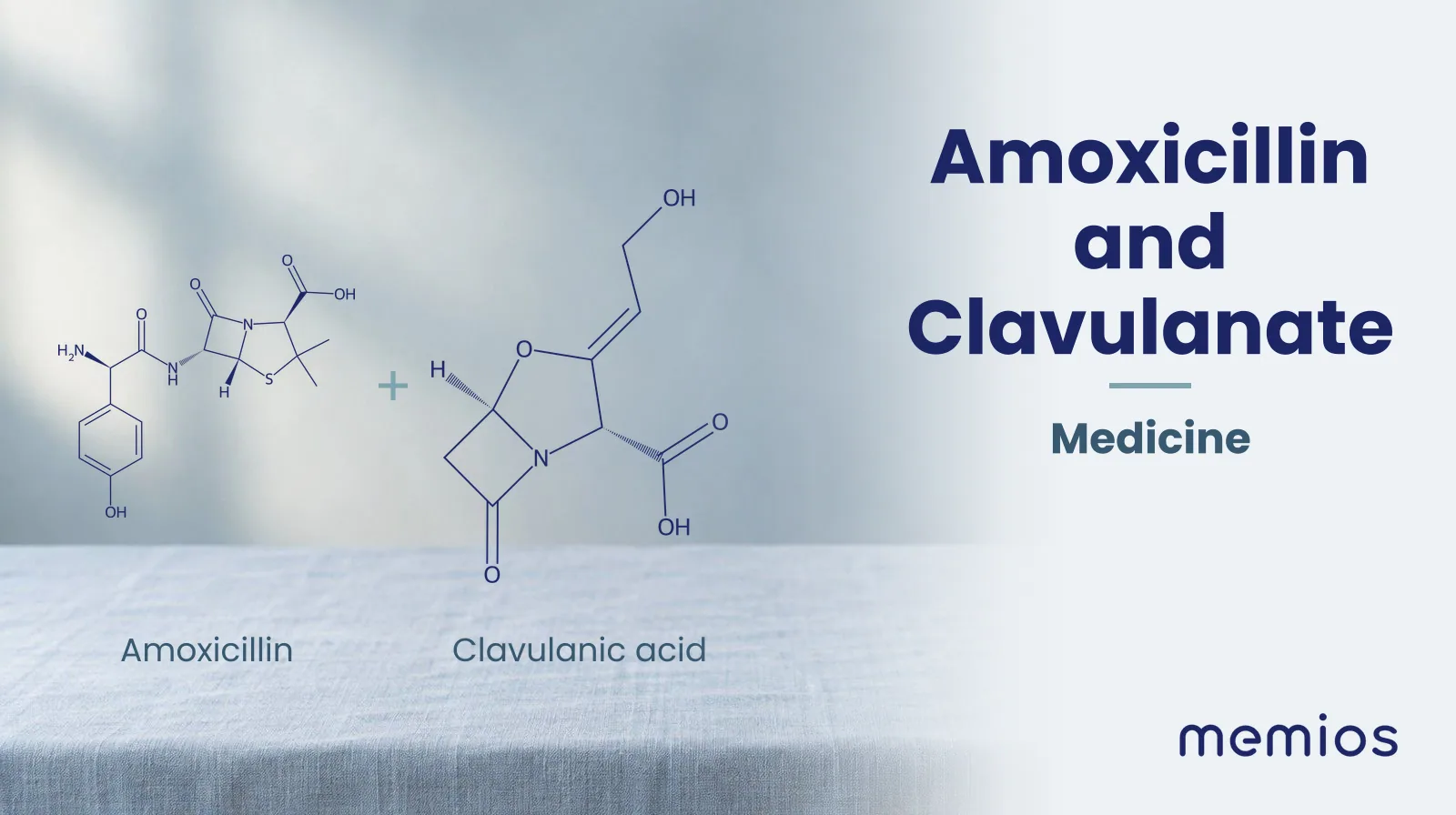
A fixed combination of two beta-lactam compounds. Amoxicillin is a semisynthetic penicillin that kills a broad range of gram-positive and gram-negative bacteria. Clavulanic acid has little antibacterial action of its own; it blocks the beta-lactamase enzymes that many bacteria use to destroy penicillins, so the pair works against organisms amoxicillin alone cannot touch. It is given by mouth as tablets or a suspension.
What the research says
Where placebo-controlled evidence exists, the benefit is real but modest and the harms are quantified. The 2023 Cochrane review of antibiotics for acute otitis media in children (13 trials, 3,401 children) found no effect on pain at 24 hours with high-certainty evidence, about a third fewer children in pain at two to three days (NNTB 20), and one extra child with vomiting, diarrhoea or rash for every 14 treated. A meta-analysis of placebo-controlled trials found diarrhoea was attributable specifically to the clavulanate-containing form, with a number needed to harm of 10. The combination is also the commonest single cause of drug-induced liver injury in large case series worldwide.
Evidence grade: Well established.
How it works
Drug class: Aminopenicillin plus beta-lactamase inhibitor
Amoxicillin stops bacteria building their cell walls, which kills them. Many bacteria defend themselves by making beta-lactamase enzymes that break amoxicillin apart; clavulanic acid sacrifices itself to disable those enzymes, so the amoxicillin survives long enough to work. (Source 1)
What it is used for
- High-certainty evidence from 13 placebo-controlled trials shows antibiotics do not reduce ear pain at 24 hours but do reduce pain at two to three days (NNTB 20), while causing one extra adverse event for every 14 children treated. In the review's second comparison, six trials of immediate antibiotics versus waiting and observing, immediate antibiotics caused one extra episode of vomiting, diarrhoea or rash for every 10 children treated. The review's authors conclude that watchful waiting is justified for most mild cases in high-income countries. Evidence: established. (Source 2)
- These are the label's approved indications, recorded here as a regulatory position dated 12/2024. We could not reach the Cochrane review of antibiotics for acute rhinosinusitis (repeated 429 and 403 responses), so we are not reporting an evidence grade for these indications from primary literature. Evidence: unknown. (Source 3)
- A Cochrane review of eight studies found prophylactic antibiotics reduced infection after human bites and after bites on the hand (OR 0.10, 95% CI 0.01 to 0.86; NNT 4), but found no evidence of benefit for cat or dog bites, and the human-bite result rests on a single trial. The authors say confirmatory research is required for both positive conclusions. The review was published in 2001 and has not been updated. This use is not on the label we read. Evidence: limited. (Source 4)
Interactions
- Probiotics (Lactobacillus, Bifidobacterium, Saccharomyces boulardii) (clinical trial): Taken alongside antibiotics in children, probiotics cut the rate of antibiotic-associated diarrhoea from 19% to 8%, about one case prevented for every nine children treated. Serious side effects were not seen in these mostly healthy children. (Source 5)
- Alcohol (pharmacokinetic study): In eight healthy volunteers alcohol slowed how fast amoxicillin was absorbed but did not change how much got in overall. (Source 6)
- Warfarin and other oral anticoagulants (label): INR can rise unexpectedly when amoxicillin is added, so clotting needs watching and the anticoagulant dose may need changing. (Source 7)
- Allopurinol (label): Taking the two together substantially raises the chance of a rash compared with amoxicillin alone, though it is not clear whether allopurinol or the underlying high uric acid is responsible. (Source 7)
- Probenecid (label): Probenecid slows how fast the kidneys clear amoxicillin, pushing blood levels higher and keeping them up for longer. (Source 7)
- Combined oral contraceptives (label): The label states the antibiotic may disturb gut bacteria and so reduce contraceptive effectiveness. This is a label position rather than a demonstrated pharmacokinetic effect. (Source 7)
Stopping it
- No dependence or withdrawal state is described. The stopping question for this drug is course length, and a 2017 BMJ analysis argued that the widely taught rule to always finish the course is not supported by evidence, while longer than necessary courses do increase resistance. (Source 8)
- One harm is specifically tied to stopping: liver injury frequently appears only after the course has ended, which is why it is often not connected to the drug. (Source 9)
What goes wrong
In placebo-controlled trials, diarrhoea was attributable specifically to the clavulanate-containing combination, with a number needed to harm of 10. (Source 10)
- Meta-analysis, Moderate certainty.
- Size: 45 trials included, 25 with data suitable for harms assessment.
- Who: participants in randomised, participant-blinded, placebo-controlled trials of amoxicillin or amoxicillin-clavulanic acid for any indication.
- How long: single antibiotic courses.
- Result: diarrhoea Peto OR 3.30 (95% CI 2.23-4.87); candidiasis OR 7.77 (95% CI 2.23-27.11); NNH 10 (95% CI 6-17) for diarrhoea with amoxicillin-clavulanic acid and 27 (95% CI 24-42) for candidiasis.
- Funding: not stated in the passage read; the authors note harms were under-reported in the source trials.
Limit of this finding: One number in this paper does not add up, and it has been left exactly as CMAJ prints it. For thrush (candidiasis) the review reports that one extra case occurs for about every 27 courses of antibiotics, but gives the range around that figure as 24 to 42 courses, which does not contain 27. CMAJ prints it that way on two separate pages, so it is an error in the published paper, not a transcription slip, and it has not been corrected here. Take from it that thrush is a real and measurable extra risk of amoxicillin, and do not rely on the precise range.
Diarrhea was attributed to amoxicillin only in the form of amoxicillin–clavulanic acid (Peto odds ratio [OR] 3.30, 95% confidence interval [CI] 2.23–4.87).
Antibiotics cause one extra adverse event (vomiting, diarrhoea or rash) for every 14 children treated for acute otitis media. (Source 2)
- Systematic review, High certainty.
- Size: 8 trials, 2,107 children.
- Who: children with acute otitis media.
- How long: during and shortly after treatment.
- Result: RR 1.38 (95% CI 1.16 to 1.63), NNTH 14; 8 trials, 2,107 children.
- Funding: not stated in the abstract read; Cochrane review.
Antibiotics increase the risk of adverse events such as vomiting, diarrhoea or rash (RR 1.38, 95% CI 1.16 to 1.63; number needed to treat for an additional harmful outcome (NNTH) 14; 8 trials, 2107 children; high-certainty evidence).
Amoxicillin-clavulanate is the most common cause of drug-induced liver disease in large case series from several continents, and the injury often appears after the course has finished. (Source 9)
- Expert review, not systematic, Moderate certainty.
- Size: hundreds of reported cases across large case series.
- Who: people prescribed amoxicillin-clavulanate.
- How long: onset a few days to about 8 weeks after starting, average about 3 weeks.
- Result: no rate is given in this passage; the pattern is typically cholestatic.
- Funding: US National Institute of Diabetes and Digestive and Kidney Diseases (LiverTox)
Amoxicillin-clavulanate has been implicated in hundreds of cases of clinically apparent acute liver injury and is currently the most common cause of drug induced liver disease in most large case series from North and South America, Australia, and Europe.
LiverTox estimates idiosyncratic liver injury after roughly 1 in 2,000 prescriptions, more often in men, the elderly and after repeat courses, with specific HLA associations. (Source 11)
- Official position, Low certainty.
- Size: not stated; an estimate drawn from published series.
- Who: people prescribed amoxicillin-clavulanate.
- How long: per prescription.
- Result: approximately 1 in 2,000 prescriptions; HLA-DRB115:01-DRB501:01-DQB106:02 haplotype and HLA-A02.01.
- Funding: US National Institute of Diabetes and Digestive and Kidney Diseases.
The hepatic injury is idiosyncratic and is estimated to occur after ~1 in 2,000 prescriptions. The injury is more common in men than women, in the elderly, and after multiple courses.
LiverTox grades amoxicillin-clavulanate at its highest likelihood category for causing clinically apparent liver injury. (Source 12)
- Official position, Moderate certainty.
- Size: not applicable.
- Who: people prescribed amoxicillin-clavulanate.
- How long: not applicable.
- Result: Likelihood score A.
- Funding: US National Institute of Diabetes and Digestive and Kidney Diseases.
Likelihood score: A (well established cause of clinically apparent liver injury).
In the second comparison of the same review, immediate antibiotics caused one extra episode of vomiting, diarrhoea or rash for every 10 children treated compared with waiting and observing, while the pain benefit over waiting was small and mostly uncertain. (Source 13)
- Systematic review, High certainty.
- Size: 6 trials, 1,556 children in the comparison; 3 trials, 946 children for the adverse-event estimate.
- Who: children with acute otitis media in high-income countries.
- How long: pain outcomes from two to fourteen days.
- Result: vomiting, diarrhoea or rash RR 1.87 (95% CI 1.39 to 2.51), NNTH 10, high-certainty evidence; pain at two to three days RR 0.53 (95% CI 0.35 to 0.79), NNTB 8, one trial, low-certainty evidence; pain at three to seven days RR 0.75 (95% CI 0.50 to 1.12), moderate-certainty evidence.
- Funding: not stated in the abstract read; Cochrane review.
Immediate antibiotics increase the risk of vomiting, diarrhoea or rash (RR 1.87, 95% CI 1.39 to 2.51; NNTH 10; 3 trials, 946 children; high-certainty evidence).
What the evidence supports
Antibiotics reduce the number of children still in pain at two to three days after acute otitis media, with a number needed to treat of 20. (Source 2)
- Systematic review, High certainty.
- Size: 13 trials, 3,401 children and 3,938 AOM episodes.
- Who: children with acute otitis media in high-income countries.
- How long: outcomes at 24 hours to 3 months.
- Result: pain at 2-3 days RR 0.71 (95% CI 0.58 to 0.88), NNTB 20, 7 trials, 2,320 children.
- Funding: not stated in the abstract read; Cochrane review.
but result in almost a third fewer children having pain at two to three days (RR 0.71, 95% CI 0.58 to 0.88; number needed to treat for an additional beneficial outcome (NNTB) 20; 7 trials, 2320 children; high-certainty evidence)
What the evidence does not support
Antibiotics do not reduce ear pain at 24 hours in acute otitis media, on high-certainty evidence. (Source 2)
- Systematic review, High certainty.
- Size: 5 trials, 1,394 children (24-hour outcome)
- Who: children with acute otitis media.
- How long: 24 hours.
- Result: RR 0.89 (95% CI 0.78 to 1.01)
- Funding: not stated in the abstract read; Cochrane review.
Antibiotics do not reduce pain at 24 hours (risk ratio (RR) 0.89, 95% confidence interval (CI) 0.78 to 1.01; 5 trials, 1394 children; high-certainty evidence)
Antibiotics do not reduce late recurrences of acute otitis media or abnormal tympanometry beyond four weeks. (Source 2)
- Systematic review, Moderate certainty.
- Size: 3-6 trials, 809 to 2,200 children depending on outcome.
- Who: children with acute otitis media.
- How long: six to eight weeks, three months.
- Result: abnormal tympanometry at 6-8 weeks RR 0.89 (95% CI 0.70 to 1.13); at three months RR 0.94 (95% CI 0.66 to 1.34); late AOM recurrences RR 0.94 (95% CI 0.79 to 1.11)
- Funding: not stated in the abstract read; Cochrane review.
However, antibiotics do not reduce the risk of abnormal tympanometry findings at six to eight weeks (RR 0.89, 95% CI 0.70 to 1.13; 3 trials, 953 children) and at three months (RR 0.94, 95% CI 0.66 to 1.34; 3 trials, 809 children) or late AOM recurrences (RR 0.94, 95% CI 0.79 to 1.11; 6 trials, 2200 children).
Where the evidence is mixed
The same meta-analysis found rashes, nausea, itching, vomiting and abnormal liver function tests were not significantly increased versus placebo, and that harms were probably under-reported. (Source 10)
- Meta-analysis, Low certainty.
- Size: 45 trials, only 25 with usable harms data.
- Who: as above.
- How long: single antibiotic courses.
- Result: no significant increase reported for those outcomes; the review notes under-reporting.
- Funding: not stated in the passage read.
Limit of this finding: One number in this paper does not add up, and it has been left exactly as CMAJ prints it. For thrush (candidiasis) the review reports that one extra case occurs for about every 27 courses of antibiotics, but gives the range around that figure as 24 to 42 courses, which does not contain 27. CMAJ prints it that way on two separate pages, so it is an error in the published paper, not a transcription slip, and it has not been corrected here. Take from it that thrush is a real and measurable extra risk of amoxicillin, and do not rely on the precise range.
The risk of bias was low, although only 25 trials provided data suitable for assessment of harms, which suggested under-reporting.
Prophylactic antibiotics reduced infection after hand bites and after human bites, but not after cat or dog bites. (Source 4)
- Systematic review, Very low certainty.
- Size: eight studies.
- Who: people presenting with mammalian bite wounds.
- How long: until wound infection was assessed.
- Result: hand bites OR 0.10 (95% CI 0.01 to 0.86), NNT 4 (95% CI 2 to 50); no benefit shown for cat or dog bites.
- Funding: not stated in the summary read; Cochrane review.
Limit of this finding: Two things a reader should hold in mind. First, this Cochrane review was published in 2001 and has not been updated, so it does not take account of any trial done in the last twenty-five years. Second, its own conclusions are not uniformly negative: alongside the finding of no benefit for cat or dog bites, the authors conclude that antibiotics after hand bites and after human bites do reduce infection, while saying in both cases that confirmatory research is required. The hand-bite result rests on very few events, which is why the confidence interval is so wide.
Prophylactic antibiotics were associated with a statistically significant reduction in the rate of infection in hand bites (OR 0.10, 95% CI 0.01 to 0.86; NNT = 4, 95% CI 2 to 50).
The review's authors conclude that prophylactic antibiotics reduce infection after human bites and after hand bites, each on evidence they call in need of confirmation, and that there is no evidence of benefit for cat or dog bites. (Source 14)
- Systematic review, Very low certainty.
- Size: eight studies.
- Who: people presenting with mammalian bite wounds.
- How long: until wound infection was assessed.
- Result: no numbers are given in the conclusions section; the authors state the human-bite conclusion rests on one trial and that confirmatory research is required for both the human-bite and the hand-bite conclusion.
- Funding: not stated in the summary read; Cochrane review.
Limit of this finding: This review is from 2001 and has not been updated, so its conclusions do not reflect any evidence published since. The typo 'antibiotic prophylactic' is in the original and has been left as printed.
There is evidence that the use of antibiotic prophylactic after bites of the hand reduces infection but confirmatory research is required.
Where the research disagrees
Whether patients should always complete the full antibiotic course
- World Health Organization, Antibiotic Awareness Week 2016 materials, as quoted in the BMJ analysis, position: always complete the full prescription, even if you feel better, because stopping treatment early promotes the growth of drug-resistant bacteria. (Source 8)
- Llewelyn and colleagues, BMJ 2017, narrative analysis of the evidence base: the idea that stopping antibiotic treatment early encourages antibiotic resistance is not supported by evidence, while taking antibiotics for longer than necessary increases the risk of resistance. (Source 8)
How much
- Reference intake: There is no reference intake for an antibiotic; dosing is set by the prescriber. The US label for the ES-600 paediatric formulation records 90 mg/kg/day of the amoxicillin component divided every 12 hours for 10 days, as a regulatory position revised 12/2024. (Source 15)
- Upper limit: No upper limit is set in the nutrient sense. The label states the recommended paediatric regimen above as its maximum recommended exposure for that formulation, a position dated 12/2024. (Source 15)
- Studied: The Cochrane review pooled 13 placebo-controlled trials in 3,401 children; the abstract does not specify a single dose across trials (Source 2)
- Studied: The harms meta-analysis pooled 45 placebo-controlled trials of amoxicillin or amoxicillin-clavulanic acid for varied indications and doses (Source 10)
- Studied: Amoxicillin 500 mg as a single oral dose in the alcohol pharmacokinetic study (Source 6)
A common belief, and what the research shows
The belief: Co-amoxiclav is a gentle, routine antibiotic and the only real downside is an upset stomach.
What the research shows: The diarrhoea is real and measurable: in placebo-controlled trials, "Diarrhea was attributed to amoxicillin only in the form of amoxicillin–clavulanic acid (Peto odds ratio [OR] 3.30, 95% confidence interval [CI] 2.23–4.87)." But the serious signal is the liver. LiverTox records that it "has been implicated in hundreds of cases of clinically apparent acute liver injury and is currently the most common cause of drug induced liver disease in most large case series from North and South America, Australia, and Europe." The injury is idiosyncratic, estimated at about 1 in 2,000 prescriptions, and often shows up after the course is finished, so it is easy to miss.
Questions and answers
What is it?
It is two medicines in one tablet or suspension. Amoxicillin is a penicillin-type antibiotic that kills a broad range of bacteria. Clavulanate is added because on its own amoxicillin is destroyed by enzymes many bacteria produce. (Source 1)
What does it do in the body?
Amoxicillin blocks bacterial cell wall building, which kills the bacterium. Clavulanic acid disables the beta-lactamase enzymes that would otherwise break amoxicillin down, which is what extends the combination's range to resistant organisms. (Source 1)
Is it good or bad for you?
Both, and the numbers are known for ear infections. It shortens the days of pain a little, and it causes vomiting, diarrhoea or rash in one extra child for every 14 treated. The Cochrane authors judged watchful waiting reasonable for most mild cases in high-income countries. (Source 16)
How do you get more of it?
It is a prescription antibiotic, not something to accumulate. The dose and the length of the course are set by the prescriber; the US label for one paediatric formulation records 90 mg/kg/day of the amoxicillin component for 10 days as its recommended regimen. (Source 15)
If it is harmful, what reduces it?
The drug itself leaves the body through the kidneys within hours. What can be reduced is its commonest harm: in children, probiotics given alongside the antibiotic cut antibiotic-associated diarrhoea from 19% to 8%, about one case prevented for every nine treated. (Source 5)
Why might someone be low in it or missing it?
Being low in it only applies while taking a course. Alcohol taken at the same time slows absorption without reducing the total amount absorbed; probenecid raises levels by slowing kidney clearance. Missed doses and vomiting are the ordinary reasons levels fall short. (Source 6)
Which whole foods contain it or feed it?
No food contains it. The food and drink question that has actually been measured is alcohol, and the finding was reassuring on absorption: the rate changed, the total amount did not. (Source 6)
What happens if you do not have it?
For most mild ear infections in high-income countries, not taking it changes less than people expect: there is no difference in pain at 24 hours on high-certainty evidence, and most cases settle on their own. For serious bacterial infections the calculation is entirely different. (Source 2)
How can you test for it?
Blood levels of the drug are not measured in ordinary care. What is tested is its main serious harm: liver blood tests, which in this injury typically show a cholestatic pattern with raised alkaline phosphatase and gamma glutamyl transpeptidase, sometimes weeks after the course ended. (Source 9)
References
- US Food and Drug Administration. AUGMENTIN ES-600 prescribing information — Microbiology (mechanism of action). 2024. Read the source
- Cochrane Database of Systematic Reviews. Antibiotics for acute otitis media in children (Cochrane Database of Systematic Reviews) - Main results, Antibiotics versus placebo. 2023. PMID 37965923, DOI 10.1002/14651858.CD000219.pub5. Read the source
- US Food and Drug Administration. AUGMENTIN ES-600 prescribing information — INDICATIONS AND USAGE. 2024. Read the source
- Cochrane Database of Systematic Reviews (cochrane.org evidence summary). Antibiotic prophylaxis for mammalian bites - Main results. 2001. PMID 11406003, DOI 10.1002/14651858.CD001738. Read the source
- Cochrane Database of Systematic Reviews (plain language summary, cochrane.org). Probiotics for the prevention of pediatric antibiotic-associated diarrhea. 2019. PMID 31039287, DOI 10.1002/14651858.CD004827.pub5. Read the source
- Antimicrobial Agents and Chemotherapy. Fact versus Fiction: a Review of the Evidence behind Alcohol and Antibiotic Interactions (penicillins). 2020. PMID 31871085, DOI 10.1128/AAC.02167-19. Read the source
- US Food and Drug Administration. AUGMENTIN ES-600 (amoxicillin/clavulanate potassium) prescribing information — 7 DRUG INTERACTIONS. 2024. Read the source
- BMJ. The antibiotic course has had its day. 2017. PMID 28747365, DOI 10.1136/bmj.j3418. Read the source
- National Institute of Diabetes and Digestive and Kidney Diseases (NCBI Bookshelf). Amoxicillin-Clavulanate — LiverTox: Clinical and Research Information on Drug-Induced Liver Injury. 2019. PMID 31643835. Read the source
- CMAJ. Common harms from amoxicillin: a systematic review and meta-analysis of randomized placebo-controlled trials for any indication. 2015. PMID 25404399, DOI 10.1503/cmaj.140848. Read the source
- National Institute of Diabetes and Digestive and Kidney Diseases (NCBI Bookshelf). Amoxicillin-Clavulanate — LiverTox (frequency and genetic risk factors). 2019. PMID 31643835. Read the source
- National Institute of Diabetes and Digestive and Kidney Diseases (NCBI Bookshelf). Amoxicillin-Clavulanate — LiverTox (likelihood score). 2019. PMID 31643835. Read the source
- Cochrane Database of Systematic Reviews. Antibiotics for acute otitis media in children (Cochrane Database of Systematic Reviews) - Main results, Immediate antibiotics versus expectant observation. 2023. PMID 37965923, DOI 10.1002/14651858.CD000219.pub5. Read the source
- Cochrane Database of Systematic Reviews (cochrane.org evidence summary). Antibiotic prophylaxis for mammalian bites - Authors' conclusions. 2001. PMID 11406003, DOI 10.1002/14651858.CD001738. Read the source
- US Food and Drug Administration. AUGMENTIN ES-600 prescribing information — DOSAGE AND ADMINISTRATION. 2024. Read the source
- Cochrane Database of Systematic Reviews. Antibiotics for acute otitis media in children (Cochrane Database of Systematic Reviews) — Authors' conclusions. 2023. PMID 37965923, DOI 10.1002/14651858.CD000219.pub5. Read the source