Medications · September 29, 2026 · Memios · 17 min read
Amlodipine
In large outcome trials amlodipine-based treatment lowered blood pressure and cardiovascular events about as well as a thiazide diuretic (ALLHAT) and better than an atenolol-based regimen (ASCOT-BPLA).
TLDR
- Well established. In large outcome trials amlodipine-based treatment lowered blood pressure and cardiovascular events about as well as a thiazide diuretic (ALLHAT) and better than an atenolol-based regimen (ASCOT-BPLA), but ALLHAT recorded more heart failure than with the diuretic.
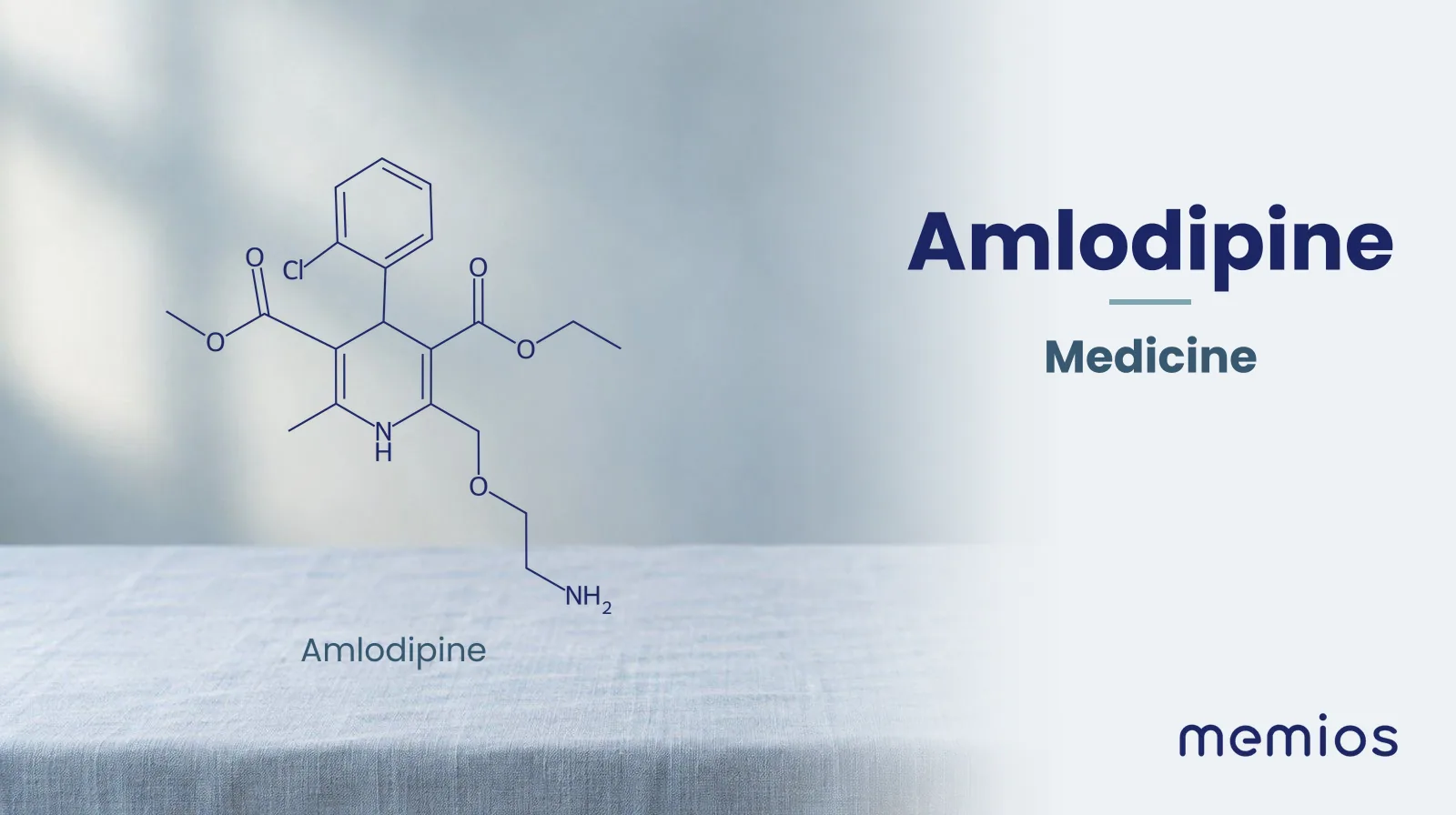
- What it is: Amlodipine is a prescription blood-pressure medicine of the dihydropyridine calcium channel blocker class.
- Main use: High blood pressure (to lower cardiovascular risk) (well supported).
- Other approved uses: Chronic stable angina (evidence not rated).
- Recommended dose (official position): The dose is set by the prescriber. As a position, the US label (revised 2/2025) gives a usual starting dose of 5 mg once daily for high blood pressure.
- Studied dose (a trial dose, not a recommendation): ALLHAT gave amlodipine 2.5 to 10 mg per day. Findings citing that trial: 1 against, 1 on harm.
- Upper limit: As a position, the US label gives a maximum of 10 mg once daily.
- What goes wrong: 6 findings on harm. In ALLHAT, heart failure was more common with amlodipine than with chlorthalidone.
- Interactions: 3 recorded, including CYP3A inhibitors (moderate and strong), Simvastatin, Grapefruit juice.
- Common myth: Ankle swelling on amlodipine is rare.
What it is
Amlodipine is a prescription blood-pressure medicine of the dihydropyridine calcium channel blocker class. It blocks calcium from entering the muscle cells of blood vessel walls and heart muscle, with a greater effect on blood vessels.
What the research says
In large outcome trials amlodipine-based treatment lowered blood pressure and cardiovascular events about as well as a thiazide diuretic (ALLHAT) and better than an atenolol-based regimen (ASCOT-BPLA), but ALLHAT recorded more heart failure than with the diuretic. Ankle swelling is its best-known side effect and rises with dose.
Evidence grade: Well established.
How it works
Drug class: Dihydropyridine calcium channel blocker
Amlodipine blocks calcium from flowing into the smooth muscle of artery walls, so the arteries relax and widen, resistance to blood flow falls, and blood pressure drops. (Source 1)
What it is used for
- Large outcome trials support it: in ALLHAT it matched chlorthalidone on the main coronary outcome, and in ASCOT-BPLA an amlodipine-based regimen had fewer strokes and deaths than an atenolol-based one. Evidence: established. (Source 2)
- The label lists this use. We did not review angina trials in this pass, so we do not rate the evidence here. Evidence: unknown. (Source 3)
Interactions
- CYP3A inhibitors (moderate and strong) (label): Raise amlodipine levels in the blood; the label says the dose may need lowering. (Source 4)
- Simvastatin (label): Amlodipine raises simvastatin levels; the label limits simvastatin to 20 mg a day with amlodipine. (Source 5)
- Grapefruit juice (pharmacokinetic study): In a small study of healthy volunteers, grapefruit juice raised amlodipine levels in the blood, but not by enough to significantly change blood pressure or heart rate. The authors said the interaction still cannot be ignored, because people vary a lot and drinking more grapefruit juice might have a bigger effect. (Source 6)
Stopping it
- A 2025 Cochrane review update in older people (all blood-pressure drugs, not this drug alone) found that stopping blood-pressure drugs may make little or no difference to death, hospital admission or stroke, but may raise blood pressure; effects on heart attack and on side effects were very uncertain. (Source 7)
- The review rated the evidence low to very low certainty, mainly because the studies were small and events were few. (Source 7)
What goes wrong
In ALLHAT, heart failure was more common with amlodipine than with chlorthalidone. (Source 2)
- Randomized trial, Moderate certainty.
- Size: 33,357 participants.
- Who: adults 55+ with hypertension and another risk factor.
- How long: mean 4.9 years.
- Result: 6-year heart failure rate 10.2% vs 7.7%; RR 1.38 (1.25-1.52), about 2.5 percentage points absolute.
- Funding: not stated in the abstract we read.
For amlodipine vs chlorthalidone, secondary outcomes were similar except for a higher 6-year rate of HF with amlodipine (10.2% vs 7.7%; RR, 1.38; 95% CI, 1.25-1.52).
Pooled trials show calcium channel blockers roughly triple the rate of peripheral (ankle) oedema compared with control. (Source 8)
- Meta-analysis, Low certainty.
- Size: 106 studies, 99,469 participants.
- Who: people in randomised trials of calcium channel blockers.
- How long: mean follow-up 27 weeks.
- Result: Oedema 10.7% on CCBs vs 3.2% on control; rising from 2.3% at 4 weeks to 23.8% at 26+ weeks. CRD reviewers called the conclusions tentative.
- Funding: not stated in the abstract we read.
CCBs were associated with a significantly higher peripheral oedema rate (10.7%, 95% CI 10.6 to 10.9; number of studies not reported).
The same meta-analysis found oedema rates rose with dose. (Source 9)
- Meta-analysis, Low certainty.
- Size: 106 studies.
- Who: people in randomised trials of calcium channel blockers.
- How long: up to 66 months.
- Result: 5.7% with low-dose vs 16.1% with high-dose CCBs.
- Funding: not stated in the abstract we read.
Dosage of CCB significantly influenced peripheral oedema rates: incidence of oedema was 5.7% (95% CI 5.5 to 5.9) with low-dose CCBs and 16.1% (95% CI 15.9 to 16.3) with high-dose CCBs (number of studies not reported).
Oedema led more people to stop calcium channel blockers than stopped control treatment. (Source 10)
- Meta-analysis, Low certainty.
- Size: 39 trials for this outcome.
- Who: people in randomised trials of calcium channel blockers.
- How long: median under 6 months for most trials.
- Result: Withdrawal for oedema 2.1% vs 0.5%; up to 5.5% with long-term use.
- Funding: not stated in the abstract we read.
CCBs were associated with a significantly higher patient withdrawal rate (2.1%, 95% CI 1.9 to 2.2; 39 trials).
The label warns that symptomatic low blood pressure can occur. (Source 11)
- Official position, Certainty not rated.
- Size: n/a.
- Who: label population.
- How long: n/a.
- Result: No rate given in the passage read.
- Funding: n/a (regulatory label)
Symptomatic hypotension is possible, particularly in patients with severe aortic stenosis.
SPRINT's more intensive blood-pressure target came with more serious adverse events of low blood pressure, fainting, electrolyte problems and acute kidney injury. (Source 12)
- Randomized trial, Moderate certainty.
- Size: 9,361 participants.
- Who: adults at high cardiovascular risk without diabetes.
- How long: median 3.26 years.
- Result: Higher rates of serious hypotension, syncope, electrolyte abnormalities and acute kidney injury in the intensive group; injurious falls not higher.
- Funding: National Institutes of Health.
Rates of serious adverse events of hypotension, syncope, electrolyte abnormalities, and acute kidney injury or failure, but not of injurious falls, were higher in the intensive-treatment group than in the standard-treatment group.
What the evidence supports
In ASCOT-BPLA, an amlodipine-based regimen (with perindopril added as needed) had fewer strokes, cardiovascular events and deaths than an atenolol-based regimen, though its main coronary endpoint was not significantly different; the result reflects the combination, not amlodipine alone. (Source 13)
- Randomized trial, Moderate certainty.
- Size: 19,257 patients.
- Who: adults 40-79 with hypertension and at least three other risk factors.
- How long: median 5.5 years (stopped early)
- Result: Stroke 327 vs 422 (HR 0.77, 0.66-0.89); all-cause mortality 738 vs 820 (HR 0.89, 0.81-0.99); primary endpoint HR 0.90 (0.79-1.02), not significant.
- Funding: not stated in the abstract we read.
The amlodipine-based regimen prevented more major cardiovascular events and induced less diabetes than the atenolol-based regimen.
Across 48 randomised trials of blood-pressure-lowering drugs of all classes, the rate of major cardiovascular events was lower in treated groups, in people with and without prior cardiovascular disease. (Source 14)
- Meta-analysis, High certainty.
- Size: 344,716 participants in 48 randomised trials.
- Who: adults in blood-pressure-lowering trials, with and without previous cardiovascular disease.
- How long: median 4.15 years.
- Result: Without previous CVD: 31.9 vs 25.9 major CV events per 1000 person-years (comparator vs intervention). With previous CVD: 39.7 vs 36.0 per 1000 person-years. HR per 5 mm Hg systolic reduction 0.91 (0.89-0.94) and 0.89 (0.86-0.92).
- Funding: British Heart Foundation, UK NIHR, Oxford Martin School (independent)
In participants without previous cardiovascular disease at baseline, the incidence rate for developing a major cardiovascular event per 1000 person-years was 31·9 (95% CI 31·3–32·5) in the comparator group and 25·9 (25·4–26·4) in the intervention group.
The same individual-participant meta-analysis found that each 5 mm Hg fall in systolic pressure was linked to about a 10% lower risk of major cardiovascular events, regardless of prior disease; this is a class-wide result, not specific to one drug. (Source 15)
- Meta-analysis, High certainty.
- Size: 344,716 participants in 48 randomised trials.
- Who: adults in blood-pressure-lowering trials.
- How long: median 4.15 years.
- Result: About 10% relative reduction per 5 mm Hg systolic reduction.
- Funding: British Heart Foundation, UK NIHR, Oxford Martin School (independent)
a 5 mm Hg reduction of systolic blood pressure reduced the risk of major cardiovascular events by about 10%, irrespective of previous diagnoses of cardiovascular disease,
In SPRINT, targeting systolic pressure below 120 rather than below 140 mm Hg in high-risk adults without diabetes lowered the rate of the primary cardiovascular outcome; this tests treatment intensity, using any drugs, not this drug specifically. (Source 12)
- Randomized trial, Moderate certainty.
- Size: 9,361 participants.
- Who: adults aged 50+ at high cardiovascular risk without diabetes, systolic 130 mm Hg or higher.
- How long: median 3.26 years (stopped early)
- Result: Primary outcome 1.65% vs 2.19% per year (HR 0.75, 0.64-0.89); all-cause mortality HR 0.73 (0.60-0.90). Absolute difference about 0.54 percentage points per year.
- Funding: National Institutes of Health.
The intervention was stopped early after a median follow-up of 3.26 years owing to a significantly lower rate of the primary composite outcome in the intensive-treatment group than in the standard-treatment group (1.65% per year vs. 2.19% per year; hazard ratio with intensive treatment, 0.75; 95% confidence interval [CI], 0.64 to 0.89; P<0.001).
The Hygia trial reported that taking blood-pressure drugs at bedtime rather than on waking was followed by markedly fewer major cardiovascular events (see the disagreement with the TIME trial). (Source 16)
- Randomized trial, Low certainty.
- Size: 19,084 patients.
- Who: hypertensive patients in Spanish primary care.
- How long: 6.3-year median follow-up.
- Result: Adjusted HR for primary CVD outcome 0.55 (95% CI 0.50-0.61)
- Funding: not stated in the abstract we read.
Routine ingestion by hypertensive patients of ≥1 prescribed BP-lowering medications at bedtime, as opposed to upon waking, results in improved ABP control (significantly enhanced decrease in asleep BP and increased sleep-time relative BP decline, i.e. BP dipping) and, most importantly, markedly diminished occurrence of major CVD events.
What the evidence does not support
In ALLHAT, amlodipine was no better than the diuretic chlorthalidone at preventing fatal coronary heart disease or non-fatal heart attack. (Source 2)
- Randomized trial, Moderate certainty.
- Size: 33,357 participants (9,048 on amlodipine)
- Who: adults 55+ with hypertension and at least one other coronary risk factor, 623 North American centres.
- How long: mean 4.9 years.
- Result: 6-year rate 11.3% amlodipine vs 11.5% chlorthalidone; RR 0.98 (0.90-1.07)
- Funding: not stated in the abstract we read.
The primary outcome occurred in 2956 participants, with no difference between treatments.
ASCOT-BPLA's primary endpoint (non-fatal heart attack and fatal coronary disease) was not significantly reduced by the amlodipine-based regimen. (Source 17)
- Randomized trial, Moderate certainty.
- Size: 19,257 patients.
- Who: adults 40-79 with hypertension and three or more other risk factors.
- How long: median 5.5 years.
- Result: 429 vs 474 primary events; unadjusted HR 0.90 (0.79-1.02), p=0.1052.
- Funding: not stated in the abstract we read.
Though not significant, compared with the atenolol-based regimen, fewer individuals on the amlodipine-based regimen had a primary endpoint (429 vs 474; unadjusted HR 0.90, 95% CI 0.79-1.02, p=0.1052),
The UK TIME trial found no difference in major cardiovascular outcomes between evening and morning dosing of usual blood-pressure drugs. (Source 18)
- Randomized trial, Moderate certainty.
- Size: 21,104 participants.
- Who: adults with hypertension in the UK (90.5% White)
- How long: median 5.2 years.
- Result: Primary endpoint 3.4% evening vs 3.7% morning; unadjusted HR 0.95 (0.83-1.10); p=0.53. Open-label, blinded end-point design.
- Funding: British Heart Foundation.
Evening dosing of usual antihypertensive medication was not different from morning dosing in terms of major cardiovascular outcomes.
Where the evidence is mixed
Independent reviewers at the Centre for Reviews and Dissemination rated the oedema meta-analysis's conclusions as tentative. (Source 19)
- Official position, Low certainty.
- Size: n/a.
- Who: n/a.
- How long: n/a.
- Result: Quality appraisal of the review.
- Funding: not stated.
Given a lack of clarity on quality and potential for bias in the review process, the authors' conclusions should be considered tentative.
Where the research disagrees
Whether taking blood-pressure drugs at bedtime prevents more heart attacks and strokes than morning dosing
- Hermida and colleagues (Hygia Chronotherapy Trial, 2020), randomised endpoint trial, 19,084 patients, one research network: Routine ingestion by hypertensive patients of ≥1 prescribed BP-lowering medications at bedtime, as opposed to upon waking, results in improved ABP control (significantly enhanced decrease in asleep BP and increased sleep-time relative BP decline, i.e. BP dipping) and, most importantly, markedly diminished occurrence of major CVD events. (Source 16)
- Mackenzie and colleagues (TIME study, 2022), randomised, open-label, blinded end-point trial, 21,104 participants: Evening dosing of usual antihypertensive medication was not different from morning dosing in terms of major cardiovascular outcomes. (Source 18)
Whether grapefruit juice affects amlodipine
- Josefsson and colleagues (1996), randomised crossover pharmacokinetic study, 12 healthy men, single 5 mg dose: An interaction between grapefruit juice and amlodipine was demonstrated. (Source 6)
- US amlodipine label (revised 2/2025), regulatory label position: Co-administered cimetidine, magnesium-and aluminum hydroxide antacids, sildenafil, and grapefruit juice have no impact on the exposure to amlodipine. (Source 20)
How much
- Reference intake: The dose is set by the prescriber. As a position, the US label (revised 2/2025) gives a usual starting dose of 5 mg once daily for high blood pressure. (Source 21)
- Upper limit: As a position, the US label gives a maximum of 10 mg once daily. (Source 21)
- Studied: ALLHAT gave amlodipine 2.5 to 10 mg per day. (Source 2)
- Studied: ASCOT-BPLA gave amlodipine 5-10 mg with perindopril 4-8 mg added as required. (Source 17)
A common belief, and what the research shows
The belief: Ankle swelling on amlodipine is rare.
What the research shows: Pooled trials put oedema at about 10.7% on calcium channel blockers against 3.2% on control, and higher at higher doses: "CCBs were associated with a significantly higher peripheral oedema rate (10.7%, 95% CI 10.6 to 10.9; number of studies not reported)."
Questions and answers
What is it?
Amlodipine is a prescription blood-pressure medicine. It belongs to the dihydropyridine calcium channel blocker family. (Source 22)
What does it do in the body?
It acts directly on the muscle in artery walls, widening the arteries, which lowers resistance to blood flow and lowers blood pressure. (Source 1)
Is it good or bad for you?
For people with high blood pressure, an amlodipine-based regimen prevented more major cardiovascular events and caused less diabetes than an atenolol-based regimen in the ASCOT-BPLA trial. Its harms are listed in the findings. (Source 13)
How do you get more of it?
The prescriber sets the dose. As a regulatory position, the US label gives a usual starting dose of 5 mg once daily and a maximum of 10 mg once daily. (Source 21)
If it is harmful, what reduces it?
Its main side effect is ankle swelling (oedema). A summary of pooled trials of calcium channel blockers found swelling was dose-related: about 5.7% at low doses against 16.1% at high doses. (Source 9)
Why might someone be low in it or missing it?
Does not apply. Amlodipine is a prescription medicine, not a nutrient or a substance the body makes, so there is no deficiency state; the label describes it as a treatment. (Source 23)
We searched: DailyMed label indications and mechanism sections; Cochrane and trial literature on this drug
Which whole foods contain it or feed it?
No food contains amlodipine. In a small study, grapefruit juice raised amlodipine levels, but not by enough to change blood pressure or heart rate. (Source 6)
What happens if you do not have it?
Nobody needs amlodipine in the way they need a nutrient; it matters only for people it is prescribed to. In a Cochrane review of older people whose blood-pressure drugs were stopped, blood pressure may rise. (Source 7)
How can you test for it?
No routine test of amlodipine levels is described in the sources we read. The label notes that CYP3A-inhibiting drugs raise amlodipine exposure and may require a lower dose; its effect is tracked by blood-pressure measurement in the trials. (Source 4)
We searched: DailyMed amlodipine label (dosing, interactions, pharmacology) and the outcome trials above; no drug-level test described
References
- US National Library of Medicine, DailyMed (FDA-approved label). Amlodipine besylate tablets - prescribing information (DailyMed), revised 2/2025. 2025. Read the source
- JAMA. Major outcomes in high-risk hypertensive patients randomized to angiotensin-converting enzyme inhibitor or calcium channel blocker vs diuretic: The Antihypertensive and Lipid-Lowering Treatment to Prevent Heart Attack Trial (ALLHAT). 2002. PMID 12479763, DOI 10.1001/jama.288.23.2981. Read the source
- US National Library of Medicine, DailyMed (FDA-approved label). Amlodipine besylate tablets - prescribing information (DailyMed), revised 2/2025. 2025. Read the source
- US National Library of Medicine, DailyMed (FDA-approved label). Amlodipine besylate tablets - prescribing information (DailyMed), revised 2/2025. 2025. Read the source
- US National Library of Medicine, DailyMed (FDA-approved label). Amlodipine besylate tablets - prescribing information (DailyMed), revised 2/2025. 2025. Read the source
- European Journal of Clinical Pharmacology. Effect of grapefruit juice on the pharmacokinetics of amlodipine in healthy volunteers. 1996. PMID 8911887, DOI 10.1007/s002280050183. Read the source
- Cochrane Database of Systematic Reviews. What are the effects of stopping blood pressure medications in older people? (Cochrane review CD012572, withdrawal of antihypertensive drugs in older people, 2025 update). 2025. Read the source
- Centre for Reviews and Dissemination, Database of Abstracts of Reviews of Effects (DARE), summarising Makani et al., Journal of Hypertension 2011. The quoted words are the DARE summary's, not the original authors'.. Peripheral edema associated with calcium channel blockers: incidence and withdrawal rate; a meta-analysis of randomized trials (DARE structured abstract, Centre for Reviews and Dissemination). 2011. PMID 21558959, DOI 10.1097/hjh.0b013e3283472643. Read the source
- Centre for Reviews and Dissemination, Database of Abstracts of Reviews of Effects (DARE), summarising Makani et al., Journal of Hypertension 2011. The quoted words are the DARE summary's, not the original authors'.. Peripheral edema associated with calcium channel blockers: incidence and withdrawal rate; a meta-analysis of randomized trials (DARE structured abstract, Centre for Reviews and Dissemination). 2011. PMID 21558959, DOI 10.1097/hjh.0b013e3283472643. Read the source
- Centre for Reviews and Dissemination, Database of Abstracts of Reviews of Effects (DARE), summarising Makani et al., Journal of Hypertension 2011. The quoted words are the DARE summary's, not the original authors'.. Peripheral edema associated with calcium channel blockers: incidence and withdrawal rate; a meta-analysis of randomized trials (DARE structured abstract, Centre for Reviews and Dissemination). 2011. PMID 21558959, DOI 10.1097/hjh.0b013e3283472643. Read the source
- US National Library of Medicine, DailyMed (FDA-approved label). Amlodipine besylate tablets - prescribing information (DailyMed), revised 2/2025. 2025. Read the source
- New England Journal of Medicine. A Randomized Trial of Intensive versus Standard Blood-Pressure Control. 2015. PMID 26551272, DOI 10.1056/nejmoa1511939. Read the source
- Lancet. Prevention of cardiovascular events with an antihypertensive regimen of amlodipine adding perindopril as required versus atenolol adding bendroflumethiazide as required, in the Anglo-Scandinavian Cardiac Outcomes Trial-Blood Pressure Lowering Arm (ASCOT-BPLA): a multicentre randomised controlled trial. 2005. PMID 16154016, DOI 10.1016/s0140-6736(05)67185-1. Read the source
- Lancet. Pharmacological blood pressure lowering for primary and secondary prevention of cardiovascular disease across different levels of blood pressure: an individual participant-level data meta-analysis. 2021. PMID 33933205, DOI 10.1016/S0140-6736(21)00590-0. Read the source
- Lancet. Pharmacological blood pressure lowering for primary and secondary prevention of cardiovascular disease across different levels of blood pressure: an individual participant-level data meta-analysis. 2021. PMID 33933205, DOI 10.1016/S0140-6736(21)00590-0. Read the source
- European Heart Journal. Bedtime hypertension treatment improves cardiovascular risk reduction: the Hygia Chronotherapy Trial. 2020. PMID 31641769, DOI 10.1093/eurheartj/ehz754. Read the source
- Lancet. Prevention of cardiovascular events with an antihypertensive regimen of amlodipine adding perindopril as required versus atenolol adding bendroflumethiazide as required, in the Anglo-Scandinavian Cardiac Outcomes Trial-Blood Pressure Lowering Arm (ASCOT-BPLA): a multicentre randomised controlled trial. 2005. PMID 16154016, DOI 10.1016/s0140-6736(05)67185-1. Read the source
- Lancet. Cardiovascular outcomes in adults with hypertension with evening versus morning dosing of usual antihypertensives in the UK (TIME Study): a prospective, randomised, open-label, blinded end-point clinical trial. 2022. PMID 36240838, DOI 10.1016/S0140-6736(22)01786-X. Read the source
- Centre for Reviews and Dissemination, Database of Abstracts of Reviews of Effects (DARE), summarising Makani et al., Journal of Hypertension 2011. The quoted words are the DARE summary's, not the original authors'.. Peripheral edema associated with calcium channel blockers: incidence and withdrawal rate; a meta-analysis of randomized trials (DARE structured abstract, Centre for Reviews and Dissemination). 2011. PMID 21558959, DOI 10.1097/hjh.0b013e3283472643. Read the source
- US National Library of Medicine, DailyMed (FDA-approved label). Amlodipine besylate tablets - prescribing information (DailyMed), revised 2/2025. 2025. Read the source
- US National Library of Medicine, DailyMed (FDA-approved label). Amlodipine besylate tablets - prescribing information (DailyMed), revised 2/2025. 2025. Read the source
- US National Library of Medicine, DailyMed (FDA-approved label). Amlodipine besylate tablets - prescribing information (DailyMed), revised 2/2025. 2025. Read the source
- US National Library of Medicine, DailyMed (FDA-approved label). Amlodipine besylate tablets - prescribing information (DailyMed), revised 2/2025. 2025. Read the source