Medications · September 29, 2026 · Memios · 14 min read
Amitriptyline
For depression, a Cochrane review of 39 trials found amitriptyline clearly beat placebo on response, but the trials were old and poorly reported.
TLDR
- Boxed warning: Amitriptyline hydrochloride tablets are not approved for use in pediatric patients.
- Limited evidence. For depression, a Cochrane review of 39 trials found amitriptyline clearly beat placebo on response, but the trials were old and poorly reported.
- What it is: Amitriptyline is a tricyclic antidepressant taken by mouth as a tablet.
- Main use: Major depressive disorder (well supported).
- Off-label uses (not on the FDA label): Neuropathic pain (painful diabetic neuropathy, post-herpetic neuralgia and similar) (disputed); Irritable bowel syndrome, second line in primary care (limited evidence).
- Recommended dose (official position): Dose is set by the prescriber, not by the reader. As a position, the manufacturer's label (Rev: 08/2025) states: 'For outpatients, 75 mg of amitriptyline hydrochloride a day in divided doses is usually satisfactory.'
- Studied dose (a trial dose, not a recommendation): The ATLANTIS trial gave 10 mg once daily, self-titrated by participants to a maximum of 30 mg once daily, for 6 months. Findings citing that trial: 1 for, 1 on harm.
- Upper limit: We did not capture a maximum-dose sentence from the label sections we transcribed; the label states that dose is adjusted to clinical response and not to plasma levels.
- What goes wrong: 5 findings on harm. In the 6-month IBS trial, withdrawal because of adverse events was more common on amitriptyline than placebo.
- Interactions: 3 recorded, including St John's wort (Hypericum perforatum), Alcohol, barbiturates and other central nervous system depressants, Monoamine oxidase inhibitors (including the antidepressant class and linezolid-type drugs).
- Common myth: Amitriptyline is a proven painkiller for nerve pain because doctors have prescribed it for that for forty years.
What it is
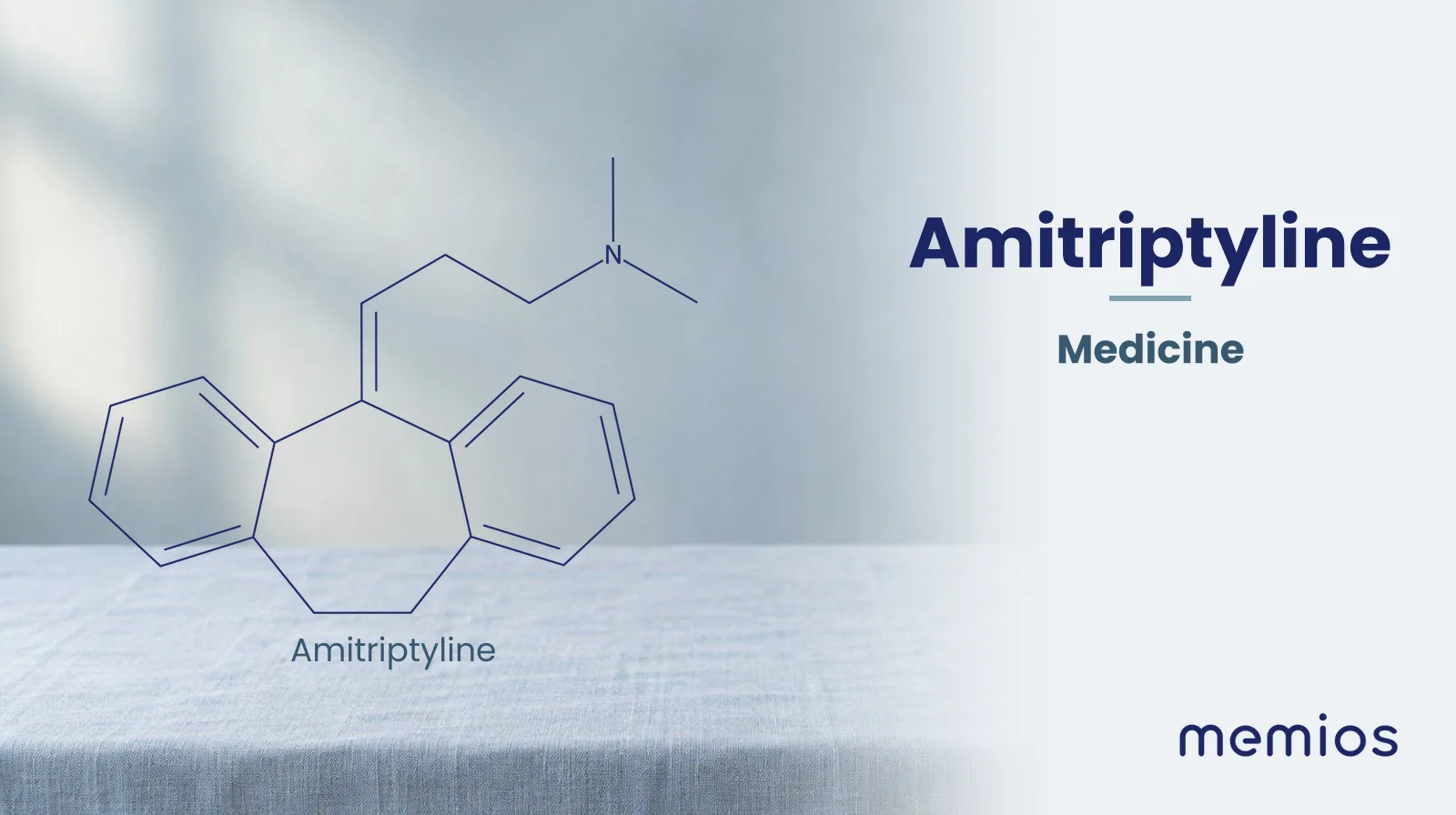
Amitriptyline is a tricyclic antidepressant taken by mouth as a tablet. In the body it blocks the reuptake transporters that recycle noradrenaline and serotonin back into nerve endings, and it also blocks acetylcholine, histamine and alpha-adrenergic receptors, which is where most of its side effects come from. In the United States the label approves it only for depression, but most of the modern trial evidence concerns pain and gut symptoms, where it is used off-label at much lower doses.
What the research says
For depression, a Cochrane review of 39 trials found amitriptyline clearly beat placebo on response, but the trials were old and poorly reported. For neuropathic pain, where it has been first-line for decades, Cochrane found no unbiased evidence of benefit - not evidence that it does not work, but trials too small and too flawed to show it does. For irritable bowel syndrome, a 2023 primary-care trial at 10-30 mg found a modest but real improvement. Side effects are common and dose-limiting in every one of these settings.
Evidence grade: Limited evidence.
How it works
Drug class: Tricyclic antidepressant (TCA); noradrenaline and serotonin reuptake inhibitor
Amitriptyline blocks the pumps that pull noradrenaline and serotonin back into nerve endings, so more of these signalling chemicals stay in the gap between nerves. It also blocks acetylcholine, histamine and alpha-adrenergic receptors, which produces dry mouth, constipation, blurred vision, drowsiness and dizziness on standing. (Source 1)
Boxed warning
Antidepressants increased the risk compared to placebo of suicidal thinking and behavior (suicidality) in children, adolescents and young adults in short-term studies of major depressive disorder (MDD) and other psychiatric disorders. Anyone considering the use of amitriptyline hydrochloride tablets or any other antidepressant in a child, adolescent, or young adult must balance this risk with the clinical need. Short-term studies did not show an increase in the risk of suicidality with antidepressants compared to placebo in adults beyond age 24; there was a reduction in risk with antidepressants compared to placebo in adults aged 65 and older. Depression and certain other psychiatric disorders are themselves associated with increases in the risk of suicide. Patients of all ages who are started on antidepressant therapy should be monitored appropriately and observed closely for clinical worsening, suicidality, or unusual changes in behavior. Families and caregivers should be advised of the need for close observation and communication with the prescriber. Amitriptyline hydrochloride tablets are not approved for use in pediatric patients.
(Source 2)
What it is used for
- A Cochrane review of 39 placebo-controlled trials (3,509 people) found amitriptyline roughly doubled to trebled the odds of acute response compared with placebo, but the review itself says the trials were poorly reported and possibly biased, and far more people stopped amitriptyline because of side effects. Evidence: established. (Source 3)
- Cochrane pooled 17 studies in 1,342 people and concluded there is no unbiased evidence of benefit; the trials were small and at high risk of bias. The review does not say amitriptyline fails, only that the evidence cannot show that it works, while adverse events were clearly more common than with placebo. Evidence: disputed. (Source 4)
- In the ATLANTIS randomised trial, 463 adults took 10 mg titrated to a maximum 30 mg once daily or placebo for 6 months; the IBS symptom severity score was 27.0 points lower on amitriptyline (95% CI -46.9 to -7.10; p = 0.008). One trial is not a literature, and withdrawals for adverse events were more frequent on the drug. Evidence: limited. (Source 5)
Interactions
- St John's wort (Hypericum perforatum) (pharmacokinetic study): St John's wort induces CYP3A4 and P-glycoprotein and has been shown in human studies to lower blood levels of amitriptyline, which could reduce its effect. (Source 6)
- Alcohol, barbiturates and other central nervous system depressants (label): Amitriptyline adds to the sedating effect of alcohol and other depressant drugs. (Source 1)
- Monoamine oxidase inhibitors (including the antidepressant class and linezolid-type drugs) (label): The label states the two must not be given together; the combination can cause severe, sometimes fatal reactions. (Source 1)
Stopping it
- The label records that stopping abruptly after long use can cause nausea, headache and malaise. (Source 1)
- A systematic review of antidepressants as a class (not amitriptyline specifically) found withdrawal effects are common, often severe and often longer than guidelines assume. (Source 7)
- The same review found that in about half of those affected the withdrawal was rated at the top of the severity scale offered. (Source 7)
What goes wrong
More than half of people taking amitriptyline in neuropathic pain trials reported at least one adverse event, against about a third on placebo. (Source 4)
- Systematic review, Low certainty.
- Size: 17 studies, 1,342 participants.
- Who: Adults with neuropathic pain.
- How long: Mostly short trials.
- Result: 55% versus 36%; RR 1.5 (95% CI 1.3 to 1.8); number needed to treat for an additional harmful outcome 5.2 (3.6 to 9.1); serious adverse events rare.
- Funding: not stated.
More participants experienced at least one adverse event; 55% of participants taking amitriptyline and 36% taking placebo.
In depression trials, people stopped amitriptyline because of side effects about four times as often as they stopped placebo. (Source 3)
- Systematic review, Low certainty.
- Size: 19 RCTs, n = 2174 for the side-effect withdrawal outcome.
- Who: Adults with major depressive disorder.
- How long: Acute-phase trials.
- Result: OR 4.15, 95% CI 2.71 to 6.35 for withdrawal due to side effects.
- Funding: not stated.
but more amitriptyline-treated participants withdrew due to side effects (19 RCTs, n = 2174, OR 4.15, 95% CI 2.71 to 6.35)
Anticholinergic and cardiac side effects, sedation, weight gain and sexual dysfunction were all more common on amitriptyline than placebo. (Source 3)
- Systematic review, Low certainty.
- Size: 39 trials, 3,509 participants.
- Who: Adults with major depressive disorder.
- How long: Acute-phase trials.
- Result: Reported as a list of more frequent events rather than as rates.
- Funding: not stated.
Limit of this finding: The review's own sentence lists 'sedation' twice; that is how the Cochrane abstract prints it and it is left uncorrected here. It is one side effect, not two.
Amitriptyline also caused more anticholinergic side effects, tachycardia, dizziness, nervousness, sedation, tremor, dyspepsia, sedation, sexual dysfunction and weight gain.
In the 6-month IBS trial, withdrawal because of adverse events was more common on amitriptyline than placebo. (Source 5)
- Randomized trial, Moderate certainty.
- Size: 463 participants.
- Who: Adults with irritable bowel syndrome in primary care.
- How long: 6 months.
- Result: 12.9% versus 8.7% withdrew for adverse events; most adverse events mild.
- Funding: NIHR Health Technology Assessment programme (publicly funded)
Adverse event trial withdrawals were more common with amitriptyline (12.9% vs. 8.7% for placebo) but most adverse events were mild.
The US label records cardiac conduction effects and reports of myocardial infarction and stroke with this drug class - a regulator's position dated 08/2025, not a trial result. (Source 1)
- Official position, Certainty not rated.
- Size: Not applicable.
- Who: People prescribed tricyclic antidepressants.
- How long: Not applicable.
- Result: No rates given in the label text we read.
- Funding: Manufacturer label.
Tricyclic antidepressant drugs, including amitriptyline hydrochloride, particularly when given in high doses, have been reported to produce arrhythmias, sinus tachycardia, and prolongation of the conduction time.
What the evidence supports
In placebo-controlled trials in major depression, amitriptyline produced substantially more acute responders than placebo. (Source 3)
- Systematic review, Low certainty.
- Size: 39 trials, 3,509 participants (18 RCTs, n = 1987 for the response outcome)
- Who: Adults with major depressive disorder.
- How long: Acute-phase trials.
- Result: OR 2.67, 95% CI 2.21 to 3.23 for acute response; trim-and-fill adjusted OR 2.64, 95% CI 2.24 to 3.10.
- Funding: not stated in the summary we read; the review notes possible publication bias.
Limit of this finding: The review included 39 trials and 3,509 people in total, but this response estimate rests on the 18 trials and 1,987 people that reported it. Do not read the larger total as the denominator for the odds ratio.
Amitriptyline was significantly more effective than placebo in achieving acute response (18 RCTs, n = 1987, OR 2.67, 95% CI 2.21 to 3.23).
In a 6-month primary-care randomised trial, low-dose amitriptyline improved irritable bowel syndrome severity scores more than placebo. (Source 5)
- Randomized trial, Moderate certainty.
- Size: 463 participants (232 amitriptyline, 231 placebo)
- Who: Adults with irritable bowel syndrome in UK primary care whose symptoms had not responded to first-line treatment.
- How long: 6 months.
- Result: IBS Severity Scoring System difference -27.0, 95% CI -46.9 to -7.10; p = 0.008.
- Funding: NIHR Health Technology Assessment programme (publicly funded)
An intention-to-treat analysis of the primary outcome showed a significant difference in favour of amitriptyline for irritable bowel syndrome Severity Scoring System score between arms at 6 months [−27.0, 95% confidence interval (CI) −46.9 to −7.10; p = 0.008].
What the evidence does not support
Cochrane found no unbiased evidence that amitriptyline relieves neuropathic pain, despite decades of first-line use. (Source 8)
- Systematic review, Very low certainty.
- Size: 17 studies, 1,342 participants.
- Who: Adults with seven different neuropathic pain conditions.
- How long: Mostly short cross-over and parallel-group trials.
- Result: No pooled efficacy estimate was considered reliable; the review reports that supportive unbiased evidence is absent.
- Funding: not stated.
The fact that there is no supportive unbiased evidence for a beneficial effect is disappointing, but has to be balanced against decades of successful treatment in many people with neuropathic pain.
Where the evidence is mixed
The same Cochrane review judges the depression trial evidence poorly reported and open to bias. (Source 3)
- Systematic review, Low certainty.
- Size: 39 trials, 3,509 participants.
- Who: Adults with major depressive disorder.
- How long: Acute-phase trials.
- Result: No numeric effect; a quality judgement on the included trials.
- Funding: not stated.
However, methods of randomisation, allocation concealment and blinding were usually poorly reported.
The neuropathic-pain review stresses this is absence of evidence rather than evidence of absence, and that only a minority get satisfactory relief. (Source 8)
- Systematic review, Very low certainty.
- Size: 17 studies, 1,342 participants.
- Who: Adults with neuropathic pain.
- How long: Mostly short trials.
- Result: Qualitative conclusion.
- Funding: not stated.
Amitriptyline should continue to be used as part of the treatment of neuropathic pain, but only a minority of people will achieve satisfactory pain relief.
Where the research disagrees
Whether amitriptyline should still be used for neuropathic pain when trials cannot demonstrate benefit
- Moore and colleagues, Cochrane 2015, systematic-review of 17 studies, 1,342 participants: There is no good evidence of a lack of effect; rather our concern should be of overestimation of treatment effect. (Source 8)
- The same review, on practice, systematic-review conclusion: Amitriptyline should continue to be used as part of the treatment of neuropathic pain, but only a minority of people will achieve satisfactory pain relief. (Source 8)
How much
- Reference intake: Dose is set by the prescriber, not by the reader. As a position, the manufacturer's label (Rev: 08/2025) states: 'For outpatients, 75 mg of amitriptyline hydrochloride a day in divided doses is usually satisfactory.' (Source 1)
- Upper limit: We did not capture a maximum-dose sentence from the label sections we transcribed; the label states that dose is adjusted to clinical response and not to plasma levels. No upper limit is stated here. (Source 1)
- Studied: The ATLANTIS trial gave 10 mg once daily, self-titrated by participants to a maximum of 30 mg once daily, for 6 months. (Source 5)
- Studied: The Cochrane neuropathic pain review pooled 17 studies in 1,342 participants across seven neuropathic pain conditions; doses were not captured in the passage we transcribed. (Source 4)
A common belief, and what the research shows
The belief: Amitriptyline is a proven painkiller for nerve pain because doctors have prescribed it for that for forty years.
What the research shows: Length of use is not evidence. Cochrane's 2015 review of 17 studies in 1,342 people concluded: 'The fact that there is no supportive unbiased evidence for a beneficial effect is disappointing, but has to be balanced against decades of successful treatment in many people with neuropathic pain.' The adverse-event side of the ledger is better measured: 'More participants experienced at least one adverse event; 55% of participants taking amitriptyline and 36% taking placebo.'
Questions and answers
What is it?
Amitriptyline is a prescription tricyclic antidepressant tablet, first marketed in the 1960s. Its approved use in the United States is depression, but it is widely prescribed at lower doses for pain and gut symptoms. It has been used as a first-line nerve-pain treatment for decades. (Source 8)
What does it do in the body?
It blocks the transporters that pull noradrenaline and serotonin back into nerve endings, so those signals persist longer. It also blocks acetylcholine, histamine and alpha-adrenergic receptors, which is why dry mouth, constipation, drowsiness and dizziness are so common. (Source 1)
Is it good or bad for you?
It depends entirely on the condition and the dose. In depression it clearly outperformed placebo in old trials of modest quality. In neuropathic pain Cochrane could not find unbiased evidence of benefit, and says only a minority get satisfactory relief. Side effects are frequent in every setting, and the label carries a boxed warning about suicidal thinking in people under 25. (Source 8)
How do you get more of it?
Amitriptyline is prescription-only and there is no food or supplement source of it. Dose is set and changed by the prescriber. As a position, the label states the usual outpatient dose, but this is not a recommendation to the reader. (Source 1)
If it is harmful, what reduces it?
Reducing or stopping amitriptyline is a decision for the prescriber, because both the drug's effects and withdrawal effects matter. The label records that stopping abruptly after prolonged use can cause nausea, headache and malaise, which is why tapering rather than sudden cessation is discussed in the literature on antidepressants. (Source 1)
Why might someone be low in it or missing it?
This question is about nutrients and does not apply directly to a prescribed drug. The nearest equivalent is why people stop taking it: in depression trials people left amitriptyline because of side effects about four times as often as they left placebo. (Source 3)
Which whole foods contain it or feed it?
No whole food contains amitriptyline. The food-related point that matters is alcohol: the label records that amitriptyline increases the effect of alcohol and other sedating drugs. (Source 1)
What happens if you do not have it?
Not taking amitriptyline is not a deficiency. What the trials show is the size of what is forgone: in depression it produced markedly more acute responders than placebo, while in neuropathic pain the evidence cannot show a benefit at all. (Source 3)
How can you test for it?
Blood levels of amitriptyline can be measured, but the label says they correlate poorly with benefit and are mainly useful for suspected toxicity, suspected non-absorption, or in elderly patients. Dose is adjusted by response, not by the blood test. (Source 1)
References
- DailyMed (US National Library of Medicine) / manufacturer label, Rev: 08/2025. AMITRIPTYLINE HYDROCHLORIDE tablet, film coated - clinical pharmacology, warnings, dosage. label revision Rev: 08/2025 (AiPing Pharmaceutical, Inc.). Read the source
- DailyMed (US National Library of Medicine) / manufacturer label, Rev: 08/2025. AMITRIPTYLINE HYDROCHLORIDE tablet, film coated - boxed warning and indications. label revision Rev: 08/2025 (AiPing Pharmaceutical, Inc.). Read the source
- Cochrane Database of Systematic Reviews (plain-language evidence page, cochrane.org). Amitriptyline versus placebo for major depressive disorder (Main results). 2012. PMID 23235671, DOI 10.1002/14651858.CD009138.pub2. Read the source
- Cochrane Database of Systematic Reviews (abstract on cochrane.org). Amitriptyline for neuropathic pain in adults (Main results). 2015. PMID 26146793, DOI 10.1002/14651858.CD008242.pub3. Read the source
- NIHR Health Technology Assessment (NCBI Bookshelf). Low-dose titrated amitriptyline as second-line treatment for adults with irritable bowel syndrome in primary care: the ATLANTIS RCT. 2024. DOI 10.3310/BFCR7986. Read the source
- Journal of Psychopharmacology 18(2): 262-276. Pharmacokinetic Interactions of Drugs with St John's Wort. 2004. PMID 15260917, DOI 10.1177/0269881104042632. Read the source
- Addictive Behaviors 97: 111-121. A systematic review into the incidence, severity and duration of antidepressant withdrawal effects: Are guidelines evidence-based?. 2019. PMID 30292574, DOI 10.1016/j.addbeh.2018.08.027. Read the source
- Cochrane Database of Systematic Reviews (abstract on cochrane.org). Amitriptyline for neuropathic pain in adults (Authors' conclusions). 2015. PMID 26146793, DOI 10.1002/14651858.CD008242.pub3. Read the source