Medications · September 30, 2026 · Memios · 25 min read
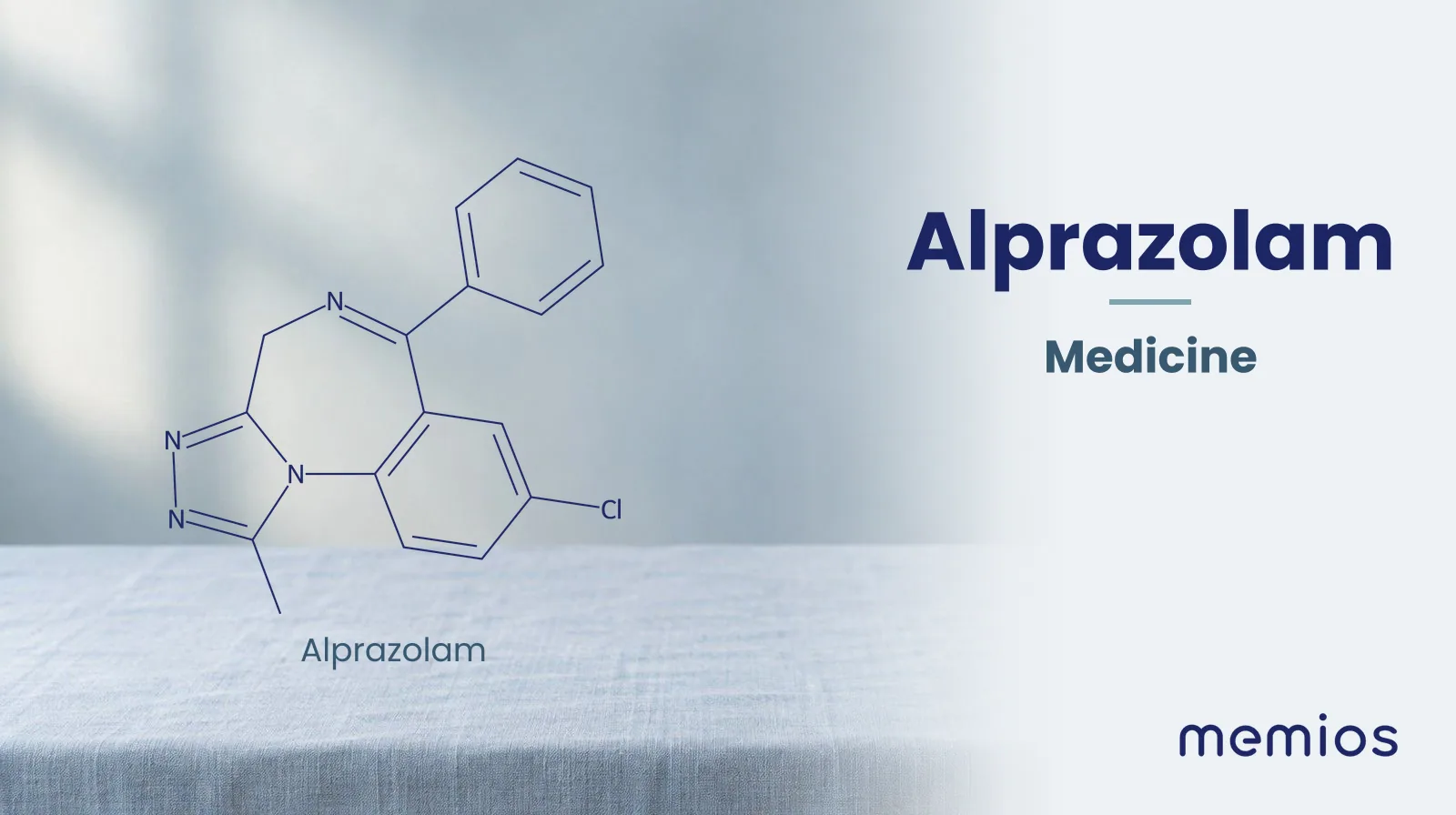
Alprazolam
Cochrane's review of benzodiazepines against placebo in panic disorder found a clear short-term advantage (response RR 1.65) but rated the evidence low quality.
TLDR
- Boxed warning: Limit dosages and durations to the minimum required.
- Limited evidence. Cochrane's review of benzodiazepines against placebo in panic disorder found a clear short-term advantage (response RR 1.65) but rated the evidence low quality.
- What it is: Alprazolam is a synthetic triazolobenzodiazepine, a prescription-only Schedule IV controlled substance in the United States, taken as immediate-release or extended-release tablets or orally disintegrating tablets.
- Main use: Panic disorder, with or without agoraphobia, in adults (limited evidence).
- Other approved uses: Acute treatment of generalised anxiety disorder in adults (limited evidence).
- Off-label uses (not on the FDA label): Depression (disputed).
- Recommended dose (official position): There is no reference intake for a medicine. Dose is set by the prescriber; as a position, the US label (revised 1/2025) says dosages and durations should be limited to the minimum required.
- Studied dose (a trial dose, not a recommendation): Controlled panic disorder trials used 1 mg to 10 mg daily. No finding here cites that trial.
- Upper limit: As a position, the US label states that the controlled panic disorder trials used dosages in the range of 1 mg to 10 mg daily, with a mean of about 5 mg to 6 mg daily, and that safety and efficacy beyond 10 weeks in panic disorder are not known.
- What goes wrong: 6 findings on harm. A crossover pharmacokinetic study in 12 healthy volunteers found 14 days of St John's wort halved alprazolam exposure and doubled its clearance.
- Interactions: 4 recorded, including Opioid painkillers, Alcohol and other central nervous system depressants, St John's wort (Hypericum perforatum), Grapefruit juice.
- Common myth: Grapefruit juice is dangerous with all benzodiazepines, and alprazolam is a safe long-term anxiety treatment as long as the dose stays low.
What it is
Alprazolam is a synthetic triazolobenzodiazepine, a prescription-only Schedule IV controlled substance in the United States, taken as immediate-release or extended-release tablets or orally disintegrating tablets. It is approved for the acute treatment of generalised anxiety disorder and for panic disorder with or without agoraphobia in adults. It is cleared by the CYP3A4 enzyme, which is why CYP3A4 inducers such as St John's wort change its levels.
What the research says
Cochrane's review of benzodiazepines against placebo in panic disorder found a clear short-term advantage (response RR 1.65) but rated the evidence low quality, and a separate Cochrane review of alprazolam in depression found it beat placebo yet was no better than tricyclic antidepressants and rested on poor-quality short-term studies. The harms are the reason this drug is contentious: more people report at least one adverse effect than on placebo (RR 1.18) and more drop out because of them (RR 1.58), and the boxed warning covers death with opioids, abuse and addiction, and life-threatening withdrawal. A large claims analysis linked concurrent benzodiazepine and opioid prescriptions to roughly double the odds of opioid overdose.
Evidence grade: Limited evidence.
How it works
Drug class: Triazolobenzodiazepine; GABA A receptor positive allosteric modulator (benzodiazepine anxiolytic)
Alprazolam binds the benzodiazepine site on GABA-A receptors in the brain and strengthens the inhibitory signalling GABA already produces, which quietens over-active circuits and reduces anxiety and panic. The same action produces sedation, poorer coordination and, with repeated use, tolerance and physical dependence. (Source 1)
Boxed warning
WARNING: RISKS FROM CONCOMITANT USE WITH OPIOIDS; ABUSE, MISUSE, AND ADDICTION; and DEPENDENCE AND WITHDRAWAL REACTIONS
(Source 2)
What it is used for
- Cochrane pooled 24 benzodiazepine trials (4233 participants) and found response RR 1.65 (95% CI 1.39 to 1.96) against placebo, but rated the evidence low quality and found more adverse effects and more adverse-effect dropouts. The label states that safety and efficacy beyond 10 weeks are not known. Evidence: limited. (Source 3)
- The approved indication is acute treatment only, and the label states that safety and effectiveness beyond 4 months in anxiety disorder are not known. We did not reach a systematic review specific to alprazolam in generalised anxiety disorder in this run. Evidence: limited. (Source 4)
- A Cochrane review of 21 studies (2693 participants) found alprazolam better than placebo (risk difference 0.32 for 50% improvement, three people treated for one extra responder) but no better than conventional antidepressants on continuous severity and worse on the pass-or-fail measure, on studies it called heterogeneous and of poor quality, addressing only short-term effects. Evidence: disputed. (Source 5)
Interactions
- Opioid painkillers (label): Taking alprazolam with an opioid can cause deep sedation, slowed breathing, coma and death. A claims analysis of 315428 people found roughly double the adjusted odds of opioid overdose when the two were prescribed together. (Source 2)
- Alcohol and other central nervous system depressants (label): Alcohol adds to alprazolam's sedation and impairment, which is why the label tells prescribers to caution patients about drinking during treatment. (Source 6)
- St John's wort (Hypericum perforatum) (pharmacokinetic study): Two weeks of St John's wort doubled how fast healthy volunteers cleared alprazolam and halved its half-life, so the drug would be expected to work less well and for less long. (Source 7)
- Grapefruit juice (pharmacokinetic study): Unlike many drugs handled by CYP3A4, alprazolam levels were unchanged by 600 ml of grapefruit juice a day for a week or more, in both healthy volunteers and patients. The authors attribute this to alprazolam's high oral bioavailability. (Source 8)
Stopping it
- The boxed warning's position is that stopping suddenly or cutting the dose quickly after continued use can cause acute withdrawal reactions that may be life-threatening, and that a gradual taper is used to reduce that risk. The label also records withdrawal seizures after rapid decrease or abrupt discontinuation. (Source 2)
- The label states that some risk of dependence exists even after relatively short-term use at doses of 4 mg a day or less. (Source 9)
- Cochrane reviewed 38 trials of medicines intended to help people come off long-term benzodiazepines and concluded that the evidence is too weak and too sparse to draw firm conclusions, so there is no drug shortcut to stopping. (Source 10)
What goes wrong
In the same review more people on benzodiazepines dropped out because of adverse effects, and more reported at least one adverse effect, than on placebo. (Source 3)
- Systematic review, Low certainty.
- Size: 4233 participants across 24 studies.
- Who: adults with panic disorder.
- How long: short-term trials.
- Result: dropouts due to adverse effects RR 1.58 (95% CI 1.16 to 2.15); at least one adverse effect RR 1.18 (95% CI 1.02 to 1.37); both low-quality evidence.
- Funding: Cochrane review, independent.
the number of dropouts due to adverse effects was higher with benzodiazepines than with placebo (RR 1.58, 95% CI 1.16 to 2.15; low-quality evidence)
In a retrospective analysis of 315 428 privately insured US adults taking opioids, having a benzodiazepine prescription at the same time was associated with roughly double the adjusted odds of an emergency room visit or admission for opioid overdose. (Source 11)
- Cohort study, Low certainty.
- Size: 315 428 privately insured people aged 18-64 who filled at least one opioid prescription.
- Who: US adults aged 18-64 in an administrative health claims database.
- How long: claims data from 2001 to 2013.
- Result: adjusted odds ratio 2.14 (95% CI 2.05 to 2.24; P<0.001) in all opioid users; 1.42 (1.33 to 1.51) in intermittent users; 1.81 (1.67 to 1.96) in chronic users; concurrent use rose from 9% in 2001 to 17% in 2013.
- Funding: not stated in the passage recorded.
Compared with opioid users who did not use benzodiazepines, concurrent use of both drugs was associated with an increased risk of an emergency room visit or inpatient admission for opioid overdose (adjusted odds ratio 2.14, 95% confidence interval 2.05 to 2.24; P<0.001) among all opioid users.
The authors conclude that concurrent benzodiazepine and opioid use rose sharply over 2001 to 2013 and contributed to the overall population risk of opioid overdose. (Source 12)
- Cohort study, Low certainty.
- Size: 315 428 privately insured people aged 18-64.
- Who: US adults aged 18-64 with opioid prescriptions.
- How long: claims data from 2001 to 2013.
- Result: no separate estimate; the authors' summary of the trend and its population impact.
- Funding: not stated in the passage recorded.
Limit of this finding: This is a study of insurance claims, so it can show that two prescriptions went together with more overdoses, not that one caused the other. The authors' own results section says 'If this association is causal' before giving the 15% figure, but their conclusion then says the combination 'significantly contributed to' overdose risk, which sounds causal. Take the association as real and well measured; treat the 15% as a what-if, not a measured effect of stopping the combination.
From 2001 to 2013, concurrent benzodiazepine/opioid use sharply increased in a large sample of privately insured patients in the US and significantly contributed to the overall population risk of opioid overdose.
A crossover pharmacokinetic study in 12 healthy volunteers found 14 days of St John's wort halved alprazolam exposure and doubled its clearance. (Source 13)
- Blood level study, Moderate certainty.
- Size: 12 healthy volunteers (6 men and 6 women) aged 22 to 38 years.
- Who: healthy volunteers given 2 mg alprazolam as a CYP3A4 probe.
- How long: probe doses before and after 14 days of St John's wort 300 mg three times daily.
- Result: two-fold decrease in alprazolam AUC and two-fold increase in clearance; elimination half-life shortened from a mean (SD) of 12.4 (3.9) hours to 6.0 (2.4) hours.
- Funding: not stated in the passage recorded.
A 2-fold decrease in the area under the curve for alprazolam plasma concentration vs time
The US label carries a boxed warning that benzodiazepines including alprazolam expose users to abuse, misuse and addiction that can lead to overdose or death. (Source 2)
- Official position, Certainty not rated.
- Size: not stated; class-wide regulatory review.
- Who: all patients prescribed benzodiazepines.
- How long: risk present with continued use; the label states some dependence risk even after relatively short-term use at 4 mg/day or less.
- Result: no rate given in the boxed warning.
- Funding: regulatory position (US FDA-approved labelling, revised 1/2025)
The use of benzodiazepines, including alprazolam, exposes users to risks of abuse, misuse, and addiction, which can lead to overdose or death.
The same boxed warning states that stopping alprazolam abruptly or cutting the dose quickly after continued use may cause acute withdrawal reactions that can be life-threatening. (Source 2)
- Official position, Certainty not rated.
- Size: not stated; postmarketing and trial experience.
- Who: patients who have taken alprazolam continuously.
- How long: on stopping or reducing the dose.
- Result: no rate given; the label separately records reports of withdrawal seizures on rapid decrease or abrupt discontinuation.
- Funding: regulatory position (US FDA-approved labelling, revised 1/2025)
Abrupt discontinuation or rapid dosage reduction of alprazolam after continued use may precipitate acute withdrawal reactions, which can be life-threatening.
What the evidence supports
Cochrane found benzodiazepines superior to placebo for short-term response in panic disorder, on low-quality evidence, with about four people needing treatment for one extra responder. (Source 3)
- Systematic review, Low certainty.
- Size: 4233 participants across 24 studies, 2124 randomised to benzodiazepines and 1475 to placebo.
- Who: adults with panic disorder, with or without agoraphobia.
- How long: short-term trials only.
- Result: response RR 1.65 (95% CI 1.39 to 1.96), NNTB 4 (95% CI 3 to 7); remission RR 1.61 (95% CI 1.38 to 1.88); social functioning SMD -0.53 (95% CI -0.65 to -0.42); dropout RR 0.50 (95% CI 0.39 to 0.64), NNTB 6 (95% CI 5 to 9)
- Funding: Cochrane review, independent; included trials largely industry sponsored.
The estimated risk ratio (RR) for a response to treatment was 1.65 (95% confidence interval (CI) 1.39 to 1.96) in favour of benzodiazepines
Cochrane's review of alprazolam in depression found it produced more clinical responses than placebo, with about three people needing treatment for one extra responder. (Source 5)
- Systematic review, Low certainty.
- Size: 2693 participants across 21 alprazolam studies (22 reports); 771 in placebo comparisons and 1765 in cyclic antidepressant comparisons.
- Who: adults with depression.
- How long: typically four to six weeks.
- Result: risk difference for 50% improvement 0.32 in favour of alprazolam (95% CI 0.22 to 0.42), NNTB 3 (95% CI 2 to 5); continuous mean difference -5.34 (95% CI -7.48 to -3.20); all-cause withdrawals no different from placebo.
- Funding: not stated in the passage recorded.
The risk difference (RD) for the dichotomous measure of clinical response (50% improvement) was 0.32 in favour of alprazolam (95% CI 0.22 to 0.42; I2 =0%), with a number needed to treat to benefit (NNTB) of 3 (95% CI 2 to 5).
What the evidence does not support
The same review found alprazolam no different from conventional antidepressants when depression severity was measured on a continuous scale. (Source 5)
- Systematic review, Low certainty.
- Size: 2693 participants across 21 studies; 1765 in antidepressant comparisons.
- Who: adults with depression.
- How long: typically four to six weeks.
- Result: mean difference 0.25 (95% CI -0.93 to 1.43; I2 = 55%), neither statistically nor clinically different.
- Funding: not stated in the passage recorded.
When depression severity was measured as a continuum the effect of alprazolam did not differ statistically or clinically from the effects of any of the conventional antidepressants combined (MD 0.25, 95% CI -0.93 to 1.43; I2 = 55%).
On the pass-or-fail measure of depression severity the same review found alprazolam did less well than conventional antidepressants. (Source 5)
- Systematic review, Low certainty.
- Size: 2693 participants across 21 studies; 1765 in antidepressant comparisons.
- Who: adults with depression.
- How long: typically four to six weeks.
- Result: RR 0.86 (95% CI 0.75 to 0.99); risk difference -0.11 (95% CI -0.24 to 0.01); NNTB 9 (95% CI 4 to 100)
- Funding: not stated in the passage recorded.
Limit of this finding: The review's two ways of measuring the same comparison disagree. The risk ratio (0.86, interval 0.75 to 0.99) says alprazolam did worse than antidepressants by a margin that just clears statistical significance; the risk difference in the same bracket (-0.11, interval -0.24 to 0.01) includes zero, which means no difference. Read it as a hint that alprazolam is not better than an antidepressant, not as a settled finding that it is worse.
However, for dichotomised depression severity, alprazolam had less effect than antidepressants (RR 0.86, 95% CI 0.75 to 0.99; I2 =37%; RD -0.11, 95% CI -0.24 to 0.01; I2 = 58%; NNTB 9, 95% CI 4 to 100).
Repeated grapefruit juice did not change alprazolam blood levels or most measures of psychomotor function, unlike its effect on many other CYP3A4 drugs. (Source 8)
- Blood level study, Low certainty.
- Size: eight healthy volunteers in study 1 and 11 patients with anxiety disorders in study 2.
- Who: healthy volunteers given a single 0.8 mg dose, and patients taking alprazolam 0.8-2.4 mg/day.
- How long: 600 ml/day grapefruit juice for 10 days (study 1) and 7 days (study 2)
- Result: no change in plasma concentrations at any time point, no change in pharmacokinetic parameters, and no change in steady-state concentration or clinical status.
- Funding: not stated in the passage recorded.
Grapefruit juice altered neither the plasma concentrations of alprazolam at any time points, any pharmacokinetic parameters
Cochrane found the evidence too weak to say whether any medicine helps people come off long-term benzodiazepines. (Source 10)
- Systematic review, Very low certainty.
- Size: 38 trials involving 2543 participants; data extractable from 35 trials with 2295 participants across 18 comparisons.
- Who: people treated with benzodiazepines for more than two months or diagnosed with benzodiazepine dependence.
- How long: end of intervention and longest available follow-up.
- Result: no firm conclusions possible; adverse events could not be reliably assessed because of poor reporting.
- Funding: Cochrane review, independent.
it is not possible to draw firm conclusions regarding pharmacological interventions to facilitate benzodiazepine discontinuation in chronic benzodiazepine users.
The Medication Guide bound to the label states that it is not known whether alprazolam is safe and effective beyond 10 weeks in panic disorder or beyond 4 months in anxiety disorder. (Source 14)
- Official position, Certainty not rated.
- Size: not stated; the controlled trials were short.
- Who: adults treated for panic disorder or anxiety disorder.
- How long: beyond 10 weeks (panic disorder) and beyond 4 months (anxiety disorder)
- Result: no long-term efficacy estimate exists.
- Funding: regulatory position (US FDA-approved labelling, Medication Guide, revised 1/2025)
It is not known if alprazolam is safe and effective when used to treat panic disorder for longer than 10 weeks. It is not known if alprazolam is safe and effective when used to treat anxiety disorder for longer than 4 months.
Where the evidence is mixed
The same review judged the methodological quality of its included studies poor, with 20 of the 24 at high risk of bias in at least one domain. (Source 3)
- Systematic review, Low certainty.
- Size: 24 studies, 4233 participants.
- Who: adults with panic disorder.
- How long: short-term trials.
- Result: all 24 studies at unclear risk of bias in at least three domains; 20 of 24 at high risk of bias in at least one domain.
- Funding: Cochrane review, independent.
In addition, we judged 20 of the 24 included studies as having a high risk of bias in at least one domain.
The review's own conclusion describes the advantage over placebo as only possible, on low-quality evidence, and only in the short term. (Source 15)
- Systematic review, Low certainty.
- Size: 4233 participants across 24 studies.
- Who: adults with panic disorder.
- How long: short-term trials.
- Result: quality of evidence rated low for both primary outcomes and very low for other secondary outcomes.
- Funding: Cochrane review, independent.
Low-quality evidence shows a possible superiority of benzodiazepine over placebo in the short-term treatment of panic disorders.
The review states that none of its trials looked at long-term benefit or at the risks of dependency and withdrawal at all. (Source 15)
- Systematic review, Low certainty.
- Size: 24 studies, 4233 participants.
- Who: adults with panic disorder.
- How long: short-term only; no long-term data.
- Result: no long-term efficacy estimate and no dependency or withdrawal outcomes were examined; the authors also flag possible unmasking, high dropout and probable publication bias.
- Funding: Cochrane review, independent.
Moreover, the included studies were only short-term studies and did not examine the long-term efficacy nor the risks of dependency and withdrawal symptoms.
The alprazolam-for-depression review judged its included studies heterogeneous and of poor quality, addressing only short-term effects, with six at high risk of bias. (Source 16)
- Systematic review, Very low certainty.
- Size: 21 studies, 2693 participants.
- Who: adults with depression.
- How long: short-term only.
- Result: no effect estimate; a quality judgement, and the authors add that their withdrawal findings should be read with caution given the dependency properties of benzodiazepines.
- Funding: not stated in the passage recorded.
However, the studies included in the review were heterogeneous, of poor quality and only addressed short-term effects, thus limiting our confidence in the findings.
The same paper projects that, if the association is causal, ending concurrent benzodiazepine and opioid use would cut opioid-related emergency visits and overdose admissions by about 15%. (Source 11)
- Cohort study, Low certainty.
- Size: 315 428 privately insured people aged 18-64.
- Who: US adults aged 18-64 with opioid prescriptions.
- How long: claims data from 2001 to 2013.
- Result: an estimated 15% reduction (95% CI 14 to 16), stated by the authors as conditional on the association being causal.
- Funding: not stated in the passage recorded.
Limit of this finding: This is a study of insurance claims, so it can show that two prescriptions went together with more overdoses, not that one caused the other. The authors' own results section says 'If this association is causal' before giving the 15% figure, but their conclusion then says the combination 'significantly contributed to' overdose risk, which sounds causal. Take the association as real and well measured; treat the 15% as a what-if, not a measured effect of stopping the combination.
If this association is causal, elimination of concurrent benzodiazepine/opioid use could reduce the risk of emergency room visits related to opioid use and inpatient admissions for opioid overdose by an estimated 15% (95% confidence interval 14 to 16).
The only discontinuation signals that review found came from single small trials, and it rated risk of bias high in all trials but one. (Source 17)
- Systematic review, Very low certainty.
- Size: 38 trials, 2543 participants; the valproate signal rests on 1 study of 27 participants and the tricyclic signal on 1 study of 47 participants.
- Who: chronic benzodiazepine users attempting discontinuation.
- How long: end of intervention and longest follow-up.
- Result: valproate RR 2.55 (95% CI 1.08 to 6.03), very low quality; tricyclic antidepressants RR 2.20 (95% CI 1.27 to 3.82), low quality; risk of bias high in all trials but one; Trial Sequential Analysis showed imprecision for all comparisons.
- Funding: Cochrane review, independent.
For benzodiazepine discontinuation, we found a potential benefit of valproate at end of intervention (1 study, 27 participants; risk ratio (RR) 2.55, 95% confidence interval (CI) 1.08 to 6.03; very low-quality evidence) and of tricyclic antidepressants at longest follow-up (1 study, 47 participants; RR 2.20, 95% CI 1.27 to 3.82; low-quality evidence).
Where the research disagrees
Whether the short-term benefit of alprazolam in panic disorder justifies the dependence and overdose risk
- Cochrane review of benzodiazepines versus placebo for panic disorder (2019), systematic review and meta-analysis of 24 randomised trials, 4233 participants, rated low quality: Low-quality evidence shows a possible superiority of benzodiazepine over placebo in the short-term treatment of panic disorders. (Source 15)
- US FDA-approved labelling for alprazolam (revised 1/2025), regulatory position based on class-wide safety review: Abrupt discontinuation or rapid dosage reduction of alprazolam after continued use may precipitate acute withdrawal reactions, which can be life-threatening. (Source 2)
How much
- Reference intake: There is no reference intake for a medicine. Dose is set by the prescriber; as a position, the US label (revised 1/2025) says dosages and durations should be limited to the minimum required. (Source 2)
- Upper limit: As a position, the US label states that the controlled panic disorder trials used dosages in the range of 1 mg to 10 mg daily, with a mean of about 5 mg to 6 mg daily, and that safety and efficacy beyond 10 weeks in panic disorder are not known. (Source 18)
- Studied: Controlled panic disorder trials used 1 mg to 10 mg daily. (Source 18)
- Studied: The grapefruit juice study gave a single 0.8 mg dose to healthy volunteers and studied patients taking 0.8-2.4 mg/day. (Source 8)
- Studied: The St John's wort interaction study used a single 2 mg dose of alprazolam as a CYP3A4 probe. (Source 19)
A common belief, and what the research shows
The belief: Grapefruit juice is dangerous with all benzodiazepines, and alprazolam is a safe long-term anxiety treatment as long as the dose stays low.
What the research shows: For alprazolam specifically the grapefruit study concluded "grapefruit juice is unlikely to affect pharmacokinetics or pharmacodynamics of alprazolam due to its high bioavailability." The real documented supplement interaction runs the other way: St John's wort produced "A 2-fold decrease in the area under the curve for alprazolam plasma concentration vs time". And low dose is not a safeguard against dependence: the label states "Even after relatively short-term use at doses of ≤4 mg/day, there is some risk of dependence."
Questions and answers
What is it?
Alprazolam is a prescription benzodiazepine tablet and a Schedule IV controlled substance in the United States. It is approved for the acute treatment of generalised anxiety disorder and for panic disorder with or without agoraphobia in adults. It carries a boxed warning covering opioid co-use, abuse and addiction, and withdrawal. (Source 4)
What does it do in the body?
It binds the benzodiazepine site on GABA-A receptors and strengthens GABA's inhibitory signalling, damping down over-active circuits. That reduces anxiety and panic quickly, and also causes sedation and impaired coordination. With continued use the same mechanism produces tolerance and physical dependence. (Source 1)
Is it good or bad for you?
In the short term the pooled trials favour benzodiazepines over placebo in panic disorder (response RR 1.65), though Cochrane rated that low quality. Over longer periods the picture changes: the label says efficacy beyond 10 weeks is unknown, dependence can follow even short-term use at 4 mg a day or less, withdrawal can be life-threatening, and combining it with an opioid is associated with about double the odds of overdose. (Source 3)
How do you get more of it?
This does not apply as it would to a nutrient. Alprazolam is prescription-only and its dose is set by a prescriber; the boxed warning's position is that dosages and durations should be held to the minimum required. The controlled panic disorder trials used 1 mg to 10 mg daily. (Source 18)
If it is harmful, what reduces it?
Exposure is reduced by a prescriber tapering the dose gradually, not by stopping abruptly, because sudden withdrawal can be life-threatening and withdrawal seizures have been reported. Cochrane reviewed 38 trials of medicines meant to make coming off easier and found the evidence too weak to draw firm conclusions. (Source 20)
Why might someone be low in it or missing it?
Nobody is deficient in alprazolam; the body does not make it. Blood levels can drop for documented reasons though: St John's wort doubled its clearance and halved its half-life in healthy volunteers, and stopping the drug after continued use can trigger withdrawal rather than simply a return to baseline. (Source 13)
Which whole foods contain it or feed it?
No whole food contains alprazolam. On food and drink: grapefruit juice, which raises levels of many CYP3A4 drugs, did not change alprazolam levels or clinical status in either of two studies. Alcohol does matter, because the label warns about combining it with alprazolam. (Source 8)
What happens if you do not have it?
Nothing is lost physiologically. For someone with untreated panic disorder, the pooled trials suggest a lower chance of short-term response than on a benzodiazepine (RR 1.65 in favour of the drug), though on low-quality evidence. For someone already taking it, being without it suddenly is a different matter: withdrawal reactions can be life-threatening. (Source 3)
How can you test for it?
No validated test to decide whether someone needs alprazolam appears in the sources we reached; the trials measured panic and anxiety symptom response instead. Blood and urine benzodiazepine assays exist for detection, but the reviews and label we read do not describe a monitoring threshold that guides treatment. (Source 3)
We searched: Searched the Cochrane benzodiazepines-for-panic-disorder review, the Cochrane alprazolam-for-depression review, the Cochrane benzodiazepine discontinuation review and the US label; all report symptom-scale outcomes and none gives a validated diagnostic or monitoring test threshold.
References
- DailyMed (US National Library of Medicine), FDA-approved labelling, Revised: 1/2025. ALPRAZOLAM tablets, for oral use, CIV — section 12.1 Mechanism of Action, in full. 2025. Read the source
- DailyMed (US National Library of Medicine), FDA-approved labelling, labeller Mylan Pharmaceuticals Inc., Revised: 1/2025. ALPRAZOLAM tablets, for oral use, CIV — the complete BOXED WARNING, with its heading and its three bullets kept separate. 2025. Read the source
- Cochrane Database of Systematic Reviews 2019, Issue 3, Art. No.: CD010677. Benzodiazepines for panic disorder in adults — Main results section of the abstract, in full. 2019. PMID 30921478, DOI 10.1002/14651858.CD010677.pub2. Read the source
- DailyMed (US National Library of Medicine), FDA-approved labelling, Revised: 1/2025. ALPRAZOLAM tablets, for oral use, CIV — section 1 INDICATIONS AND USAGE, printed as a lead-in and two bullets. 2025. Read the source
- Cochrane Database of Systematic Reviews 2022, Issue 3, Art. No.: CD007139. Alprazolam for depression — Main results section of the abstract, in full. 2022. DOI 10.1002/14651858.CD007139.pub2. Read the source
- DailyMed (US National Library of Medicine), FDA-approved labelling, Revised: 1/2025. ALPRAZOLAM tablets, for oral use, CIV — section 5.4 Effects on Driving and Operating Machinery, in full. 2025. Read the source
- JAMA (repository copy of the published paper; Markowitz JS et al., JAMA 17 September 2003;290(11):1500-1504). Effect of St John's Wort on Drug Metabolism by Induction of Cytochrome P450 3A4 Enzyme — Conclusions section of the structured abstract, in full. 2003. PMID 13129991. Read the source
- Psychopharmacology. Effects of repeated ingestion of grapefruit juice on the single and multiple oral-dose pharmacokinetics and pharmacodynamics of alprazolam — the abstract in full. 2000. PMID 10907671, DOI 10.1007/s002130000438. Read the source
- DailyMed (US National Library of Medicine), FDA-approved labelling, Revised: 1/2025. ALPRAZOLAM tablets, for oral use, CIV — section 5.3 Dependence and Withdrawal Reactions, the short-term-use sentence. 2025. Read the source
- Cochrane Database of Systematic Reviews 2018, Issue 3, Art. No.: CD011481. Medications for discontinuation of long-term benzodiazepine use — Authors' conclusions section of the abstract, in full. 2018. DOI 10.1002/14651858.CD011481.pub2. Read the source
- BMJ. Association between concurrent use of prescription opioids and benzodiazepines and overdose: retrospective analysis — Results section of the structured abstract, in full. 2017. PMID 28292769, DOI 10.1136/bmj.j760. Read the source
- BMJ. Association between concurrent use of prescription opioids and benzodiazepines and overdose: retrospective analysis — Conclusions section of the structured abstract. 2017. PMID 28292769, DOI 10.1136/bmj.j760. Read the source
- JAMA (repository copy of the published paper; Markowitz JS et al., JAMA 17 September 2003;290(11):1500-1504). Effect of St John's Wort on Drug Metabolism by Induction of Cytochrome P450 3A4 Enzyme — Results section of the structured abstract, in full. 2003. PMID 13129991. Read the source
- DailyMed (US National Library of Medicine), FDA-approved labelling, Medication Guide, Revised: 1/2025. ALPRAZOLAM — MEDICATION GUIDE (the patient-facing document bound to the label, not the prescribing information): the two adjacent sentences on how long alprazolam has been studied. 2025. Read the source
- Cochrane Database of Systematic Reviews 2019, Issue 3, Art. No.: CD010677. Benzodiazepines for panic disorder in adults — Authors' conclusions section of the abstract, in full. 2019. PMID 30921478, DOI 10.1002/14651858.CD010677.pub2. Read the source
- Cochrane Database of Systematic Reviews 2022, Issue 3, Art. No.: CD007139. Alprazolam for depression — Authors' conclusions section of the abstract, in full. 2022. DOI 10.1002/14651858.CD007139.pub2. Read the source
- Cochrane Database of Systematic Reviews 2018, Issue 3, Art. No.: CD011481. Medications for discontinuation of long-term benzodiazepine use — Main results section of the abstract, first two paragraphs. 2018. DOI 10.1002/14651858.CD011481.pub2. Read the source
- DailyMed (US National Library of Medicine), FDA-approved labelling, Revised: 1/2025. ALPRAZOLAM tablets, for oral use, CIV — section 2.2 Dosage in panic disorder, the paragraph on the dosages used in the controlled trials. 2025. Read the source
- JAMA (repository copy of the published paper; Markowitz JS et al., JAMA 17 September 2003;290(11):1500-1504). Effect of St John's Wort on Drug Metabolism by Induction of Cytochrome P450 3A4 Enzyme — Intervention section of the structured abstract, in full. 2003. PMID 13129991. Read the source
- DailyMed (US National Library of Medicine), FDA-approved labelling, Revised: 1/2025. ALPRAZOLAM tablets, for oral use, CIV — section 6.1 Clinical Trials Experience, the withdrawal-seizure sentence. 2025. Read the source