Medications · September 30, 2026 · Memios · 25 min read
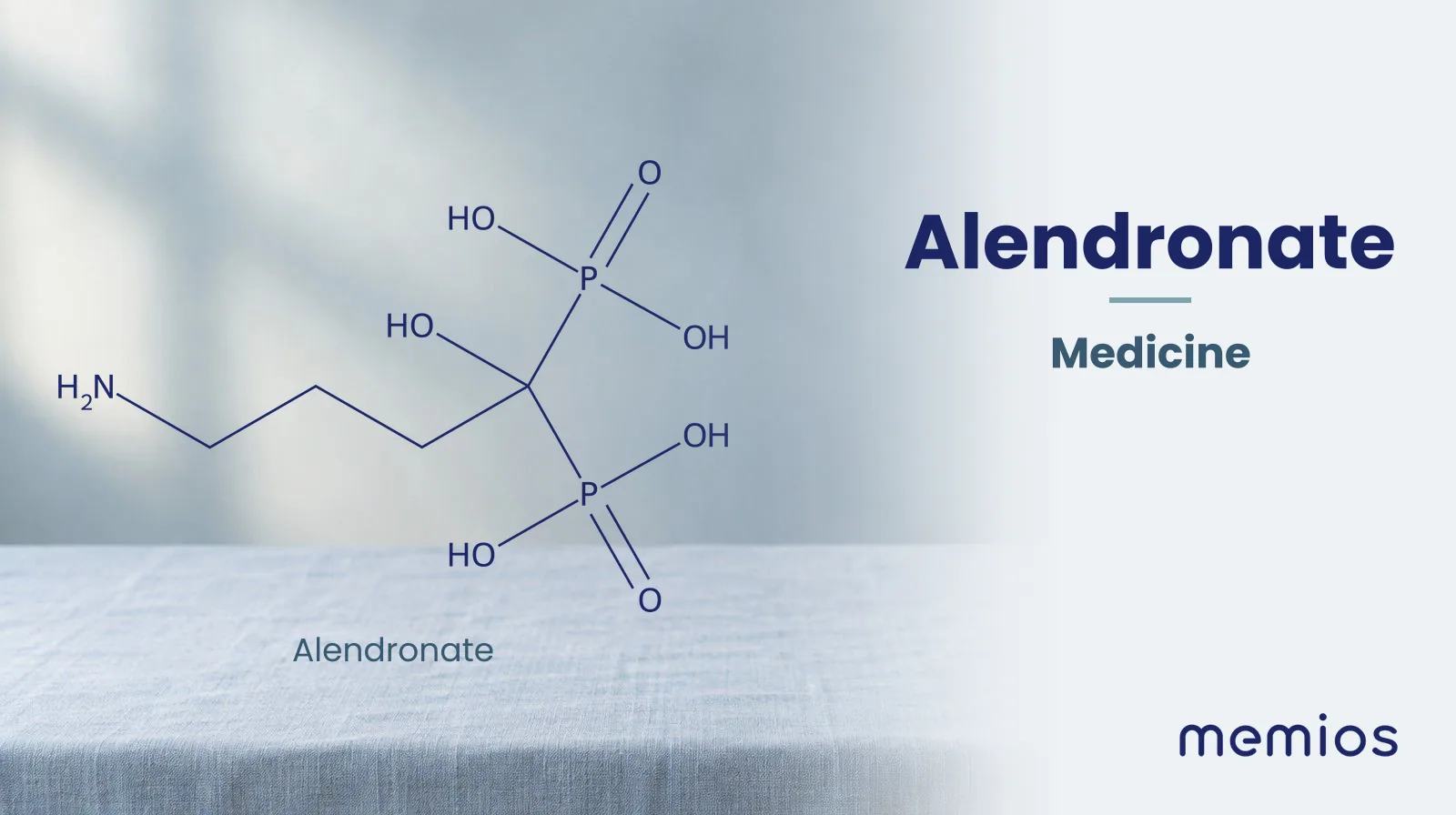
Alendronate
Well established. For postmenopausal women who already have low bone density or a previous fracture.
TLDR
- Well established. For postmenopausal women who already have low bone density or a previous fracture, the evidence that alendronate prevents further fractures is strong and quantified: a Cochrane review of 11 trials in 12,068 women found a 45% relative reduction in vertebral fracture.
- What it is: Alendronate is an oral prescription drug of the bisphosphonate class, given for osteoporosis and Paget's disease of bone.
- Main use: Secondary prevention of osteoporotic fracture in postmenopausal women (low bone density or prior vertebral fracture) (well supported).
- Other approved uses: Primary prevention of osteoporotic fracture in postmenopausal women without prior fracture or established osteoporosis (limited evidence); Osteoporosis in men (limited evidence); Glucocorticoid-induced osteoporosis (limited evidence) and 1 more.
- Uses NOT supported by research: Osteogenesis imperfecta in children.
- Recommended dose (official position): There is no reference intake: alendronate is a prescription medicine and the dose is set by the prescriber for the condition treated.
- Studied dose (a trial dose, not a recommendation): The Cochrane fracture results are for alendronate 10 mg per day. Findings citing that trial: 1 for, 1 against, 1 mixed, 1 on harm.
- Upper limit: There is no tolerable upper intake level of the kind set for nutrients.
- What goes wrong: 4 findings on harm. Long-term alendronate use was associated with osteonecrosis of the jaw at about 262 cases per 100,000 person-years in a national cohort, with tooth extraction the strongest single trigger.
- Interactions: 6 recorded, including Calcium supplements and antacids (and any product containing multivalent cations such as magnesium, iron or zinc), Coffee and orange juice, Any food or breakfast, Calcium supplement added on top of a meal.
- Common myth: It is fine to take your alendronate with breakfast, or with your morning coffee and your calcium tablet.
What it is
Alendronate is an oral prescription drug of the bisphosphonate class, given for osteoporosis and Paget's disease of bone. Bisphosphonates bind to bone mineral and are taken up by the cells that break bone down. It is very poorly absorbed from the gut: under fasting conditions only about 0.64% of a dose reaches the bloodstream in women and 0.59% in men, which is why the label instructs that it be swallowed with plain water well before any food or other medicine.
What the research says
For postmenopausal women who already have low bone density or a previous fracture, the evidence that alendronate prevents further fractures is strong and quantified: a Cochrane review of 11 trials in 12,068 women found a 45% relative reduction in vertebral fracture, with a number needed to treat of 16 for secondary prevention, and significant reductions in hip and wrist fracture in that group. For women without that prior risk, the picture is weaker: vertebral fracture reduction remained significant but nonvertebral and hip fracture reduction did not. In men it reduces vertebral fractures; the evidence for nonvertebral fractures in men is not statistically significant. In children with osteogenesis imperfecta it raised bone density substantially but did not reduce fractures. Harms that matter are upper gastrointestinal injury, osteonecrosis of the jaw (roughly 262 cases per 100,000 person-years in one national cohort of users, rising sharply after tooth extraction) and atypical femoral fractures, which rise steeply with years of use and fall quickly after stopping.
Evidence grade: Well established.
How it works
Drug class: Nitrogen-containing bisphosphonate (bone resorption inhibitor)
Alendronate sticks to bone mineral and is then taken up by osteoclasts, the cells that dissolve old bone. It disables those cells, so bone is broken down more slowly than it is rebuilt and bone density rises. Markers of bone turnover in the blood and urine fall within weeks, and rise again when the drug stops. (Source 1)
What it is used for
- A Cochrane review of 11 randomised trials in 12,068 women found alendronate 10 mg daily cut vertebral fractures by 45% (RR 0.55, 95% CI 0.43 to 0.69, absolute reduction 6%), nonvertebral fractures by 23% (RR 0.77, absolute reduction 2%), hip fractures by 53% (RR 0.47, absolute reduction 1%) and wrist fractures by 50% (RR 0.50, absolute reduction 2%) in this group. The American Family Physician commentators put the number needed to treat for one vertebral fracture prevented at 16 in this group. Evidence: established. (Source 1)
- The same Cochrane review found only vertebral fracture reduction reached significance for primary prevention (RR 0.55, 95% CI 0.38 to 0.80, absolute reduction 2%). Nonvertebral fracture reduction did not (RR 0.89, 95% CI 0.76 to 1.04), and hip fracture reduction was not significant in this group. The American Family Physician commentators put the number needed to treat for one vertebral fracture prevented at 50 here. Evidence: limited. (Source 1)
- Only two randomised trials totalling 375 men were available for meta-analysis. They were pooled with Bayesian methods that incorporated prior anti-fracture efficacy from meta-analyses in women, so the pooled figures are not male-only estimates: alendronate 10 mg daily gave a vertebral fracture odds ratio of 0.44 (95% credibility interval 0.23 to 0.83), while the non-vertebral figure was not statistically significant (0.60, 0.29 to 1.44) in a trial base the authors call too small to have the power to detect such an effect. The FDA label phrases this indication as treatment to increase bone mass in men, not as fracture prevention. Evidence: limited. (Source 2)
- Alendronate is licensed for this use, but a meta-analysis of 5 randomised trials found teriparatide reduced new vertebral fractures substantially more than alendronate (RR 0.13, 95% CI 0.05 to 0.34) and raised bone density more at spine, total hip and femoral neck. Nonvertebral fractures and adverse events did not differ between the two drugs. The abstract's stated total of 4102 patients across those 5 trials appears to be an error and should not be read as the size of the evidence base. Evidence: limited. (Source 3)
- This sits in the FDA label's indication list with a dose of 40 mg daily for six months, a regulatory position dated 2/2026. We did not reach a systematic review or trial of alendronate for Paget's disease in this run, so we record the position and no evidence grade of our own. Evidence: unknown. (Source 4)
- A 2-year multicentre double-blind randomised placebo-controlled trial in 139 children found oral alendronate raised spine bone mineral density by 51% versus 12% with placebo and cut bone turnover, but long-bone fracture incidence, vertebral height, bone pain and physical activity were the same as placebo. Density improved; fractures did not. Evidence: not-supported. (Source 5)
Interactions
- Calcium supplements and antacids (and any product containing multivalent cations such as magnesium, iron or zinc) (label): Taken at the same time, these bind alendronate in the gut and stop it being absorbed. Because alendronate is barely absorbed to begin with, this can wipe out the dose. (Source 4)
- Coffee and orange juice (pharmacokinetic study): Either drink taken with the tablet cuts the amount of alendronate absorbed by roughly 60% compared with plain water. (Source 6)
- Any food or breakfast (pharmacokinetic study): Swallowing alendronate with a meal, or even as late as two hours after one, can cut absorption by 85 to 90%. Taking it 30 to 60 minutes before breakfast rather than two hours before still loses about 40%. (Source 6)
- Calcium supplement added on top of a meal (pharmacokinetic study): One nuance from the same review: in the study where the tablet was taken with breakfast, adding a calcium supplement on top did not make absorption measurably worse than the meal alone. The meal had already done the damage. (Source 6)
- Calcium and vitamin D as co-treatment (as opposed to co-administration) (clinical trial): Separating the timing is a different matter from avoiding calcium altogether. The American Family Physician commentators note that nine of the eleven trials in the Cochrane review gave calcium supplementation alongside alendronate, so the fracture results describe alendronate plus calcium, not alendronate alone. (Source 7)
- Plain water and upright posture (label): The label's administration instruction exists both for absorption and to reduce oesophageal injury: plain water, at least 30 minutes before the first food, drink or other medicine. (Source 4)
Stopping it
- The FLEX randomised trial is the main evidence on stopping. After five years of alendronate, 1099 women were randomised to continue or switch to placebo for another five years. Hip and spine bone density fell in those who stopped, but stayed at or above where they had started ten years earlier. (Source 8)
- Stopping after five years did not increase nonvertebral fractures over the next five years, and the trial's own conclusion is that for many women a break of up to five years does not appear to raise fracture risk. (Source 8)
- The exception was clinically recognised vertebral fracture, which was commoner in those who stopped (5.3% vs 2.4%), so the trial concluded that women at very high risk of such fractures may do better continuing. (Source 8)
- There is a safety argument for stopping as well as a risk of stopping: in a Swedish national cohort the excess risk of atypical femoral fracture fell by about 70% for each year since the last bisphosphonate dose. (Source 9)
- The American Family Physician commentators flagged that the long-term safety evidence is thin relative to how long people stay on the drug, which is part of why stopping is discussed at all. (Source 7)
What goes wrong
Long-term alendronate use was associated with osteonecrosis of the jaw at about 262 cases per 100,000 person-years in a national cohort, with tooth extraction the strongest single trigger. (Source 10)
- Cohort study, Low certainty.
- Size: 7625 alendronate users and 2223 raloxifene comparators.
- Who: Osteoporotic subjects in a nationwide Taiwanese retrospective cohort.
- How long: Treatment durations from 1 to 8 years.
- Result: Incidence 262 per 100,000 person-years with alendronate and no events on raloxifene; overall prevalence 0.34%, rising to 2.16% after tooth extraction; adjusted odds ratio for tooth extraction 9.60 (4.33-21.29), for drug duration over 3 years 3.00 (1.33-6.76), for concomitant rheumatoid arthritis 4.94 (1.64-14.90)
- Funding: not stated.
Incidence of ONJ following long-term alendronate therapy was 262/100,000 person-years, while no event developed in the control group on raloxifene.
Atypical femoral fracture risk rises steeply with years of bisphosphonate use and is higher with alendronate than risedronate, though the absolute risk stays small. (Source 9)
- Cohort study, Low certainty.
- Size: 5342 Swedish women and men aged 55 or over with a femoral shaft fracture; 172 atypical fractures identified; case-control comparison with 952 ordinary shaft fractures.
- Who: Swedish adults aged 55 and over, 2008-2010; 93% of the atypical fractures were in women.
- How long: Nationwide cohort over a 3-year fracture window, exposure up to 4 or more years of use.
- Result: Age-adjusted relative risk 55 (95% CI 39-79) in women and 54 (15-192) in men; alendronate versus risedronate RR 1.9 (1.1-3.3); after 4 or more years of use RR 126 (55-288) with an absolute risk of 11 (7-14) fractures per 10,000 person-years; risk fell 70% per year after stopping.
- Funding: not stated.
The RR after 4 years or more of use reached 126 (CI: 55-288), with a corresponding absolute risk of 11 (CI: 7-14) fractures per 10,000 person-years of use.
The randomised trials themselves showed no statistically significant difference in adverse events, and the review abstract adds that the concern about upper gastrointestinal injury and, less commonly, osteonecrosis of the jaw comes from observational data rather than from the trials. (Source 1)
- Systematic review, Low certainty.
- Size: 11 trials, 12,068 women.
- Who: Postmenopausal women in randomised trials of up to four years.
- How long: One to four years, which the reviewers note is short relative to real-world use.
- Result: No statistically significant difference in adverse events in any included study; the harm signal comes from observational data rather than the trials.
- Funding: not stated.
For adverse events, the authors found no statistically significant difference in any included study. However, observational data raise concerns about potential risk for upper gastrointestinal injury and, less commonly, osteonecrosis of the jaw.
The FDA label records oesophageal injury, jaw osteonecrosis and atypical femoral shaft fracture as identified risks. (Source 4)
- Official position, Certainty not rated.
- Size: Not applicable.
- Who: All users of the product.
- How long: Not applicable.
- Result: No rates given in the label text retrieved.
- Funding: Manufacturer label submitted to FDA, revised 2/2026.
Esophageal adverse experiences, such as esophagitis, esophageal ulcers and esophageal erosions, occasionally with bleeding and rarely followed by esophageal stricture or perforation
What the evidence supports
In the Cochrane review's pooled data, alendronate 10 mg daily reduced vertebral fractures by 45 percent relative to comparator, with a 6 percent absolute reduction in the secondary-prevention trials and 2 percent in the primary-prevention trials. (Source 1)
- Systematic review, Moderate certainty.
- Size: 11 trials representing 12,068 women.
- Who: Postmenopausal women, mean age 53 to 78 years; secondary-prevention trials enrolled women with bone density at least two standard deviations below peak bone mass or prior vertebral compression fracture.
- How long: At least one and up to four years.
- Result: Vertebral fracture RR 0.55 (95% CI 0.45 to 0.67) overall; secondary prevention RR 0.55 (0.43 to 0.69) with 6 percent absolute risk reduction; primary prevention RR 0.55 (0.38 to 0.80) with 2 percent absolute risk reduction. The numbers needed to treat of 16 and 50 often quoted for this review are the American Family Physician commentators' own figures, not Cochrane's.
- Funding: not stated.
For vertebral fractures, a 45 percent relative risk reduction was found (relative risk [RR] = 0.55; 95% confidence interval [CI], 0.45 to 0.67). This was significant for primary prevention, with a 45 percent relative risk reduction (RR = 0.55; 95% CI, 0.38 to 0.80) and 2 percent absolute risk reduction; and for secondary prevention, with 45 percent relative risk reduction (RR = 0.55; 95% CI, 0.43 to 0.69) and 6 percent absolute risk reduction.
What the evidence does not support
For primary prevention, the same review found no significant reduction in nonvertebral fractures, and only vertebral fracture reduction held up. (Source 1)
- Systematic review, Moderate certainty.
- Size: 11 trials, 12,068 women.
- Who: Postmenopausal women classified as primary prevention (average T-score within two standard deviations of the mean, or fracture prevalence under 20%)
- How long: One to four years.
- Result: Nonvertebral fracture RR 0.89 (95% CI 0.76 to 1.04) for primary prevention, versus RR 0.77 (0.64 to 0.92) for secondary prevention; overall nonvertebral RR 0.84 (0.74 to 0.94)
- Funding: not stated.
For nonvertebral fractures, a 16 percent relative risk reduction was found (RR = 0.84; 95% CI, 0.74 to 0.94). This was significant for secondary prevention, with a 23 percent relative risk reduction (RR = 0.77; 95% CI, 0.64 to 0.92) and a 2 percent absolute risk reduction, but not for primary prevention (RR = 0.89; 95% CI, 0.76 to 1.04).
In a two-year randomised placebo-controlled trial in children with osteogenesis imperfecta, oral alendronate raised spine bone density and suppressed a bone-turnover marker, but fracture incidence, vertebral height, bone pain and physical activity were no different from placebo. (Source 11)
- Randomized trial, Moderate certainty.
- Size: 139 children randomised (placebo n = 30, alendronate n = 109)
- Who: Children aged 4 to 19 years with type I, III or IV osteogenesis imperfecta, multicentre, double-blind.
- How long: 2 years.
- Result: Spine areal BMD rose 51% with alendronate versus 12% with placebo (P < 0.001); spine areal BMD z-score moved from -4.6 to -3.3 with alendronate versus -4.6 to -4.5 with placebo; urinary N-telopeptide of collagen type I fell 62% versus 32% (P < 0.001); long-bone fracture incidence, average midline vertebral height, iliac cortical width, bone pain and physical activity were similar between groups, as were clinical and laboratory adverse experiences.
- Funding: Not stated on the abstract page retrieved.
Long-bone fracture incidence, average midline vertebral height, iliac cortical width, bone pain, and physical activity were similar between groups.
In a meta-analysis of five randomised trials in glucocorticoid-induced osteoporosis, alendronate came out behind teriparatide on new vertebral fracture and on bone density at three sites, with no difference in non-vertebral fracture or adverse events. (Source 12)
- Meta-analysis, Low certainty.
- Size: 5 randomised trials. The abstract states 4102 patients were enrolled, a figure that does not fit the small randomised alendronate-versus-teriparatide comparisons it describes and that a reviewer should check against the paper's table of included studies.
- Who: Patients who had taken glucocorticoid doses greater than 7.5 mg/d for more than 3 months before treatment.
- How long: Not stated in the abstract retrieved.
- Result: New vertebral fracture RR 0.13 (95% CI 0.05 to 0.34, P<0.00001) favouring teriparatide over alendronate; lumbar spine BMD 0.53 (95% CI 0.42 to 0.64, P<0.00001), total hip 0.17 (95% CI 0.05 to 0.28, P = 0.004), femoral neck 0.17 (95% CI 0.05 to 0.29, P = 0.006), all favouring teriparatide; no significant difference in non-vertebral fracture or adverse events.
- Funding: The paper states the authors received no specific funding for this work and declared no competing interests.
TPTD increased LS bone mineral density (BMD) (0.53, 95% CI 0.42–0.64, P<0.00001), TH BMD (0.17, 95% CI 0.05–0.28, P = 0.004) and FN BMD (0.17, 95% CI 0.05–0.29, P = 0.006) compared to ALE. However, there was no significant difference in the incidence of non-vertebral fracture and adverse events between the two groups.
Where the evidence is mixed
Hip fracture reduction was significant only in the secondary-prevention group, where the absolute reduction was 1%. (Source 1)
- Systematic review, Moderate certainty.
- Size: 11 trials, 12,068 women.
- Who: Postmenopausal women.
- How long: One to four years.
- Result: Hip fracture RR 0.60 (95% CI 0.40 to 0.92) overall; secondary prevention RR 0.47 (0.26 to 0.85), 1% absolute risk reduction.
- Funding: not stated.
There was a 40 percent relative risk reduction in hip fractures (RR = 0.60; 95% CI, 0.40 to 0.92), but only secondary prevention was significant, with a 53 percent relative risk reduction (RR = 0.47; 95% CI, 0.26 to 0.85) and a 1 percent absolute risk reduction.
Stopping alendronate after five years did not raise nonvertebral fracture risk over the following five years, but clinically recognised vertebral fractures were more than twice as common in those who stopped. (Source 8)
- Randomized trial, Moderate certainty.
- Size: 1099 postmenopausal women.
- Who: Women who had already had a mean of five years of alendronate in the Fracture Intervention Trial, at 10 US centres.
- How long: Five further years (1998-2003)
- Result: Nonvertebral fracture RR 1.00 (95% CI 0.76-1.32), 19% continuing vs 18.9% discontinuing; clinical vertebral fracture 5.3% placebo vs 2.4% alendronate, RR 0.45 (0.24-0.85); morphometric vertebral fracture 11.3% vs 9.8%, RR 0.86 (0.60-1.22)
- Funding: Two of the listed authors were affiliated with the manufacturer (Merck); funding not stated in the abstract retrieved.
Among those who continued, there was a significantly lower risk of clinically recognized vertebral fractures (5.3% for placebo and 2.4% for alendronate; RR, 0.45; 95% CI, 0.24-0.85) but no significant reduction in morphometric vertebral fractures
Pooling the only two randomised trials of alendronate in men, and feeding in prior anti-fracture efficacy measured in women, the reviewers reported lower odds of vertebral fracture but an interval for non-vertebral fracture that crossed no effect. (Source 13)
- Meta-analysis, Low certainty.
- Size: Two randomised trials including 375 men.
- Who: Men with low bone mass or a history of prevalent fracture(s); men with secondary causes of osteoporosis other than hypogonadism were excluded.
- How long: Not stated in the abstract retrieved.
- Result: Odds ratios of incident fracture with alendronate 10 mg daily: vertebral 0.44 (95% credibility interval 0.23 to 0.83); non-vertebral 0.60 (0.29 to 1.44). These are Bayesian posterior estimates that incorporate prior anti-fracture efficacy from meta-analyses in women, so they are not a male-only result.
- Funding: No separate study funding statement was given on the page retrieved. The competing-interests statement records that the first author's fellowship was partly funded by an unrestricted educational grant from Hoffmann-La Roche, and that several co-authors declare consultancies, honoraria or research involvement with manufacturers including Merck, Eli Lilly, Novartis, Procter and Gamble and Hoffmann-La Roche.
The odds ratios of incident fractures in men (with 95% credibility intervals) with alendronate (10 mg daily) were: vertebral fractures, 0.44 (0.23, 0.83) and non-vertebral fractures, 0.60 (0.29, 1.44).
Where the research disagrees
Whether alendronate is worth taking for primary prevention, in a woman with low bone density but no previous fracture
- Cochrane review authors (Wells et al.), Systematic review and meta-analysis of 11 randomised trials in 12,068 women: The authors found no statistically significant results for primary prevention, with the exception of vertebral fractures, for which the reduction was clinically important. (Source 1)
- American Family Physician Cochrane for Clinicians commentary (Holder and Kerley), Narrative clinical commentary on the same review: Although alendronate was found to provide greater protection in secondary prevention of osteoporotic fractures, there is still some benefit in its use as primary prevention. (Source 7)
Whether to keep going past five years
- FLEX trial investigators (Black et al.), Randomised double-blind extension trial, 1099 women, five further years: These results suggest that for many women, discontinuation of alendronate for up to 5 years does not appear to significantly increase fracture risk. (Source 8)
- FLEX trial investigators, on the high-risk subgroup, Exploratory fracture outcome in the same trial; clinical vertebral fracture 5.3% vs 2.4%: However, women at very high risk of clinical vertebral fractures may benefit by continuing beyond 5 years. (Source 8)
- Schilcher et al., Swedish national cohort, Nationwide cohort and case-control study with blinded radiographic review, 172 atypical fractures: The RR after 4 years or more of use reached 126 (CI: 55-288), with a corresponding absolute risk of 11 (CI: 7-14) fractures per 10,000 person-years of use. (Source 9)
How much
- Reference intake: There is no reference intake: alendronate is a prescription medicine and the dose is set by the prescriber for the condition treated. As a position, the FDA label (revised 2/2026) gives 70 mg once weekly or 10 mg once daily for treating osteoporosis, and 35 mg weekly or 5 mg daily for prevention in postmenopausal women. (Source 4)
- Upper limit: There is no tolerable upper intake level of the kind set for nutrients. The highest dose in the FDA label (revised 2/2026) is 40 mg once a day for six months, and that is for Paget's disease of bone, not osteoporosis. (Source 4)
- Studied: The Cochrane fracture results are for alendronate 10 mg per day. (Source 1)
- Studied: In nine of the eleven trials in that review, participants also took calcium supplementation alongside alendronate, according to the American Family Physician commentary on it. (Source 7)
- Studied: The FLEX extension randomised women who had already had about five years of alendronate to 5 mg/day, 10 mg/day or placebo for a further five years. (Source 8)
- Studied: The paediatric osteogenesis imperfecta trial gave 5 mg/day to children under 40 kg and 10 mg/day to those 40 kg and over, for two years. (Source 5)
A common belief, and what the research shows
The belief: It is fine to take your alendronate with breakfast, or with your morning coffee and your calcium tablet.
What the research shows: It is not. Absorption is tiny to start with: oral bioavailability of alendronate under fasting conditions is 0.64% in women (for dosage range 5-70 mg), and 0.59% in men. A review of the pharmacokinetic data reports that coffee and orange juice were found to significantly reduce alendronate absorption (by 60% for both beverages) relative to administration with water, and that ingesting alendronate concomitantly with breakfast, or even 2 h after the meal, may drastically impair drug absorption (by 85-90%). The label's instruction is to swallow tablets whole with 6-8 ounces plain water at least 30 minutes before the first food, drink, or medication. Calcium is not the enemy in general, though: nine of the eleven trials behind the Cochrane fracture results gave calcium supplementation alongside alendronate, just not at the same moment.
Questions and answers
What is it?
Alendronate is a prescription bisphosphonate tablet, best known by the brand name Fosamax, used for osteoporosis and Paget's disease of bone. It is not a mineral or a vitamin and it is not something the body makes. Almost none of a dose is absorbed: under fasting conditions about 0.64% in women and 0.59% in men. (Source 6)
What does it do in the body?
It slows the cells that break bone down, so bone is removed more slowly than it is replaced and density rises. Blood and urine markers of bone turnover drop while it is being taken and climb again when it stops. Higher density is not the point in itself: what the trials measure is whether fewer bones break. (Source 1)
Is it good or bad for you?
It depends heavily on who is taking it. In postmenopausal women who already have very low bone density or a previous fracture, the Cochrane review found clinically important and statistically significant reductions in vertebral, nonvertebral, hip and wrist fractures. In women without that prior risk, only vertebral fracture reduction reached significance. Set against that are osteonecrosis of the jaw at roughly 262 cases per 100,000 person-years and atypical femoral fractures at about 11 per 10,000 person-years after four or more years of use. (Source 1)
How do you get more of it?
Only by prescription. The label positions are 70 mg once weekly or 10 mg once daily for treating osteoporosis and 35 mg weekly or 5 mg daily for prevention, with 40 mg daily for six months in Paget's disease. The fracture trials used 10 mg daily, usually together with calcium supplementation. There is no food or supplement route to it and no reason to seek more. (Source 4)
If it is harmful, what reduces it?
Alendronate binds into bone and leaves slowly, which is why stopping it has been studied as a distinct question. In the FLEX trial, stopping after five years let bone density drift down and turnover markers rise, yet density stayed at or above the pretreatment level ten years earlier and nonvertebral fractures did not increase. One clear benefit of stopping is safety: the excess risk of atypical femoral fracture fell by about 70% for each year since the last dose. (Source 9)
Why might someone be low in it or missing it?
People who might benefit often are not taking it, or stop. Upper gastrointestinal problems are one reason: the label records oesophagitis, ulcers and erosions, and the Cochrane reviewers noted observational concerns about upper gastrointestinal injury even though the trials themselves found no significant excess of adverse events. The awkward dosing rule, taking it fasted with plain water and staying upright, is another. And clinicians may hold off in people facing dental work, given the jaw osteonecrosis signal. (Source 4)
Which whole foods contain it or feed it?
No food contains alendronate, and food is the main thing that stops it working. Taking it with a meal, or even two hours after one, can cut absorption by 85 to 90%; coffee or orange juice cut it by about 60% compared with plain water. Calcium supplements, antacids and anything containing magnesium, iron or zinc bind it in the gut if taken at the same time. Calcium is still given alongside alendronate in trials, just separated in time. (Source 4)
What happens if you do not have it?
Alendronate is a medicine, so absence means osteoporosis goes untreated or is treated another way, and the fracture risk the drug was meant to reduce remains. The stakes with a hip fracture are high: the American Family Physician commentators state that mortality after a hip fracture may reach 20 percent in the first year, that half of patients never return to their previous functional capacity and that a third require long-term care. Other drugs exist: for glucocorticoid-induced osteoporosis, teriparatide beat alendronate on new vertebral fractures. (Source 7)
How can you test for it?
Alendronate itself is not measured in blood. What is tested is the condition it treats and the response to it. Bone mineral density by dual energy x-ray absorptiometry is the standard measure, and the Cochrane trials classified women by how far their bone density sat below peak bone mass. Bone turnover markers in blood and urine track the drug's biological effect: the FLEX trial saw them rise by 28% to 60% after stopping, and the paediatric trial measured urinary N-telopeptide. Neither test predicts an individual fracture. (Source 7)
References
- American Family Physician (reproducing, with stated minor editing changes, the Cochrane Database of Systematic Reviews abstract). Cochrane Abstract of Wells GA, et al., Alendronate for the primary and secondary prevention of osteoporotic fractures in postmenopausal women (Cochrane Database of Systematic Reviews 2008, CD001155.pub2), as reproduced under the heading Cochrane Abstract in Alendronate for Fracture Prevention in Postmenopause, Cochrane for Clinicians, American Family Physician. 2008. Read the source
- BMC Musculoskeletal Disorders. Does Alendronate reduce the risk of fracture in men? A meta-analysis incorporating prior knowledge of anti-fracture efficacy in women. 2005. PMID 16011797, DOI 10.1186/1471-2474-6-39. Read the source
- PLOS ONE. The efficiency and safety of alendronate versus teriparatide for treatment glucocorticoid-induced osteoporosis: A meta-analysis and systematic review of randomized controlled trials. 2022. PMID 35507643, DOI 10.1371/journal.pone.0267706. Read the source
- Organon (FDA-approved US prescribing information). FOSAMAX (alendronate sodium) tablets, for oral use; FOSAMAX (alendronate sodium) oral solution - Prescribing Information. 2026. Read the source
- The Journal of Clinical Endocrinology & Metabolism. Alendronate for the Treatment of Pediatric Osteogenesis Imperfecta: A Randomized Placebo-Controlled Study. 2011. PMID 21102323, DOI 10.1210/jc.2010-0636. Read the source
- Foods (MDPI). Optimal Dosing Regimen of Osteoporosis Drugs in Relation to Food Intake as the Key for the Enhancement of the Treatment Effectiveness - A Concise Literature Review. 2021. PMID 33805435, DOI 10.3390/foods10040720. Read the source
- American Family Physician. Alendronate for Fracture Prevention in Postmenopause, Cochrane for Clinicians: the Evidence-Based Answer and Practice Pointers written by Holder KK and Kerley SS (the commentators' own text, not Cochrane text). 2008. Read the source
- JAMA. Effects of continuing or stopping alendronate after 5 years of treatment: the Fracture Intervention Trial Long-term Extension (FLEX): a randomized trial. 2006. PMID 17190893, DOI 10.1001/jama.296.24.2927. Read the source
- Acta Orthopaedica. Risk of atypical femoral fracture during and after bisphosphonate use. 2015. PMID 25582459, DOI 10.3109/17453674.2015.1004149. Read the source
- PLOS ONE. The influence of alendronate and tooth extraction on the incidence of osteonecrosis of the jaw among osteoporotic subjects. 2018. PMID 29694412, DOI 10.1371/journal.pone.0196419. Read the source
- The Journal of Clinical Endocrinology & Metabolism. Alendronate for the Treatment of Pediatric Osteogenesis Imperfecta: A Randomized Placebo-Controlled Study. 2011. DOI 10.1210/jc.2010-0636. Read the source
- PLOS ONE. The efficiency and safety of alendronate versus teriparatide for treatment glucocorticoid-induced osteoporosis: A meta-analysis and systematic review of randomized controlled trials. 2022. PMID 35639783, DOI 10.1371/journal.pone.0267706. Read the source
- BMC Musculoskeletal Disorders (read on SpringerLink). Does Alendronate reduce the risk of fracture in men? A meta-analysis incorporating prior knowledge of anti-fracture efficacy in women. 2005. PMID 16008835, DOI 10.1186/1471-2474-6-39. Read the source