Medications · September 29, 2026 · Memios · 13 min read
Albuterol
Albuterol relaxes airway muscle within minutes and reliably protects against exercise-induced narrowing of the airways when taken as a single dose.
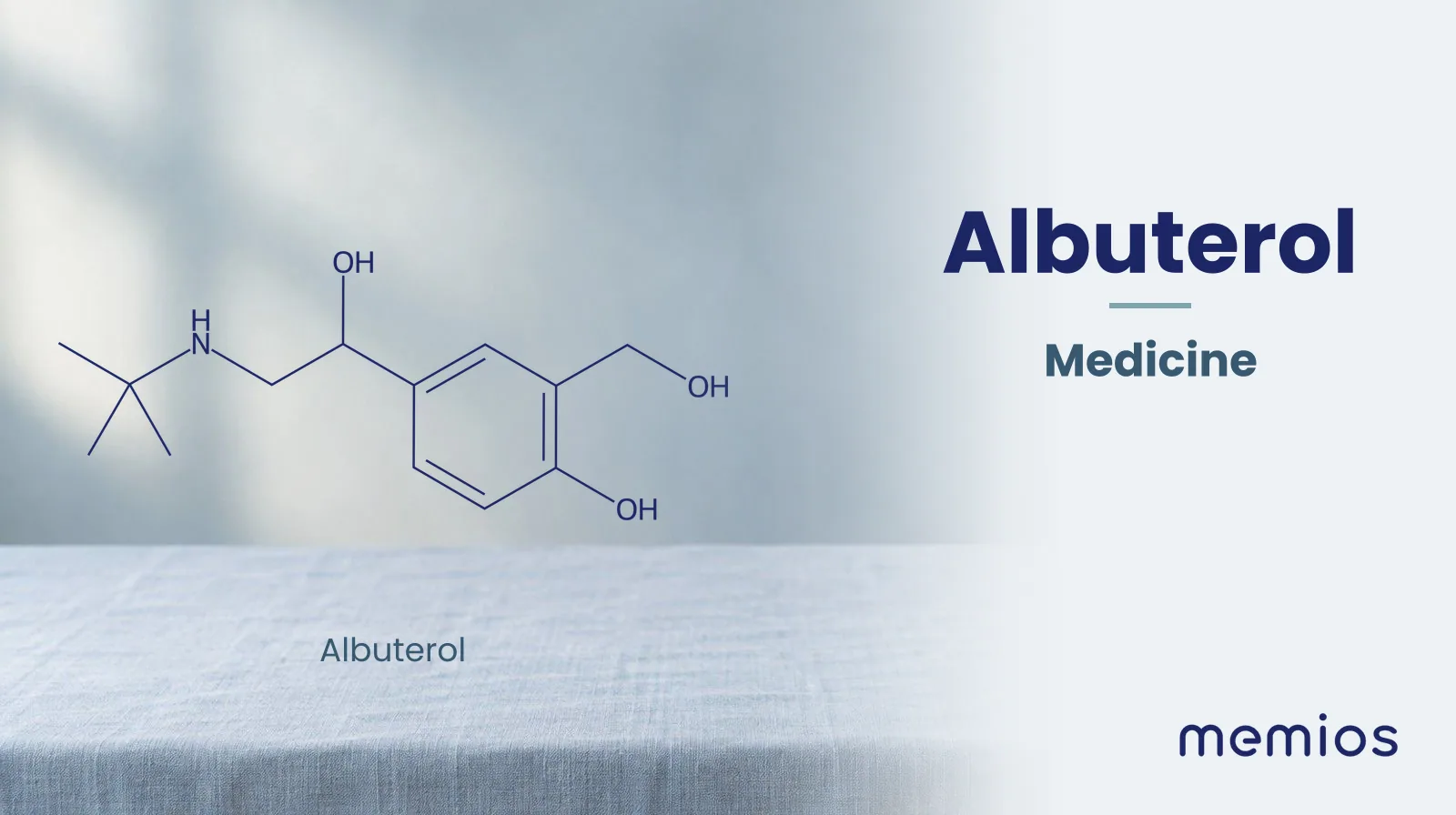
TLDR
- Well established. Albuterol relaxes airway muscle within minutes and reliably protects against exercise-induced narrowing of the airways when taken as a single dose.
- What it is: Albuterol, called salbutamol outside North America, is a short-acting beta2-agonist inhaled as a reliever for bronchospasm.
- Main use: Relief of asthma symptoms (reliever) as the only asthma treatment (disputed).
- Other approved uses: Prevention of exercise-induced bronchoconstriction (single dose before exercise) (well supported).
- Uses NOT supported by research: Acute cough or acute bronchitis without wheeze.
- Recommended dose (official position): Dosing is set by the prescriber. As a position, the US label (2024) lists 2 inhalations every 4 to 6 hours for bronchospasm in adults and children aged 4 and over, noting 1 inhalation every 4 hours may be enough for some patients.
- Studied dose (a trial dose, not a recommendation): Novel START gave albuterol 100 μg per inhalation, two inhalations as needed, compared with budesonide-formoterol as needed or regular budesonide. Findings citing that trial: 1 against.
- Upper limit: The label extracts we could reach did not state a maximum daily number of inhalations.
- What goes wrong: 7 findings on harm. In a meta-analysis of randomised trials, a single dose of a beta2-agonist raised heart rate by about 9 beats per minute and lowered blood potassium by about 0.36 mmol/L compared with placebo.
- Interactions: 2 recorded, including Beta-blockers (for example propranolol, and to a lesser degree cardioselective ones such as metoprolol), Non-potassium-sparing diuretics (loop and thiazide diuretics).
- Common myth: If my reliever inhaler controls my symptoms, my asthma is being treated.
What it is
Albuterol, called salbutamol outside North America, is a short-acting beta2-agonist inhaled as a reliever for bronchospasm. The US label describes it as a beta2-adrenergic agonist indicated for treatment or prevention of bronchospasm in reversible obstructive airway disease and for prevention of exercise-induced bronchospasm.
What the research says
Albuterol relaxes airway muscle within minutes and reliably protects against exercise-induced narrowing of the airways when taken as a single dose. What it does not do is treat the underlying inflammation of asthma. Using it as the only treatment, and especially relying on it heavily, is linked in observational data to more severe attacks and, historically, to asthma deaths. Since 2019 the Global Initiative for Asthma (GINA) has stopped recommending albuterol alone for adults and adolescents, and a trial found an inhaled steroid-formoterol reliever halved exacerbations compared with albuterol alone. Common side effects are a faster heart rate, tremor and a dip in blood potassium.
Evidence grade: Well established.
How it works
Drug class: Short-acting beta2-adrenergic agonist (SABA) bronchodilator
Albuterol switches on beta2 receptors on the smooth muscle lining the airways. This raises a messenger molecule (cyclic AMP) inside the muscle cells, lowers their calcium and makes the muscle relax, so the airway widens. (Source 1)
What it is used for
- Albuterol relieves symptoms quickly, but using it alone without an inhaled steroid is no longer recommended by GINA for adults and adolescents. In a 52-week trial, an as-needed budesonide-formoterol reliever roughly halved exacerbations compared with as-needed albuterol. Evidence: disputed. (Source 2)
- A Cochrane review of 53 trials found that single doses of beta2-agonists protect against the fall in lung function with exercise (low to moderate quality evidence). Regular long-term use leads to tolerance. Evidence: established. (Source 3)
- A Cochrane review found beta2-agonists are not likely to help adults with acute cough who have no airflow limitation, and they cause tremor, shaking or nervousness in about one in two people treated. Evidence: not-supported. (Source 4)
Interactions
- Beta-blockers (for example propranolol, and to a lesser degree cardioselective ones such as metoprolol) (label): Beta-blockers block albuterol's effect in the lungs and can trigger severe bronchospasm in people with asthma. (Source 1)
- Non-potassium-sparing diuretics (loop and thiazide diuretics) (label): Both lower blood potassium; albuterol can acutely worsen diuretic-related low potassium and ECG changes. (Source 1)
Stopping it
- There is no withdrawal syndrome from albuterol itself. The evidence concerns the opposite problem: needing more doses than usual is a sign that asthma is getting worse, and relying on SABA alone leaves the underlying inflammation untreated. (Source 1)
What goes wrong
GINA's 2019 change was prompted by case-control studies from two epidemics of asthma deaths that linked overuse of short-acting beta2-agonists to a higher risk of dying from asthma. (Source 2)
- Official position, Certainty not rated.
- Size: Not applicable (narrative editorial summarising earlier case-control studies)
- Who: People with asthma.
- How long: Not applicable.
- Result: Not quantified in this editorial.
- Funding: not stated.
The risks of SABA were the focus of extensive research in the 1980s and 1990s following two international epidemics of asthma deaths, with case-control studies showing that over-use of SABA was associated with increased risk of asthma-related death.
Even short-term regular use of a SABA on its own has been shown to worsen measures of airway reactivity and inflammation. (Source 2)
- Official position, Certainty not rated.
- Size: Not applicable (editorial summarising multiple studies)
- Who: People with asthma.
- How long: Short-term regular use.
- Result: Not quantified in this editorial.
- Funding: not stated.
Multiple studies had demonstrated adverse effects of even short-term regular use of SABA-alone, including reduced bronchoprotection and bronchodilator response, increased airway hyperresponsiveness
Across 10 observational datasets from Europe and North America, patients on step 3 to 5 treatment who were prescribed 3 or more SABA canisters a year had more severe exacerbations than those prescribed 1 or 2. (Source 5)
- Cohort study, Low certainty.
- Size: 1,033,564 patients aged 12 and over.
- Who: Asthma patients in Canada, France, the Netherlands, Poland, Spain, the UK and the US.
- How long: Observational, varying follow-up.
- Result: IRR 1.08 (US Medicare) to 2.11 (Poland) for 3 or more vs 1 or 2 canisters in GINA steps 3 to 5; 40.2% were prescribed 3 or more canisters a year.
- Funding: Industry-funded: writing support fully funded by AstraZeneca.
steps 3 to 5–treated patients prescribed/possessing 3 or more versus 1 or 2 SABAs experienced more severe exacerbations
The same Cochrane review found that regular long-term use of beta2-agonists leads to tolerance, with a shorter duration of protection. (Source 3)
- Systematic review, Low certainty.
- Size: 8 long-term studies within the 53-trial review.
- Who: People with exercise-induced asthma.
- How long: Long-term regular use.
- Result: Not pooled numerically in the abstract.
- Funding: not stated.
However, long-term use of both SABA and LABA induced the onset of tolerance and decreased the duration of drug effect, even after a short treatment period.
In a meta-analysis of randomised trials, a single dose of a beta2-agonist raised heart rate by about 9 beats per minute and lowered blood potassium by about 0.36 mmol/L compared with placebo. (Source 6)
- Meta-analysis, Moderate certainty.
- Size: 13 single-dose RCTs (n=232); 20 longer trials (n=6,623)
- Who: People with asthma or COPD.
- How long: Single dose; longer trials of varying length.
- Result: Heart rate +9.12 bpm (95% CI 5.32 to 12.92); potassium -0.36 mmol/L (95% CI 0.18 to 0.54); longer treatment RR 2.54 (95% CI 1.59 to 4.05) for adverse cardiovascular events.
- Funding: not stated.
a single-dose beta2-agonist was associated with a statistically significant increase in heart rate (9.12 beats per minute, 95% CI: 5.32, 12.92) and a decrease in potassium concentration (0.36 mmol/L, 95% CI: 0.18, 0.54)
The same meta-analysis found that longer-duration beta2-agonist treatment was associated with more adverse cardiovascular events than placebo; the longer trials included beta2-agonists other than albuterol. (Source 6)
- Meta-analysis, Low certainty.
- Size: 20 trials, 6,623 participants.
- Who: People with asthma or COPD.
- How long: Longer-duration treatment.
- Result: RR 2.54 (95% CI 1.59 to 4.05)
- Funding: not stated.
longer duration treatment with a beta2-agonist was associated with a statistically significant increased risk for adverse cardiovascular events (RR 2.54, 95% CI: 1.59, 4.05)
The label records that beta2-agonists can cause significant hypokalaemia (low blood potassium) in some patients. (Source 1)
- Official position, Certainty not rated.
- Size: Not applicable.
- Who: Label warning.
- How long: Not applicable.
- Result: Not quantified.
- Funding: Regulatory label (GSK product)
Beta-adrenergic agonist medicines may produce significant hypokalemia in some patients, possibly through intracellular shunting.
What the evidence supports
A Cochrane review found that a single dose of a beta2-agonist before exercise substantially reduces the fall in lung function (FEV1) caused by exercise, compared with placebo. (Source 3)
- Systematic review, Moderate certainty.
- Size: 53 trials, 1,139 participants.
- Who: People with exercise-induced asthma or bronchoconstriction.
- How long: Single dose and some long-term studies.
- Result: Maximum fall in FEV1: mean difference -17.67% (95% CI -19.51% to -15.84%) versus placebo; side effects not significantly different from placebo.
- Funding: not stated.
Evidence of low to moderate quality shows that beta2-agonists, both SABA and LABA, when administered in a single dose, are effective and safe in preventing EIA.
What the evidence does not support
In an open-label trial in adults with mild asthma, an as-needed budesonide-formoterol reliever roughly halved the annual exacerbation rate compared with as-needed albuterol alone, and there were fewer severe exacerbations (9 vs 23). (Source 7)
- Randomized trial, Moderate certainty.
- Size: 668 analysed of 675 randomised.
- Who: Adults with mild asthma.
- How long: 52 weeks.
- Result: Annualised exacerbation rate 0.195 vs 0.400; relative rate 0.49 (95% CI 0.33 to 0.72); severe exacerbations 9 vs 23, relative risk 0.40 (95% CI 0.18 to 0.86)
- Funding: Funded by AstraZeneca (maker of budesonide-formoterol) and the Health Research Council of New Zealand; open-label design.
The annualized exacerbation rate in the budesonide–formoterol group was lower than that in the albuterol group (absolute rate, 0.195 vs. 0.400; relative rate, 0.49; 95% confidence interval [CI], 0.33 to 0.72; P<0.001)
For acute cough or bronchitis in adults without airflow limitation, a Cochrane review found beta2-agonists are unlikely to help and caused tremor, shaking or nervousness with a number needed to harm of 2. (Source 4)
- Systematic review, Low certainty.
- Size: Two paediatric albuterol trials and five adult trials (per the summary)
- Who: Children and adults with acute cough or clinical acute bronchitis.
- How long: Short courses.
- Result: Number needed to harm = 2 for tremor, shaking or nervousness in adults.
- Funding: not stated.
Beta2 agonists are not likely to benefit and may cause adverse effects in adults who do not have evidence of airflow restriction (number needed to harm [NNH] = 2).
Where the evidence is mixed
The same SABINA analysis did not find this association in every group: among mild (step 1 or 2) patients in the Netherlands and the US the link was absent or reversed, which the authors attributed to patterns of care rather than a protective effect. (Source 5)
- Cohort study, Low certainty.
- Size: 1,033,564 patients across 10 datasets.
- Who: Asthma patients treated at GINA steps 1 or 2.
- How long: Observational.
- Result: Netherlands IRR 1.25 (95% CI 0.91 to 1.71); US commercial IRR 0.92; US Medicare IRR 0.74.
- Funding: Industry-funded: writing support fully funded by AstraZeneca.
This association was not observed in all step 1 or 2–treated patients
Where the research disagrees
Whether SABA-only reliever treatment is acceptable in mild asthma
- GINA (Reddel et al., 2019), Guideline position resting on randomised trials (for example SYGMA, Novel START) and case-control studies of asthma deaths: The new recommendations follow a decade-long programme of work by GINA, prompted by concerns about the risks and consequences of the long-standing approach of commencing asthma treatment with short-acting beta2-agonists (SABA) alone. (Source 2)
- SABINA authors (Quint et al., 2022), Observational database analysis, AstraZeneca-supported: We hypothesize that this inverse association between SABA and severe exacerbations in the U.S. datasets was attributable to the large patient population possessing fewer than 3 SABA and no maintenance therapy and receiving oral corticosteroid bursts without face-to-face health care provider encounters. (Source 5)
How much
- Reference intake: Dosing is set by the prescriber. As a position, the US label (2024) lists 2 inhalations every 4 to 6 hours for bronchospasm in adults and children aged 4 and over, noting 1 inhalation every 4 hours may be enough for some patients. (Source 1)
- Upper limit: The label extracts we could reach did not state a maximum daily number of inhalations. The label instead treats needing more doses than usual as a warning sign that asthma is worsening. (Source 1)
- Studied: Novel START gave albuterol 100 μg per inhalation, two inhalations as needed, compared with budesonide-formoterol as needed or regular budesonide. (Source 7)
A common belief, and what the research shows
The belief: If my reliever inhaler controls my symptoms, my asthma is being treated.
What the research shows: Albuterol relieves narrowing but does not treat airway inflammation. GINA no longer recommends reliever-only SABA treatment for adults and adolescents, and in a trial a steroid-containing reliever gave fewer exacerbations: 'budesonide–formoterol used as needed was superior to albuterol used as needed for the prevention of asthma exacerbations.'
Questions and answers
What is it?
Albuterol (salbutamol) is a short-acting beta2-agonist, the standard 'blue' reliever inhaler. It is approved for treating or preventing bronchospasm in reversible obstructive airway disease and for preventing exercise-induced bronchospasm. (Source 1)
What does it do in the body?
It switches on beta2 receptors on airway muscle. This raises cyclic AMP inside the muscle cells and lowers their calcium, so the muscle relaxes and the airway opens within minutes. It does not treat the underlying inflammation. (Source 1)
Is it good or bad for you?
It depends on context. As a single dose it is effective at relieving and preventing bronchospasm, including before exercise. As the only asthma treatment, and especially when relied on heavily, it is associated with more severe exacerbations and historically with asthma deaths, and GINA no longer recommends SABA-only treatment for adults and adolescents. (Source 2)
How do you get more of it?
Does not apply in the usual sense: albuterol is a prescription medicine, not a nutrient. How much is used is a prescriber's decision. Needing more doses than usual is itself a warning sign. (Source 1)
If it is harmful, what reduces it?
The concern is overreliance on albuterol. In trials, switching the reliever to an inhaled steroid-formoterol combination reduced exacerbations compared with albuterol alone. Any change in treatment is for the prescriber. (Source 7)
Why might someone be low in it or missing it?
Does not apply. Albuterol is not made by the body and there is no deficiency state. The literature's concern is the reverse: poor adherence to inhaled steroids leaves people relying on SABA alone. (Source 2)
Which whole foods contain it or feed it?
No food contains albuterol. It is a synthetic drug given by inhalation. The label we reached documents no food interactions. (Source 1)
We searched: Ventolin HFA label (DailyMed, 2024) sections on indications, interactions and warnings; no food source or food interaction documented
What happens if you do not have it?
Does not apply as a deficiency. Without a reliever, people with asthma have no rapid way to reverse bronchospasm, but the evidence favours an inhaled-steroid-containing reliever over albuterol alone for preventing exacerbations. (Source 7)
How can you test for it?
No blood test for albuterol is used in routine care. The papers we reached did not describe a clinical test for albuterol levels. Heavy use shows up in records as the number of canisters dispensed a year, which is what observational studies use as a risk marker. (Source 5)
We searched: Ventolin HFA label; GINA 2019 editorial (Reddel); SABINA analysis (Quint 2022). None describes a drug-level test; SABINA uses canisters per year as the exposure measure.
References
- U.S. National Library of Medicine DailyMed (FDA-approved labeling). VENTOLIN HFA (albuterol sulfate) inhalation aerosol - prescribing information. 2024. Read the source
- European Respiratory Journal. GINA 2019: a fundamental change in asthma management. 2019. DOI 10.1183/13993003.01046-2019. Read the source
- Cochrane Database of Systematic Reviews. Beta2-agonists for exercise-induced asthma. 2013. PMID 24089311, DOI 10.1002/14651858.CD003564.pub3. Read the source
- American Family Physician. Beta2 Agonists for Acute Cough or Acute Bronchitis (Cochrane for Clinicians summary of Becker LA et al., Cochrane 2015, CD001726.pub5). 2017. Read the source
- The Journal of Allergy and Clinical Immunology: In Practice. Short-Acting Beta-2-Agonist Exposure and Severe Asthma Exacerbations: SABINA Findings From Europe and North America. 2022. DOI 10.1016/j.jaip.2022.02.047. Read the source
- Database of Abstracts of Reviews of Effects (NCBI Bookshelf). Cardiovascular effects of beta-agonists in patients with asthma and COPD: a meta-analysis (Salpeter SR et al., Chest 2004) - DARE structured abstract. 2004. PMID 15189956, DOI 10.1378/chest.125.6.2309. Read the source
- New England Journal of Medicine. Controlled Trial of Budesonide-Formoterol as Needed for Mild Asthma (Novel START). 2019. PMID 31112386, DOI 10.1056/NEJMoa1901963. Read the source