Medications · September 30, 2026 · Memios · 21 min read
Acetaminophen and Oxycodone
For a single dose of acute pain after surgery, the combination is genuinely effective and better than oxycodone alone: a Cochrane review put the number needed to treat for at least half pain relief at 2.7 for oxycodone 10 mg plus paracetamol 650 mg, against 4.6 for oxycodone 15 mg alone.
TLDR
- Well established. For a single dose of acute pain after surgery, the combination is genuinely effective and better than oxycodone alone: a Cochrane review put the number needed to treat for at least half pain relief at 2.7 for oxycodone 10 mg plus paracetamol 650 mg, against 4.6 for oxycodone 15 mg alone.
- What it is: This is a single tablet containing two different painkillers.
- Main use: Acute pain severe enough to require an opioid, where alternatives are inadequate (well supported).
- Off-label uses (not on the FDA label): Long-term treatment of chronic non-cancer pain (disputed).
- Uses NOT supported by research: Neuropathic pain (painful diabetic neuropathy, postherpetic neuralgia).
- Recommended dose (official position): There is no reference intake for a prescription opioid. Dosing is set by the prescriber and the product is a controlled substance.
- Studied dose (a trial dose, not a recommendation): The Cochrane review's best-evidenced combination was a single dose of oxycodone 10 mg plus paracetamol 650 mg; oxycodone 15 mg alone was the comparison. Findings citing that trial: 2 for.
- Upper limit: As a position, the label (DailyMed record updated 28 July 2026) tells patients not to exceed 4,000 mg of acetaminophen per day from all sources, and the boxed warning states most liver injury occurs above that.
- What goes wrong: 8 findings on harm. Across 16 Cochrane reviews of 14 opioids, opioids taken for longer than two weeks nearly tripled the risk of a serious adverse event compared with placebo.
- Interactions: 5 recorded, including Alcohol, Benzodiazepines and other CNS depressants, St John's wort (Hypericum perforatum), CYP3A4 inhibitors (including some antifungals, macrolide antibiotics and HIV drugs).
- Common myth: The acetaminophen half is the harmless part of the tablet, so the only thing to be careful about is the opioid.
What it is
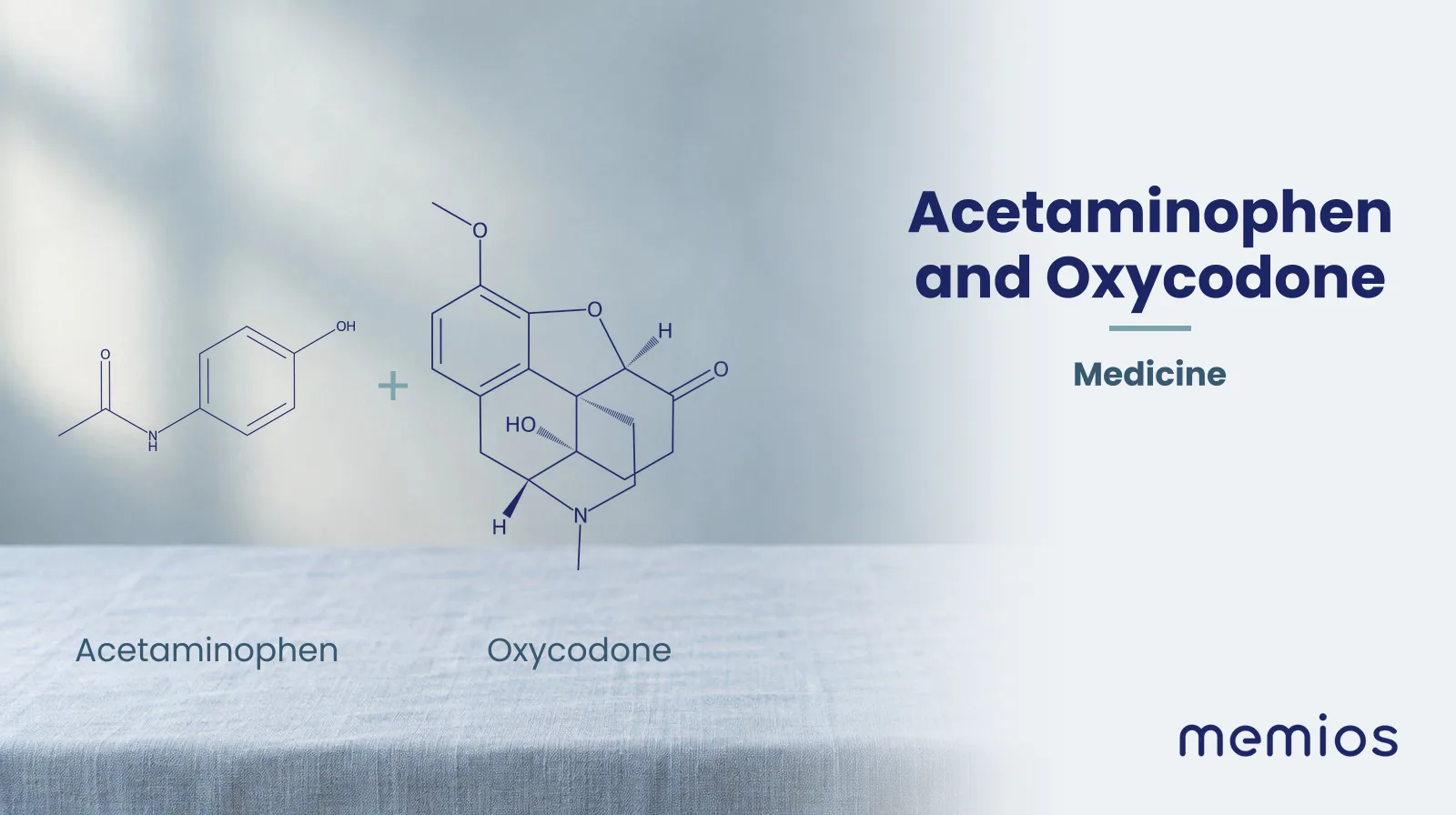
This is a single tablet containing two different painkillers. Oxycodone is a full opioid agonist acting mainly at the mu-opioid receptor, a Schedule II controlled substance. Acetaminophen, known as paracetamol outside the United States, is a non-opioid analgesic whose mechanism is still not settled. The product carries a boxed warning covering addiction, fatal respiratory depression, accidental ingestion, neonatal opioid withdrawal, drug interactions and liver failure.
What the research says
For a single dose of acute pain after surgery, the combination is genuinely effective and better than oxycodone alone: a Cochrane review put the number needed to treat for at least half pain relief at 2.7 for oxycodone 10 mg plus paracetamol 650 mg, against 4.6 for oxycodone 15 mg alone. Beyond short-term acute pain the picture changes. A Cochrane review found no good evidence that oxycodone helps nerve pain from diabetes or shingles. An overview of 16 Cochrane reviews covering more than 18,000 participants found opioids nearly triple the risk of a serious adverse event compared with placebo. Acetaminophen is the leading cause of acute liver failure in the United States and United Kingdom, and this is a product where the acetaminophen is often the forgotten half.
Evidence grade: Well established.
How it works
Drug class: Fixed-dose combination of a full mu-opioid receptor agonist (oxycodone) with a non-opioid analgesic and antipyretic (acetaminophen/paracetamol)
Oxycodone binds mu-opioid receptors in the brain and spinal cord, damping the transmission and the felt unpleasantness of pain, and at higher exposures damping the brainstem drive to breathe, which is how opioid overdose kills. Acetaminophen's analgesic mechanism is still not established but is thought to act centrally. In overdose, acetaminophen is converted by liver enzymes into a reactive metabolite that exhausts the liver's glutathione and destroys liver cells. (Source 1)
Boxed warning
(Source 2)
What it is used for
- In 20 randomised, double-blind, placebo-controlled trials with 2,641 participants, a single dose of oxycodone 10 mg plus paracetamol 650 mg gave a number needed to treat of 2.7 for at least half pain relief, better than oxycodone 15 mg alone at 4.6. The evidence is about single doses over four to six hours, not about weeks of use. Evidence: established. (Source 3)
- A Cochrane review of 5 studies in 687 participants concluded there is no good evidence oxycodone works for these conditions, and rated what evidence exists as very low quality. Adverse events affected 86% on oxycodone against 63% on placebo. Evidence: not-supported. (Source 4)
- A Cochrane review of 26 studies in 4,893 participants found people who stayed on long-term opioids did get clinically significant pain relief, but the evidence was weak and nearly a quarter of those on oral opioids stopped because of adverse effects. An overview of 16 Cochrane reviews found a nearly tripled risk of serious adverse events versus placebo and noted that the reviews contain almost no information on addiction. Evidence: disputed. (Source 5)
Interactions
- Alcohol (case reports): Two separate problems at once. Alcohol adds to the opioid's suppression of breathing and sedation, which the boxed warning says can end in coma and death. Separately, chronic drinking changes how the liver handles acetaminophen, increasing the reactive metabolite and depleting the glutathione that protects liver cells. (Source 6)
- Benzodiazepines and other CNS depressants (label): Combining this product with benzodiazepines, sleeping tablets, muscle relaxants or other sedating drugs can cause profound sedation, stop breathing, and kill. This is in the boxed warning. (Source 7)
- St John's wort (Hypericum perforatum) (pharmacokinetic study): St John's wort is a strong inducer of CYP3A4, the enzyme that clears oxycodone. A controlled pharmacokinetic study in 12 healthy volunteers showed a 14-day course doubled the clearance of a CYP3A4 test drug and halved its exposure, and the authors concluded this applies to CYP3A4 substrates generally. Oxycodone is one, so the expected effect is lower oxycodone levels and less pain relief. (Source 8)
- CYP3A4 inhibitors (including some antifungals, macrolide antibiotics and HIV drugs) (label): Anything that blocks CYP3A4 raises oxycodone blood levels, which can turn a tolerated dose into an overdose. The boxed warning says this can increase or prolong adverse reactions and may cause potentially fatal respiratory depression. (Source 9)
- Other acetaminophen-containing products (cold and flu remedies, other painkillers) (label): The single biggest avoidable harm with this tablet is stacking it with another product that also contains acetaminophen without realising. The boxed warning records that acetaminophen has caused acute liver failure, sometimes ending in liver transplant or death, and that most such liver injury involves more than one acetaminophen-containing product at a total above about 4,000 mg a day. Limit: The label's own sentence giving the 4,000 mg a day figure is not quoted here. Two DailyMed routes and the openFDA record disagreed, and contradicted themselves between reads, over whether the boxed warning prints that number as "4000 mg" or "4000 milligrams", so the quote shown is the neighbouring sentence, which every route agreed on. The disagreement is only about how the unit is abbreviated; the 4,000 mg a day threshold itself is not in doubt. (Source 10)
Stopping it
- The label instructs a gradual, individualised taper rather than an abrupt stop, taking account of the dose, how long the person has been taking it, and their physical and psychological state. (Source 1)
- Tapering is not risk-free. In a cohort of 21,515 tapering events among 19,377 patients on long-term opioids, the rate of emergency visits or admissions for overdose or withdrawal was about 57% higher after a taper began than in the same patients’ pre-taper period, and mental health crises about 52% higher, with the excess persisting up to two years. These are adjusted incidence rate ratios comparing each patient with their own earlier period, not a comparison against people who did not taper. (Source 11)
- Babies born to people who have taken opioids for an extended time can go through withdrawal themselves, which the boxed warning says may be life-threatening if it is not recognised and treated. (Source 12)
- Roughly a quarter of people on long-term oral opioids in trials stopped because of adverse effects rather than because their pain resolved, which is part of the real-world picture of stopping. (Source 5)
What goes wrong
Across 16 Cochrane reviews of 14 opioids, opioids taken for longer than two weeks nearly tripled the risk of a serious adverse event compared with placebo. (Source 13)
- Review of reviews, Moderate certainty.
- Size: 16 Cochrane reviews of 14 opioids, 61 studies, more than 18,000 participants.
- Who: Adults with chronic non-cancer pain using opioids for longer than two weeks.
- How long: Medium and long term (over two weeks)
- Result: Any adverse event RR 1.42 (95% CI 1.22 to 1.66), absolute rate 78%; serious adverse event RR 2.75 (95% CI 2.06 to 3.67), absolute rate 7.5%.
- Funding: not stated.
significantly increased risk of experiencing a serious adverse event with opioids compared to placebo (RR 2.75, 95% CI 2.06 to 3.67)
The same overview flags a hole in the evidence base: the Cochrane reviews it summarised contained almost no information on addiction, depression or sleep problems. (Source 13)
- Review of reviews, Moderate certainty.
- Size: 16 Cochrane reviews, 61 studies, more than 18,000 participants.
- Who: Adults with chronic non-cancer pain.
- How long: Over two weeks.
- Result: Certainty ratings across outcomes ranged from very low to moderate; addiction not reported.
- Funding: not stated.
We did not find any information in the Cochrane Reviews about many of the known and sometimes serious side effects of opioids, such as addiction, depression, and sleep problems.
In long-term opioid trials, 22.9% of people taking oral opioids stopped because of adverse effects, while signs of addiction were recorded in only 0.27% of participants in the studies that looked, a figure the trial population makes unreliable. (Source 5)
- Systematic review, Low certainty.
- Size: 26 studies, 27 treatment groups, 4,893 participants.
- Who: Adults with chronic non-cancer pain on long-term opioid therapy, mostly in selected trial populations.
- How long: Six months or longer.
- Result: Discontinuation for adverse effects 22.9% oral (95% CI 15.3% to 32.8%), 12.1% transdermal (4.9% to 27.0%), 8.9% intrathecal (4.0% to 26.1%); signs of opioid addiction 0.27%.
- Funding: not stated.
Signs of opioid addiction were reported in 0.27% of participants in the studies that reported that outcome.
Acetaminophen is the commonest cause of acute liver failure in both the United States and the United Kingdom, and most of those cases are unintentional rather than suicide attempts. (Source 6)
- Expert review, not systematic, Moderate certainty.
- Size: Review of United States and United Kingdom acute liver failure series.
- Who: Patients presenting with acute liver failure.
- How long: Not applicable.
- Result: Acetaminophen accounted for 39% to 42% of all acute liver failure cases, with suicidal intent in 27% to 44% and unintentional overdose in 48% to 61%.
- Funding: not stated.
Currently acetaminophen is the most common cause of ALF in both United States and United Kingdom, with a trend to increasing incidence in the United States.
Most unintentional acetaminophen liver injury involves prescription opioid-acetaminophen combination tablets, the category this product belongs to. (Source 6)
- Expert review, not systematic, Low certainty.
- Size: Review of acute liver failure series.
- Who: Patients with unintentional acetaminophen-induced liver injury.
- How long: Not applicable.
- Result: Combination opioid-acetaminophen analgesics were the commonest prescription source identified.
- Funding: not stated.
The most common prescription narcotic used for pain was the combination of acetaminophen and hydrocodone.
The boxed warning states that a single accidental dose can be fatal for a child. (Source 14)
- Official position, Moderate certainty.
- Size: Not stated.
- Who: Anyone, particularly children, ingesting the tablet accidentally.
- How long: Single exposure.
- Result: Fatal oxycodone overdose possible from one dose.
- Funding: not stated.
Accidental ingestion of even one dose of oxycodone and acetaminophen tablets, especially by children, can result in a fatal overdose of oxycodone.
The boxed warning states that combining this product with benzodiazepines, other CNS depressants or alcohol can cause profound sedation, respiratory depression, coma and death. (Source 7)
- Official position, Moderate certainty.
- Size: Not stated.
- Who: People taking the product together with other sedating substances.
- How long: Not stated.
- Result: Profound sedation, respiratory depression, coma, death.
- Funding: not stated.
Concomitant use of opioids with benzodiazepines or other central nervous system (CNS) depressants, including alcohol, may result in profound sedation, respiratory depression, coma, and death.
Tapering long-term opioids was itself associated with higher rates of a combined overdose-or-withdrawal outcome, and of mental health crises, for up to two years afterwards. (Source 11)
- Cohort study, Moderate certainty.
- Size: 21,515 tapering events among 19,377 patients.
- Who: Adults prescribed long-term opioids in a United States claims cohort.
- How long: Mean 9.1 (SD 2.7) months of post-induction follow-up per event, effects extending to 2 years.
- Result: Adjusted incidence rate ratios for the post-induction period compared with the pre-taper period, from conditional negative binomial regression: 1.57 (95% CI 1.42 to 1.74) for the combined outcome of overdose or withdrawal, and 1.52 (95% CI 1.35 to 1.71) for mental health crisis.
- Funding: not stated.
Limit of this finding: These are within-patient comparisons of the period after a taper started against the same patients’ pre-taper period, not a comparison between people who tapered and people who did not, so they cannot show that tapering caused the events. The study counted one combined outcome, emergency visits or admissions for overdose or withdrawal, and a separate mental health crisis outcome. The paper’s own concluding sentence lists “overdose, withdrawal, and mental health crisis” as three items, which could be read as a separate result for withdrawal on its own; there is no such separate result in the paper.
In conditional negative binomial regression analyses, adjusted incidence rate ratios for the postinduction period compared with the pretaper period were 1.57 (95% CI, 1.42-1.74) for overdose or withdrawal and 1.52 (95% CI, 1.35-1.71) for mental health crisis.
What the evidence supports
A single dose of oxycodone combined with paracetamol relieves acute postoperative pain better than either placebo or the same opioid alone, with a number needed to treat of 2.7. (Source 3)
- Systematic review, Moderate certainty.
- Size: 20 randomised, double-blind, placebo-controlled trials, 2,641 participants.
- Who: Adults with moderate or severe acute pain after an operation.
- How long: Single dose, outcomes over 4 to 6 hours.
- Result: NNT for at least 50% pain relief 2.7 for oxycodone 10 mg plus paracetamol 650 mg, versus 4.6 for oxycodone 15 mg alone.
- Funding: not stated.
oxycodone 10 mg plus paracetamol 650 mg, the NNT was 2.7
About half of those given the combination got at least half their pain relieved, and the effect lasted up to 10 hours. (Source 3)
- Systematic review, Moderate certainty.
- Size: 20 trials, 2,641 participants.
- Who: Adults with acute postoperative pain.
- How long: Single dose, up to 10 hours.
- Result: Around 50% achieved at least 50% pain relief over 4 to 6 hours, with duration up to 10 hours.
- Funding: not stated.
About half of those treated experienced at least half pain relief over 4 to 6 hours, and the effects lasting up to 10 hours
What the evidence does not support
For nerve pain from diabetes or shingles, a Cochrane review found no good evidence that oxycodone works. (Source 4)
- Systematic review, Very low certainty.
- Size: 5 studies, 687 participants (637 diabetic neuropathy, 50 postherpetic neuralgia)
- Who: Adults with painful diabetic neuropathy or postherpetic neuralgia.
- How long: Varied by trial.
- Result: 44% on oxycodone versus 27% on placebo achieved at least 30% pain relief; adverse events 86% versus 63%; withdrawal for adverse events 11% versus 6.4%; evidence rated very low quality.
- Funding: not stated.
There was only very low quality evidence that oxycodone (as oxycodone MR) is of value in the treatment of painful diabetic neuropathy or postherpetic neuralgia.
The plain-language conclusion of the same review is blunter: there is no good evidence oxycodone works for these kinds of nerve pain. (Source 4)
- Systematic review, Very low certainty.
- Size: 5 studies, 687 participants.
- Who: Adults with painful diabetic neuropathy or postherpetic neuralgia.
- How long: Varied by trial.
- Result: No reliable benefit demonstrated.
- Funding: not stated.
There is no good evidence that oxycodone works in pain from diabetic neuropathy or postherpetic neuralgia.
Where the research disagrees
How often long-term opioid use leads to addiction
- Cochrane review of long-term opioid management, 2010, systematic-review of 26 studies, 4,893 participants, mostly selected trial populations, weak evidence: Signs of opioid addiction were reported in 0.27% of participants in the studies that reported that outcome. (Source 5)
- Cochrane overview of adverse events, 2017, umbrella overview of 16 Cochrane reviews, 61 studies, over 18,000 participants: We did not find any information in the Cochrane Reviews about many of the known and sometimes serious side effects of opioids, such as addiction, depression, and sleep problems. (Source 13)
Whether reducing the dose in someone already on long-term opioids helps or harms
- Boxed warning and label instruction, position, regulatory label: Gradually taper the dosage using a patient-specific plan that considers the following: the dose of oxycodone and acetaminophen tablets the patient has been taking, the duration of treatment, and the physical and psychological attributes of the patient. (Source 1)
- JAMA Network Open cohort study, 2022, cohort study, 21,515 tapering events in 19,377 patients; within-patient before-and-after comparison, so an association and not proof of cause. The measured outcomes were one combined overdose-or-withdrawal outcome and a separate mental health crisis outcome, so the three items listed in this sentence are not three separate results: These findings suggest that opioid tapering was associated with increased rates of overdose, withdrawal, and mental health crisis extending up to 2 years after taper initiation. (Source 15)
How much
- Reference intake: There is no reference intake for a prescription opioid. Dosing is set by the prescriber and the product is a controlled substance. As a position, the label directs individualised dosing and a patient-specific taper on discontinuation. (Source 1)
- Upper limit: As a position, the label (DailyMed record updated 28 July 2026) tells patients not to exceed 4,000 mg of acetaminophen per day from all sources, and the boxed warning states most liver injury occurs above that. (Source 1)
- Studied: The Cochrane review's best-evidenced combination was a single dose of oxycodone 10 mg plus paracetamol 650 mg; oxycodone 15 mg alone was the comparison. (Source 3)
- Studied: The neuropathic pain review tested modified-release oxycodone rather than the combination tablet, in 687 participants across 5 studies. (Source 4)
A common belief, and what the research shows
The belief: The acetaminophen half is the harmless part of the tablet, so the only thing to be careful about is the opioid.
What the research shows: Acetaminophen is "the most common cause of ALF in both United States and United Kingdom, with a trend to increasing incidence in the United States", it accounted for "39% to 42% of all cases" of acute liver failure in the series reviewed, and unintentional overdose made up "48% to 61%" of those. The boxed warning is explicit that "Acetaminophen has been associated with cases of acute liver failure, at times resulting in liver transplant and death." The trap is arithmetic rather than recklessness: liver injury usually involves more than one acetaminophen-containing product, so adding a cold remedy to a prescribed combination tablet is enough.
Questions and answers
What is it?
It is one tablet containing two painkillers: oxycodone, a strong opioid and a controlled substance, and acetaminophen, the same drug sold as paracetamol or Tylenol. It is prescription-only in the United States and is licensed only for pain severe enough to need an opioid where other treatments are not enough. (Source 1)
What does it do in the body?
Oxycodone switches on mu-opioid receptors in the brain and spinal cord, which blunts both the signal of pain and how distressing it feels, and at higher exposures blunts the brainstem's drive to breathe. Acetaminophen adds a separate analgesic effect whose mechanism is still unresolved. The two together relieve acute pain better than the opioid alone. (Source 1)
Is it good or bad for you?
Good, briefly, for severe short-lived pain: in postoperative trials the combination had a number needed to treat of 2.7 for at least half pain relief, which is a strong result for an analgesic. Bad the longer it continues and the further it drifts from that setting: opioids taken beyond two weeks nearly tripled serious adverse events in an overview of 16 Cochrane reviews, there is no good evidence for nerve pain, and the acetaminophen half is the commonest cause of acute liver failure in the US and UK. (Source 3)
How do you get more of it?
This is not something to get more of. It is a Schedule II controlled substance, and the risk the boxed warning leads with is that exposure to it can produce addiction, misuse, overdose and death. Wanting more of it, outside a prescriber's plan, is itself one of the things the label instructs clinicians to watch for. (Source 2)
If it is harmful, what reduces it?
Not by stopping suddenly if it has been taken for a while, because physical dependence develops and abrupt cessation causes withdrawal. The label calls for an individualised taper. The literature also shows tapering has its own risk: in a large cohort, rates of overdose, withdrawal and mental health crisis rose after taper began and stayed raised for up to two years, so the reduction needs support rather than just a schedule. (Source 1)
Why might someone be low in it or missing it?
Being low in it is not a deficiency, but blood levels do vary a great deal for one main reason: oxycodone is cleared by the liver enzyme CYP3A4. Drugs and supplements that induce that enzyme, St John's wort being the best documented, speed up clearance and can leave someone with markedly less drug and less pain relief than expected; inhibitors do the opposite and can cause overdose at an unchanged dose. (Source 8)
Which whole foods contain it or feed it?
No whole food contains either drug. What matters about diet here is alcohol. Alcohol adds to the opioid's suppression of breathing, and separately it changes how the liver processes acetaminophen, raising the toxic metabolite and depleting the glutathione that protects liver cells, so liver injury has occurred in people who drink heavily at ordinary acetaminophen doses. (Source 6)
What happens if you do not have it?
Nothing is deficient without it. What the trials measure is pain left untreated: in postoperative trials about half of those given the combination got at least half their pain relieved for four to six hours, so the difference without it is that severe short-term pain is less well controlled. For nerve pain and for long-term use, the reviews find little or no reliable benefit to lose. (Source 3)
How can you test for it?
There is no routine blood level test to guide treatment. Two kinds of testing do matter. Before and during prescribing, the label directs clinicians to assess and reassess each person's risk of addiction, abuse and misuse, which in practice means structured risk assessment and sometimes urine drug testing rather than a laboratory measure of the drug's effect. In suspected overdose, a timed blood acetaminophen concentration guides antidote treatment, and N-acetylcysteine is the most effective drug for preventing progression to liver failure. (Source 6)
References
- DailyMed, US National Library of Medicine (label sponsored by FH2 Pharma LLC). OXYCODONE AND ACETAMINOPHEN tablets - indications, mechanism of action, abuse and dependence sections (DailyMed record updated July 28, 2026). 2026. Read the source
- DailyMed, US National Library of Medicine (label sponsored by FH2 Pharma LLC). OXYCODONE AND ACETAMINOPHEN tablets - BOXED WARNING, "Addiction, Abuse, and Misuse" subsection (DailyMed record updated July 28, 2026). 2026. Read the source
- Cochrane Database of Systematic Reviews (CD002763), plain-language record on cochrane.org. Single dose oral oxycodone and oxycodone plus paracetamol (acetaminophen) for acute postoperative pain in adults. 2009. DOI 10.1002/14651858.CD002763.pub2. Read the source
- Cochrane Database of Systematic Reviews (CD010692), plain-language record on cochrane.org. Oxycodone for neuropathic pain in adults. 2016. DOI 10.1002/14651858.CD010692.pub3. Read the source
- Cochrane Database of Systematic Reviews (CD006605), plain-language record on cochrane.org. Long-term opioid management for chronic noncancer pain. 2010. DOI 10.1002/14651858.CD006605.pub2. Read the source
- Journal of Clinical Gastroenterology (copy hosted by University of Florida Division of Gastroenterology, Hepatology and Nutrition). Acetaminophen Hepatotoxicity and Acute Liver Failure. 2009. Read the source
- DailyMed, US National Library of Medicine (label sponsored by FH2 Pharma LLC). OXYCODONE AND ACETAMINOPHEN tablets - BOXED WARNING, "Risks from Concomitant Use with Benzodiazepines or Other CNS Depressants" subsection (DailyMed record updated July 28, 2026). 2026. Read the source
- JAMA (PDF copy). Effect of St John's Wort on Drug Metabolism by Induction of Cytochrome P450 3A4 Enzyme. 2003. PMID 13129991. Read the source
- DailyMed, US National Library of Medicine (label sponsored by FH2 Pharma LLC). OXYCODONE AND ACETAMINOPHEN tablets - BOXED WARNING, "Cytochrome P450 3A4 Interaction" subsection (DailyMed record updated July 28, 2026). 2026. Read the source
- DailyMed, US National Library of Medicine (label sponsored by FH2 Pharma LLC). OXYCODONE AND ACETAMINOPHEN tablets - BOXED WARNING, "Hepatotoxicity" subsection (DailyMed record updated July 28, 2026). 2026. Read the source
- JAMA Network Open 2022;5(6):e2216726 (abstract as deposited with PubMed by the publisher). Long-term Risk of Overdose or Mental Health Crisis After Opioid Dose Tapering - abstract, Results. 2022. PMID 35696163, DOI 10.1001/jamanetworkopen.2022.16726. Read the source
- DailyMed, US National Library of Medicine (label sponsored by FH2 Pharma LLC). OXYCODONE AND ACETAMINOPHEN tablets - BOXED WARNING, "Neonatal Opioid Withdrawal Syndrome (NOWS)" subsection (DailyMed record updated July 28, 2026). 2026. Read the source
- Cochrane Database of Systematic Reviews (CD012509), plain-language record on cochrane.org. Adverse events associated with medium- and long-term use of opioids for chronic non-cancer pain: an overview of Cochrane Reviews. 2017. DOI 10.1002/14651858.CD012509.pub2. Read the source
- DailyMed, US National Library of Medicine (label sponsored by FH2 Pharma LLC). OXYCODONE AND ACETAMINOPHEN tablets - BOXED WARNING, "Accidental Ingestion" subsection (DailyMed record updated July 28, 2026). 2026. Read the source
- JAMA Network Open 2022;5(6):e2216726 (abstract as deposited with PubMed by the publisher). Long-term Risk of Overdose or Mental Health Crisis After Opioid Dose Tapering - abstract, Conclusions and Relevance. 2022. PMID 35696163, DOI 10.1001/jamanetworkopen.2022.16726. Read the source