Supplements · September 29, 2026 · Memios · 16 min read
5-HTP
Limited evidence. The evidence is thin rather than absent.
TLDR
- Limited evidence. The evidence is thin rather than absent.
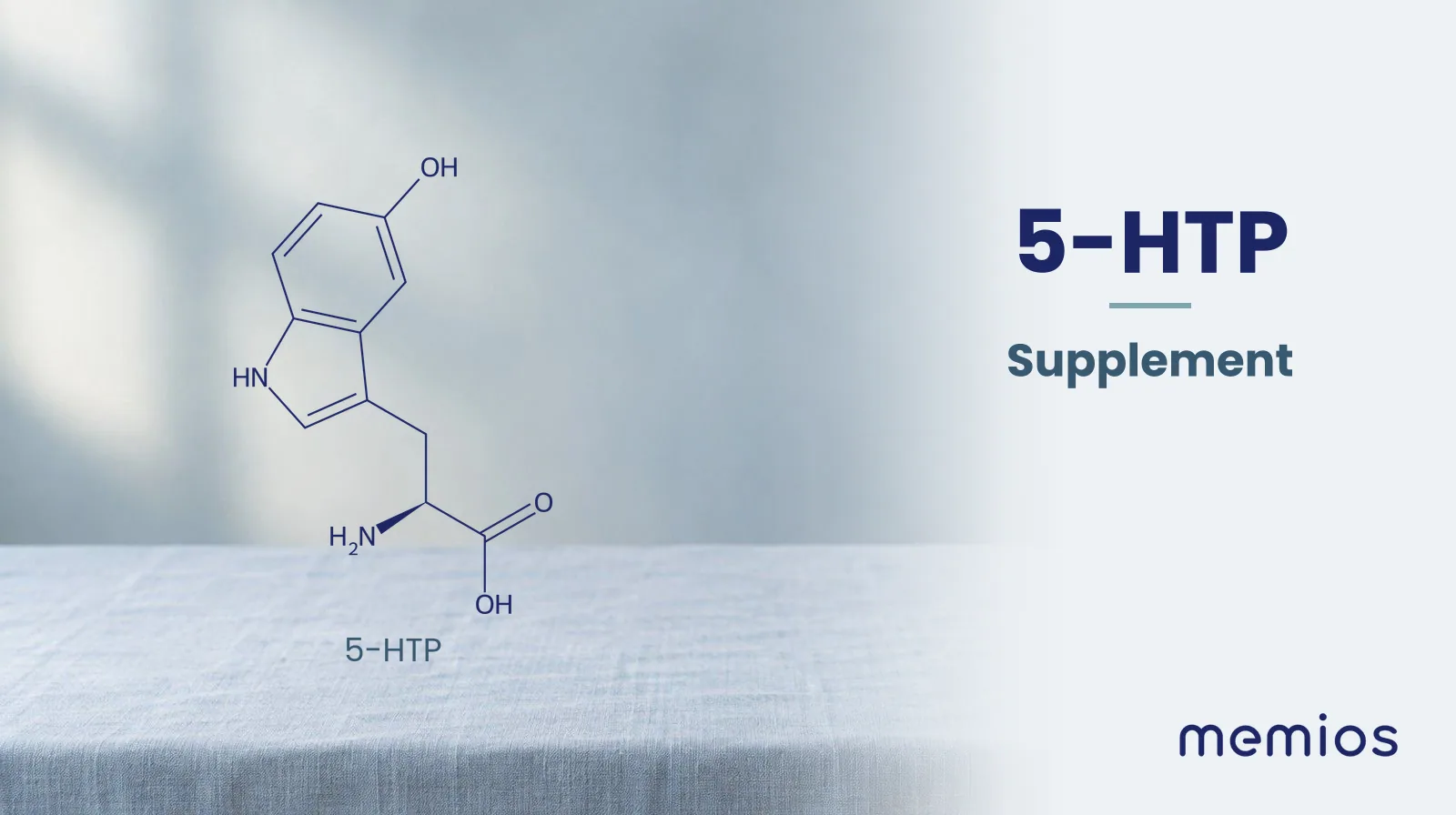
- What it is: 5-HTP is the chemical step between the amino acid tryptophan and serotonin: the enzyme tryptophan hydroxylase converts tryptophan into 5-HTP, and 5-HTP is then decarboxylated to serotonin and onward to melatonin. It is sold as a dietary supplement and, in some countries, used as a medicine.
- Main use, supported: A Cochrane systematic review found that although many trials of 5-HTP and tryptophan for depression exist, almost none were good enough to pool, and the pooled result from the two usable trials favoured the supplements. (very low certainty)
- Claim NOT supported by research: In a small randomised cross-over trial in Parkinson's disease, 5-HTP improved one depression rating scale but had no effect at all on apathy. (low certainty)
- Another claim NOT supported: The same meta-analysis judged the existing 5-HTP studies to be methodologically weak, with few placebo-controlled. (very low certainty)
- Recommended dose: not established. No reference intake such as an RDA has been set for 5-HTP by any body we could reach. It is not a dietary essential: the body makes it from tryptophan, and that conversion is the rate-limiting step in serotonin and melatonin synthesis.
- Studied dose (a trial dose, not a recommendation): A randomised cross-over trial in Parkinson's disease gave 50 mg of 5-HTP daily for 4 weeks against placebo. Findings citing that trial: 1 against.
- Upper limit: No tolerable upper intake level or acceptable daily intake was found.
- What goes wrong: 5 findings on harm. Laboratory analysis of commercial 5-HTP products found that every sample tested contained several contaminants of the 'peak X' family, the same marker found in 5-HTP implicated in eosinophilia-myalgia-like illness.
- Common myth: 5-HTP is a natural, gentler alternative to antidepressants, so it must be safe.
What it is
5-HTP is the chemical step between the amino acid tryptophan and serotonin: the enzyme tryptophan hydroxylase converts tryptophan into 5-HTP, and 5-HTP is then decarboxylated to serotonin and onward to melatonin. It is sold as a dietary supplement and, in some countries, used as a medicine. Almost all commercial 5-HTP is extracted from the seeds of the West African plant Griffonia simplicifolia rather than produced synthetically.
What the research says
The evidence is thin rather than absent. A Cochrane review located 108 trials of 5-HTP and tryptophan for depression and could use only two, involving 64 patients; the pooled result favoured the supplements but the reviewers called the evidence insufficient to be conclusive and said proven, safer antidepressants limit its usefulness. A later meta-analysis reported a remission rate of 0.65 while rating the studies as relatively weak with few placebo controls, and a small randomised trial in Parkinson's disease improved a depression scale but did nothing for apathy. Against that sits a genuine safety record: contaminants of the 'peak X' family were found in every commercial sample tested in one analysis, eosinophilia-myalgia-like illness has been reported after 5-HTP exposure, and the FDA stated in 2001 that it could not conclude 5-HTP can be safely used as a supplement.
Evidence grade: Limited evidence.
What goes wrong
Laboratory analysis of commercial 5-HTP products found that every sample tested contained several contaminants of the 'peak X' family, the same marker found in 5-HTP implicated in eosinophilia-myalgia-like illness. (Source 1)
- Lab study in cells, Low certainty.
- Size: 8 commercially available 5-hydroxytryptophan samples.
- Who: Retail 5-HTP products, not people.
- How long: Not applicable.
- Result: All eight samples contained three or more peak X family contaminants; peak X members share molecular weight 234 Da.
- Funding: not stated.
We also demonstrate that all eight samples of commercially available 5-OHTrp analyzed by HPLC-MS contained three or more contaminants of the peak X family.
Eosinophilia-myalgia-like illness has been reported after taking or being exposed to 5-HTP, and the implicated product carried the case-associated peak X marker. (Source 1)
- Lab study in cells, Low certainty.
- Size: Not stated in the abstract.
- Who: People who ingested or were exposed to 5-hydroxy-L-tryptophan.
- How long: Not stated.
- Result: Peak X present in EMS-implicated 5-OHTrp; peak X shown to be a family of contaminants rather than a single compound.
- Funding: not stated.
However, eosinophilia-myalgia syndrome (EMS)-like symptoms have also been associated with ingestion or exposure to 5-OHTrp.
A 2021 review of 5-HTP records dose-dependent gastrointestinal side effects, and psychiatric side effects when 5-HTP is combined with a peripheral decarboxylase inhibitor. (Source 2)
- Expert review, not systematic, Low certainty.
- Size: Not a pooled analysis.
- Who: People given 5-HTP, including in combination with decarboxylase inhibitors.
- How long: Not stated.
- Result: Dose-dependent gastrointestinal problems; acute anxiety with a peripheral decarboxylase inhibitor; vomiting and nausea reported above 100 mg.
- Funding: not stated.
Among the side effects, the administration of 5-HTP may cause dose-dependent gastrointestinal problems, whereas the combination of 5-HTP with a peripheral decarboxylase inhibitor may cause psychopathological side effects, like acute anxiety. Additionally, vomiting and nausea have been reported when 5-HTP was used at doses above 100 mg.
Excess serotonergic stimulation from 5-HTP is the mechanism behind serotonin syndrome, which the review states can be fatal. (Source 3)
- Expert review, not systematic, Low certainty.
- Size: Not a pooled analysis.
- Who: People with excess serotonergic stimulation.
- How long: Not applicable.
- Result: No rate given; the review states the syndrome may result in death but that most patients recover fully with supportive care.
- Funding: not stated.
Serotonin syndrome may eventually result in death; however, supportive care alone is sufficient to recover completely for most of patients. Excessive 5-HTP stimulation is the main pathophysiologic mechanism involved.
The US Food and Drug Administration stated in February 2001 that it could not conclude that oral L-tryptophan or 5-hydroxy-L-tryptophan can be safely used as dietary supplements. (Source 4)
- Official position, Certainty not rated.
- Size: Not applicable.
- Who: US consumers of L-tryptophan and 5-HTP supplements.
- How long: Position dated February 2001.
- Result: No effect size; a regulatory conclusion that safe use could not be determined.
- Funding: government agency.
Consequently, FDA cannot determine that oral dosage forms of L-Tryptophan and related compounds such as L-5-hydroxytryptophan can be safely used as dietary supplements.
What the evidence supports
A Cochrane systematic review found that although many trials of 5-HTP and tryptophan for depression exist, almost none were good enough to pool, and the pooled result from the two usable trials favoured the supplements. (Source 5)
- Systematic review, Very low certainty.
- Size: 2 trials, 64 patients, from 108 trials located.
- Who: Adults with unipolar depression or dysthymia.
- How long: Not stated in the abstract.
- Result: Peto Odds Ratio 4.10; 95% confidence interval 1.28-13.15; RD 0.36; NNT 2.78.
- Funding: not stated.
Limit of this finding: The review says two different things in two places. Its results section calls the evidence “of insufficient quality to be conclusive”, while its conclusions say the available evidence “does suggest these substances are better than placebo”. Both statements rest on the same two small trials in 64 patients, so the positive-sounding sentence should not be read as a reliable finding. The review is also from 2002 and has not been updated here.
108 trials were located using the specified search strategy. Of these, only two trials, involving a total of 64 patients, were of sufficient quality to meet inclusion criteria. The available evidence suggests these substances were better than placebo at alleviating depression (Peto Odds Ratio 4.10; 95% confidence interval 1.28-13.15; RD 0.36; NNT 2.78). However, the evidence was of insufficient quality to be conclusive.
What the evidence does not support
The same meta-analysis judged the existing 5-HTP studies to be methodologically weak, with few placebo-controlled. (Source 6)
- Meta-analysis, Very low certainty.
- Size: 13 investigations.
- Who: Depressed patients.
- How long: Varied.
- Result: Heterogeneity I2 = 76%, τ2 = 0.379; the OHAT risk-of-bias tool rated the studies relatively weak.
- Funding: not stated.
Limit of this finding: The paper's own numbers do not line up. It says 13 investigations were in the systematic review and only 7 in the meta-analysis, yet it reports the pooled remission rate with “remission rate [k] = 13”. It is therefore unclear how many studies produced the 0.65 figure, so treat that number as uncertain rather than as a firm pooled result.
In addition, the OHAT (Office of Health Assessment and Translation risk of bias rating) tool suggested that, on the whole, current studies are relatively weak (few include placebo groups).
In a small randomised cross-over trial in Parkinson's disease, 5-HTP improved one depression rating scale but had no effect at all on apathy. (Source 7)
- Randomized trial, Low certainty.
- Size: 25 individuals enrolled.
- Who: People with Parkinson's disease.
- How long: 50 mg daily for 4 weeks per arm, with assessments at screening, baseline and weeks 4, 8, 12 and 16.
- Result: A significant improvement of depressive symptoms on the Hamilton Depression Rating Scale versus placebo; no effect on the Apathy Scale. The paper reports no numerical effect size in its abstract.
- Funding: not stated.
Repeated-measures analysis revealed a significant improvement of depressive symptoms during the 50-mg 5-HTP treatment compared with placebo as assessed by the HDRS. No effect of 5-HTP was seen on apathy symptoms assessed by the AS.
The Cochrane reviewers concluded that the link between these substances and eosinophilia-myalgia syndrome remains unresolved and that safer proven antidepressants limit their clinical usefulness. (Source 8)
- Systematic review, Very low certainty.
- Size: 2 included trials, 64 patients.
- Who: Adults with unipolar depression or dysthymia.
- How long: Not stated.
- Result: No quantitative estimate; a judgement about certainty and clinical usefulness.
- Funding: not stated.
Limit of this finding: The review says two different things in two places. Its results section calls the evidence “of insufficient quality to be conclusive”, while its conclusions say the available evidence “does suggest these substances are better than placebo”. Both statements rest on the same two small trials in 64 patients, so the positive-sounding sentence should not be read as a reliable finding. The review is also from 2002 and has not been updated here.
The possible association between these substances and the potentially fatal Eosinophilia-Myalgia Syndrome has not been elucidated. Because alternative antidepressants exist which have been proven to be effective and safe the clinical usefulness of 5-HTP and tryptophan is limited at present.
Where the evidence is mixed
A 2019 meta-analysis reported a pooled depression remission rate of 0.65 with 5-HTP, while rating the underlying studies as weak and mostly lacking placebo groups. (Source 6)
- Meta-analysis, Very low certainty.
- Size: 13 investigations in the systematic review, 7 in the meta-analysis.
- Who: Patients described as depressed, across different depression types.
- How long: Treatment duration varied between studies and was a source of heterogeneity.
- Result: Remission rate 0.65 (95% CI 0.55–0.78, reported with remission rate [k] = 13); Hedges' g 1.11 (95% CI 0.53–1.69); heterogeneity I2 = 76%.
- Funding: not stated.
Limit of this finding: The paper's own numbers do not line up. It says 13 investigations were in the systematic review and only 7 in the meta-analysis, yet it reports the pooled remission rate with “remission rate [k] = 13”. It is therefore unclear how many studies produced the 0.65 figure, so treat that number as uncertain rather than as a firm pooled result.
Analyses revealed a depression remission rate of 0.65 (95% confidence interval [CI], 0.55–0.78; remission rate [k] = 13), and this was confirmed by the questionnaire results, which revealed a large Hedges' g (1.11; 95%CI, 0.53–1.69).
Where the research disagrees
Whether 5-HTP works for depression
- Javelle and colleagues, Nutrition Reviews 2019, meta-analysis of 13 investigations, 7 pooled: Analyses revealed a depression remission rate of 0.65 (95% confidence interval [CI], 0.55–0.78; remission rate [k] = 13), and this was confirmed by the questionnaire results, which revealed a large Hedges' g (1.11; 95%CI, 0.53–1.69). (Source 6)
- Shaw, Turner and Del Mar, Cochrane Collaboration 2002, systematic review; 2 of 108 trials met inclusion criteria: A large number of studies appear to address the research questions, but few are of sufficient quality to be reliable. (Source 8)
Whether 5-HTP supplements can be regarded as safe to sell
- US Food and Drug Administration, February 2001, agency position: Consequently, FDA cannot determine that oral dosage forms of L-Tryptophan and related compounds such as L-5-hydroxytryptophan can be safely used as dietary supplements. (Source 4)
- Klarskov and colleagues, 1999, laboratory analysis of retail products: We also demonstrate that all eight samples of commercially available 5-OHTrp analyzed by HPLC-MS contained three or more contaminants of the peak X family. (Source 1)
How much
- Reference intake: No reference intake such as an RDA has been set for 5-HTP by any body we could reach. It is not a dietary essential: the body makes it from tryptophan, and that conversion is the rate-limiting step in serotonin and melatonin synthesis. (Source 9)
- Upper limit: No tolerable upper intake level or acceptable daily intake was found. The US FDA stated in February 2001 that it could not determine that oral L-tryptophan or L-5-hydroxytryptophan can be safely used as dietary supplements. (Source 4)
- Studied: A randomised cross-over trial in Parkinson's disease gave 50 mg of 5-HTP daily for 4 weeks against placebo. (Source 7)
- Studied: A 2021 review notes that vomiting and nausea have been reported when 5-HTP was used at doses above 100 mg. (Source 2)
A common belief, and what the research shows
The belief: 5-HTP is a natural, gentler alternative to antidepressants, so it must be safe.
What the research shows: Being a precursor of serotonin is exactly why it is not gentle. The Cochrane reviewers wrote that “The possible association between these substances and the potentially fatal Eosinophilia-Myalgia Syndrome has not been elucidated.” A product analysis found that “all eight samples of commercially available 5-OHTrp analyzed by HPLC-MS contained three or more contaminants of the peak X family.” And the review of 5-HTP toxicology states that “Serotonin syndrome may eventually result in death; however, supportive care alone is sufficient to recover completely for most of patients.”
Questions and answers
What is it?
5-HTP is a small molecule the body makes from the amino acid tryptophan, using an enzyme called tryptophan hydroxylase. It is the step between tryptophan and serotonin. Sold as a supplement it is usually extracted from the seeds of an African plant, and in some countries it is also used as a medicine. (Source 9)
What does it do in the body?
Inside the body 5-HTP is converted into serotonin, and serotonin can then be converted into melatonin. Making 5-HTP from tryptophan is the rate-limiting step in that chain, which is why 5-HTP has been studied as a way of raising serotonin. What this means for symptoms in people is much less settled than the biochemistry. (Source 9)
Is it good or bad for you?
The honest answer is that the evidence is too weak to call it good, and there are real safety questions. The Cochrane review found only two of 108 trials good enough to include, and concluded that because effective and safe antidepressants already exist, the clinical usefulness of 5-HTP is limited. Separately, contaminants have been found in commercial 5-HTP and a serotonin-related toxicity exists when it is combined with serotonergic drugs. (Source 8)
How do you get more of it?
Commercial 5-HTP is not synthesised in the body from a supplement of itself and is not obtained in meaningful amounts from ordinary meals. Supplement material is extracted from the seeds of the West African plant Griffonia simplicifolia. We are reporting what the literature describes, not suggesting anyone take it. (Source 10)
If it is harmful, what reduces it?
5-HTP is not something that accumulates and needs clearing. The harm described in the literature is an excess of serotonin signalling, and the review of 5-HTP states that supportive care alone is enough for most patients to recover fully, with excessive 5-HTP stimulation identified as the mechanism. Reducing exposure means not taking the supplement, particularly alongside serotonergic medicines. (Source 3)
Why might someone be low in it or missing it?
There is no recognised state of 5-HTP deficiency, because the body makes its own from dietary tryptophan. What the literature does describe is that the step from tryptophan to 5-HTP limits how much serotonin and melatonin can be made, and that transport of 5-HTP into the brain appears to be impaired in major depression. (Source 11)
Which whole foods contain it or feed it?
No ordinary whole food is a meaningful source of 5-HTP. The review of natural occurrence lists plant sources such as Griffonia seeds and only trace detections elsewhere, for example during alcoholic fermentation of some grape cultivars. Dietary tryptophan, from protein foods, is the precursor the body actually uses. (Source 12)
What happens if you do not have it?
Nothing is described as happening from an absence of dietary 5-HTP, because it is an intermediate the body produces itself rather than a nutrient that must be eaten. If the conversion from tryptophan is limited, that limits how much serotonin and melatonin can be made, which is the reason 5-HTP has been studied at all. (Source 9)
How can you test for it?
5-HTP can be measured in human plasma and urine in a laboratory, using high-performance liquid chromatography with mass spectrometry or other detectors. These are research and analytical methods, and the literature we read does not describe a validated clinical test with reference ranges that would tell an individual whether their 5-HTP is too low. (Source 13)
References
- Advances in Experimental Medicine and Biology (Tryptophan, Serotonin, and Melatonin), Springer. Eosinophilia-Myalgia Syndrome Case-Associated Contaminants in Commercially Available 5-Hydroxytryptophan. 1999. PMID 10721089, DOI 10.1007/978-1-4615-4709-9_58. Read the source
- International Journal of Molecular Sciences (MDPI). 5-Hydroxytryptophan (5-HTP): Natural Occurrence, Analysis, Biosynthesis, Biotechnology, Physiology and Toxicology (side effects). 2021. PMID 33375373, DOI 10.3390/ijms22010181. Read the source
- International Journal of Molecular Sciences (MDPI). 5-Hydroxytryptophan (5-HTP): Natural Occurrence, Analysis, Biosynthesis, Biotechnology, Physiology and Toxicology (serotonin syndrome). 2021. PMID 33375373, DOI 10.3390/ijms22010181. Read the source
- U.S. Food and Drug Administration, Center for Food Safety and Applied Nutrition, Office of Nutritional Products, Labeling, and Dietary Supplements. Information Paper on L-Tryptophan and 5-hydroxy-L-tryptophan (conclusion on use as dietary supplements). 2001. Read the source
- Cochrane Database of Systematic Reviews (The Cochrane Collaboration); abstract text read from the Europe PMC record (abstractText field), not from the Cochrane Library page. Tryptophan and 5-hydroxytryptophan for depression (Main results section of the abstract). 2002. PMID 11869656, DOI 10.1002/14651858.CD003198. Read the source
- Nutrition Reviews (Oxford Academic); abstract read on the publisher page. Effects of 5-hydroxytryptophan on distinct types of depression: a systematic review and meta-analysis. 2019. PMID 31504850, DOI 10.1093/nutrit/nuz039. Read the source
- European Journal of Neurology; abstract text read from the PubMed record. Efficacy and safety of 5-hydroxytryptophan on depression and apathy in Parkinson's disease: a preliminary finding. 2020. PMID 32067288, DOI 10.1111/ene.14179. Read the source
- Cochrane Database of Systematic Reviews (The Cochrane Collaboration); abstract text read from the Europe PMC record (abstractText field), not from the Cochrane Library page. Tryptophan and 5-hydroxytryptophan for depression (Reviewer's conclusions section of the abstract). 2002. PMID 11869656, DOI 10.1002/14651858.CD003198. Read the source
- International Journal of Molecular Sciences (MDPI). 5-Hydroxytryptophan (5-HTP): Natural Occurrence, Analysis, Biosynthesis, Biotechnology, Physiology and Toxicology (abstract). 2021. PMID 33375373, DOI 10.3390/ijms22010181. Read the source
- International Journal of Molecular Sciences (MDPI). 5-Hydroxytryptophan (5-HTP): Natural Occurrence, Analysis, Biosynthesis, Biotechnology, Physiology and Toxicology (commercial source of 5-HTP). 2021. PMID 33375373, DOI 10.3390/ijms22010181. Read the source
- International Journal of Molecular Sciences (MDPI). 5-Hydroxytryptophan (5-HTP): Natural Occurrence, Analysis, Biosynthesis, Biotechnology, Physiology and Toxicology (blood-brain barrier transport in depression). 2021. PMID 33375373, DOI 10.3390/ijms22010181. Read the source
- International Journal of Molecular Sciences (MDPI). 5-Hydroxytryptophan (5-HTP): Natural Occurrence, Analysis, Biosynthesis, Biotechnology, Physiology and Toxicology (detection in grape fermentation). 2021. PMID 33375373, DOI 10.3390/ijms22010181. Read the source
- International Journal of Molecular Sciences (MDPI). 5-Hydroxytryptophan (5-HTP): Natural Occurrence, Analysis, Biosynthesis, Biotechnology, Physiology and Toxicology (analytical detection of 5-HTP). 2021. PMID 33375373, DOI 10.3390/ijms22010181. Read the source